Muscatine Art Center
Muscatine, IA
319-263-8282
Ultra-realistic Sculpture
by Marc Sijan
July 8 - September 3, 2001
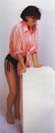 Marc Sijan's Superrealistic sculptures are
"homages to humanity's fascination with its own forms -- a fascination
which has compelled artists throughout the millennia to mirror life in
Marc Sijan's Superrealistic sculptures are
"homages to humanity's fascination with its own forms -- a fascination
which has compelled artists throughout the millennia to mirror life in  virtually
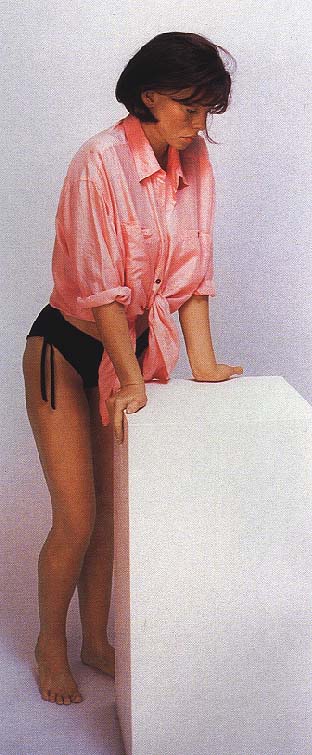
every medium." Sijan's figures are incredibly lifelike, sensuous and
graceful. In fact, they are so lifelike, they seem always on the verge of
movement, a mere instant away from action. The pores in the skin, the tiny
hairs, and veins; even the bald spots, the blemishes, the individual shapes
of the faces that make human beings so similar, yet so unique: These are
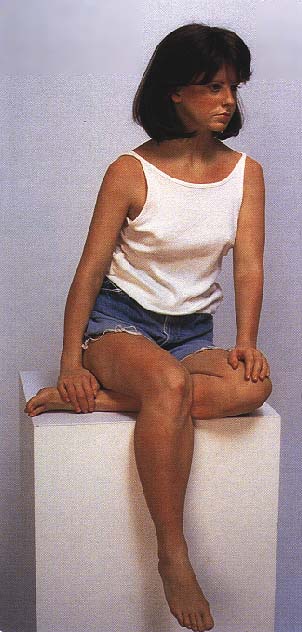
the essence of what makes Marc Sijan's work so arresting. (left:
Standing with Pedestal, 1996; right: Legs Folded, 1990)
virtually
every medium." Sijan's figures are incredibly lifelike, sensuous and
graceful. In fact, they are so lifelike, they seem always on the verge of
movement, a mere instant away from action. The pores in the skin, the tiny
hairs, and veins; even the bald spots, the blemishes, the individual shapes
of the faces that make human beings so similar, yet so unique: These are
the essence of what makes Marc Sijan's work so arresting. (left:
Standing with Pedestal, 1996; right: Legs Folded, 1990)
Sijan, a Milwaukee-based artist, carries on the tradition
of a very old form, but his approach is very modern. His realism recalls
the work of the Greek sculptors in its bold expression of human energy and
poise. But Sijan is not necessarily celebrating the ideal form. His figures
are more gritty, more natural -- a tribute to real people. Sijan's work
is similar to that of fellow artists Duane Hansen and John DeAndrea, who
use lifelike human figures to express elements of the human condition and
human relationships. But whereas his colleagues tend to express a kind of
static existence, Sijan tries to capture a life force in full swing.
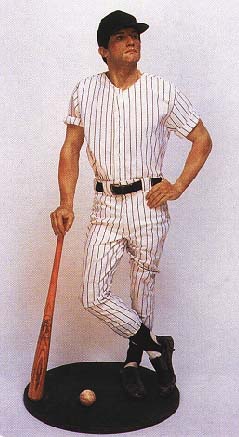
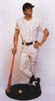 "I
am seeking to freeze motion rather than suggest life," he notes. "The
sculpture appears passive, but there is so much going on inside." (left:
Baseball Player, 1999)
"I
am seeking to freeze motion rather than suggest life," he notes. "The
sculpture appears passive, but there is so much going on inside." (left:
Baseball Player, 1999)
Sijan received his Bachelor's degree in art education from
the University of Wisconsin in 1968, then went on to complete a Master of
Science in Art degree three years later. It was then that he began to sculpt
the human figure. His work has won him recognition  throughout the country, with over 40 one-man museum
exhibitions throughout North America."
throughout the country, with over 40 one-man museum
exhibitions throughout North America."
His inspiration? Michelangelo's David. Sijan has
always been intrigued with the instinctive and sensitive way the artist
treated that famous form, and with the incredible attention Michelangelo
paid to details of anatomy. Sijan included anatomy among his own course
work, and combined it with the very latest methods in sculptural casting
and modeling. (right: Hand on Knee, 1999)
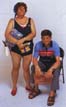 His
goal was to create sculpture that could stand alone, on the verge of movement,
yet somehow remain deeply silent and "spiritual." "The human
figure is one of the most challenging subjects to work with," he said.
"1 am working to develop a niche of my own where I can develop a believable
figurative sculpture that works not only on a visual level, but on a deeper
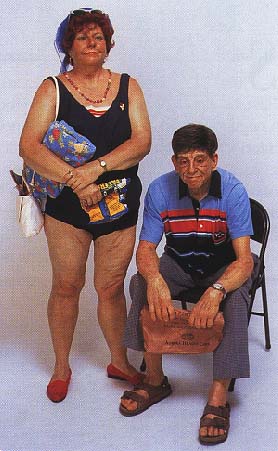
more emotional level." (left: Bathing Beauty, 1999 and
Seated Man-Shopper, 1999)
His
goal was to create sculpture that could stand alone, on the verge of movement,
yet somehow remain deeply silent and "spiritual." "The human
figure is one of the most challenging subjects to work with," he said.
"1 am working to develop a niche of my own where I can develop a believable
figurative sculpture that works not only on a visual level, but on a deeper
more emotional level." (left: Bathing Beauty, 1999 and
Seated Man-Shopper, 1999)
Sijan's method is distinct and exacting. First, he works
from live models, to produce a 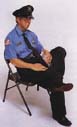 negative mold in plaster, and sculpts the interior
with special tools and a magnifying glass to assure accurate detail. Then,
he casts the figure in a polyester resin. To achieve realistic flesh tones,
Sijan applies 25 coats of paint -- and adds varnish. Sijan uses oil paint
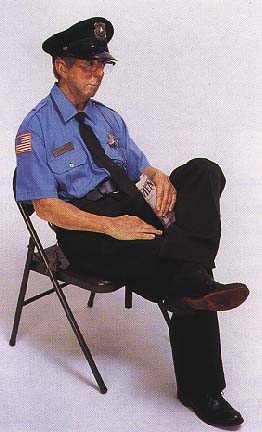
in the final stages of the work. (right: Security Guard Seated,
1995)
negative mold in plaster, and sculpts the interior
with special tools and a magnifying glass to assure accurate detail. Then,
he casts the figure in a polyester resin. To achieve realistic flesh tones,
Sijan applies 25 coats of paint -- and adds varnish. Sijan uses oil paint
in the final stages of the work. (right: Security Guard Seated,
1995)
"The goal is to achieve depth, yet translucency,"
he says. "It can't be flat. The chest and throat texture is different
from that of the arms, legs and stomach. Facial skin differs from that on
the torso." To achieve the remarkably realistic product on view here
today, Sijan looks for "variations." Those are the millions of
individual features we all possess -- goosebumps, skin imperfections, skin
color, sunburn, birthmarks, age spots -- and Sijan spends as long as six
months reproducing this detail on one piece.
The above text is excerpted from an essay by Ruth Sternberg,
formerly of The Canton Institute of Art. Exhibition organized by Smith Kramer
Fine Art Services, Kansas City, MO.
Read more about the Muscatine
Art Center in Resource Library Magazine
Please click on thumbnail images bordered by a red line
to see enlargements.
This page was originally published in Resource
Library Magazine. Please see Resource Library's Overview section for
more information. rev. 5/23/11
Search Resource
Library for thousands of articles and essays on American art.
Copyright 2011 Traditional Fine Arts Organization, Inc., an Arizona nonprofit corporation. All rights
reserved.
 Marc Sijan's Superrealistic sculptures are
"homages to humanity's fascination with its own forms -- a fascination
which has compelled artists throughout the millennia to mirror life in
Marc Sijan's Superrealistic sculptures are
"homages to humanity's fascination with its own forms -- a fascination
which has compelled artists throughout the millennia to mirror life in 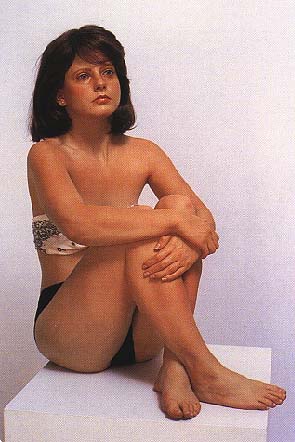 virtually
every medium." Sijan's figures are incredibly lifelike, sensuous and
graceful. In fact, they are so lifelike, they seem always on the verge of
movement, a mere instant away from action. The pores in the skin, the tiny
hairs, and veins; even the bald spots, the blemishes, the individual shapes
of the faces that make human beings so similar, yet so unique: These are
the essence of what makes Marc Sijan's work so arresting. (left:
Standing with Pedestal, 1996; right: Legs Folded, 1990)
virtually
every medium." Sijan's figures are incredibly lifelike, sensuous and
graceful. In fact, they are so lifelike, they seem always on the verge of
movement, a mere instant away from action. The pores in the skin, the tiny
hairs, and veins; even the bald spots, the blemishes, the individual shapes
of the faces that make human beings so similar, yet so unique: These are
the essence of what makes Marc Sijan's work so arresting. (left:
Standing with Pedestal, 1996; right: Legs Folded, 1990)