Crocker Art Museum
Sacramento, CA
916-264-5423
http://www.crockerartmuseum.org/
American Revolutions: The
Other Side of Modern, 1900-1945
by Scott A. Shields
The history of twentieth-century
art in the United States is usually discussed as a series of revolutions.
These revolutions are manifest in changing attitudes about the goals and
purposes of art, definitions of what art is and should be and, most importantly,
the development of abstraction. The primacy given to these changes by art
historians, especially the development of abstraction, has relegated the
consideration of subject-based painting, with the traditional themes like
landscape, still-life, figure, portrait and genre painting, to a secondary
role. However, for artists on both the East and West Coasts, it was precisely
through these themes that American modernism primarily developed. This exhibition
seeks to explore the evolution of early twentieth-century painting not through
abstraction, but through representational art.
Until the generation of the Abstract Expressionists, most
American artists were never entirely comfortable with relinquishing the
hard-earned drawing skills they learned through rigorous academic training.
This is particularly evident in the work of American Impressionist artists
who, unlike their European counterparts, were never quite willing to dissolve
their subjects in a flurry of brushstrokes and light. By and large,  American
artists utilized only the Impressionists' vocabulary of color and brushwork,
but retained the underlying solidity and structure of the forms they were
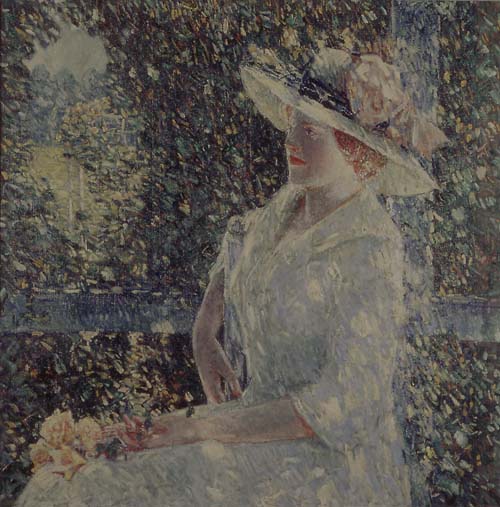
portraying. American Impressionist Childe Hassam (1859-1935) [fig. 1] took
his nationalism one step further. Descended from old New England lineage,
Hassam not only retained the solidity of the subjects he portrayed, but
identified himself as an American artist seeking to invest Impressionism
with an American spirit. Many local artists followed suit, and sought to
make their impressionist paintings not only distinctly American, but distinctly
Californian. (left: fig. 1 Childe Hassam (1859-1935), An Outdoor
Portrait of Miss Weir, 1909. Oil on canvas, 38 x 38 in. Crocker Art
Museum, gift of Mr. And Mrs. Vern C. Jones and other donors)
American
artists utilized only the Impressionists' vocabulary of color and brushwork,
but retained the underlying solidity and structure of the forms they were
portraying. American Impressionist Childe Hassam (1859-1935) [fig. 1] took
his nationalism one step further. Descended from old New England lineage,
Hassam not only retained the solidity of the subjects he portrayed, but
identified himself as an American artist seeking to invest Impressionism
with an American spirit. Many local artists followed suit, and sought to
make their impressionist paintings not only distinctly American, but distinctly
Californian. (left: fig. 1 Childe Hassam (1859-1935), An Outdoor
Portrait of Miss Weir, 1909. Oil on canvas, 38 x 38 in. Crocker Art
Museum, gift of Mr. And Mrs. Vern C. Jones and other donors)
Other artists in the first decades of the century pursued
different paths. Painters of the Boston school, for instance, chose to concentrate
less on style than on subject, depicting the wealthy, refined sitters reminiscent
 of
America's Gilded Age. Others, like the Urban Realists, also called the "Ashcan
School," produced darker, grittier scenes of the more seamy aspects
of city life. This group of artists, led by Robert Henri (1865-1929), broke
with the academic traditions of the last century and exhibited together
as "The Eight." Their styles and subjects varied widely, and in
addition to city views included rural landscapes, genre scenes, and portraits
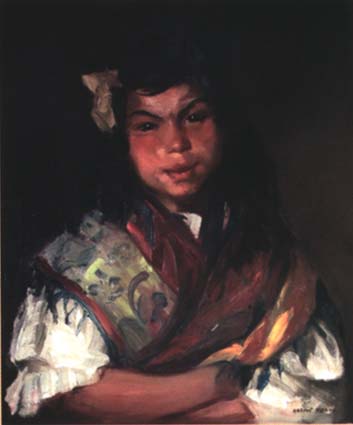
of children, frequently drawn from the urban poor. Henri himself was particularly
dedicated to portraiture, and the artist's portraits of children, frequently
representing different ethnic groups, manifest his democratic view of humanity
[fig. 2].
of
America's Gilded Age. Others, like the Urban Realists, also called the "Ashcan
School," produced darker, grittier scenes of the more seamy aspects
of city life. This group of artists, led by Robert Henri (1865-1929), broke
with the academic traditions of the last century and exhibited together
as "The Eight." Their styles and subjects varied widely, and in
addition to city views included rural landscapes, genre scenes, and portraits
of children, frequently drawn from the urban poor. Henri himself was particularly
dedicated to portraiture, and the artist's portraits of children, frequently
representing different ethnic groups, manifest his democratic view of humanity
[fig. 2]. ( left: fig.
2 Robert Henri (1865-1929), The Romany Girl, n.d.. Oil on canvas,
24 x 30 in. Crocker Art Museum, gift of the Museum Purchase Fund; right:
fig. 3 Rockwell Kent (1882-1971), March, Greenland, 1932-33. Oil
on canvas mounted on board, 34 x 44 in. Crocker Museum Purchase)
( left: fig.
2 Robert Henri (1865-1929), The Romany Girl, n.d.. Oil on canvas,
24 x 30 in. Crocker Art Museum, gift of the Museum Purchase Fund; right:
fig. 3 Rockwell Kent (1882-1971), March, Greenland, 1932-33. Oil
on canvas mounted on board, 34 x 44 in. Crocker Museum Purchase)
In contrast, other painters, particularly those who worked
outside the East's artistic centers, depicted landscape scenes nearly devoid
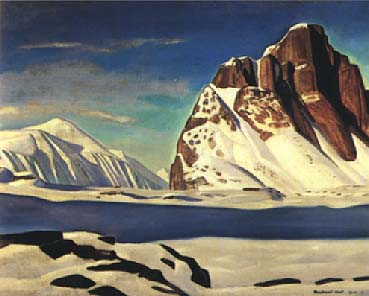
of human presence. Artist Rockwell Kent's (1882-1971) northern snow-clad
 landscapes,
for instance, present nature as a sublime force imbued with transcendental
and symbolic meaning, continuing the traditions of the nineteenth-century
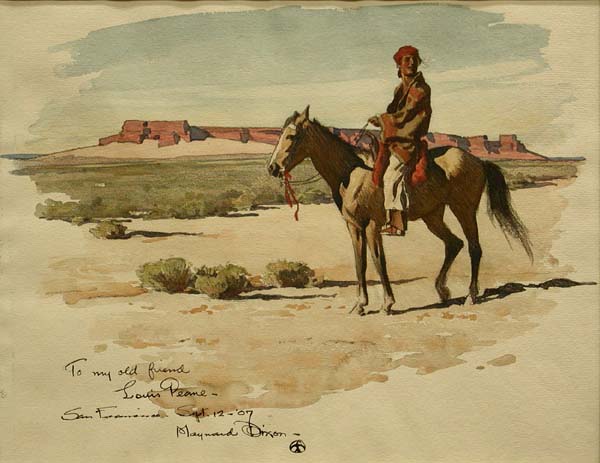
Hudson River School [fig. 3]. California artist Maynard Dixon (1875-1946),
by contrast, focused on the West, depicting the frontier landscape and the
Native Americans and vaqueros who lived there [fig. 4]. Other Californians
depicted scenes of pure landscape-from mountain to coastal views-while some
portrayed California as an Arcadia, a place where nymphs might bathe in
pastoral settings [fig. 5]. (left: fig. 4 Maynard Dixon (1875-1946),
Indian on a Horse, 1907. Watercolor, 10 1/2 x 13 3/8 in. Crocker
Art Museum, gift of Dr. Herzl Friedlander)
landscapes,
for instance, present nature as a sublime force imbued with transcendental
and symbolic meaning, continuing the traditions of the nineteenth-century
Hudson River School [fig. 3]. California artist Maynard Dixon (1875-1946),
by contrast, focused on the West, depicting the frontier landscape and the
Native Americans and vaqueros who lived there [fig. 4]. Other Californians
depicted scenes of pure landscape-from mountain to coastal views-while some
portrayed California as an Arcadia, a place where nymphs might bathe in
pastoral settings [fig. 5]. (left: fig. 4 Maynard Dixon (1875-1946),
Indian on a Horse, 1907. Watercolor, 10 1/2 x 13 3/8 in. Crocker
Art Museum, gift of Dr. Herzl Friedlander)
After San Francisco's Panama Pacific International Exposition
in 1915, California artists began to strike out in new directions, moving
from Tonalism, which was then the dominant aesthetic in the San Francisco
Bay Area, to Impressionism and beyond. Even when applying more modern methods
such as Post-impressionist paint application, cubist composition, and Fauvist
color, Californians continued to focus on the state's natural settings and
were reluctant to abandon their subject matter completely. This would not
change until the mid-twentieth century.
In New York, the core group of artists championed by Alfred
Stieglitz (1864-1946), which included Arthur Dove (1880-1946), Georgia O'Keeffe
(1887-1986), and John Marin (1870-1953), as well as the closely associated
Marsden Hartley (1877-1943), were pioneers in the development of abstraction
in the United States between 1910 and 1920. However, even these artists
chose representation as their primary mode of  expression. Hartley's cubist-inspired abstractions,
for instance, although highly significant in his oeuvre, were a brief foray
in his career, and for Dove, O'Keeffe and Marin, non-referential abstraction
was attempted only rarely. Theirs was a relative abstraction, a means for
communicating the underlying essence and spirit of their subjects. Georgia
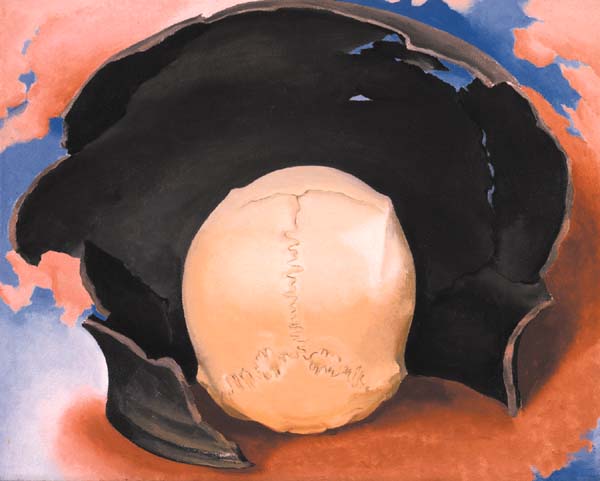
O'Keeffe's still life from 1942 entitled It Was a Man and a Pot [fig. 6]
combines a recognizable subject with an abstract composition. Characterized
by a combination of formal power and romantic mystery, the painting is an
elegiac meditation on mortality through the broken shards of a ceramic vessel
and a human skull. (left: fig. 6 Georgia O'Keeffe (1887-1986), It
Was a Man and a Pot, 1942. Oil on canvas, 16 x 20 in. Crocker Art Museum
Association purchase with matching funds from the National Endowment for
the Arts)
expression. Hartley's cubist-inspired abstractions,
for instance, although highly significant in his oeuvre, were a brief foray
in his career, and for Dove, O'Keeffe and Marin, non-referential abstraction
was attempted only rarely. Theirs was a relative abstraction, a means for
communicating the underlying essence and spirit of their subjects. Georgia
O'Keeffe's still life from 1942 entitled It Was a Man and a Pot [fig. 6]
combines a recognizable subject with an abstract composition. Characterized
by a combination of formal power and romantic mystery, the painting is an
elegiac meditation on mortality through the broken shards of a ceramic vessel
and a human skull. (left: fig. 6 Georgia O'Keeffe (1887-1986), It
Was a Man and a Pot, 1942. Oil on canvas, 16 x 20 in. Crocker Art Museum
Association purchase with matching funds from the National Endowment for
the Arts)
As America came of age in the early twentieth century,
and as the United States began to assume a more global position of world
leadership, American artists generally were attempting to define the native
qualities of their art. In the years following World War I, writers such
as Van Wyck Brooks and Waldo Frank urged artists to render their own distinctly
American perception of place, arguing that by rendering the particular they
could achieve the universal. With American isolationist tendencies and attitudes
strong in the wake of the War, concentration on people and places American
became particularly pronounced.
American scene painting and the Golden State variant, California
scene painting, are labels broadly applied to many artists, particularly
the Regionalists, Social Realists, and artists under government employ during
the Great Depression. These artists turned to local subjects, depicting
the people, manmade environments, and landscapes they found close at hand.
Their art sought to express nationalistic sentiments and an explicitly American
experience through topicality, local custom, and anecdote. By depicting
the subject matter they  knew best, these artists sought to develop a democratic
art accessible to the ordinary person. They employed recognizable themes,
easily readable styles, and occasionally nostalgia and sentiment. In technique,
they sought to avoid or reject foreign influences and to create American
art in an American style. Works of this period include the Midwestern regionalism
of artists like Thomas Hart Benton (1889-1975) [fig. 7], figurative artists
such as Moses Soyer (1899-1974) and Guy Pène du Bois (1884-1958),
and local California scene paintings and prints by Millard Sheets (1907-1989),
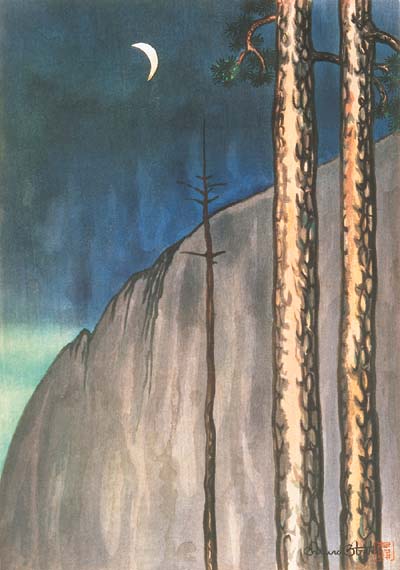
Chiura Obata (1885-1975) [fig. 8], Otis Oldfield (1890-1969), and others.
(left: fig. 8 Chiura Obata (1885-1975), Evening Moon: Yosemite,
ca. 1928. Color woodblock print, 17 3/4 x 13 1/4 in. Crocker Art Museum,
gift of Mr. and Mrs. Eugene Kodani)
knew best, these artists sought to develop a democratic
art accessible to the ordinary person. They employed recognizable themes,
easily readable styles, and occasionally nostalgia and sentiment. In technique,
they sought to avoid or reject foreign influences and to create American
art in an American style. Works of this period include the Midwestern regionalism
of artists like Thomas Hart Benton (1889-1975) [fig. 7], figurative artists
such as Moses Soyer (1899-1974) and Guy Pène du Bois (1884-1958),
and local California scene paintings and prints by Millard Sheets (1907-1989),
Chiura Obata (1885-1975) [fig. 8], Otis Oldfield (1890-1969), and others.
(left: fig. 8 Chiura Obata (1885-1975), Evening Moon: Yosemite,
ca. 1928. Color woodblock print, 17 3/4 x 13 1/4 in. Crocker Art Museum,
gift of Mr. and Mrs. Eugene Kodani)
In the span of forty years, these American paintings, although
based on visual reality, could not, and did not, remain stagnant, but responded
to forces of change and evolving conceptions of modernity. During this period,
artists' interpretations of the American experience were widely divergent,
and the diversity present in their art was greater than in any previous
period of American art history and has since only continued to expand. It
is this individuality of experience, this tenacity of purpose, that most
characterize the American vision.
Captions
fig. 1 Childe Hassam (1859-1935), An Outdoor Portrait of Miss Weir,
1909. Oil on canvas, 38 x 38 in. Crocker Art Museum, gift of Mr. And Mrs.
Vern C. Jones and other donors.
fig. 2 Robert Henri (1865-1929), The Romany Girl, n.d.. Oil on
canvas, 24 x 30 in. Crocker Art Museum, gift of the Museum Purchase Fund.
fig. 3 Rockwell Kent (1882-1971), March, Greenland, 1932-33. Oil
on canvas mounted on board, 34 x 44 in. Crocker Museum Purchase.
fig. 4 Maynard Dixon (1875-1946), Indian on a Horse, 1907. Watercolor,
10 1/2 x 13 3/8 in. Crocker Art Museum, gift of Dr. Herzl Friedlander.
fig. 5 Xavier Martinez (1869-1943), The Bathers, n.d. Oil on canvas,
16 x 13 in. Crocker Art Museum, gift of William C. Wright.
fig. 6 Georgia O'Keeffe (1887-1986), It Was a Man and a Pot, 1942.
Oil on canvas, 16 x 20 in. Crocker Art Museum Association purchase with
matching funds from the National Endowment for the Arts.
fig. 7 Thomas Hart Benton (1889-1975), Planting, 1939. Lithograph,
11 3/8 x 15 3/4 in. Crocker Art Museum, gift of James M. Stephens.
fig. 8 Chiura Obata (1885-1975), Evening Moon: Yosemite, ca. 1928.
Color woodblock print, 17 3/4 x 13 1/4 in. Crocker Art Museum, gift of Mr.
and Mrs. Eugene Kodani.
About the Curator: Scott A. Shields
 Formerly
the Curator of Fine Arts at the California Historical Society, Scott A.
Shields has extensive experience working with California art in various
media. He became particularly interested in California painting while serving
as the National Endowment for the Arts Intern in American Paintings at the
Fine Arts Museums of San Francisco, and subsequently selected a California-based
dissertation topic dealing with the artists' colony of Monterey and Carmel.
His undergraduate degrees are in art education and graphic design, both
from the University of Nebraska, and he holds an M.A. in art history from
the University of Kansas. He is currently a Ph.D. candidate in American
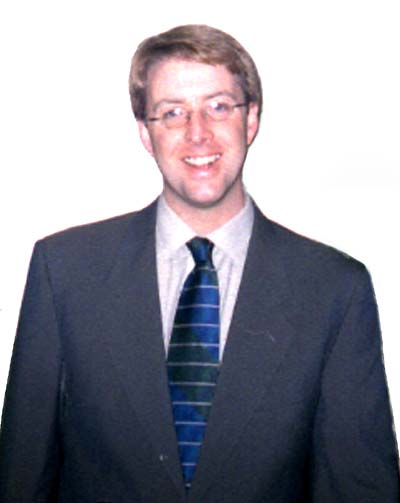
Art at this same institution. (left: Scott A. Shields)
Formerly
the Curator of Fine Arts at the California Historical Society, Scott A.
Shields has extensive experience working with California art in various
media. He became particularly interested in California painting while serving
as the National Endowment for the Arts Intern in American Paintings at the
Fine Arts Museums of San Francisco, and subsequently selected a California-based
dissertation topic dealing with the artists' colony of Monterey and Carmel.
His undergraduate degrees are in art education and graphic design, both
from the University of Nebraska, and he holds an M.A. in art history from
the University of Kansas. He is currently a Ph.D. candidate in American
Art at this same institution. (left: Scott A. Shields)
Shields has curated numerous exhibitions including The
Exoticized Woman and Her Allure in American Art, Feminine and Floral Imagery
of the Art Nouveau, Stay East Young Man: California Gold Rush Letter Sheets,
Interpreting California: The Art of History, and California 1900.
He is currently at work on an exhibition featuring California's French painters,
entitled Splendide Californie: French Artists Impressions of the Golden
State, 1786-1900. Shields has written articles for various scholarly
journals, including the Smithsonian's journal American Art and, most recently,
was one of the contributing authors to a book on artist Percy Gray, published
by the Carmel Art Association.
American Revolutions: The Other Side of Modern, 1900
- 1945 is on exhibit February 2 - April 29, 2001
Checklist of the Exhibition
Milton Avery, American, 1893 - 1965, Drawbridge,
1936, Drypoint, Gift of Bruce Beck in memory of Philip S. Tow 1986.10
Gifford Beal, American, 1879 - 1956, Bareback Act, Old
Hippodrome, Not dated, Lithograph, Gift of Associated American Artists,
1967.12
Thomas Hart Benton, American, 1889 - 1975, Planting
(also titled Spring Plowing), 1939, Lithograph, Gift of James M.
Stephens, 1966.21
Thomas Hart Benton, American, 1889 - 1975, Loading Corn
(also titled Shucking Corn), 1945, Lithograph, Gift of Mr. and Mrs.
Michael J. Heller 1968.32
Ray Bertrand, American, 1909 - 1960, Study for Hermit
Valley, Not dated, Carbon watercolor wash on paper, Crocker Art Museum
Association, 1885.547
Rex Brandt, American, 1914 - 2000, Junction at Julian,
c. 1939, Watercolor on paper, Art Acquisition Fund 1959 ,1959.8
Giuseppe Leone Cadenasso, American, 1854 - 1918, Seminary
Avenue, Mills College, Not dated, Oil on canvas, Gift of Dr. and Mrs.
Ralph W. Schaffarzick in memory of their son, Jon, 1991.13
Jennie Vennerstrom Cannon, American, 1869 - 1952, San
Francisco, Not dated, Lithograph, Gift of Jennie Crocker Fassett, 1925.3.148e
Colin Campbell Cooper, American, 1856 -1937, Palace
of Fine Arts, San Francisco, c. 1915, Oil on canvas, Gift of Helene
Seeley in memory of Mr. and Mrs. C.C. Cooper, Conserved with funds provided
by Gerald Gordon through the Gifts to Share program, 1940.24
Tom Craig, American, 1907 - 1969, City of Elk, Not
dated, Watercolor on paper, Gift of Mr. and Mrs. A. Alan Post, 1973.3
Arthur Bowen Davies, American, 1862 - 1928, Woodland
Spring, Not dated, Lithograph, Gift of Jennie Crocker Fassett, 1925.3.148j
Maynard Dixon American, 1875 - 1946, Indian on Horse,
Sept. 12, 1907, Watercolor on paper, Gift of Dr. Herzl Friedlander, 1980.77
Guy Péne du Bois, American, 1884 - 1958, Girl
Reading a Book, 1929, Oil on canvas, Gift of Dr. and Mrs. Herzl Friedlander,
1972.13
Frederick Carl Frieseke, American, 1874 - 1939, Woman
in Her Boudoir, Not dated, Oil on canvas, Gift of Anne and Malcolm McHenry,
1994.18.1
John Marshall Gamble, American, 1863 - 1957, Wild Lilac
and Poppies, Not dated, Oil on canvas, Gift of the California Museum
Association, 1948.5
Percy Gray, American, 1869 - 1952, Cypress Trees near
Pt. Lobos, 1924, Watercolor on paper laminated to cardboard, Gift of
the California Museum Association, 1948.3
Marion Greenwood, American, 1909 - 1970, Fringed Scarf,
Not dated, Lithograph, Gift of Associated American Artists, 1925.3.148g
Marsden Hartley, American, 1877 - 1943, Fisherman's
Family, Not dated, Oil on canvas, Gift of Dr. and Mrs. Herzl Friedlander,
1976.15
Childe Hassam American, 1859 - 1935, An Outdoor Portrait
of Miss Weir, 1909, Oil on canvas, Gift of Mr. and Mrs. Vern C. Jones
and other donors, 1980.23
Childe Hassam, American, 1859 - 1935, On the Palisades,
1916, Watercolor on paper, Purchased with funds from the Crocker Art Gallery
Association and the Art Acquisition Fund 1975, 1975.53
Robert Henri, American, 1865 - 1929, The Romany Girl,
Not dated, Oil on canvas, Museum Purchase Fund 1965, 1965.38
Herman G. Herkomer, American, 1863 - 1935, The Artist's
Wife and Son, 1904, Oil on canvas, Gift of Mrs. Blanche Herkomer, 1950.12
Clarence Kaiser Hinkle, American, 1880 - 1960, Palm
Canyon, Not dated, Oil on canvas, Museum Purchase, 1939.77
Maryn Hunzeker, American, 1907 - 1972, S.P. [Southern
Pacific] Yards, Roseville, Not dated, Watercolor on paper, Gift in memory
of Mary Hunzeker, 1974.33
William Franklin Jackson, American, 1850 - 1936, Suisun
Marshes, Not dated, Oil on canvas, Anonymous gift, 1948.1
Rockwell Kent, American, 1882 - 1971, March, Greenland,1932
- 33, Oil on canvas mounted on board, Crocker Art Museum Association, 1975.25
Dong Kingman, American, b. 1911, Bay at Sunrise,
Not dated, Lithograph, Donor unknown, 1885.351
Gene (Alice Geneva) Kloss, American, 1903 - 1996, From
Telegraph Hill, Not dated, Engraving, Gift of the Kingsley Art Club,
1974.25.17
Mary Amanda Lewis, American, 1877 - 1953, Sketching,
c. 1914, Oil on canvas, Gift of the artist, 1950.19
Erle Loran, American, 1905 - 1999, San Francisco Bay,
1940, Lithograph, Crocker Art Museum Association, 1925.3.148c
Peppino Mangravite, American, 1896 - 1978, Untitled,
Not dated, Lithograph, Crocker Art Museum Association, 1885.353
Xavier Timoteo Martinez, American, 1869 - 1943, The
Bathers, Not dated, Oil on canvas, Gift of William C. Wright, 1962.22
Gertrude Mihsfeldt, American, 1903 - 1989, The Dancing
Lesson, 1940, Lithograph, Crocker Art Museum Association, 1885.489
Barse Miller, American, 1904 - 1973, Along the Sacramento,
1941, Watercolor on paper, Gift of Mrs. Barse Miller, 1975.71
Perham Wilhelm Nahl, American, 1869 - 1935, Fifteenth
Goblin: The Fairy Prince Cloud-Chariot and the Serpent Shell-Crest. Which
is the more self-sacrificing?, c. 1916, Watercolor and chalk on paper
backed by board, Gift of Mrs. Helen Crawford, 1943.4
Karl Eugen Neuhaus, American, 1879 - 1963, Mouth of
the Navarro River, c. 1920, Oil on canvas, Gift of Robert Neuhaus, 1979.19
Chiura Obata, American (b. Japan), 1885 - 1975, Evening
Moon: Yosemite, c. 1928, Color woodblock on paper, Gift of Mr. and Mrs.
Eugen Kodani, 1994.25.2
Georgia O'Keeffe, American, 1887 - 1986, It was a Man
and a Pot, 1942, Oil on canvas, Gift of California Art Gallery Association
with matching funds from the National Endowment for the Arts, 1973.23
Otis William Oldfield, American, 1890 - 1969, Mountain
Flag Stop, Not dated, Watercolor on paper, Donor unknown, 1885.470
George Booth Post, American, b. 1906, Piedmont Hills,
1966, Watercolor on paper, Gift of the Crocker Art Gallery Association,
1967.17
William Frederick Ritschel, American, 1864 - 1949, The
In-Stealing Fog, 1916, Oil on canvas, Gift of Mrs. Charles Alexander,
1939.61.1
Millard Sheets, American, 1907 - 1989, Beyond the Arroyo,
1937, Watercolor on paper, Gift of Dr. and Mrs. Herzl Friedlander, 1972.29
John Sloan, American, 1871 - 1951, Brainerd's Office,
Not dated, Black wax crayon on paper, Gift of Maude T. Pook, 1965.6
John Sloan, American, 1871 - 1951, Salvation Dinners,
1909, Etching, Crocker Art Museum Association, 1966.9.1
Moses Soyer, American, 1898 - 1974, Ballerina, Not
dated, Oil on canvas, Gift of Dr. and Mrs. Herzl Friedlander, 1979.49
Maurice H. Sterne, American (b. Russia), 1877 - 1957, Italian
Summer - Shepherdess Sleeping, 1925 - 36, Oil on board, Gift of Dr.
and Mrs. Herzl Friedlander, 1973.5
Charles Frederick Surendorf, American, 1906 - 1979, Old
Fire House-Columbia, Not dated, Lithograph, Gift of Dr. and Mrs. Herzl
Friedlander, 1972.12.4
Edmund C. Tarbell, American, 1862 - 1934, In the Station
Waiting Room, Boston, ca. 1915, Oil on canvas, Gift of Dr. Joseph R.
Fazzano, 1956.7
Theodore Wores, American, 1860 - 1939, Sand Dunes and
Wild Flowers, Not dated, Oil on canvas, Gift of Dr. Ben Shenson and
Dr. A. Jess Shenson, 1970.19
Harry Wickey, American, 1892 - 1968, Third Avenue El,
Not dated, Etching, Museum Purchase Fund,. 1967.35
Read more about the Crocker
Art Museum in Resource Library Magazine
Please click on thumbnail images bordered by a red line
to see enlargements.
For further biographical information on selected artists
cited above please see America's Distinguished
Artists, a national registry of historic artists.
This page was originally published in Resource
Library Magazine. Please see Resource Library's Overview section for
more information. rev. 5/23/11
Search Resource
Library for thousands of articles and essays on American art.
Copyright 2011 Traditional Fine Arts Organization, Inc., an Arizona nonprofit corporation. All rights
reserved.
 American
artists utilized only the Impressionists' vocabulary of color and brushwork,
but retained the underlying solidity and structure of the forms they were
portraying. American Impressionist Childe Hassam (1859-1935) [fig. 1] took
his nationalism one step further. Descended from old New England lineage,
Hassam not only retained the solidity of the subjects he portrayed, but
identified himself as an American artist seeking to invest Impressionism
with an American spirit. Many local artists followed suit, and sought to
make their impressionist paintings not only distinctly American, but distinctly
Californian. (left: fig. 1 Childe Hassam (1859-1935), An Outdoor
Portrait of Miss Weir, 1909. Oil on canvas, 38 x 38 in. Crocker Art
Museum, gift of Mr. And Mrs. Vern C. Jones and other donors)
American
artists utilized only the Impressionists' vocabulary of color and brushwork,
but retained the underlying solidity and structure of the forms they were
portraying. American Impressionist Childe Hassam (1859-1935) [fig. 1] took
his nationalism one step further. Descended from old New England lineage,
Hassam not only retained the solidity of the subjects he portrayed, but
identified himself as an American artist seeking to invest Impressionism
with an American spirit. Many local artists followed suit, and sought to
make their impressionist paintings not only distinctly American, but distinctly
Californian. (left: fig. 1 Childe Hassam (1859-1935), An Outdoor
Portrait of Miss Weir, 1909. Oil on canvas, 38 x 38 in. Crocker Art
Museum, gift of Mr. And Mrs. Vern C. Jones and other donors)