The Norman Rockwell Museum at Stockbridge
Stockbridge, MA
413-298-4100
http://www.nrm.org
Norman Rockwell: Pictures
for the American People
America is falling
in love with Norman Rockwell all over again. Following successful engagements
in Atlanta, 
 Chicago, Washington, D.C., San Diego and Phoenix,
Norman Rockwell: Pictures for the American People is coming to the
Norman Rockwell Museum in his beloved hometown of Stockbridge for an exclusive
New England appearance from June 9 to October 21, 2001. More than three-quarters
of a million people will have seen this landmark exhibition of more than
70 of Rockwell's original oil paintings and all 322 of his Saturday Evening
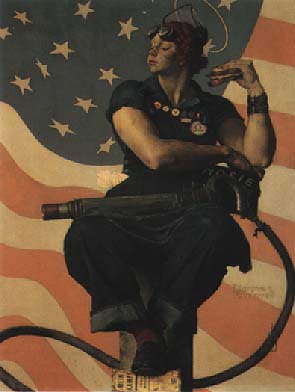
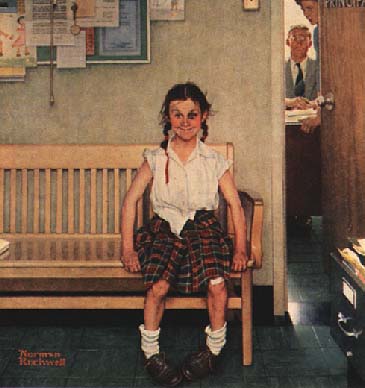
Post covers by the time it arrives in Stockbridge. (left: Rosie
the Riveter, 1943 © Curtis Publishing Company, The Saturday
Evening Post cover, oil on canvas, 52 x 40 inches, C403, Private collection;
right: Girl with Black Eye, 1953 © Curtis Publishing Company,
The Saturday Evening Post cover, oil on canvas, 34 x 30 inches, C466,
Wadsworth Athenaeum, Hartford, CT, Gift of Kenneth Smith)
Chicago, Washington, D.C., San Diego and Phoenix,
Norman Rockwell: Pictures for the American People is coming to the
Norman Rockwell Museum in his beloved hometown of Stockbridge for an exclusive
New England appearance from June 9 to October 21, 2001. More than three-quarters
of a million people will have seen this landmark exhibition of more than
70 of Rockwell's original oil paintings and all 322 of his Saturday Evening
Post covers by the time it arrives in Stockbridge. (left: Rosie
the Riveter, 1943 © Curtis Publishing Company, The Saturday
Evening Post cover, oil on canvas, 52 x 40 inches, C403, Private collection;
right: Girl with Black Eye, 1953 © Curtis Publishing Company,
The Saturday Evening Post cover, oil on canvas, 34 x 30 inches, C466,
Wadsworth Athenaeum, Hartford, CT, Gift of Kenneth Smith)
"It's a joy to be able to present a major comprehensive
exhibition to the nation with well-known works from our Museum, as well
as rarely-seen classics from private collections and other institutions,"
says Laurie  Norton
Moffatt,
Norton
Moffatt,  director
of the Norman Rockwell Museum. "We've watched with pleasure as a new
generation has discovered the power of Rockwell's original paintings. It
was heart-wrenching to send some of our most-loved Rockwells on the road,
but we knew the reward would be the return of this big, glorious show to
Stockbridge where all of New England would be treated to a once-in-a-lifetime
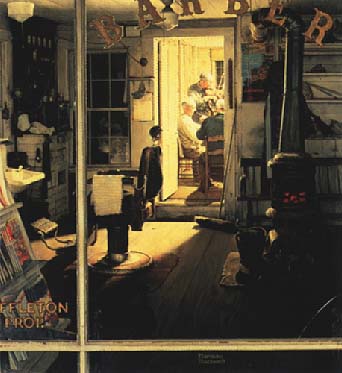
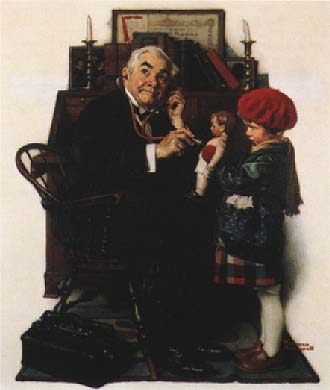
opportunity." (left: Doctor and Doll, 1929 © Curtis
Publishing Company, The Saturday Evening Post cover, oil on canvas,
32 x 26 1/4 inches, C303, Private collection; right: Shuffleton's Barbershop,
1950 © Curtis Publishing Company, The Saturday Evening Post
cover, oil on canvas, 46 1/4 x 43 inches, Collection of the Berkshire Museum,
Pittsfield, MA)
director
of the Norman Rockwell Museum. "We've watched with pleasure as a new
generation has discovered the power of Rockwell's original paintings. It
was heart-wrenching to send some of our most-loved Rockwells on the road,
but we knew the reward would be the return of this big, glorious show to
Stockbridge where all of New England would be treated to a once-in-a-lifetime
opportunity." (left: Doctor and Doll, 1929 © Curtis
Publishing Company, The Saturday Evening Post cover, oil on canvas,
32 x 26 1/4 inches, C303, Private collection; right: Shuffleton's Barbershop,
1950 © Curtis Publishing Company, The Saturday Evening Post
cover, oil on canvas, 46 1/4 x 43 inches, Collection of the Berkshire Museum,
Pittsfield, MA)
Norman Rockwell: Pictures for the American People will make its final stop in New York City at the Solomon R. Guggenheim
Museum (November 16, 2001 - March 3, 2002). The exhibition is organized
by the Norman Rockwell Museum and the High Museum of Art in Atlanta.
Norman Rockwell's Stockbridge
 Those
who visit the exhibition at Stockbridge will be able to walk down Main Street,
Stockbridge, where visitors will recognize scenes that are familiar from
the artist's works and may even catch a glimpse of one of Rockwell's models
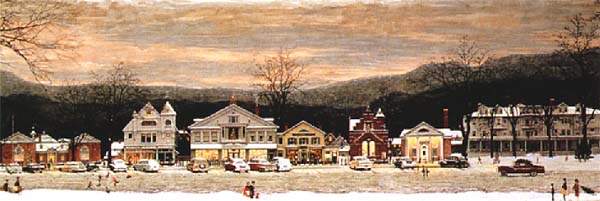
or their descendants who still live in the town. Main Street, made famous
by Rockwell, is just minutes from the Museum. (left: Stockbridge
Mainstreet at Christmas (Home for Christmas), 1967 © The Norman
Rockwell Family Trust, McCall's illustration, oil on canvas, 26.5
x 95.5 inches, Collection of the Norman Rockwell Museum at Stockbridge)
Those
who visit the exhibition at Stockbridge will be able to walk down Main Street,
Stockbridge, where visitors will recognize scenes that are familiar from
the artist's works and may even catch a glimpse of one of Rockwell's models
or their descendants who still live in the town. Main Street, made famous
by Rockwell, is just minutes from the Museum. (left: Stockbridge
Mainstreet at Christmas (Home for Christmas), 1967 © The Norman
Rockwell Family Trust, McCall's illustration, oil on canvas, 26.5
x 95.5 inches, Collection of the Norman Rockwell Museum at Stockbridge)
I n
Stockbridge, Rockwell's home for the last 25 years of his life, this extraordinary
traveling exhibition of his masterpieces will take on special significance
while on display at the Norman Rockwell Museum. A number of the paintings
included in the tour, such as Rosie the Riveter, Doctor and Doll,
Girl with Black Eye and Gary Cooper as the Texan, have never
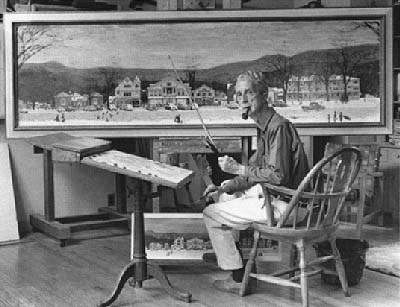
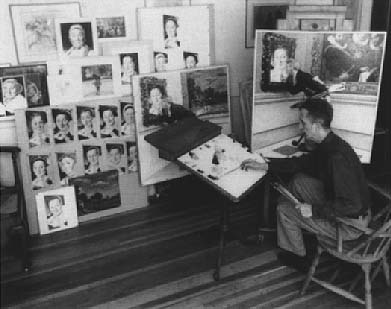
been on view at the Museum. (left: Norman Rockwell painting Stockbridge
Mainstreet at Christmas, 1967, photo by Louie Lamone, photo courtesy
of the Norman Rockwell Museum at Stockbridge)
n
Stockbridge, Rockwell's home for the last 25 years of his life, this extraordinary
traveling exhibition of his masterpieces will take on special significance
while on display at the Norman Rockwell Museum. A number of the paintings
included in the tour, such as Rosie the Riveter, Doctor and Doll,
Girl with Black Eye and Gary Cooper as the Texan, have never
been on view at the Museum. (left: Norman Rockwell painting Stockbridge
Mainstreet at Christmas, 1967, photo by Louie Lamone, photo courtesy
of the Norman Rockwell Museum at Stockbridge)
One special highlight of the exhibition is an adult audio
tour created to enhance the visitor's experience that features illuminating
interviews with Rockwell's models and commentary by the nationally renowned
historian Doris Kearns Goodwin. The exhibition is also accompanied by an
award-winning audio tour designed especially for children and families and
a fully illustrated, 200-page catalogue.
Excerpts from the catalogue, Norman Rockwell: Pictures for the
American People published by Harry N. Abrams, Inc. in association with
The Norman Rockwell Museum and the High Museum of Art.
- "In American art, there has rarely been a creator
of such influence as Norman Rockwell. These days, now that the obsession
for abstraction has cooled, his achievements are being discovered by scholars.
Rockwell is more and more identified - correctly - as a cultural phenomenon.
one who made a sea change in the perception of art in this nation."
- Tom Hoving
-
- "Norman Rockwell had an extraordinary ability to
create narrative imagery, virtually inventing a visual vocabulary that
gave shape and definition to the ideas. social needs, and aspirations of
twentieth-century American culture."
- Judy L. Larson and Maureen Hart Hennessey
-
 "In
the history of Western art, this idea expresses itself in the traditional
distinction between 'history painting' and 'genre painting.' Genre painting,
in this tradition. concerns itself with 'low' subjects, with everyday people
whose ordinary, inconsequent activities -
"In
the history of Western art, this idea expresses itself in the traditional
distinction between 'history painting' and 'genre painting.' Genre painting,
in this tradition. concerns itself with 'low' subjects, with everyday people
whose ordinary, inconsequent activities -  eating, gambling, smoking, reading, singing, and
playing the lute - are portrayed as evidence of human vanitas, as
testaments to the perpetual evanescence of earthly desires. History painting,
on the other hand, concerns itself with kings, heroes, gods and saints
and their consequent (which is to say historical) activities. Norman Rockwell's
great achievement was introducing this distinction and investing the everyday
activities of ordinary people with a sense of historical consequence, and
this acute micro-historical consciousness, I think, best explains Rockwell's
survival as an artist of consequence.
eating, gambling, smoking, reading, singing, and
playing the lute - are portrayed as evidence of human vanitas, as
testaments to the perpetual evanescence of earthly desires. History painting,
on the other hand, concerns itself with kings, heroes, gods and saints
and their consequent (which is to say historical) activities. Norman Rockwell's
great achievement was introducing this distinction and investing the everyday
activities of ordinary people with a sense of historical consequence, and
this acute micro-historical consciousness, I think, best explains Rockwell's
survival as an artist of consequence.
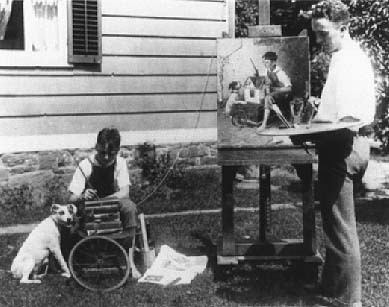
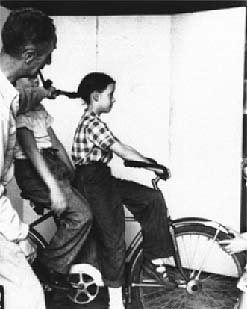
- Dave Hickey (left: Norman Rockwell working on Painting the
Little House, 1921, photographer unknown, photo courtesy of the Norman
Rockwell Museum at Stockbridge; right: Norman Rockwell posing the model
for Day in the Life of Little Girl, 1952, photo by Gene Pelham,
photo courtesy of the Norman Rockwell Museum at Stockbridge)
-
- "Norman Rockwell keeps pricking my art-historical
conscience.....We are learning that there are many fresh approaches to
Rockwell, even psychological ones....It's a tribute to Rockwell's diverse
powers that his art now seems to look in so many directions, including
transatlantic ones.....Just in time for the new millennium, we may have
a new Rockwell....."
- Robert Rosenblum
The Norman Rockwell Museum and the Rockwell Studio
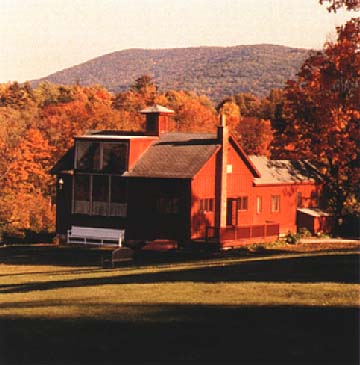
One of only a handful of single-artist museums in the United
States, the Norman Rockwell Museum is located on a scenic 36-acre estate
with rolling lawns and striking vistas. This inviting setting, where visitors
stroll and picnic on the  grounds and children play on whimsical outdoor sculptures
by Rockwell's son Peter, sets the stage to explore the dramatic Museum building
designed by renowned architect Robert A.M. Stern, who based it on a New
England town hall concept. (left: Norman Rockwell's Stockbridge Studio,
The Norman Rockwell Museum at Stockbridge, photo by James Patrick)
grounds and children play on whimsical outdoor sculptures
by Rockwell's son Peter, sets the stage to explore the dramatic Museum building
designed by renowned architect Robert A.M. Stern, who based it on a New
England town hall concept. (left: Norman Rockwell's Stockbridge Studio,
The Norman Rockwell Museum at Stockbridge, photo by James Patrick)
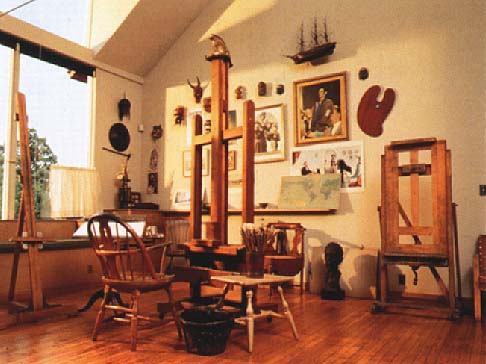
Visitors to the Museum can also experience the intimacy
of Rockwell's Stockbridge studio, one of the few major artists' studios
preserved in the United States, where many of his most famous  works
were created. The studio, moved to the Museum grounds from Rockwell's home,
was left as it was during the last years of Rockwell's life and contains
his 500-volume art library, his furnishings and decorative items, ethnographic
objects,
works
were created. The studio, moved to the Museum grounds from Rockwell's home,
was left as it was during the last years of Rockwell's life and contains
his 500-volume art library, his furnishings and decorative items, ethnographic
objects,  mementos
collected on his travels and gifts sent by admirers. (right: Interior
of Norman Rockwell's Stockbridge Studio, The Norman Rockwell Museum at Stockbridge,
© Brownie Harris, Courtesy of GE)
mementos
collected on his travels and gifts sent by admirers. (right: Interior
of Norman Rockwell's Stockbridge Studio, The Norman Rockwell Museum at Stockbridge,
© Brownie Harris, Courtesy of GE)
Norman Rockwell helped found the Museum, which opened in
1969 and moved to its present location in 1993. The Norman Rockwell Museum
welcomes nearly 200,000 visitors each year and is one of the most popular
year-round tourist destinations in the Berkshires, a resort area offering
a rich array of cultural pursuits and natural beauty. (left: Norman
Rockwell painting Art Critic, 1955, photo by Bill Scovill, photo
courtesy of The Norman Rockwell Museum at Stockbridge)
Additional information on this exhibition (including more images):
Additional resources on Norman Rockwell:
Read more in Resource Library
Magazine about the Norman Rockwell Museum
Please click on thumbnail images to see enlargements.
For further biographical information please see America's Distinguished Artists, a national
registry of historic artists.
Please click here to
view photos of an historic inn in Stockbridge MA
Links to sources of information outside of our web site
are provided only as referrals for your further consideration. Please use
due diligence in judging the quality of information contained in these and
all other web sites. Information from linked sources may be inaccurate or
out of date. TFAO neither recommends or endorses these referenced organizations.
Although TFAO includes links to other web sites, it takes no responsibility
for the content or information contained on those other sites, nor exerts
any editorial or other control over them. For more information on evaluating
web pages see TFAO's General Resources
section in Online Resources for Collectors and Students of Art History.
This page was originally published in Resource
Library Magazine. Please see Resource Library's Overview section for
more information. rev. 5/23/11
Search Resource
Library for thousands of articles and essays on American art.
Copyright 2013 Traditional Fine Arts Organization, Inc., an Arizona nonprofit corporation. All rights
reserved.
 Chicago, Washington, D.C., San Diego and Phoenix,
Norman Rockwell: Pictures for the American People is coming to the
Norman Rockwell Museum in his beloved hometown of Stockbridge for an exclusive
New England appearance from June 9 to October 21, 2001. More than three-quarters
of a million people will have seen this landmark exhibition of more than
70 of Rockwell's original oil paintings and all 322 of his Saturday Evening
Post covers by the time it arrives in Stockbridge. (left: Rosie
the Riveter, 1943 © Curtis Publishing Company, The Saturday
Evening Post cover, oil on canvas, 52 x 40 inches, C403, Private collection;
right: Girl with Black Eye, 1953 © Curtis Publishing Company,
The Saturday Evening Post cover, oil on canvas, 34 x 30 inches, C466,
Wadsworth Athenaeum, Hartford, CT, Gift of Kenneth Smith)
Chicago, Washington, D.C., San Diego and Phoenix,
Norman Rockwell: Pictures for the American People is coming to the
Norman Rockwell Museum in his beloved hometown of Stockbridge for an exclusive
New England appearance from June 9 to October 21, 2001. More than three-quarters
of a million people will have seen this landmark exhibition of more than
70 of Rockwell's original oil paintings and all 322 of his Saturday Evening
Post covers by the time it arrives in Stockbridge. (left: Rosie
the Riveter, 1943 © Curtis Publishing Company, The Saturday
Evening Post cover, oil on canvas, 52 x 40 inches, C403, Private collection;
right: Girl with Black Eye, 1953 © Curtis Publishing Company,
The Saturday Evening Post cover, oil on canvas, 34 x 30 inches, C466,
Wadsworth Athenaeum, Hartford, CT, Gift of Kenneth Smith)