Impressionism, Post-Impressionism,
and the Eucalyptus School in Southern California
by Nancy Dustin Wall
Moure
Continued from page one
Eucalyptus School
In the September 1, 1928, issue of the West Coaster,
Merle Armitage, art critic, wrote;
- "Soon exhibitions will be hung in our various galleries
for the fall season. Our artists have returned from desert and mountain,
trail and canyon, and columns will be written about Susie Gumdrop's handling
of tree forms, John Popcorn's rendering of California mountains, and Mr.
Whosit's lovely handling of desert colors. What does it all mean? Most
of it means that nine-tenths of the men and women painting here on the
West Coast are grinding out the usual output of pleasant calendars. They
all see a desert, a sunset, a mountain or the sea with exactly the same
eyes and the same minds. They are simply unintentionally making illustrations
rather than creature [sic--creative] art. The difficulty of this situation
from the standpoint of the reviewer is that most of them are such excellent
folk that one shrinks from naming specific instances of their harmless
art. I call it the 'eucalyptus school' of painting."
This column gave birth to the title which has since been
applied (and wrongly) to all landscapes created in Southern California before
what some people consider the enlightened 1950's. What was the Eucalyptus
School and how does it relate to the American Impressionist movement in
general and to the Southern California Impressionist movement specifically?
The Eucalyptus School, taking its name from eucalyptus
trees which have been a unique arboreal feature of California since their
transplantation from Australia in the late nineteenth century, is a loose
title to cover the large number of landscapists active in Southern California
from about 1915 to about 1930. Eucalyptus School artists used local geography
for subject matter. Their paintings were generally representational and
they usually excluded humans, animals or architecture. Landscape was the
most popular subject matter of Impressionists, and a natural for local artists.
As early as the first regular art reviews we know that Anderson and his
fellow artists revered and admired the local landscape.[25] We hear that its coloration was considered subtle and exquisite,[26] that its mountains were not as grand
as the Swiss Alps, but were appreciated for their greater humanness,[27] that to paint the landscape made local
artists unique [28] and that the
local landscape was so outstanding it could attract Eastern artists.[29]
The Eucalyptus School artists painted with attractive,
acceptable coloration and loose brushwork. This style was based on Impressionism's
liberation of brushwork and color but it also borrowed elements from numerous
other progressive art movements of the early twentieth century, such as
the Ash Can School. (This absorption was probably not conscious but a natural
reaction of sensitive individuals to outside stimuli.) Like many things
American, the Eucalyptus style was a mongrel (or as art historians would
say, eclectic) and, in fact, not too dissimilar from the style produced
across America in mid-sized Americas cities and such artists' colonies as
Gloucester, Cape Ann, Provincetown, Silvermine and Woodstock. That is not
to say depiction of local geographic features and local coloration was not
unique and, in fact, critics even noted the stylistic difference between
Southern and Northern California.[30]
But the style shared a generic similarity to all American painting contemporary
to it.
The term Eucalyptus School, as originally applied, had
a negative connotation which it has not yet outgrown. Even as late as 1981,
critics, historians and collectors stand too historically and physically
close to view it objectively, that is, to ignore the work of the large number
of amateurs who participated in it. (Amateurs existed in equal proportions
in other United States art colonies, but are obscured to us by distance.)
Eucalyptus School pictures have been condemned for numerous
faults -- bland coloration, undeveloped or uninteresting compositions, weak
construction, superficial, weightless, substanceless form, insignificant
content, cotton-candy fluff brushwork, decorativeness, etc. Bland coloration
suggests bland ideas and compromise to decorators and, indeed, pastel tones
dominate Eucalyptus School landscapes. Yet the irony is that these are Southern
California's true colors. No one can deny that after a rain or wind the
air is so clear and crisp that colors and forms glow with unnatural brilliance
and saturation. But most of the year Los Angeles' atmosphere is tinged with
haze. This is not a recent phenomenon. In 1542, Cabrillo observed the effect
of Southern California's inversion layer when he saw smoke rise from an
Indian campfire at San Pedro Harbor and level out a few hundred feet in
the air. Because of this he named the bay "La Bahia de los Fumos."
In 1912 a traveler who ascended five thousand feet up Mt. Lowe observed
that "the effect of Los Angeles smoke on the surrounding pellucid air
is evident and apparent as a gray brown veil hanging over the city."[31] Today, we call this haze "smog.
But under whatever name, the haze has the same effect. Landscape colors
are paled to pastel, close to the tones we criticize in Eucalyptus School
landscapes. And, while no one can deny that Southern California enjoys beautiful
greens in the spring of the year, most of the time the desert climate leaves
the hills scantily covered with dry-looking brush in shades of bland buffs
and browns.
Eucalyptus School pictures have been called decorative.
Merle Armitage called them harmless decoration. Antony Anderson admitted,
"...where there is a surplus of scenery, there is also apt to be a
large measure of the painting of mere externals."[32]
In 1921, in a rare negative mood, he recorded an opinion
that was to become more and more true of landscape in the 1920's:
- "'Eucalyptus and Clouds' by Douglas Parshall, while
original in its decorative scheme of gold and gray colors, remains only
a decoration...Orrin White took a prize on his 'Eucalypti'...yet we note
here, as in many other pictures by Mr. White, a sort of diffusion of many
colors, not all of which are closely related...when he joins beauty and
strength, he will be a very fine landscapist indeed."[33]
Is harmless decorativeness a fault? In serious painting
it is. Anderson tells us, "Art is not a plaything for idle hands, but
the expression of a strong soul's aspiration toward the ideal in life."[34] The French Impressionists' works had
been decorative, yes, but they had also managed to invest them with strength
and character which saved them from banality. But when Southern California
Eucalyptus School artists reacted to Impressionism, instead of pressing
forward toward the greatness prophesied for them, they diverted from the
experimental path of true art, down a tangent stream of harmless decorativeness.
Why did the local mainstream lapse into decorativeness? We know local artists
were serious about improving their art. The numerous artists' clubs formed
for self-improvement demonstrate this. [35] Yet they seem to have striven for professionalism, not for experiment.
Certainly, the relative isolation of Los Angeles from the East Coast, the
widely separated residences of the artists which discouraged intellectual
or other competition, the frankly prosaic living conditions had their effect.
Arthur Millier attributed local weakness to the lack of great models in
museum collections from which our artists could learn.[36]
One of the strongest factors was probably lack of strong
direction. Antony Anderson's art criticism might have helped, but anyone
reading the Los Angeles Times art reviews between 1906 and 1924 cannot
help noticing Anderson's overly-positive, encouraging attitude. Like an
over-protective, over-anxious and overly-supportive mother, Anderson cajoled,
congratulated and encouraged almost all the artists. In view of the generally
unsophisticated nature of local art prior to 1914 and the fact that it was
in a vulnerable, youthful state, he probably felt he was doing more good
than if he had leveled scathing criticism,
Arthur Millier, the art critic who followed Anderson about
1924, was more critical but does not seem to have been able to effect much
change. In his first years on the job he wrote some pretty substantive reviews,
though they were not overly critical. By the 1930's, when he had begun to
call paintings as he saw them, his reduced column and an overload of work
which sapped his energies and resulted in brief, five-sentence reviews,
left no room for extended appraisal.
Local artists were also hampered by their belief in the
mystique that their place of residence and their potential for greatness
were far superior to that of Eastern artists. The idea that Southern California
was an artistic mecca, a Garden of Eden, a "Land of Heart's Desire"[37] probably originated with the real estate
promoters who developed Los Angeles, but it came to be heartily believed
by local artists. This became bound up with the ages-old philosophical notion
that rural is more honest and natural than urban, and that the West (as
identified with rural) was more healthy than the East (which was identified
with urban).
- "We have been told that conditions are right for
a renaissance of art in California -- that we have the proper civilization,
the correct climate for self-expression in the realms of thought and beauty.
On the whole we are inclined to believe that these glowing prophecies will
come to pass, are already beginning to come to pass -- and that the Great
Far West will soon have an art epoch of strength and originality. Living
in California our strength goes without saying, and living on this glorious
side of the Great Divide, we'll have to have originality if we have anything
at all. Even though our young painters go East to study in ever increasing
numbers, the most of our landscape painters remain, and it is in landscape
that we have freest expression."[38]
Even late into the 1920's, art lovers were confident Los
Angeles' climate gave it the potential of becoming the Athens of the West.[39] Arthur Millier believed the sun was
the lodestone of the Southland [40] and
even as acerbic a critic as Merle Armitage said, "I will not maintain
that Los Angeles, the home of the mediocre, is the Athens of the West, but
I will point out that the curiosity and the vigor of this community is potentially
important, that we are more likely to accept new modes and expressions in
art than the inelastic Eastern mind suffering with arrested development."[41] This message was spread to the nation
in a number of magazine articles extolling Southern California's qualities
as an art paradise.[42]
Even after 1921, the year the optimistic Antony Anderson
was driven to level accusations of decorativeness at local landscapes in
the California Art Club exhibition and perceptive people realized the mainstream
of Southern California art had taken the tangent toward decorativeness,
the movement had its defenders. Millier railed against Merle Armitage's
name-calling in the West Coaster.[43] He defended the school for its honesty when C.J. Rider complained
the local artists were academic, imitative, and painted for the public,
not in the true spirit of inventive creativity [44]
In spite of the many general arguments against the Eucalyptus
School, a number of its landscapists rose to extremely high competence.
Each had his or her own slightly different style. Benjamin Brown, mentioned
earlier as Los Angeles' first resident "impressionist," used a
greater impasto than most of his fellows and was known for his views of
pine trees bowed by thick blankets of snow. Franz Bischoff, who entered
the local landscape movement quite early, carried over his relatively dark
palette from florals. He is well entrenched in the Eucalyptus School category
primarily by intent. Some of Paul Lauritz's paintings, such as his Arroyo
Seco (Private Collection), are crisp in brushwork and highly articulate,
and are among the top of the line, but his later works are hardly worthy
of mention. Edgar Payne, too, excelled among his brethren. Even though his
three favorite subjects (boats in harbors, Indians riding through Southwestern
landscape, and mountain scenes) were exceedingly repetitive, his construction,
palette and application of paint remained even and highly professional.
Hanson Puthuff spread pale greyed-greens over rolling hills and lavender
over distant mountains. His career, like several other Eucalyptus School
painters, included diorama and theater scene painting. These disciplines
involve the literal translation of surface appearance and may have influenced
him toward naturalism. Arthur Hill Gilbert (1894-1970) simplified landscape
to the point of poeticism. Though lack Wilkinson Smith varied from super-slick
calendar artist to sincere craftsman, he painted some technically well-developed
marines and landscapes. Alfred Mitchell and Maurice Braun were the premier
San Diego landscapists. Braun potboilered yards of softly-muted, cotton-candy
hills and valleys, but occasionally extends himself to produce an outstanding
work which reveals conscientious compositional construction and more developed
coloration, See California Valley Farm (Private Collection). These
are just a few of the many artists who sought to transcribe nature realistically
onto canvas, but who achieved a certain distinction in their style. Others
certainly exist who are not mentioned here.
Conclusion
Can the nineteenth century French terms Impressionism and
Post-Impressionism be applied to any Southern California art movement of
the early twentieth century? The answer is no, not to any movement,when
the terms are used in their purist sense. But they can be, without hesitation,
applied to the work of some individual local painters, most often to European
or East Coast trained artists who moved to the Southland after careers elsewhere.
The closest thing to a movement which involved either Impressionism or Post-Impressionism
was the Modern Art Society, but that was basically a short-lived exhibiting
group and not a movement. The Southland's one true art movement, the Eucalyptus
School, was a definite offspring of Impressionism, but probably did not
adhere to enough of French Impressionism's original tenets to deserve to
be called Southern California Impressionism. The terms "impressionistic"
or Impressionist style," meaning a colorful, light-filled rendering
of landscape or a landscape approaching the French Impressionists' style,
could probably be used with most Southern California landscapes painted
in the period between 1915 and 1930.
Endnotes
1. Splitter, Henry Winifred, "Art in Los Angeles before 1900,"
Historical Society of Southern California Quarterly, XLI, June, 1959,
p.136.
2. First reproduced oil,"Mt. San Antonio," in Land of Sunshine,
December, 1896, p. 34, is very amateurish and not impressionistic.
3. Millier, Arthur, "Growth of Art in California," in Frank
J. Taylor, Land of Homes, Los Angeles: Powell, 1929, Chap. 13, p.
334. Millier traces the beginning of the California landscape movement to
the artists Elmer Wachtel and Marion Kavanaugh Wachtel, Benjamin C. Brown,
Hanson Puthuff, Jack Wilkinson Smith and William Wendt, and says, "Elmer
Wachtel was one of the first to discover the beauties of characteristic
dry arroyos where coloring is pale under the strong light with lavender
shadows. He may be truly said to have founded a school."
4. Although his earliest reproductions and reviews suggest he preferred
sunsets, moonlight scenes and nocturnes which were more common to Barbizon
style, some works were said to have reached for intense and glowing sunlight.
5. Approximate order of arrival: Hanson Puthuff (1903), Sam Hyde Harris
(1904), Ernest Browning Smith (1904-11), Jack Wilkinson Smith (1906), John
Gamble to Santa Barbara (1906), Martin J. Jackson (1906), William Wendt
(1906), Jean Mannheim (1908), Alfred T. Mitchell (1908), Maurice Braun to
San Diego (1910).
6. Antony Anderson discusses the California colony of Paris' Latin Quarter
and the inclusion in the prestigious Salons of work by Los Angeles artists
Mrs. Aurella deWalt Payne (not related to Edgar Payne) and Maude Daggett,
sculptress of Pasadena, Los Angeles Times, July 31, 1910, 3-14-1,2;
Los Angeles painters at the Salon, Los Angeles Times, July 9, 1911,
3-21-1.
7. Los Angeles Times, April 8, 1917, 3-4-4.
8. Los Angeles Times, November 28, 1908, 3-16-3.
9. Los Angeles Times, November 24, 1912, 3-18-2.
10. Gerdts, William, American Impression, exhibition organized
and circulated by the Henry Art Gallery, University of Washington, Seattle,
1980.
11. Los Angeles Times, April 8, 1917, 3-4-4.
12. Two articles in Western Art, June, July, August, 1914.
13. Museum of History, Science and Art, Exhibition of Selected Honor
Paintings from the Palace of Fine Arts, Panama-Pacific International
Exposition, San Francisco, 1915, October 1, 1916-May 1, 1917.
14. Museum of History, Science and Art, Exhibition of Paintings Loaned
from Gallery of Fine Arts, Panama-California Exposition, San Diego,
January 18-February 1, 1916.
15. Petersen Galleries, The Paintings of Sam Hyde Harris (1889-1977),
a Retrospective Exhibition, Beverly Hills, 1980.
16. Los Angeles Times, October 17, 1915, 3-20-2.
17. Ibid.
18. Ibid, column 3.
19. Ibid.
20. Ibid, column 5.
21. Pierce, Patricia Jobe, The Ten, North Abington, MA: Pierce
Galleries, 1976.
22. Reproductions listed in Moure, Nancy Dustin Wall, Dictionary of
Art and Artists in Southern California before 1930, Los Angeles: Privately
printed, 1975.
23. National Gallery of Art, Post Impressionism Cross Currents in
European and American Painting 1880-1906, Washington, DC: 1980, p. 14.
25. Los Angeles Times, 18,1908, 3-2-5.
26. Los Angeles County Museum of Art, Painting and Sculpture in Los
Angeles 1900-1945, September 25-November 23, 1980, pp. 8 and following.
27. Los Angeles Times, October 17, 1915, 3-20-4.
28. When A Sufferer ("A Chance for Real Art," Los Angeles
Times, March 3, 1907, 6-2-1,2) attacked the landscape painters of Laguna
and the Arroyo complaining that he had seen seventy-nine versions of the
"Twin Sycamores in the Arroyo Seco," Anderson was quick to explain
that, "Not cheap French restaurants but the lovely vistas of the Arroyo
Seco distinguish Los Angeles from other cities; not five-cent theatres,but
the marvelous scenic beauties of the Garvanza hills, not little Italian
priests in queer little transplanted gardens, but big native California
laymen in perennial rose bowers of a hundred acres."
29. Los Angeles Times, May 5, 1907, 6-2-4.
30. Oakland Museum, Impressionism, A California View, 1981, p.
20. Both Antony Anderson and Arthur Millier had noted this difference. Both
writers admitted a definite rivalry between San Francisco and Los Angeles
(not just in art but in other matters, primarily real estate). Anderson
saw more vigor in San Francisco art, and believed the cooler, foggier weather
discouraged landscape painting, while he felt there was more subtlety and
refinement in Southern California art and that the Southland's favorite
climate fostered landscape painting, Los Angeles Times, March 12,
1922, 3-20-4. Arthur Millier attributed San Francisco's aesthetic, intellectual
ideas to its urban personality and its concentrated artists' quarter which
fostered stimulating interchange of ideas. Southern California, on the other
hand, tended to produce more representational art, due to its dispersed
artists' residences and the agrarian background of most of its residents,
Los Angeles Times, August 21, 1927, 3-22-1, 2, 3 and 3-23-1,
31. "Los Angeles 1781-1981:' special issue of California History,
LX, Spring, 1981, p. 54.
32. Los Angeles Times, October 17, 1915, 3-20-3.
33. Los Angeles Times, October 9, 1921, 3-2-4, 5.
34. Los Angeles Times, October 11, 1908, 3-2-4.
35, In the early years these were Art Association (1890), the Palette
Club of Los Angeles (1905), the Painters Club (1906) which became the California
Art Club (about 1909). See other clubs in Moure, Nancy Dustin Wall, Artists'
Clubs and Exhibitions in Los Angeles before 1930, Los Angeles: Privately
printed, 1974.
36. Los Angeles Times, November 27, 1927, 3-20.
37. Frederick R. Miner, "California the Landscapist Land of Heart's
Desire," Western Art, June, July, August, 1914, pp. 31-34.
38. Los Angeles Times, November 24, 1912, 3-18-1.
39. Los Angeles Times, December 10, 1933, 2-3-1.
40. Los Angeles Times, November 6, 1927, 3-19-7, 8 and 3-22-1.
41. West Coaster, June 15, 1928, p. 24.
42. Los Angeles County Museum of Art, op. cit., p. 13, footnote 8.
43. Los Angeles Times, September 16, 1928, 3-17. "In The
West Coaster, wisecracking Hollywood monthly, trying with more or less
success to be the New Yorker of this region, Merle Armitage writes about
art in the snappy manner demanded for this after-cocktail type of magazine,
which insists that everything must have a 'kick' in it. He informs us that
the galleries will soon be draped with exhibits of paintings by members
of the 'Eucalyptus School of Painters,' who are, however such nice people
that he just hasn't the heart to tell the dreadful truth about their 'harmless'
art...This division of art into 'creative' and 'harmless,' with the inference
that one is real and the other bogus, is a comparatively recent invention
and one that won't bear water...The truth is that the 'harmless' art of
the 'Eucalyptus' school is the most hopeful ground-work for a really genuine
indigenous Southern California art. To over-praise its average production
is obviously misleading, but to patronize it shows a complete lack of understanding
of the processes whereby art comes into being.
44. Los Angeles Times, September 23, 1928, 3-17-7, 8.
Return to page one
Also in this magazine or available through the Internet: an essay by Deborah Epstein Solon on the Laguna
Art Colony; The Development of Southern California
Impressionism, an essay by Jean Stern; information on most artists listed
in the essay via our Distinguished
artists; 100 top-ranked California
artists courtesy of AskArt.com, including many artists referenced in the
above essay; Harvey L. Jones' essay on California Tonalism, "Twilight and Reverie: California Tonalist Painting 1890-1930;"
California Art Club; Mission
San Juan Capistrano: An Artistic Legacy; Gardena
High School Art Collection; The Fieldstone
Collection: Impressionism in Southern California.
On a national scale see: American
Impressionism to Modernism: A Brief History, by Patricia Jobe Pierce;
American Impressionism from the Permanent Collection,
from the Sheldon Memorial Art Gallery and Sculpture Garden; American
Impressionism: Treasures from the Smithsonian American Art Museum; American Impressionism from Great Lakes Museums;
Sunlight and Shadow: American Impressionism
1885-1945; Maurice Prendergast and
His Associates: American Impressionist and Early Modernist Works on Paper
from the WAM Collection; Visions of
Home: American Impressionist Images of Suburban Leisure and Country Comfort;
Decisive Moments: American Impressionist
Painting from West Coast Collections.
rev. 7/3/01
------------
Resource Library features these essays concerning Southern California art:
The American Scene: Regionalist
Painters of California 1930-1960: Selections from the Michael Johnson Collection by Susan M. Anderson
Dream and Perspective: American
Scene Painting in Southern California by Susan
M. Anderson
Modern Spirit: The Group
of Eight & Los Angeles Art of the 1920s by
Susan M. Anderson
A Seed of Modernism: The Art
Students League of Los Angeles, 1906-53 by Julia
Armstrong-Totten, Marian Yoshiki-Kovinick, and Will South
The Arts in Santa Barbara by Janet Blake Dominik
Ranchos: The Oak Group
Paints the Santa Barbara Countryside by Ellen Easton
Speculative Terrain - Recent
Views of the Southern California Landscape from San Diego to Santa Barbara by Gordon L. Fuglie
Sampler Tour of Art Tiles from
Catalina Island by John Hazeltine
Mission San Juan Capistrano:
An Artistic Legacy by Gerald J. Miller
Loners, Mavericks & Dreamers:
Art in Los Angeles Before 1900 by Nancy Moure
Impressionism, Post-Impressionism,
and the Eucalyptus School in Southern California
by Nancy Moure
San Diego Beginnings by Martin E. Petersen
Keeping the Faith: Painting
in Santa Catalina 1935-1985 by Roy C. Rose
The Art Student League of Los
Angeles: A Brief History by Will South
Artists in Santa Catalina Island
Before 1945 by Jean Stern
The Development of Southern California
Impressionism by Jean Stern
The Legacy of the Art Students
League: Defining This Unique Art Center in Pre-War Los Angeles by Julia Armstrong-Totten
The Development of an Art Community
in the Los Angeles Area by Ruth Westphal
A Bit of Paris in Heart Mountain by Marian Yoshiki-Kovinick
A Seed of Modernism: The Art
Students League of Los Angeles, 1906-53 by Marian
Yoshiki-Kovinick and Julia Armstrong-Totten
The Historic Landscapes of
Malibu by Michael Zakian
and these articles:
 California Impressionists at Laguna
is a 2000 exhibit at the Florence Griswold Museum
organized by Florence Griswold Museum curator Jack Becker,
the exhibition consists of twenty-six paintings by over a dozen California
artists and selected works by members of the Lyme Art Colony, providing
opportunity to compare and contrast the styles and subjects of the Lyme
and Laguna Impressionists. The exhibition examines how the colonies contributed
to the very identity of their regions; in the case of Laguna as a new Eden
of perpetual sunshine, and for Lyme as a place rooted in traditional New
England values. (left: William Wendt (1865-1946), South Coast
Highway, Laguna Beach, 1918, oil on canvas, 12 x 16 inches, Mr. and
Mrs. Thomas B. Stiles II)
California Impressionists at Laguna
is a 2000 exhibit at the Florence Griswold Museum
organized by Florence Griswold Museum curator Jack Becker,
the exhibition consists of twenty-six paintings by over a dozen California
artists and selected works by members of the Lyme Art Colony, providing
opportunity to compare and contrast the styles and subjects of the Lyme
and Laguna Impressionists. The exhibition examines how the colonies contributed
to the very identity of their regions; in the case of Laguna as a new Eden
of perpetual sunshine, and for Lyme as a place rooted in traditional New
England values. (left: William Wendt (1865-1946), South Coast
Highway, Laguna Beach, 1918, oil on canvas, 12 x 16 inches, Mr. and
Mrs. Thomas B. Stiles II)
Circles of Influence: Impressionism
to Modernism in Southern California Art 1910-1930 is a 2000 exhibit at the Orange County Museum of Art which thematically
explores Southern California's early twentieth-century artistic development
-- from the expanding influences of East Coast artists, to the building
of local art organizations striving for independent expression, and finally
the early stirrings of avant-garde Modernism. Presenting over seventy paintings,
drawn from public and private collections, the exhibition will focus attention
on the progressive artists of Los Angeles and their response to national
and international art movements.
Clarence Hinkle: Modern
Spirit and the Group of Eight is a 2012 exhibition
at the Laguna Art Museum which features over one hundred paintings dating
from the early 1900s through the 1950s, and includes many paintings that
were in the original exhibitions of the Group of Eight, especially their
1927 show at the Los Angeles Museum of History, Science, and Art.
The Fieldstone Collection:
Impressionism in Southern California, a 1999 exhibit at the the William D. Cannon Art Gallery, includes
approximately 40 works, created between the late 1800s and early 1900s,
depict the natural landscapes of the region in the "plein air"
style of the French Impressionists.
The Final Eden: Early Images
of the Santa Barbara Region 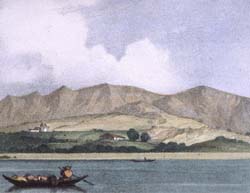 is a 2002 Wildling Art Museum exhibit of paintings, watercolors
and prints depicting the Central Coast of California between 1836 and 1960
and celebrating "its rural pristine and fertile nature," selected
by guest curator, Frank Goss. It is his thesis that the paradise that once
was California, a land of boundless resources and unlimited opportunities,
has shrunk through urbanization and exploitation, and the Central Coast,
not yet paved over, is "the Final Eden." (left: John Hall
Esq. (1808 - ?), "Santa Barbara-Upper California," 1836, hand-colored
lithograph.. Lent by Eric Hvolboi
is a 2002 Wildling Art Museum exhibit of paintings, watercolors
and prints depicting the Central Coast of California between 1836 and 1960
and celebrating "its rural pristine and fertile nature," selected
by guest curator, Frank Goss. It is his thesis that the paradise that once
was California, a land of boundless resources and unlimited opportunities,
has shrunk through urbanization and exploitation, and the Central Coast,
not yet paved over, is "the Final Eden." (left: John Hall
Esq. (1808 - ?), "Santa Barbara-Upper California," 1836, hand-colored
lithograph.. Lent by Eric Hvolboi
First Generation: Art in
Claremont, 1907-1957 is a 2008 exhibit at the
Claremont Museum of Art, which traces the art history of Claremont and the
region in the first 50 years after the city's incorporation in 1907.
On a clear day a century ago, one could see the peak of
Mt. Baldy from virtually every corner of the Los Angeles basin, from ocean
to desert. The original inhabitants of this area, the Tongva/Gabrielino
Indians, called the mountain "Yoát," or snow. Its siren
song has drawn generations of settlers to its shadow. Since the late 19th
century, prominent artists have been among those attracted to the foothills
of Mt. Baldy and its neighboring peaks-and the city of Claremont, in particular.The
exhibit traces the art history of the region, from
the work of such artists as Hannah Tempest Jenkins, Emil Kosa, Jr., and
William Manker to that of Millard Sheets and his circle in the 1930s. Sheets's
influence as artist and teacher extended as well to bringing artists such
as Henry Lee McFee, Phil Dike, and Jean Ames to Scripps College, thereby
enhancing the existing art community and assuring its lasting influence.
Greetings from Laguna Beach: Our
Town in the Early 1900s is a 2000 Laguna Art
Museum exhibit which illustrates Laguna's early history through 20 landscapes
painted by some of the town's earliest artist residents as well as historical
photos and a room-sized installation of a typical period cottage. The paintings
include works by Franz A. Bischoff, Conway Griffith , Clarence Kaiser Hinkle,
Joseph Kleitsch Millard Sheets, William Wendt, and Karl Yens.
L.A. RAW: Abject Expressionism
in Los Angeles 1945-1980, From Rico Lebrun to Paul McCarthy
is a 2012 exhibit at the Pasadena Museum of California Art.
The figurative artists, who dominated the postwar Los Angeles art scene
until the late 1950s, have largely been written out of today's art history.
This exhibition, part of the Getty Foundations initiative "Pacific
Standard Time: Art in L.A. 1945-1980," traces the distinctive aesthetic
of figurative expressionism from the end of World War II, bringing together
over 120 works by forty-one artists in a variety of media -- painting, sculpture,
photography, and performance
The Legacy of the California
Art Club in San Diego chronicles the history of
art in San Diego, California from the turn of the 20th century through the
beginning of the present century.
Painted Light: California
Impressionist Paintings from the Gardena High School Los Angeles Unified
School District Collection, hosted by CSU Dominguez
Hills in 1999, features works by Franz A. Bischoff, Jessie Arms Botke (1883-1971),
Maurice Braun (1877-1941), Benjamin Chambers Brown, Alson Skinner Clark,
Leland S. Curtis, Maynard Dixon, Victor Clyde Forsythe, John (Jack) Frost,
Joe Duncan Gleason, Armin Carl Hansen, Sam Hyde Harris, Clarence Kaiser
Hinkle, Frank Tenney Johnson, Emil Jean Kosa, Jr., Jean Mannheim, Peter
Nielsen, Edgar Alwin Payne, Hanson Duvall Puthuff, John Hubbard Rich, Carl
Clemens Moritz Rungius, Walter Elmer Schofield, Clyde Eugene Scott, Jack
Wilkinson Smith, James Guifford Swinnerton, Marion Kavanagh Wachtel, William
Wendt (1865-1946) and Orrin Augustine White.
Painted Light: California
Impressionist Paintings: The Gardena High School/Los Angeles Unified School
District Collection toured to The Irvbine Museum
in 1999.
Representing LA, Pictorial Currents
in Contemporary Southern California Art, featured
at the Frye Museum in 2000, is the first group exhibition to explore the
rich and varied representational painting, drawing, printmaking, and sculpture
produced by Southern California artists from 1990 to 2000, and fills a gap
in West Coast and Southern California art history by surveying and interpreting
about 80 works by 70 artists working in representational or realist styles
and approaches.
For further biographical information on selected artists
cited above please see America's Distinguished
Artists, a national registry of historic artists.
This page was originally published in Resource
Library Magazine. Please see Resource Library's Overview section for
more information. rev. 5/28/11
Search Resource
Library for thousands of articles and essays on American art.
Copyright 2011-2021 Traditional Fine Arts Organization, Inc., an Arizona nonprofit corporation. All rights
reserved.
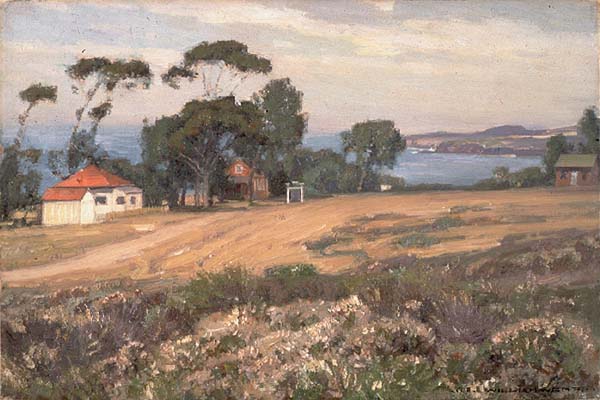 California Impressionists at Laguna
is a 2000 exhibit at the Florence Griswold Museum
organized by Florence Griswold Museum curator Jack Becker,
the exhibition consists of twenty-six paintings by over a dozen California
artists and selected works by members of the Lyme Art Colony, providing
opportunity to compare and contrast the styles and subjects of the Lyme
and Laguna Impressionists. The exhibition examines how the colonies contributed
to the very identity of their regions; in the case of Laguna as a new Eden
of perpetual sunshine, and for Lyme as a place rooted in traditional New
England values. (left: William Wendt (1865-1946), South Coast
Highway, Laguna Beach, 1918, oil on canvas, 12 x 16 inches, Mr. and
Mrs. Thomas B. Stiles II)
California Impressionists at Laguna
is a 2000 exhibit at the Florence Griswold Museum
organized by Florence Griswold Museum curator Jack Becker,
the exhibition consists of twenty-six paintings by over a dozen California
artists and selected works by members of the Lyme Art Colony, providing
opportunity to compare and contrast the styles and subjects of the Lyme
and Laguna Impressionists. The exhibition examines how the colonies contributed
to the very identity of their regions; in the case of Laguna as a new Eden
of perpetual sunshine, and for Lyme as a place rooted in traditional New
England values. (left: William Wendt (1865-1946), South Coast
Highway, Laguna Beach, 1918, oil on canvas, 12 x 16 inches, Mr. and
Mrs. Thomas B. Stiles II)