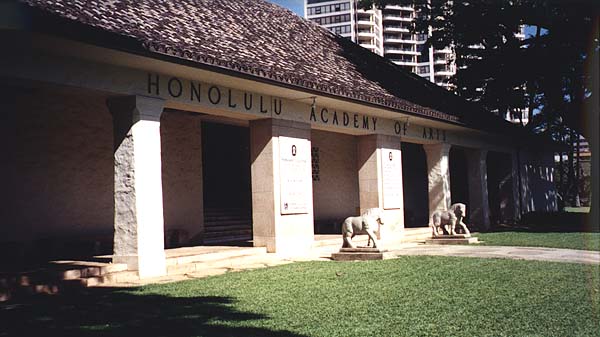
Honolulu Academy of Arts
Photo: ©2000 John Hazeltine
Honolulu, HI
808-532-8712
http://www.honoluluacademy.org/
Following is an essay written by John K. Howat for the publication Honolulu Academy of Arts Journal, Vol. 1, 1974: A Selection of American Paintings in the Collection.
A Picturesque Site in the Catskills: The Kaaterskill Falls as Painted by William Guy Wall
by John K. Howat
On May 11, 1827, the fledgling National Academy of Design in New York City opened its second annual exhibition in galleries situated on the third floor of the recently completed Arcade Baths Building on Chambers Street.[1] The exhibition met with considerable public abuse fomented by the older competing American Academy of Fine Arts and its leader Colonel John Trumbull. Despite the contretemps, a warm reception was given a painting executed by William Guy Wall depicting Cauterskill Falls on the Catskill Mountains, taken from under the Cavern; [2] the picture also received unusual accolades in the press. Although the painting subsequently disappeared, to reappear only in recent years on the New York art market, it enjoyed, as one of Wall's finest productions, an important place in the art history of the time. Both the subject and treatment of the picture struck a responsive chord in the American art world at that moment when landscape painting was being established as the dominant national art form.
The Kaaterskill Falls are located in Greene County, New York, on Kaaterskill Creek about twelve miles west of the village of Catskill on the Hudson River, The Falls, included in the Catskill State Park, are today a relatively uncelebrated landmark, but during the last three-quarters of the nineteenth century in their tourist heyday they were one of the United States' best known and most sought-out natural sights, one of those places artists felt obliged to see and record. Visitors came in droves to see the superb landscape features of the neighborhood -- the famous sixty-mile view over the Hudson Valley from the Pine Orchard, North and South Lakes nestled on the high plateau near North Mountain, the Kaaterskill Falls themselves, and Haines Falls at the head of the Kaaterskill Clove. Elegant hotels were erected and miles of trails, walkways, roads, and railways were developed to accommodate the visitors. Today the hotels are gone and only roads and trails survive, but a visit to this extraordinary area makes immediately clear why it became such a touchstone of romantic and artistic sensibility.[3]
The United States Geological Survey contour map for Kaaterskill[4] shows that the Catskill Mountains, an eroded plateau of sedimentary beds, have been sharply eaten away on their higher edge, the eastern escarpment, leaving an upland surmounted by isolated peaks and skirted by precipitous hillsides and deep ravines, particularly the Kaaterskill Clove. At the Kaaterskill Falls a hard upper layer of gray sandstone has withstood the action of nature, providing the ledge over which the Kaaterskill throws itself. Softer red shale beneath has crumbled away to form a deep amphitheater. After the first cascade of one hundred eighty feet the water goes over another ledge, falling another eighty feet perpendicularly before flowing down the steep ravine to join the other branch of the Kaaterskill flowing from Haines Falls. The imposing presence of the Kaaterskill Falls in full flood has best been captured at close view in Henry Fenn's theatrical rendition.
The name Kaaterskill (the preferred form on the survey maps, although they offer "Cauterskill" as a variant) is uncertain in origin (Indian or Dutch ?), varied in spelling, providing a rich source for linguistic speculation. The most commonly accepted explanation first reached print in the early nineteenth century:
Shortly thereafter, because of recurrent anglicization of the name, one writer complained that "there are people who object to this Dutch way of writing these Dutch names, preferring rather to murder their own mother tongue. Instead of Kaaterskill, they write Cattskill, Cautskill, and Cauterskill."[6]
During the later eighteenth and early nineteenth century, the Kaaterskill Falls and locality, lightly inhabited aside from the valleys or "cloves" that probed the mountains from the east, were described only occasionally in print by such naturalists and authors of travelogues as the famous John Bartram, Samuel Mitchell, and Timothy Dwight. Such observers were impressed by the primeval and romantic wildness of the area, often comparing Kaaterskill Falls as a natural wonder to Niagara, but the local populace was concerned mainly with felling lumber and harvesting bark for the burgeoning tanning industry. Washington Irving, who helped make the neighborhood famous in his tale of Rip Van Winkle [1819-20] did not visit the location until years later during the 1830's.
Timothy Dwight's relative, Henry E. Dwight writing in 1819, provided one of the last profiles of the area before it was commercially developed for tourism, noting "the scenery is in the highest degree beautiful and sublime, and well deserves the best efforts of the muse and of the pencil...little or nothing is known of the existence of such scenery, excepting in the immediate vicinity. Few even of those who live within a few hours ride, have curiosity enough to visit it."[7]
Such obscurity rapidly vanished with the growth of enthusiasm for picturesque landscape vistas, Also the development of steam shipping on the Hudson River, with the impending opening of the Erie Canal in 1825, made the construction of the Catskill Mountain House at the Pine Orchard in 1823 an attractive business proposition. In 1824 William L. Stone touted the hotel and environs in a series of articles titled "Ten Days in the Country." He lauded the precarious site of the Mountain House on its cliff-edge and was wryly amused that the stream feeding the Kaaterskill Falls had been dammed for a sawmill: "This saw-mill, we shrewdly suspect, had been erected for a purpose different from that of cutting boards. The owner has dammed up the water so as to nearly destroy the beauty of the cascade at pleasure, and when visitors come, he lets off the waters as a matter of favor, and before they leave the spot, duns everyone to pay for it. This is selling water to good advantage." Stone, however, waxed enthusiastic over this: "...one of nature's mightiest efforts. ...Nothing can equal the sparkling brilliancy of the scene [viewed from the amphitheater behind the Falls], as the torrent rains down its exhaustless store of diamonds."[8]
Subsequently in the flood of travel books that appeared concerning the United States during the nineteenth century the Mountain House and Kaaterskill Falls almost always received mention. One of the earliest of these mentions appeared in the famous book, written by the Englishman Captain Basil Hall, Travels in North America in the Years 1827 and 1828. In June 1827 Hall and his wife visited the Mountain House and Hall wrote a good thumbnail outline of the area's history:
Captain Hall's wife, a lady of strong tastes and opinions, who found the United States somewhat uncongenial, was pleased with the view but was more delighted to find an obliging Englishman named Webb as manager of the Mountain House where
Webb also provided a circulating library for the benefit of those clients who escaped the heat and pestilence of the city at his hostelry.[11] Painters were lured to the vicinity by such attractions as well as by the natural spectacle.
Thomas Cole, one of America's foremost landscape painters and a founder of the Hudson River School, in 1843 provided an evocative description of the Kaaterskill Falls. This is only appropriate, since the painting which guaranteed Cole's success was his view of the Falls seen from within the cavern.
The Kaaterskill Falls were first seen by the twenty-four year old Cole in the summer of 1825 during his first trip to the Catskills. Cole was discovered as a result of exhibiting his painting of the scene, an event famous in American art history which was described shortly afterwards by William Dunlap, painter, writer, dramatist, and earliest of America's art historians:
Dunlap further relates how Colonel Trumbull, the discovering artist, bought a landscape for $25 saying, "I am delighted and at the same time mortified. This youth has done at once, and without instruction, what I cannot do after 50 years practice." Trumbull told Dunlap of his find, Dunlap bought one of the pictures, as did Asher B. Durand, all within the same day. In 1834 Dunlap continued the tale:
Shortly thereafter in December 1825, Colonel Trumbull lent Catterskill Upper Fall, CatskilI Mountains to the exhibition at the American Academy of Fine Arts (where it was shown again in 1826 but subsequently has vanished). The picture was a success, giving it and Cole's name further currency in New York, and in 1826 Cole painted a replica for Daniel Wadsworth of Hartford, Connecticut, a collector and Trumbull's nephew-in-law.[15] Cole, as is well-known, became the painter of the Catskill landscape, eventually settling in the village of Catskill. What Cole achieved with his pictures of the Catskills done in 1825 and 1826, besides establishing his own reputation, was to bring in graphic form before the public eye the wild beauty and romantic appeal of the imposing landscape vistas that were available so near to civilization. Cole's example both helped set for a generation the "iconography" of the fledgling school of American landscape painting and contributed to the development of the hitherto remote Catskills as a resort for the traveler questing after romantic scenery.
In America previous to Cole, accomplished paintings of scenery had been confined primarily to the work of topographers and draughtsmen (mostly trained in Great Britain], who executed lucid views of familiar sights to be reproduced in book or print form. Largely thanks to the success of Cole (and it should be added, his fellow-artist Thomas Doughty) the easel painter in oils at that juncture took the lead in American landscape painting.[16]
At the time Cole was discovered by Trumbull, William Guy Wall (1792-after 1864) was a familiar figure in the American art world as a result of his contribution of watercolor views to the popular edition of prints, The Hudson River Portfolio. Wall completed this series of watercolors on a summer trip up the river from New York to the foothills of the Adirondacks in 1820, and the first group of aquatint plates was issued in 1821. The entire first issue was complete by 1825, and later editions followed in response to lively demand.[17] Wall was a leader among the many topographical watercolorists who emigrated to the United States from Great Britain in the early years of the United States, the best of whom included William and Thomas Birch, Archibald and Alexander Robertson, John Rubens Smith, John Hill, William Bennett, Joshua Shaw, and Robert Havell. Wall, who was born, raised and trained in Dublin, came to New York in 1818, starting his first residence in the United States, which lasted from 1818 until at least 1836 when he returned to Ireland. There he was active as a landscapist and painter of backgrounds for silhouette portraits done by the popular and youthful Master Hubard. Wall returned in 1856 to live in Newburgh, New York, where he remained until 1882. Then he returned to Dublin, where he died sometime after 1864. If we judge by Dunlap's and other printed comments, Wall reached a pinnacle of success in New York in 1827 when he displayed his Cauterskill Falls on the Catskill Mountains, taken from under the Cavern. According to Dunlap:
If, as Dunlap said, Wall painted his landscapes "from nature on the spot," he probably painted the Cauterskill Falls canvas, or at least a sketch for it, during the autumn of 1826, since he exhibited the finished picture the following spring. New-York Commercial Advertiser published Dunlap's comment as part of a general review of the 1827 exhibition, possibly written by the editor, William L. Stone, who had expatiated so glowingly on the Kaaterskill Falls three years earlier:
Six days later this special notice appeared in the Commercial Advertiser's columns:
Whether Mr. Webb succeeded in purchasing the picture, presumably to further embellish the Mountain House, is not known, nor is it known whether Wall profited to the extent of five hundred dollars from Stone's public advice. Dunlap in 1834 wrote that Wall "had sold many of his late pictures at from three to four hundred dollars each." Wall's two pictures in the exhibition received an extended notice later that summer in the United States Review and Literary Gazette noting :
The Cole and Wall views are strikingly similar, having been painted from the almost identical place within the cavern, and at the same season. This, and the proximity of date, leads to the strong suspicion that Wall, impressed by the success of the rising star, Cole, and the power of his picture, hastened in 1826 to emulate or rival Cole with his own version of the Kaaterskill Falls. The similarities of the pictures are naturally intriguing, but the differences are important to notice. Cole's view, a dark, tempestuous, somewhat indistinct scene, expresses the artist's heightened sensitivity and poetic feelings toward the forces of nature in action. The picture is the work of an artist in awe of his subject. Wall, an accomplished topographer, took a more straightforward, less emotional look at the dramatic scene. He carefully delineated the variations in color and form of foliage, rocks, water, clouds, and the elegantly costumed visitors. His rendition is spritely and specific, providing an attractive record of an inspiring place of resort. In Cole's romantic vision, which includes a wholly imaginary Indian brave on the precipice, one senses none of the paraphernalia of civilization, only the "savage and silent grandeur" of the scene. It is worth noting that Philip Hone, writing in 1833, thought Cole's landscapes "too solid, massy, and umbrageous," but that "every American is bound to prove his love of country by admiring Cole."[34]
Wall, perhaps more to Hone's taste, presents a bright perception of nature, including the dandified tourists, one of whom could well be signaling to the refreshment stand at the top of the Falls, asking that a picnic basket and champagne be lowered into the gulf. And one can imagine the happy tinkling of silver and glass not far away at Mr. Webb's Mountain House. Cole and Wall chose to portray different aspects of the same scene, but both succeeded in presenting to the art-conscious portion of the American public a proud glimpse of "the natural scenery of our country."
Subsequently throughout the nineteenth century artists in large numbers painted both the grand and the more intimate aspects of the Kaaterskill Falls. Among those whose Kaaterskill Falls views were published or exhibited were William H. Bartlett, William Bennett, Jasper Cropsey, Currier and Ives, Thomas Doughty, Asher B. Durand, Harry Fenn, Sanford Gifford, Robert Havell, Winslow Homer, John Kensett, Thomas Nast, Thomas Addison Richards, James Smillie, and John Rubens Smith. The attraction of the Kaaterskill Falls as a monument for artists was strong and widespread. We are fortunate that William Guy Wall's Cauterskill Falls on the Catskill Mountains, taken from under the Cavern has survived in a state of excellent preservation as a rarity and as a pioneer testimony to the dramatic beauty of the site.
Endnotes pending.
Essay reprinted with permission of Honolulu Academy of Arts, Honolulu, HI.
About the author...
John K. Howat retired in 2001 from his position as the Lawrence A. Fleischman Chairman of the Departments of American Art at The Metropolitan Museum of Art. Mr. Howat served in curatorial positions at the Metropolitan for more than 33 years, during which time he led the major effort to expand the Museum's American Wing. Mr. Howat supervised the installation of the new American Wing in 1980, and the Luce Center in 1988. Housing one of the finest and most comprehensive collections of American art in existence, the department holds more than 15,000 paintings, sculptures, and decorative arts, dating from the 17th to the 20th century, most which are accessible to the public on four floors of gallery and study areas. The American Wing also features 25 furnished period rooms that offer an unparalleled view of American domestic architecture. It also offers visitors one of the Museum's most beloved spaces, the Charles Engelhard Court.
Read more about the Honolulu Academy of Arts in Resource Library Magazine
Please click on thumbnail images bordered by a red line to see enlargements.
For further biographical information on selected artists cited above please see America's Distinguished Artists, a national registry of historic artists.
This page was originally published in Resource Library Magazine. Please see Resource Library's Overview section for more information. rev. 5/28/11
Search Resource Library for thousands of articles and essays on American art.
Copyright 2011 Traditional Fine Arts Organization, Inc., an Arizona nonprofit corporation. All rights reserved.