The Development of Southern
California Impressionism
by Jean Stern
Continued from page one
Impressionism in California
In the 1870's and 1880's, at the time that Impressionism
began in France and was slowly coming to America, California was a distant,
isolated region, both hazardous and time-consuming to reach. The initial
transcontinental railroad was completed in 1869. Prior to that the only
ways to reach California were overland through hostile territory or by ship
around South America, an equally long and risky method.
In 1876, a railroad route was opened between San Francisco
and Los Angeles. In 1885, a railway route was completed from Los Angeles,
through the Southwest, to Chicago.[60] This became the first commercially viable link from the large
agricultural area of California to markets in the East. Within a few years,
the population of Southern California increased tremendously with the arrival
of large-scale agricultural and industrial activity.
As a result of the real estate boom of the early 1880's,
Los Angeles began to attract professional artists. By the late 1880's, several
artists were permanent residents: among the most prominent were Elmer Wachtel
and Elizabeth Borglum (1848-1922).[61] Wachtel was at first very much a Tonalist, showing moody and poetic
landscapes in dark tones. As he progressed, he lightened his colors and
adopted a more decorative and lyrical style, very reminiscent of Arthur
Mathews, although Wachtel did not include figures in his compositions. Elizabeth
Borglum also painted in the dark tonalities that were popular in American
painting in the late 1880's. She had been a student of William Keith (1839-1911)
in 1885, and of J. Foxcroft Cole (1837-1892) in 1887, both of whom were
well entrenched in the Tonalist-Barbizon style.
At the turn of the century, when Impressionism had only
recently become an accepted American style, Southern California experienced
an influx of young artists, most of whom had been trained in that style.
The period from 1900 to 1915 marks the flowering of California Impressionism.
Among the important artists who came in the first ten years of the twentieth
century, one can count the cream of the California style: Granville Redmond,
Hanson Puthuff, Marion K. Wachtel, William Wendt, Franz A. Bischoff, Jack
Wilkinson Smith, George Gardner Symons and Maurice Braun. In addition, Edgar
Payne was making frequent visits to Los Angeles and Laguna Beach and, by
1914, with the return of Guy Rose and the arrival of Donna Schuster, the
stage was set for one of the most remarkable and distinctive schools of
regional American art.
The Panama-Pacific International Exposition of 1915, in
San Francisco, marks both the last great Impressionist show in America and
the first major Impressionist exhibition in California. The exposition brought
to California most of the major figures of American Impressionism. William
Merritt Chase, Childe Hassam, Edmund Tarbell and Edward Redfield (1869-1965),
among others, were given individual galleries to hang their works.[63] The Grand Prize of the exposition went
to Frederick Frieseke and the Medal of Honor to Willard Metcalf. The impact
of the exposition on the California painters was tremendous and immediate.
Nineteen-fifteen also marks the beginning of San Diego's
professional artist community. In competition with San Francisco, San Diego
likewise marked the opening of the Panama Canal with an exposition, the
Panama-California Exposition, held in the newly constructed Balboa Park.
The Southern California Artists
The leading artists of Southern California were all professionals
who, like their contemporaries in the East, had been through the same training
and instruction required of artists of the time. Although they came from
various parts of the country, a large number were from Chicago, either trained
there or working professionally prior to coming West. The Art Institute
of Chicago was the most prominent art school in Chicago. Those artists trained
at the Art Institute included William Wendt (briefly in the early 1880's),
Alson S. Clark (1895-98), Marion K. Wachtel (late 1890's), Jack Wilkinson
Smith (late 1890's), Edgar Payne (briefly c. 1900), Donna Schuster (c. 1900),
Christian von Schneidau (early 1900's) and Anna Hills (early 1900's). In
addition, Hanson Puthuff, who came to Los Angeles as an established pictorial
artist, studied at the Chicago Art Academy in the late 1890's.
The Art Students' League of New York was another popular
art school where many Southern California artists had studied. Having been
established as an alternative to the conservative National Academy of Design
School of Art, the Art Students' League produced artists who were more inclined
to use the bold tenets of Impressionism. Alson S. Clark, Clarence Hinkle
and Frank Cuprien were, to some extent, products of the Art Students' League
of New York.
After initial art studies in American art schools, most
American artists of this period spent several years studying in Europe,
principally in Paris. The attraction of Europe for American artists was
the universally recognized teaching methods of the art academies. The preferred
French art school was the École des Beaux Arts, but entrance examinations
were rigorous and few Americans managed to win admission. Thus, the young
Americans invariably studied at the Academie Julian or the Academie Colarossi.
The most popular and influential teachers at these academies were Jean-Leon
Gérôme (1824-1904), Jean-Paul Laurens (1838-1921), Leon Bonnat
(1833-1922), Benjamin Constant (1845-1902), Carolus-Duran (1838-1917), G.A.
Bouguereau (1825-1905), Gustave Boulanger (1824-1888), and Jules Lefebvre
(1834-1912). They had been the most successful participants at the annual
Salon de Paris exhibitions, the established arbiter of taste in France.
The American art students joined their European counterparts
in spending endless hours drawing from casts and constructing stable compositions
for their paintings. They were taught the complex traditional method of
painting, from preparing numerous studies and details of their subject to
preparation and underpainting and, finally, to painting the finished work
using the traditional techniques of paint and color application. This method
put great emphasis on copying works in museums or galleries. The prevailing
pictorial models which students were obliged to copy were the Salon paintings
which were, by the late nineteenth century, usually devoid of originality
and often comprised of classical and mythological subject matter. Their
appearances were sentimental and contrived. Yet these classes and their
instructors were immensely popular, in spite of the trivial subjective approach,
because the techniques and draftsmanship were sound and this was the best
way to prepare for any artistic career. In addition, the Salon style was
widely fashionable with the art-buying public and the paintings commonly
sold for large sums.
In addition to the traditional art methods, the art student
in Paris was also exposed to various non-traditional styles. These would
be encountered during visits to art galleries and other artists' studios,
The most radical and contagious "modern" art style in the late
1870's was Impressionism.
Several Southern California artists pursued studies in
France. These included William Griffith (late 1880's), Guy Rose (1888-91),
Granville Redmond (C. 1896), George Gardner Symons and Jean Mannheim. In
1899, Alson S. Clark studied under the American expatriate James M. Whistler
(1834-1903) and the Art Nouveau artist Alphonse Mucha (1860-1934).
The closest equivalent to the Parisian art academies in
California was the San Francisco Art Association (known after 1907 as the
San Francisco Institute of Art). Formed in 1871, it was operated on the
European model and soon became the most influential art school in the West.
Under the directorship of Arthur Mathews (1860-1945), from 1890 to 1906,
it earned a national reputation. In addition to influencing a large group
of San Francisco artists, the Art Association counted several southerners
in its roll, notably Granville Redmond (1890) and Clarence Hinkle (c. 1903).
Many other nationally known art schools are represented
in the training of artists who came to live in Southern California. The
Pennsylvania Academy of the Fine Arts, a school steeped in the tradition
of Thomas Eakins (1844-1916) and Thomas P. Anshutz (1851-1912), produced
Alfred Mitchell, whose paintings of the period (1918-1921) are solidly in
the tradition of the Bucks County Impressionist Edward Redfield (1849-1965).
The Cincinnati Art Academy, long associated with progressive teaching methods,
trained Jack Wilkinson Smith.
Besides the regular art academies, many prominent artists
had individual pupils or followers and some had their private schools in
which they taught large classes for both amateur and
professional students. The most important teacher of American Impressionism
was William Merritt Chase. Himself an early convert to the style, Chase
began teaching at his home in Shinnecock, Long Island, in 1890, several
years before the style became fully acceptable in American circles. His
school was the first organized art instruction held strictly in plein air.
[63] In 1902, Chase was invited
to join The Ten after the death of member John H. Twachtman. His fame as
an Impressionist was worldwide and he attracted a large following. He taught
each summer at Shinnecock and, in 1914, held a summer class in Carmel, California.
Among the Southern California artists who studied with
Chase were Alson S. Clark (1898-1899), Marion Kavanagh Wachtel (late 1890's),
Maurice Braun (1901) and Donna Schustcr (1912, and in Carmel, 1914). Chase's
students absorbed much from the master, particularly
his devotion to plein air painting and the insistence on speed in painting.
Chase would admonish his student to "...take as much time as you need.
. .take two hours if necessary. . ." to paint a scene. Edmund Tarbell,
the noted Boston artist and member of The Ten, had a large following that
included Donna Schuster. In Schuster's early paintings, one sees a remarkable
fidelity to Tarbell's style. Her later work with William Merritt Chase had
a similar effect on her style, leading to her mature style which drew heavily
from Tarbell, Chase and Monet.
Summary
Thus, the Southern California school meets all the prerequisites
for a legitimate and active regional school of American painting. The artists
who made up the school were professionally trained artists who relied on
their artistic output for a living. Although they came from various parts
of the United States, they all came to Southern California to continue their
artistic development and, indeed, their mature work was formed in California
in an artistic milieu that allowed them to broaden their individuality and
constantly improve their art. The majority came here with preconceived art
styles rooted in their schools and teachers, and in time, the better artists
were able to develop personal styles which would not have been possible
outside the Southern California environment. The Southern California artists
were able to produce a unique and unified style, which in itself was constantly
growing and changing in response to continuous outside stimuli. The style
was not suffocated by gross commercialization -- this did not happen until
the late 1930's when the Southern California region became the victim of
mass tourism. Indeed, the few artists who settled here in the early part
of the century wanted to escape the restrictions of commercialization and
stylistic regimentation that pervaded the New York art establishment.
Many artists, such as William Wendt, Edgar Payne, Maurice
Braun and George Gardner Symons, continued to keep studios East and West,
and arranged to ship their California work for sale to Chicago and New York.
Marion Wachtel was a regular contributor to the New York Watercolor Society
annual shows and had dealers selling her work in New York, San Francisco
and Los Angeles.
The attraction of Southern California was felt throughout
the United States and the resultant influx of artists led to the creation
of a style that cannot be found anywhere else. Although most of the artists
came here from different parts of the country, they remained here for the
rest of their lives and died in Southern California having fulfilled their
lifelong pursuit of art.
Endnotes
52. Homer, William 1., Seurat and the Science of Painting, Cambridge,
MA: 1964, p. 27.
53. Ibid., p. 20.
54. Ibid, p. 28.
55. Ibid, p. 28.
56. McCoubrey, John W., American Art 1700-1960, Sources and Documents,
Englewood Cliffs, NJ: Prentice Hall, Inc., 1965, p. 159.
57. Cogniat, Raymond, Monet and His World, London: Thames and
Hudson, 1966, p. 62.
58. Gerdts, William H. American Impression, Seattle, WA: The Henry
Art Gallery, University of Washington, 1980, pp. 29 and 30.
59. Ibid., p, 53.
60. Moure, Nancy Dustin Wall, Dictionary of Art and Artists in Southern
California before 1930, Privately printed, Los Angeles, 1975, p. xv.
61. Ibid., under headings for Wachtel, Elmer, and Borglum, Elizabeth.
62. Gerdts, op. cit., p. 126.
63. Gerdts, op. cit., p. 24.
64. Hoopes, Donelson E, The American Impressionists, New York:
Watson-Guptill Publications, 1972, p. 44.
65. Art in California, San Francisco: R.L. Bernier, 1916, p. 68.
Return to page one
Essay courtesy of Westpahl Publishing, Irvine, California
------------
Resource Library features these essays concerning Southern California art:
The American Scene: Regionalist
Painters of California 1930-1960: Selections from the Michael Johnson Collection by Susan M. Anderson
Dream and Perspective: American
Scene Painting in Southern California by Susan
M. Anderson
Modern Spirit: The Group
of Eight & Los Angeles Art of the 1920s by
Susan M. Anderson
A Seed of Modernism: The Art
Students League of Los Angeles, 1906-53 by Julia
Armstrong-Totten, Marian Yoshiki-Kovinick, and Will South
The Arts in Santa Barbara by Janet Blake Dominik
Ranchos: The Oak Group
Paints the Santa Barbara Countryside by Ellen Easton
Speculative Terrain - Recent
Views of the Southern California Landscape from San Diego to Santa Barbara by Gordon L. Fuglie
Sampler Tour of Art Tiles from
Catalina Island by John Hazeltine
Mission San Juan Capistrano:
An Artistic Legacy by Gerald J. Miller
Loners, Mavericks & Dreamers:
Art in Los Angeles Before 1900 by Nancy Moure
Impressionism, Post-Impressionism,
and the Eucalyptus School in Southern California
by Nancy Moure
San Diego Beginnings by Martin E. Petersen
Keeping the Faith: Painting
in Santa Catalina 1935-1985 by Roy C. Rose
Artists in Santa Catalina Island
Before 1945 by Jean Stern
The Development of Southern California
Impressionism by Jean Stern
The Development of an Art Community
in the Los Angeles Area by Ruth Westphal
A Seed of Modernism: The Art
Students League of Los Angeles, 1906-53 by Marian
Yoshiki-Kovinick and Julia Armstrong-Totten
The Historic Landscapes of
Malibu by Michael Zakian
and these articles:
 California Impressionists at Laguna
is a 2000 exhibit at the Florence Griswold Museum
organized by Florence Griswold Museum curator Jack Becker,
the exhibition consists of twenty-six paintings by over a dozen California
artists and selected works by members of the Lyme Art Colony, providing
opportunity to compare and contrast the styles and subjects of the Lyme
and Laguna Impressionists. The exhibition examines how the colonies contributed
to the very identity of their regions; in the case of Laguna as a new Eden
of perpetual sunshine, and for Lyme as a place rooted in traditional New
England values. (left: William Wendt (1865-1946), South Coast
Highway, Laguna Beach, 1918, oil on canvas, 12 x 16 inches, Mr. and
Mrs. Thomas B. Stiles II)
California Impressionists at Laguna
is a 2000 exhibit at the Florence Griswold Museum
organized by Florence Griswold Museum curator Jack Becker,
the exhibition consists of twenty-six paintings by over a dozen California
artists and selected works by members of the Lyme Art Colony, providing
opportunity to compare and contrast the styles and subjects of the Lyme
and Laguna Impressionists. The exhibition examines how the colonies contributed
to the very identity of their regions; in the case of Laguna as a new Eden
of perpetual sunshine, and for Lyme as a place rooted in traditional New
England values. (left: William Wendt (1865-1946), South Coast
Highway, Laguna Beach, 1918, oil on canvas, 12 x 16 inches, Mr. and
Mrs. Thomas B. Stiles II)
Circles of Influence: Impressionism
to Modernism in Southern California Art 1910-1930 is a 2000 exhibit at the Orange County Museum of Art which thematically
explores Southern California's early twentieth-century artistic development
-- from the expanding influences of East Coast artists, to the building
of local art organizations striving for independent expression, and finally
the early stirrings of avant-garde Modernism. Presenting over seventy paintings,
drawn from public and private collections, the exhibition will focus attention
on the progressive artists of Los Angeles and their response to national
and international art movements.
Clarence Hinkle: Modern
Spirit and the Group of Eight is a 2012 exhibition
at the Laguna Art Museum which features over one hundred paintings dating
from the early 1900s through the 1950s, and includes many paintings that
were in the original exhibitions of the Group of Eight, especially their
1927 show at the Los Angeles Museum of History, Science, and Art.
The Fieldstone Collection:
Impressionism in Southern California, a 1999 exhibit at the the William D. Cannon Art Gallery, includes
approximately 40 works, created between the late 1800s and early 1900s,
depict the natural landscapes of the region in the "plein air"
style of the French Impressionists.
The Final Eden: Early Images
of the Santa Barbara Region 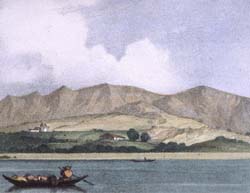 is a 2002 Wildling Art Museum exhibit of paintings, watercolors
and prints depicting the Central Coast of California between 1836 and 1960
and celebrating "its rural pristine and fertile nature," selected
by guest curator, Frank Goss. It is his thesis that the paradise that once
was California, a land of boundless resources and unlimited opportunities,
has shrunk through urbanization and exploitation, and the Central Coast,
not yet paved over, is "the Final Eden." (left: John Hall
Esq. (1808 - ?), "Santa Barbara-Upper California," 1836, hand-colored
lithograph.. Lent by Eric Hvolboi
is a 2002 Wildling Art Museum exhibit of paintings, watercolors
and prints depicting the Central Coast of California between 1836 and 1960
and celebrating "its rural pristine and fertile nature," selected
by guest curator, Frank Goss. It is his thesis that the paradise that once
was California, a land of boundless resources and unlimited opportunities,
has shrunk through urbanization and exploitation, and the Central Coast,
not yet paved over, is "the Final Eden." (left: John Hall
Esq. (1808 - ?), "Santa Barbara-Upper California," 1836, hand-colored
lithograph.. Lent by Eric Hvolboi
First Generation: Art in
Claremont, 1907-1957 is a 2008 exhibit at the
Claremont Museum of Art, which traces the art history of Claremont and the
region in the first 50 years after the city's incorporation in 1907.
On a clear day a century ago, one could see the peak of
Mt. Baldy from virtually every corner of the Los Angeles basin, from ocean
to desert. The original inhabitants of this area, the Tongva/Gabrielino
Indians, called the mountain "Yoát," or snow. Its siren
song has drawn generations of settlers to its shadow. Since the late 19th
century, prominent artists have been among those attracted to the foothills
of Mt. Baldy and its neighboring peaks-and the city of Claremont, in particular.The
exhibit traces the art history of the region, from
the work of such artists as Hannah Tempest Jenkins, Emil Kosa, Jr., and
William Manker to that of Millard Sheets and his circle in the 1930s. Sheets's
influence as artist and teacher extended as well to bringing artists such
as Henry Lee McFee, Phil Dike, and Jean Ames to Scripps College, thereby
enhancing the existing art community and assuring its lasting influence.
Greetings from Laguna Beach: Our
Town in the Early 1900s is a 2000 Laguna Art
Museum exhibit which illustrates Laguna's early history through 20 landscapes
painted by some of the town's earliest artist residents as well as historical
photos and a room-sized installation of a typical period cottage. The paintings
include works by Franz A. Bischoff, Conway Griffith , Clarence Kaiser Hinkle,
Joseph Kleitsch Millard Sheets, William Wendt, and Karl Yens.
L.A. RAW: Abject Expressionism
in Los Angeles 1945-1980, From Rico Lebrun to Paul McCarthy
is a 2012 exhibit at the Pasadena Museum of California Art.
The figurative artists, who dominated the postwar Los Angeles art scene
until the late 1950s, have largely been written out of today's art history.
This exhibition, part of the Getty Foundations initiative "Pacific
Standard Time: Art in L.A. 1945-1980," traces the distinctive aesthetic
of figurative expressionism from the end of World War II, bringing together
over 120 works by forty-one artists in a variety of media -- painting, sculpture,
photography, and performance
The Legacy of the California
Art Club in San Diego chronicles the history of
art in San Diego, California from the turn of the 20th century through the
beginning of the present century.
Painted Light: California
Impressionist Paintings from the Gardena High School Los Angeles Unified
School District Collection, hosted by CSU Dominguez
Hills in 1999, features works by Franz A. Bischoff, Jessie Arms Botke (1883-1971),
Maurice Braun (1877-1941), Benjamin Chambers Brown, Alson Skinner Clark,
Leland S. Curtis, Maynard Dixon, Victor Clyde Forsythe, John (Jack) Frost,
Joe Duncan Gleason, Armin Carl Hansen, Sam Hyde Harris, Clarence Kaiser
Hinkle, Frank Tenney Johnson, Emil Jean Kosa, Jr., Jean Mannheim, Peter
Nielsen, Edgar Alwin Payne, Hanson Duvall Puthuff, John Hubbard Rich, Carl
Clemens Moritz Rungius, Walter Elmer Schofield, Clyde Eugene Scott, Jack
Wilkinson Smith, James Guifford Swinnerton, Marion Kavanagh Wachtel, William
Wendt (1865-1946) and Orrin Augustine White.
Painted Light: California
Impressionist Paintings: The Gardena High School/Los Angeles Unified School
District Collection toured to The Irvbine Museum
in 1999.
Representing LA, Pictorial Currents
in Contemporary Southern California Art, featured
at the Frye Museum in 2000, is the first group exhibition to explore the
rich and varied representational painting, drawing, printmaking, and sculpture
produced by Southern California artists from 1990 to 2000, and fills a gap
in West Coast and Southern California art history by surveying and interpreting
about 80 works by 70 artists working in representational or realist styles
and approaches.
For further biographical information on selected artists
cited above please see America's Distinguished
Artists, a national registry of historic artists.
Links to sources of information outside of our web site
are provided only as referrals for your further consideration. Please use
due diligence in judging the quality of information contained in these and
all other web sites. Information from linked sources may be inaccurate or
out of date. TFAO neither recommends or endorses these referenced organizations.
Although TFAO includes links to other web sites, it takes no responsibility
for the content or information contained on those other sites, nor exerts
any editorial or other control over them. For more information on evaluating
web pages see TFAO's General Resources
section in Online Resources for Collectors and Students of Art History.
This page was originally published in Resource
Library Magazine. Please see Resource Library's Overview section for
more information. rev. 5/28/11
Search Resource
Library for thousands of articles and essays on American art.
Copyright 2011-2021 Traditional Fine Arts Organization, Inc., an Arizona nonprofit corporation. All rights
reserved.
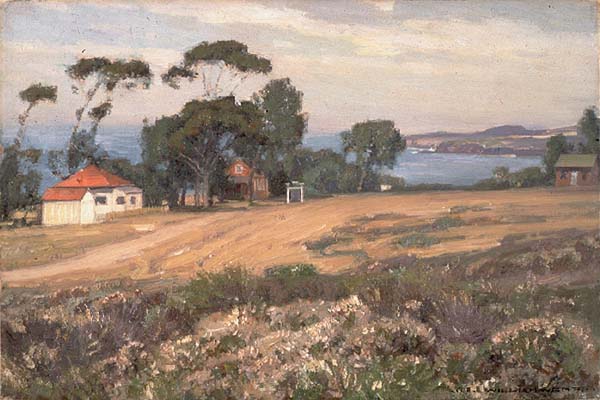 California Impressionists at Laguna
is a 2000 exhibit at the Florence Griswold Museum
organized by Florence Griswold Museum curator Jack Becker,
the exhibition consists of twenty-six paintings by over a dozen California
artists and selected works by members of the Lyme Art Colony, providing
opportunity to compare and contrast the styles and subjects of the Lyme
and Laguna Impressionists. The exhibition examines how the colonies contributed
to the very identity of their regions; in the case of Laguna as a new Eden
of perpetual sunshine, and for Lyme as a place rooted in traditional New
England values. (left: William Wendt (1865-1946), South Coast
Highway, Laguna Beach, 1918, oil on canvas, 12 x 16 inches, Mr. and
Mrs. Thomas B. Stiles II)
California Impressionists at Laguna
is a 2000 exhibit at the Florence Griswold Museum
organized by Florence Griswold Museum curator Jack Becker,
the exhibition consists of twenty-six paintings by over a dozen California
artists and selected works by members of the Lyme Art Colony, providing
opportunity to compare and contrast the styles and subjects of the Lyme
and Laguna Impressionists. The exhibition examines how the colonies contributed
to the very identity of their regions; in the case of Laguna as a new Eden
of perpetual sunshine, and for Lyme as a place rooted in traditional New
England values. (left: William Wendt (1865-1946), South Coast
Highway, Laguna Beach, 1918, oil on canvas, 12 x 16 inches, Mr. and
Mrs. Thomas B. Stiles II)