Portland Museum of Art
Portland, Maine
1-207-775-6148 or 1-800-639-4067
http://www.portlandmuseum.org
Harmonies and Contrasts:
The Art of Marguerite and William Zorach
Works of art by Marguerite
and William Zorach will be on view at the Portland Museum of Art from 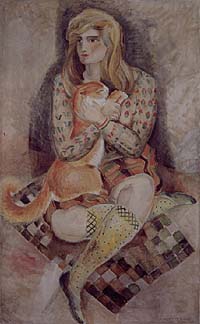 November 8, 2001 through January 6, 2002. This exhibit
explores the collaborative spirit of the Zorachs' union and the evolution
of the vision of both artists. Oil paintings, watercolors, prints, embroideries,
and sculpture in wood, stone, and bronze are included. Harmonies and
Contrasts: The Art of Marguerite and William Zorach will be shown in
conjunction with an exhibition featuring their daughter's art; Dahlov Ipcar: Seven Decades of Creativity, will be on view
from October 6, 2001 through January 27, 2001.
November 8, 2001 through January 6, 2002. This exhibit
explores the collaborative spirit of the Zorachs' union and the evolution
of the vision of both artists. Oil paintings, watercolors, prints, embroideries,
and sculpture in wood, stone, and bronze are included. Harmonies and
Contrasts: The Art of Marguerite and William Zorach will be shown in
conjunction with an exhibition featuring their daughter's art; Dahlov Ipcar: Seven Decades of Creativity, will be on view
from October 6, 2001 through January 27, 2001.
Summer residents of Robinhood, Maine, William (1889-1966)
and Marguerite (1887-1968) Zorach were among the most vital and versatile
American artists of the first half of the 20th century. Among the earliest
proponents of modernism of their generation, they participated in an artistic
revolution, living in Greenwich Village and summering periodically in the
avant-garde artists' colony at Provincetown, and producing ground-breaking
bodies of work. They are also among a handful of artist couples whose sustained
and sustaining relationship consistently enabled them to grow and test boundaries
in their art. (left: Marguerite Zorach (1887-1968), Girl with
Cat (Dahlov and Tooky), 1930, oil on canvas, 42 x 26 inches, Private
collection)
The couple's relationship began when William Zorach and
Marguerite Thompson met in Paris in 1911 while studying painting. Despite
their divergent backgrounds (Marguerite, descended from New England stock,
had enjoyed a genteel upbringing in California, while William was the son
of Lithuanian immigrants eking out a living in Cleveland), the two shared
a passionate vision of what art could be. Exposed in Paris to a new approach
to art based on creative spontaneity, the use of pure and often distorted
color, and the simplification of form, Marguerite was already a fervent
"Post-Impressionist" when she met William. She encouraged him
to liberate himself from his academic training and embrace the freedom and
expressive potential offered by modern art. Together they mapped out a utopian
vision for an art that would reject convention and would employ progressive
aesthetic ideas to celebrate the liberating beauty of nature and of human
love.
 The Zorachs chose to pursue these
artistic goals and their life together from a base in New York City, where
they were married in 1912. During the first decade of their marriage, the
Zorachs' art developed so much in tandem that it is sometimes difficult
to distinguish their work. At the time they were both focused primarily
on oil painting, and together they explored and synthesized ideas derived
first from Fauvism and then from Cubism. While they strategically made their
home in New York City, they escaped to the country every summer and well
into the fall. They both derived inspiration from these sojourns, leading
to parallel subject matter in their paintings, which draw on images captured
in Chappaqua, New York; the White Mountains of New Hampshire; Provincetown's
seaside community; the dramatic landscape of Yosemite; and, finally and
most lastingly, the coast of Maine. As their family grew to include a son,
Tessim, born in 1915, and a daughter, Dahlov, born in 1917, the joys of
children became an important and ongoing theme for both artists. The lively
exchange of ideas so evident in the vibrant paintings of this period led
on occasion to actual collaborations. The Zorachs jointly created embroideries
(a medium that would continue to be an area of innovation in Marguerite's
art) and each developed works from designs created by the other. Significantly,
when William first began to explore sculpture -- which would become his
primary creative medium -- it was with Marguerite at his side as they both
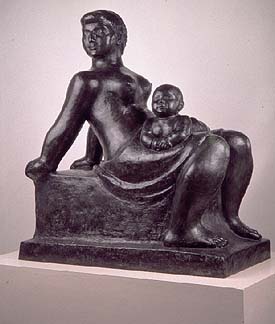
experimented with carving wood panels and modeling clay. (left: William
Zorach (1889-1966), New Horizons, 1951, bronze, 44 1/2 x 20 x 39
1/2 inches, Portland Museum of Art, Maine. Gift of Mr. and Mrs. Peter Cardone,
1986.194)
The Zorachs chose to pursue these
artistic goals and their life together from a base in New York City, where
they were married in 1912. During the first decade of their marriage, the
Zorachs' art developed so much in tandem that it is sometimes difficult
to distinguish their work. At the time they were both focused primarily
on oil painting, and together they explored and synthesized ideas derived
first from Fauvism and then from Cubism. While they strategically made their
home in New York City, they escaped to the country every summer and well
into the fall. They both derived inspiration from these sojourns, leading
to parallel subject matter in their paintings, which draw on images captured
in Chappaqua, New York; the White Mountains of New Hampshire; Provincetown's
seaside community; the dramatic landscape of Yosemite; and, finally and
most lastingly, the coast of Maine. As their family grew to include a son,
Tessim, born in 1915, and a daughter, Dahlov, born in 1917, the joys of
children became an important and ongoing theme for both artists. The lively
exchange of ideas so evident in the vibrant paintings of this period led
on occasion to actual collaborations. The Zorachs jointly created embroideries
(a medium that would continue to be an area of innovation in Marguerite's
art) and each developed works from designs created by the other. Significantly,
when William first began to explore sculpture -- which would become his
primary creative medium -- it was with Marguerite at his side as they both
experimented with carving wood panels and modeling clay. (left: William
Zorach (1889-1966), New Horizons, 1951, bronze, 44 1/2 x 20 x 39
1/2 inches, Portland Museum of Art, Maine. Gift of Mr. and Mrs. Peter Cardone,
1986.194)
In 1922, William Zorach gave up painting in oils to pursue
a career as a sculptor. From that point, the Zorachs' art becomes more divergent
as each developed their mature styles; however, their life together continued
to inform their art both in subject and style. Scenes from family life --
particularly images of their children, their pets, and each other -- appear
continually in their work as do representations of their homes in New York,
and Robinhood, Maine. Throughout their lives, they both shared a remarkable
vitality as artists whose accomplishments in their primary media of painting
and sculpture were rivaled by other artistic achievements, in her case,
creative work in textiles, and in his, hundreds of vivid, fluid watercolors
painted throughout his career.
Read more about the Portland
Museum of Art in Resource Library Magazine
For further biographical information on selected artists
cited above please see America's Distinguished
Artists, a national registry of historic artists.
This page was originally published in Resource
Library Magazine. Please see Resource Library's Overview section for
more information. rev. 6/7/11
Search Resource
Library for thousands of articles and essays on American art.
Copyright 2011 Traditional Fine Arts Organization, Inc., an Arizona nonprofit corporation. All rights
reserved.