Editor's note: The Corcoran Gallery of Art provided
source material to Resource Library Magazine for the following article
or essay. If you have questions or comments regarding the source material,
please contact the Corcoran Gallery of Art directly through either this
phone number or web address:
-
The Gilded Cage: Views
of American Women, 1873 - 1921
July 13 - August 27, 2002
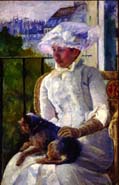 Drawn
from the Corcoran's world renowned collection of American art, The Gilded
Cage: Views of American Women, 1873 - 1921 gives a glimpse into the
refined interiors of turn-of-the-century America and the women who inhabited
them. The Gilded Age represented the period of America' s rapid growth as
an industrial, economic, and military power. Yet artists during this period
depicted women as unaffected by and protected from the quickening pace of
modern life. On view at the Corcoran Gallery of Art from July 13 through
August 27, 2002, The Gilded Cage features masterpieces by John Singer
Sargent, Mary Cassatt, Edmund Tarbell and Childe Hassam. (left: Mary
Cassatt, Young Girl at a Window, c. 1883, oil on canvas, Corcoran
Gallery of Art )
Drawn
from the Corcoran's world renowned collection of American art, The Gilded
Cage: Views of American Women, 1873 - 1921 gives a glimpse into the
refined interiors of turn-of-the-century America and the women who inhabited
them. The Gilded Age represented the period of America' s rapid growth as
an industrial, economic, and military power. Yet artists during this period
depicted women as unaffected by and protected from the quickening pace of
modern life. On view at the Corcoran Gallery of Art from July 13 through
August 27, 2002, The Gilded Cage features masterpieces by John Singer
Sargent, Mary Cassatt, Edmund Tarbell and Childe Hassam. (left: Mary
Cassatt, Young Girl at a Window, c. 1883, oil on canvas, Corcoran
Gallery of Art )
"All of the works in this exhibition depict women
embodying spirituality and serenity, seemingly oblivious to the commercialism
and materialism around them," notes Sarah Cash, Bechhoefer Curator
of American Art at the Corcoran. "These images reveal Gilded Age artists'
desire to maintain traditional depictions rather than to create new roles
for women."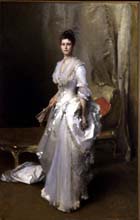
Featuring more than 35 paintings, works on paper and sculpture
from the Corcoran's permanent collection, The Gilded Cage begins
with Eastman Johnson's 1873 masterwork The Toilet and ends with Daniel
Garber's South Room, Green Street (1921). Gilded Age artists favored
showing women in insular environments, engaging in traditional solitary
pursuits -- reading, sitting, sewing. For instance, Childe Hassam's New
York Window (1912) and Thomas Wilmer Dewing's Lady with a Mask (1907)
depict women in a state of languorous reverie. Paintings illustrating maternity,
such as Frederick Frieseke's Peace (1917) reflect the high values
Gilded Age society placed on children and their mothers. (right:
John Singer Sargent, Mrs. Henry White, 1883, oil on canvas, Corcoran
Gallery of Art)
Mary Cassatt's Young Girl at a Window presents a
contemplative woman in a domestic setting, seemingly unaffected by the world
around her. Similarly, John Singer Sargent's portrait of Mrs. Henry White
shows a woman dressed in luxurious clothes, surrounded by ornate furniture,
insulated from the realities of modern life.
IMPRESSIONISM AT THE CORCORAN
The Corcoran's collection of American Impressionist paintings,
sculptures and works on paper consists chiefly of landscapes and intimate
scenes of women in domestic settings. The Corcoran acquired several American
Impressionist paintings from its first Biennial exhibition in 1907. The
Biennial started as a way to awaken public interest in contemporary American
art and to offer artists the opportunity to exhibit their work in one of
the major museums in the country. The Corcoran's permanent collection now
includes several hundred American Impressionist works.
Read more articles and essays concerning this institutional
source by visiting the sub-index page for the Corcoran
Gallery of Art in Resource Library
Magazine
Search for more
articles and essays on American art in Resource Library. See America's Distinguished Artists for biographical information on historic artists.
This page was originally published in 2002 in Resource
Library Magazine. Please see Resource Library's Overview section for
more information.
Copyright 2012 Traditional
Fine Arts Organization, Inc., an Arizona nonprofit
corporation. All rights reserved.