Editor's note: The Chrysler Museum of Art provided
source material to Resource Library Magazine for the following article
or essay. If you have questions or comments regarding the source material,
please contact the Chrysler Museum of Art directly through either this phone
number or web address:
Gentle Modernist: The Art
of Susan Watkins, 1875-1913
May 15, 2002 -- Spring
2003
IN 1946 NORFOLK banker
Goldsborough Serpell bequeathed to the Museum an extraordinary gift of paintings,
oil 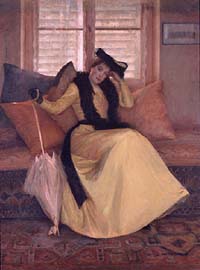 studies, academic drawings,
and sketches by his wife, the artist Susan Watkins (1875-1913). Among the
most important gifts made to the Museum prior to Walter P. Chrysler Jr.'s
arrival in 1971, the Serpell bequest comprises 62 works of art by Watkins,
as well as photographs, scrapbooks, and other memorabilia documenting her
career. The donation constitutes a veritable life's work, a rich artistic
archive through which the Chrysler can tell the fascinating story of Watkins'
career. Her work took her from her native California to the Art Students
League in New York City and then in 1896 to Paris, where, during the next
14 years, she established herself as an award-winning painter. Returning
to New York in 1910, she was elected an associate member of the National
Academy of Design, confirming her reputation as an American artist on the
rise. Her health, however, had already begun to fail her, and in 1913, only
a year after her marriage to Serpell and a move to Norfolk, Watkins died.
She was 37 years old. (right: Susan Watkins Serpell (1875-1913),
Lady in Yellow (Eleanor Reeves), ca. 1905, oil on canvas, Collection
of Chrysler Museum of Art, 46.76.137. Photo: Scott Wolff)
studies, academic drawings,
and sketches by his wife, the artist Susan Watkins (1875-1913). Among the
most important gifts made to the Museum prior to Walter P. Chrysler Jr.'s
arrival in 1971, the Serpell bequest comprises 62 works of art by Watkins,
as well as photographs, scrapbooks, and other memorabilia documenting her
career. The donation constitutes a veritable life's work, a rich artistic
archive through which the Chrysler can tell the fascinating story of Watkins'
career. Her work took her from her native California to the Art Students
League in New York City and then in 1896 to Paris, where, during the next
14 years, she established herself as an award-winning painter. Returning
to New York in 1910, she was elected an associate member of the National
Academy of Design, confirming her reputation as an American artist on the
rise. Her health, however, had already begun to fail her, and in 1913, only
a year after her marriage to Serpell and a move to Norfolk, Watkins died.
She was 37 years old. (right: Susan Watkins Serpell (1875-1913),
Lady in Yellow (Eleanor Reeves), ca. 1905, oil on canvas, Collection
of Chrysler Museum of Art, 46.76.137. Photo: Scott Wolff)
Drawn exclusively from the Museum's Permanent Collection,
Gentle Modernist traces Watkins' career from her student days in
Paris to her triumphant return to America. In so doing, it sheds new light
on the fundamental changes sweeping the art establishment in the decades
around 1900, when gifted women artists such as Mary Cassatt, Cecilia Beaux,
and Watkins herself could at last fulfill their promise and, in a discipline
long dominated by men, forge distinguished careers as professional painters.
Following is wall text from the exhibition provided by
the Museum:
- At his death in 1946, Goldsborough Serpell of Norfolk bequeathed to
the Museum an extraordinary gift of paintings, oil studies, academic drawings,
and sketches by his wife, the artist Susan Watkins. Among the most important
gifts made to the Museum prior to the arrival of Waiter P. Chrysler, Jr.'s
collection in 1971, the Serpell bequest comprises 62 works of art by Watkins,
as well as photographs, scrapbooks, and other memorabilia documenting her
career. The donation, which serves as the source for this exhibition, constitutes
a veritable life's work, a rich artistic archive through which the Chrysler
can tell the fascinating story of Watkins' exceptional, and tragically
brief, career.
-
- Born in California in 1875, Watkins began her artistic training at
age 15 at the Art Students League in New York, where her father, James
T. Watkins, had moved the family to work as an editorialist for the New
York Sun. The League was then America's most prestigious art school,
and Watkins, encouraged by her wealthy, well-connected parents, pursued
her studies there for six years. In 1896, shortly after her father's death,
Watkins and her mother, Susan Ella Owens Watkins, departed for Paris, the
epicenter of the Western art world. Though Paris was home to the revolutionary
art of the Impressionists and a host of other avant-garde aesthetic movements,
Watkins chose to follow a more traditional path and continued her studies
with the painter Raphael Collin, a conservative master who provided the
young American with a solid grounding in the French academic style.
-
- Her education completed, by 1899 Watkins had established herself as
an independent artist in the French capital and submitted her first paintings
to the Salon, the all-important exhibition of contemporary art held annually
in Paris. One of those paintings was awarded an Honorable Mention. Over
the next decade she exhibited regularly at the Salon and at major venues
back in the United States, including the Art Institute of Chicago and the
Corcoran Art Gallery in Washington, D.C., garnering a series of increasingly
prestigious awards. By 1910, the year she left Paris and returned to New
York, she had built an international reputation as a distinguished portraitist
and gifted painter of landscapes and elegant genre scenes of upper-class
life.
- In America the accolades continued. In 1910 Watkins won the highly-coveted
Julia A. Shaw Memorial Prize at the National Academy of Design in New York,
and two years later she was made an associate member of the Academy, a
clear endorsement of her achievement and her continued promise as a painter
on the threshold of artistic maturity. Sadly, that promise remained unfulfilled.
By 1912, Watkins had fallen ill, mostly likely from cancer. Her health
failing, she married longtime suitor Goldsborough Serpell and moved with
him to Norfolk. In June 1913, Susan Watkins died. She was 37 years old.
-
- Though cut short, Watkins' career saw her confirmed as a master painter
both in Europe and the United States, an exceptional accomplishment for
any young artist. Her career also serves to illuminate the fundamental
changes sweeping the art establishment in the decades around 1900, when
gifted women artists such as Mary Cassatt, Cecilia Beaux, and Susan Watkins
could at last fulfill their promise and, in a discipline long dominated
by men, forge distinguished careers as professional painters.
-
- NOTE: For a full accounting of Watkins' life and art, see Joyce
Szabo's excellent article on Susan Watkins in the Woman's Art Journal,
Fall 1999/Winter 2000, vol. 20, number 2.
Read more articles and essays concerning this institutional
source by visiting the sub-index page for the Chrysler
Museum of Art in Resource Library
Magazine.
Search for more
articles and essays on American art in Resource Library. See America's Distinguished Artists for biographical information on historic artists.
This page was originally published in 2002 in Resource
Library Magazine. Please see Resource Library's Overview section for
more information.
Copyright 2012 Traditional
Fine Arts Organization, Inc., an Arizona nonprofit
corporation. All rights reserved.