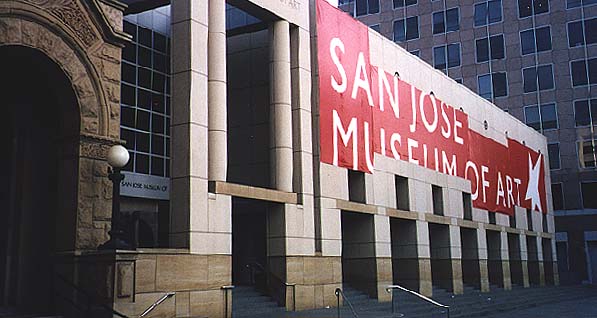
San Jose Museum of Art
photo: John Hazeltine
San Jose, CA
408-271-6840
How-To: The Paintings of Deborah Oropallo
October 13, 2001 - February 10, 2002
"How-To: The
Paintings of Deborah Oropallo," premiering October 13, 2001 at the
San Jose Museum of Art 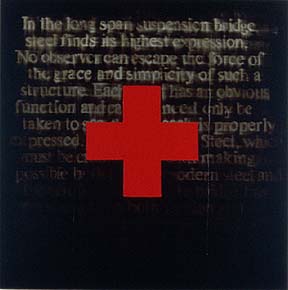 before
embarking on a West coast tour, is a mid-career survey of approximately
50 paintings that highlights the work of one of the Bay Area's most influential
painters. Oropallo has achieved national renown for her remarkable ability
to transform mundane objects into striking images of poetic resonance. In
the past 20 years, her work has evolved from richly saturated paintings
of image and text to larger, somewhat abstract silk-screened canvases of
untraditional subject matter such as rope, doormats, tickets, and toy train
tracks. By literally examining commonly overlooked objects, Oropallo's technique
encourages recognition of the extraordinary in the everyday. She transforms
bobbie pins, wire hangers, iron marks, pennies, tires, clocks, and other
objects into subject matter for aesthetic contemplation. Referencing a quote
by Flannery O'Connor, Oropallo states, "the more you look at one object,
the more of the world you see in it." (left: Steel Bridge,
1990, oil, mixed media on canvas, 80 x 80 inches)
before
embarking on a West coast tour, is a mid-career survey of approximately
50 paintings that highlights the work of one of the Bay Area's most influential
painters. Oropallo has achieved national renown for her remarkable ability
to transform mundane objects into striking images of poetic resonance. In
the past 20 years, her work has evolved from richly saturated paintings
of image and text to larger, somewhat abstract silk-screened canvases of
untraditional subject matter such as rope, doormats, tickets, and toy train
tracks. By literally examining commonly overlooked objects, Oropallo's technique
encourages recognition of the extraordinary in the everyday. She transforms
bobbie pins, wire hangers, iron marks, pennies, tires, clocks, and other
objects into subject matter for aesthetic contemplation. Referencing a quote
by Flannery O'Connor, Oropallo states, "the more you look at one object,
the more of the world you see in it." (left: Steel Bridge,
1990, oil, mixed media on canvas, 80 x 80 inches)
Typical of Oropallo's work is a painting titled "Escape Artist" (1993) where thin white lines are drawn across a canvas painted a pale gray. The lines mask a series of repeated images of handcuffs above which are images of hands seen in various poses that seem to beckon the viewer to move closer in order to examine the painting. Randomly scattered with text, and absent a centralized image, the painting compels the viewer to search the yellowed corners and edges of the painting for its meaning. About Oropallo's work, Falkenberg states, "With its emphasis on the visual trick and sleight-of-hand, Escape Artist seems an appropriate painting with which to begin a consideration of Oropallo's work, where nothing is what it might at first appear to be. Oropallo's paintings have developed remarkably over the past 20 years as she continually manages to surprise, engaging in a kind of alchemical process of transformation by representing objects in a striking new light."
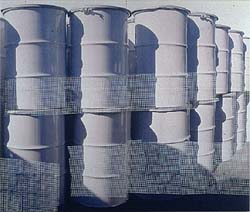
This exhibition comes at a crucial moment of transition in Oropallo's career. In her most recent work, she utilizes a strong palette of color and incorporates digital imagery to create monumental canvases of large industrial containers, stacks of cinder blocks, buckets, pipes, and other construction materials that we customarily ignore. In Oropallo's hands, these images are recreated into objects of luminous beauty. Although the painter's technique has never been the primary focus of her work, these most recent paintings demonstrate her unique ability to virtually "paint with a computer," as Jeff Kelly explains in his insightful exhibition catalogue essay. While these most recent images seem far removed from the sensuous paintings of Oropallo's early career, all of her paintings refer to the visual trick, and the process of transformation through which the viewer simultaneously recognizes and yet no longer sees the everyday objects that are her subject matter.
 Oropallo, who lives and works in
Berkeley, California, is originally from Hackensack, New Jersey. She received
her B.F.A. from Alfred University in New York State and her M.A. and M.F.A.
from the University of California, Berkeley. She is the recipient of numerous
awards, including a Eureka Fellowship Award from the Fleishhacker Foundation;
a NEA grant award; and an Engelhard Award from the Institute of Contemporary
Art in Boston. SJMA has exhibited Oropallo's work twice before: In 1993
she was represented in the Eureka Fellowship Awards exhibition, Twelve
Bay Area Painters, and in 1994 her work was shown in a solo exhibition
titled Deborah Oropallo: Selections from the Anderson Collection.
Since the mid-1980s, Oropallo has exhibited her work nationally at various
museums and art institutions, including several important group exhibitions:
American Kaleidoscope: Themes and Perspectives in Recent Art at the
National Museum of American Art, Washington, D.C.; the 43rd Corcoran
Biennial, Corcoran Gallery of Art, Washington, D.C.; and the 1989
Biennial Exhibition at the Whitney Museum of American Art. Her work
is in the holdings of numerous private and public collections. (left:
Industrial Strength, 2001, iris print, oil on canvas, 100 x 118 inches)
Oropallo, who lives and works in
Berkeley, California, is originally from Hackensack, New Jersey. She received
her B.F.A. from Alfred University in New York State and her M.A. and M.F.A.
from the University of California, Berkeley. She is the recipient of numerous
awards, including a Eureka Fellowship Award from the Fleishhacker Foundation;
a NEA grant award; and an Engelhard Award from the Institute of Contemporary
Art in Boston. SJMA has exhibited Oropallo's work twice before: In 1993
she was represented in the Eureka Fellowship Awards exhibition, Twelve
Bay Area Painters, and in 1994 her work was shown in a solo exhibition
titled Deborah Oropallo: Selections from the Anderson Collection.
Since the mid-1980s, Oropallo has exhibited her work nationally at various
museums and art institutions, including several important group exhibitions:
American Kaleidoscope: Themes and Perspectives in Recent Art at the
National Museum of American Art, Washington, D.C.; the 43rd Corcoran
Biennial, Corcoran Gallery of Art, Washington, D.C.; and the 1989
Biennial Exhibition at the Whitney Museum of American Art. Her work
is in the holdings of numerous private and public collections. (left:
Industrial Strength, 2001, iris print, oil on canvas, 100 x 118 inches)
Curated by Merrill Falkenberg, SIMA associate curator, How-To: The Paintings of Deborah Oropollo is accompanied by a 120-page, four-color catalogue with an introduction and interview with the artist by Falkenberg, and an essay by Jeff Kelley, professor of English at the University of California at Berkeley. Kelley has been widely published in nearly 20 exhibition catalogues and numerous periodicals, including Artforum and Art in America.
Exhibition Tour Itinerary
Museum of Glass: International Center for Contemporary Art, Tacoma, WA (Nov. 10 - Feb. 2, 2003); Palm Springs Desert Museum (April 2 - June 29, 2003)
Read more about San Jose Museum of Art in Resource Library Magazine.
Please click on thumbnail images bordered by a red line to see enlargements.
This page was originally published in Resource Library Magazine. Please see Resource Library's Overview section for more information. rev. 6/7/11
Search Resource Library for thousands of articles and essays on American art.
Copyright 2011 Traditional Fine Arts Organization, Inc., an Arizona nonprofit corporation. All rights reserved.