Editor's note: The Mint Museum of Craft + Design
/ Mint Museum of Art provided source material to Resource Library Magazine
for the following article. If you have questions or comments regarding
the source material, please contact the Mint Museum of Craft + Design /
Mint Museum of Art directly through either this phone number or web address:
Furniture of the American
South 1680 - 1830: The Colonial Williamsburg Collection
November 23, 2002 - January 26,
2003
It took only one
sentence uttered from the American curator at the Metropolitan Museum of
Art in a speech at the First Antiques Forum at Williamsburg in 1949 to ignite
a firestorm of research and exhibitions on early American Southern furniture.
"Very little of artistic merit was made south of Baltimore," he
declared. He might as well have fired the first cannon volley on Ft. Sumter.
 The counter to his assertion came
three years later when the Virginia Museum of Fine Arts, in collaboration
with Colonial Williamsburg and Antiques Magazine, organized the major
exhibition Southern Furniture, 1640-1820. It was the first show of
its kind, inspiring scholarship that eventually developed a comprehensive
picture of the geographic and cultural diversity of Southern furniture.
The founding of the Museum of Early Southern Decorative Arts (MESDA) in
Winston-Salem in 1965 led to a long overdue systematic approach to the study
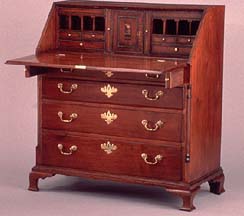
of the region's decorative arts. (left: Desk by "WH",
1789, Roanoke River Basin, North Carolina, Black walnut, yellow pine, oak.
H: 47", W: 44 7/8" D: 22 1/8")
The counter to his assertion came
three years later when the Virginia Museum of Fine Arts, in collaboration
with Colonial Williamsburg and Antiques Magazine, organized the major
exhibition Southern Furniture, 1640-1820. It was the first show of
its kind, inspiring scholarship that eventually developed a comprehensive
picture of the geographic and cultural diversity of Southern furniture.
The founding of the Museum of Early Southern Decorative Arts (MESDA) in
Winston-Salem in 1965 led to a long overdue systematic approach to the study
of the region's decorative arts. (left: Desk by "WH",
1789, Roanoke River Basin, North Carolina, Black walnut, yellow pine, oak.
H: 47", W: 44 7/8" D: 22 1/8")
Distinguished design and construction techniques found
in the exhibition Furniture of the American South 1680 - 1830: The Colonial
Williamsburg Collection, organized by the Colonial Williamsburg Foundation
with the assistance of the Trust for Museum Exhibitions, will be featured
at Charlotte's Mint Museum of Art November 23, 2002 through January 26,
2003. The exhibition refutes earlier assumptions that Southern production
was meager and unrefined or that all fine crafted furniture was imported
from England or New England. The 52 furniture pieces featured, from the
simplest to the most ornate, illustrate the taste, 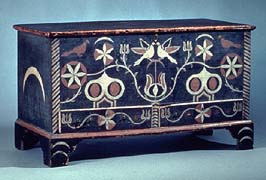 technology
and cultural diversity in three primary regions of the early South - the
Chesapeake, the Carolina Low Country and the Backcountry. The exhibition
demonstrates an astonishing array of chairs, bedsteads, tables and case
furniture made by southern joiners, turners and cabinetmakers for patrons
with roots throughout the British Isles and Europe. (left: Chest,
ca. 1795-1805, Eastern Shore of Virginia, Yellow pine. H: 57" W: 43"
D: 23")
technology
and cultural diversity in three primary regions of the early South - the
Chesapeake, the Carolina Low Country and the Backcountry. The exhibition
demonstrates an astonishing array of chairs, bedsteads, tables and case
furniture made by southern joiners, turners and cabinetmakers for patrons
with roots throughout the British Isles and Europe. (left: Chest,
ca. 1795-1805, Eastern Shore of Virginia, Yellow pine. H: 57" W: 43"
D: 23")
When colonists settled the Tidewater sections of the Chesapeake
-- Maryland, Virginia and northeast Carolina -- they found abundant hardwoods,
favoring oak and walnut for furniture. Secondary woods included yellow pine,
maple and red cedar. Initially the simplest devises passed as furniture
-- benches, stools, chests and trunks for the largely agricultural tobacco
farms. Turners created the round parts of lightweight chairs and tables
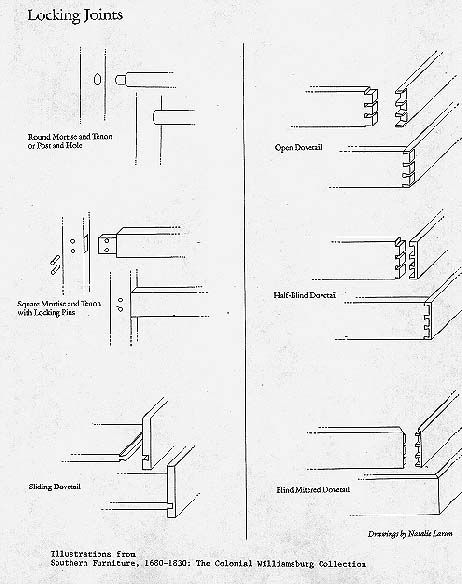
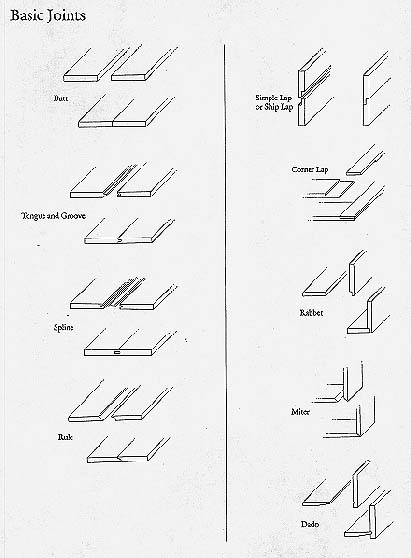
on revolving lathes and joiners framed furniture or mortised-and-tenoned
rails and stiles with inset panels (see illustrations below for Basic
Joints and Locking Joints). Examples include a walnut and yellow pine
Cupboard from Tidewater, Virginia (c. 1680-1710) and a Southside
Virginia Great Chair, c. 1700-1750. Cabinetmakers began to construct
case furniture of dovetailed boards in the urban seaports during the 1720s.
By that time English, Scottish and Irish craftsmen were drawn to growing
towns like Annapolis, Williamsburg and Norfolk.
 Colonial furniture workshops usually
had English-trained craftsmen who instructed and supervised colonial apprentices
using English copy books such as Thomas Chippendale's The Gentleman and
Cabinet-Maker's Directory (1754) and pattern books by George Hepplewhite
and Thomas Sheraton. Southern artisans soon achieved high levels of stylistic
and technical ability leading to export sales to New England and Europe
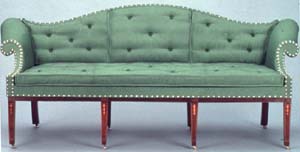
of easy chairs, tea tables, desks and secretaries.(left: Sofa,
ca. 1790-1805, Winchester, Virginia, Black walnut, yellow pine, maple. H:
37 1/4" W: 89" D: 32 3/4")
Colonial furniture workshops usually
had English-trained craftsmen who instructed and supervised colonial apprentices
using English copy books such as Thomas Chippendale's The Gentleman and
Cabinet-Maker's Directory (1754) and pattern books by George Hepplewhite
and Thomas Sheraton. Southern artisans soon achieved high levels of stylistic
and technical ability leading to export sales to New England and Europe
of easy chairs, tea tables, desks and secretaries.(left: Sofa,
ca. 1790-1805, Winchester, Virginia, Black walnut, yellow pine, maple. H:
37 1/4" W: 89" D: 32 3/4")
The British "Neat and Plain" style, characterized
by clean lines, classical proportions and restrained ornamentation proved
popular in 18th century Chesapeake. Other furniture influences came from
Philadelphia cabinetmakers and German immigrants with their preference for
florid Baroque design and precise, workmanlike construction. Exhibition
examples include a Philadelphia Bureau (ca. 1795-1810) made 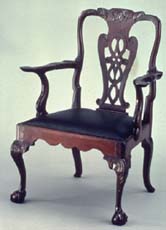 of mahogany, tulip poplar, white pine, yellow pine, satin
wood maple and rosewood and a 1789 Desk by WH made of black walnut,
yellow pine and oak in the German style from the Roanoke River Basin of
North Carolina. (left: Armchair, ca. 1745-1765, Edenton, North
Carolina, Mahogany, cherry, yellow pine H: 39 1/8" W: 28 7/8"
D: 24 1/4")
of mahogany, tulip poplar, white pine, yellow pine, satin
wood maple and rosewood and a 1789 Desk by WH made of black walnut,
yellow pine and oak in the German style from the Roanoke River Basin of
North Carolina. (left: Armchair, ca. 1745-1765, Edenton, North
Carolina, Mahogany, cherry, yellow pine H: 39 1/8" W: 28 7/8"
D: 24 1/4")
The Low Country of the North and South Carolina coast was
dominated by Charleston, a cultural rival to Philadelphia. Throughout the
colonial period, a steady mix of immigrant Dutch, French Huguenots, Swiss,
German, Welsh, 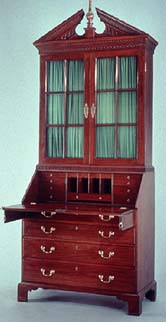 Scots, Scotch-Irish
and Sephardic Jews from Spain and Portugal added to the dominant British
culture of the Low Country. While the Neat and Plain style was popular,
the rich ornamentation of neoclassical furniture forms dominated in affluent
Charleston as seen in a Double Chest of Drawers with Secretary, ca.
1765-1780, made of mahogany, bald cypress and tulip poplar. Most examples
of the heyday of Charleston furniture production were lost to great fires
in 1740, 1828 and 1861. Ironically, when Charleston was under siege from
1863 to 1865 during the Civil War, many of its wealthy citizens shipped
their prized furniture to Columbia for safekeeping, only to be torched in
1865. (right: Desk and Bookcase, ca.1765-1775, Norfolk, Virginia,
Black walnut, yellow pine, cherry. H: 91" W: 41 1/4" D: 22 1/2")
Scots, Scotch-Irish
and Sephardic Jews from Spain and Portugal added to the dominant British
culture of the Low Country. While the Neat and Plain style was popular,
the rich ornamentation of neoclassical furniture forms dominated in affluent
Charleston as seen in a Double Chest of Drawers with Secretary, ca.
1765-1780, made of mahogany, bald cypress and tulip poplar. Most examples
of the heyday of Charleston furniture production were lost to great fires
in 1740, 1828 and 1861. Ironically, when Charleston was under siege from
1863 to 1865 during the Civil War, many of its wealthy citizens shipped
their prized furniture to Columbia for safekeeping, only to be torched in
1865. (right: Desk and Bookcase, ca.1765-1775, Norfolk, Virginia,
Black walnut, yellow pine, cherry. H: 91" W: 41 1/4" D: 22 1/2")
The Southern Backcountry is a place of striking geographic
and cultural contrasts. The eclectic cultural heritage of the area is shown
by the character of the artifacts made and used there. Many early furniture
forms illustrate the relative conservatism of Old World kinship and social
traditions. Moravian furniture in the North Carolina Piedmont redefined
the term spartan. Sawbuck tables and conservatively designed chairs met
the utilitarian needs of a simple lifestyle on the frontier.
 Southern craftsmen were able to
combine New World contemporary concepts of aesthetics with traditional homeland
techniques and style using available material and tools. Cultural cooperation
and commercial development established a furniture making tradition that
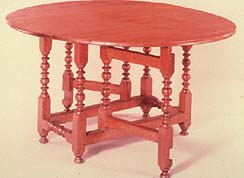
continues to this day. (left: Dining Table, ca.1700-1730,
Eastern Virginia, Black walnut, H: 27 1/8" W: 27 1/2" open, 18
3/8" closed D:53 3/4")
Southern craftsmen were able to
combine New World contemporary concepts of aesthetics with traditional homeland
techniques and style using available material and tools. Cultural cooperation
and commercial development established a furniture making tradition that
continues to this day. (left: Dining Table, ca.1700-1730,
Eastern Virginia, Black walnut, H: 27 1/8" W: 27 1/2" open, 18
3/8" closed D:53 3/4")
History and climate conspired against great collections
of Southern antiques being assembled. Family heirlooms and items belonging
to Revolutionary War heroes did survive to some extent, but furniture was
generally thrown out or given away. The destruction by heat, humidity, insects,
hurricanes, tornadoes, fires and the Civil War discouraged interest in preserving
the work of the region's craftsmen until the later half of the 20th century.
Furniture of the American South 1680 - 1830 represents the preservation
efforts and historical documentation that was not available to participants
at the 1949 Williamsburg Antiques Forum.
A fully illustrated, 639 page book entitled Furniture
of the American South 1680 - 1830: The Colonial Williamsburg Collection,
by Ronald L. Hurst and Jonathon Prown, is available in the Museum Shop.
Read more articles and essays concerning this institutional
source by visiting the sub-index page for the Mint
Museum of Art / Mint Museum of Craft+Design in Resource
Library Magazine.
Search for more
articles and essays on American art in Resource Library. See America's Distinguished Artists for biographical information on historic artists.
This page was originally published in 2002 in Resource
Library Magazine. Please see Resource Library's Overview section for
more information.
Copyright 2012 Traditional
Fine Arts Organization, Inc., an Arizona nonprofit
corporation. All rights reserved.