Gilcrease Museum
Tulsa, OK
918/596-2700, toll-free at 888/655-2278
http://www.gilcrease.org
Watercolors of the American
West: Selections from the Gilcrease Museum Permanent Collection
July 19 - October 14, 2001
Watercolor has been
used to paint the American West since the beginning of the 19th century.
Its early use was seen as an explorer's tool for "eyewitness"
documentation; it was also considered an outdoor sketching medium, not one
for finished and exhibitable paintings. Early artists who created this type
of work include Peter Rindisbacher, George Catlin, and Rudolph Kurz. By
the beginning of the 20th century, artists such as Charles M. Russell, Frank
Tenney Johnson, and Henry Farny were depicting a romanticized West in watercolors
painted in their studios. The great variety of images by all of these artists
is included in this exhibition.
Selected wall text follows, including selected biographies
of artists in the exhibition. Text and images courtesy of the Gilcrease
Museum:
Watercolor has been used in depicting the American West
since the beginning of the 19th century. Early watercolors were historically
important, an outdoor sketching medium for explorers to document points
of interest. Later artists elevated watercolor by producing studio works
that were thoughtfully composed and beautifully painted.
This exhibition includes works by the following artists:
- Alfred T. Agate (1812-184~) American
- John Ross Browne (1821-1875) American, born Ireland
- George Catlin (1796-1872) American
- Joseph Drayton (19th century) American
- Seth Eastman (1808-1875) American
- Edward M. Kern (1823-1863) American
- Rudolph F. Kurz (1818-1871) Swiss
- Alfred Jacob Miller (1810-1874) American
- Peter Rindisbacher (1806-1834) Swiss
- Vincent Colyer (1825-1888) American
- Thomas Moran (1837-1926) American, born England
- Alfred Sully (1820-1879) American
- Henry F. Farny (1847-1916) American, born France
- John Hauser (1859-1913) American
- Frank Tenney Johnson (1874-1939) American
- Frederic Remington (1861-1909) American
- Charles M. Russell (1864-1926) American
- Olaf C. Seltzer (1877-1957) American, born Denmark
The Frontier and the Western Image
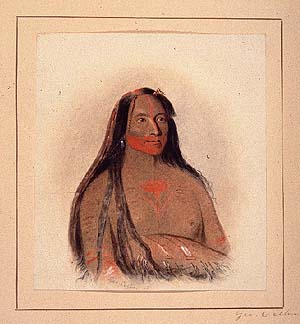 The frontier of the American West
drew artists for reasons aesthetic and scientific. Some were looking for
novel subject matter, others felt a sense of historical and anthropological
mission, yet still others arrived in the West as part of military service.
Often the works created are considered more important for their historical
merit than for their artistic merit. Some, like Swiss-born Peter Rindisbacher,
were immigrants whose families arrived as part of European colonization
during the early nineteenth century. Earlier than the better-known George
Catlin, Rindisbacher painted scenes of the Canadian Indians in the vicinity
of the Red River Colony near present day Winnipeg, as well as the landscape
near St. Louis, Missouri, before his untimely death at age twenty-nine.
Other Europeans, like Rudolph Kurz, came as visitors. During his five-year-stay
in the western wilderness, Kurz also found subjects of interest in the St.
Louis area, sketching trappers, Indians, and the landscape. (left:
George Catlin (1796-1872), MAH-TO-TOH-PA, The Four Bears Mandan,
early 1840s, waatercolor on paper, 5 3/4 x 5 1/4 inches, 0226.1544)
The frontier of the American West
drew artists for reasons aesthetic and scientific. Some were looking for
novel subject matter, others felt a sense of historical and anthropological
mission, yet still others arrived in the West as part of military service.
Often the works created are considered more important for their historical
merit than for their artistic merit. Some, like Swiss-born Peter Rindisbacher,
were immigrants whose families arrived as part of European colonization
during the early nineteenth century. Earlier than the better-known George
Catlin, Rindisbacher painted scenes of the Canadian Indians in the vicinity
of the Red River Colony near present day Winnipeg, as well as the landscape
near St. Louis, Missouri, before his untimely death at age twenty-nine.
Other Europeans, like Rudolph Kurz, came as visitors. During his five-year-stay
in the western wilderness, Kurz also found subjects of interest in the St.
Louis area, sketching trappers, Indians, and the landscape. (left:
George Catlin (1796-1872), MAH-TO-TOH-PA, The Four Bears Mandan,
early 1840s, waatercolor on paper, 5 3/4 x 5 1/4 inches, 0226.1544)
American-born artists also found artistic expression through
their western experience. Alfred Sully, Army officer stationed in a number
of far outposts, sketched forts where he was posted. Sometimes artists used
devices to help them more accurately record a scene before them. In making
the precise images of buildings and landscape, Sully was aided by a camera
lucida, the forerunner of the photographic camera. Vincent Colyer, a
Quaker, traveled to military installations in the West. He represented Friends
of the Indians, a Quaker organization that was concerned with the humanitarian
treatment of the native inhabitants in government custody. While he did
not paint Indian portraits, his sketches reveal some of the earliest forts
in Indian Territory and in the Southwest.
What these images might lack in aesthetic merit is made
up for in charm and expressiveness as quick impressions of the West. Each
man responded to the newness of the people and the places that he encountered.
Somehow the lack of great artistry makes them seem more authentic, more
like eyewitness reporting.
The Ideal West in Watercolor
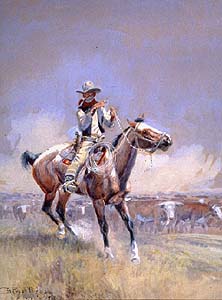 At the beginning of the twentieth
century, the romanticized West was being defined and refined by authors,
artists and performers. Artists Charles M. Russell, Henry Farny, and Frank
Tenney Johnson were all near contemporaries who lived in the West and chose
its people and environs as subjects for their paintings. Recreating history
they had experienced, these artists helped invent the ideal by focusing
on the more exciting, colorful, or engaging people and events. The tedious
and monotonous events, although more accurate, were not considered suitable
as subjects for paintings. (left: Charles M. Russell (1864-1926),
Meat Makes Fighters, 1918, waatercolor on paperboard, 0237.1324 ©
Gilcrease Museum)
At the beginning of the twentieth
century, the romanticized West was being defined and refined by authors,
artists and performers. Artists Charles M. Russell, Henry Farny, and Frank
Tenney Johnson were all near contemporaries who lived in the West and chose
its people and environs as subjects for their paintings. Recreating history
they had experienced, these artists helped invent the ideal by focusing
on the more exciting, colorful, or engaging people and events. The tedious
and monotonous events, although more accurate, were not considered suitable
as subjects for paintings. (left: Charles M. Russell (1864-1926),
Meat Makes Fighters, 1918, waatercolor on paperboard, 0237.1324 ©
Gilcrease Museum)
Watercolor has been successfully used in the West since
the beginning of the nineteenth century. In its early use, however, it was
typically an outdoor sketching medium, not one for finished and exhibitable
(and ultimately saleable) work. Also, watercolor was seen as a tool for
the explorer to document points of interest, and therefore was considered
to be more important historically than aesthetically. Artists such as Russell
elevated watercolor by producing work in the studio that was thoughtfully
composed and beautifully painted. The life of a cowboy becomes an adventure
in Russell's competent two-dimensional space. Combining opaque color with
transparent tints, a sense of atmosphere - including time of day and weather
conditions - is authentically implied. Farny's snow scene is cold and brittle-bright.
In Johnson's work, nighttime becomes a dense, mysterious other world. But
most importantly, these paintings are first and foremost works of art rather
than historical documents.
Alfred Jacob Miller
Unlike many of the pre-Civil War artists who traveled to
America's West, Alfred Jacob Miller was not a strictly documentary artist.
His European training tended toward the ideal, the romantic and thus passed
over minute and accurate detail for the sake of beauty. Miller was the only
known artist to have painted scenes of the Green River Rendezvous from his
own experience, and he secured hundreds of charming images from the 1837
trip he took in the employ of Sir William Drummond Stewart, a Scottish nobleman
who came to America annually to hunt in the Rocky Mountains.
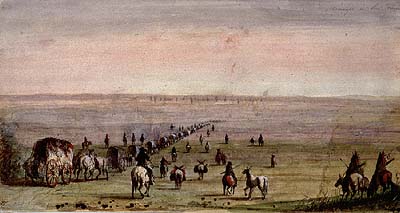 During the summer expedition, Miller
sketched the western landscape, Rendezvous events, individuals in daily
activities, and the progress of Stewart's entourage. Sir William was somewhat
of a dandy, and Miller frequently included him in his sketches, recognizable
by his light buckskin suit and his white horse. Stewart was also exceptionally
wealthy and traveled not only with such luxuries as a hired artist, but
also such retainers as valets and chefs. The stores for the trip included
champagne, caviar, and other delicacies. Hired hunters, guides and trackers
made sure that the caravan had plenty of game to eat and the best places
to set up camp for the entourage of more than 100 people with horses, mules,
and wagons. (left: Alfred J. Miller (1810-1874), Mirage on the
Prarie, 0226.1032)
During the summer expedition, Miller
sketched the western landscape, Rendezvous events, individuals in daily
activities, and the progress of Stewart's entourage. Sir William was somewhat
of a dandy, and Miller frequently included him in his sketches, recognizable
by his light buckskin suit and his white horse. Stewart was also exceptionally
wealthy and traveled not only with such luxuries as a hired artist, but
also such retainers as valets and chefs. The stores for the trip included
champagne, caviar, and other delicacies. Hired hunters, guides and trackers
made sure that the caravan had plenty of game to eat and the best places
to set up camp for the entourage of more than 100 people with horses, mules,
and wagons. (left: Alfred J. Miller (1810-1874), Mirage on the
Prarie, 0226.1032)
When Miller returned to his home studio in Baltimore, Maryland,
he spent the next forty years painting compositions based on his western
experience. He had also kept a detailed journal of the trip, which provided
additional information about his adventure that could be incorporated into
his larger oils.
Thomas Moran & Yellowstone National Park
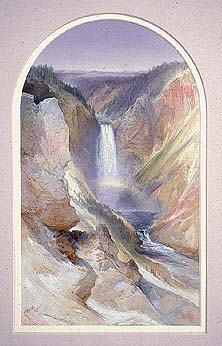 Thomas Moran saw the Yellowstone
region for the first time in the summer of 1871 with the government-sponsored
survey led by geologist Ferdinand V. Hayden. Traveling across the country
via the newly completed transcontinental railroad, Moran joined Hayden in
Virginia City, Montana. During the next two months he produced dozens of
watercolor studies, the first color images of Yellowstone ever seen in the
East. (left: Thomas Moran (1837-1926), Wyoming Falls, Yellowstone
River, waatercolor on paper, 0226.1452 © Gilcrease Museum)
Thomas Moran saw the Yellowstone
region for the first time in the summer of 1871 with the government-sponsored
survey led by geologist Ferdinand V. Hayden. Traveling across the country
via the newly completed transcontinental railroad, Moran joined Hayden in
Virginia City, Montana. During the next two months he produced dozens of
watercolor studies, the first color images of Yellowstone ever seen in the
East. (left: Thomas Moran (1837-1926), Wyoming Falls, Yellowstone
River, waatercolor on paper, 0226.1452 © Gilcrease Museum)
Shortly after the completion of the expedition, Hayden
and others began promoting the idea that Yellowstone should be protected
and preserved as a "national park." Because no member of Congress
had seen Yellowstone, Moran's watercolor sketches, along with photographs
taken by William Henry Jackson in the 1871 expedition, played a decisive
role in the debate that led to the establishment of Yellowstone as the country's
first national park in March 1872.
From his loosely sketched and often broadly painted field
studies of Yellowstone's unusual landscape, Moran composed in his studio
highly structured, exquisitely-painted watercolors. This group of works
was commissioned by English patron William Blackmore, who traveled in the
West with Hayden. The watercolors were exhibited in the autumn of 1872 to
ecstatic reviews.
In these little works Moran managed to convey the feeling
of vast panoramas, towering waterfalls, and enormous geological formations.
He did so by including recognizable elements such as plants and human figures
to help establish scale in his compositions of rarely seen natural wonders.
The delicate tints of the watercolors also approximated the beautiful colors
of the unique thermal features encountered in the Yellowstone region.
Olaf C. Seltzer
A Danish emigrant, Olaf Seltzer settled in Great Falls,
Montana. Various jobs, including a brief episode as a cowboy and then twenty
years with the Great Northern Railroad sustained him. After leaving the
railroad, Seltzer, who had been painting as an amateur, decided to pursue
art professionally. His style reflected the influence of his friend Charles
Russell, who encouraged Seltzer to paint.
Seltzer developed a fortunate business relationship with
Dr. Philip Cole in New York, who became his primary patron. Cole, a Montanan
by birth, had moved to New York to manage a family business. To ease his
homesickness, Cole filled his large estate with western art. By 1930, Seltzer
was working almost full-time on commissions for Cole. Most of Seltzer's
paintings were done to Cole's specifications and his standards. Although
a good patron, Cole was demanding and never hesitated to refuse a completed
piece or ask for it to be altered if it did not meet his criteria.
One commission that Seltzer received from Cole was for
a group of watercolors that illustrated the various cultures, occupations
and individual types. The series is known as the Western Characters. A vignette
included on the mat of the work augments each detailed painting. Another
group of watercolors are art deco style depictions of wildlife in the American
West. Many of these were completed in 1926, when Seltzer was working in
New York. Despite the fact that Seltzer was forty-four years old when he
begin painting full time, he completed over 2,500 works. Eventually Cole
acquired 350 paintings created by Olaf Seltzer.
Read more about the Gilcrease
Museum in Resource Library Magazine
For further biographical information on selected artists
cited above please see America's Distinguished
Artists, a national registry of historic artists.
This page was originally published in Resource
Library Magazine. Please see Resource Library's Overview section for
more information. rev. 6/7/11
Search Resource
Library for thousands of articles and essays on American art.
Copyright 2011 Traditional Fine Arts Organization, Inc., an Arizona nonprofit corporation. All rights
reserved.