Guggenheim Gallery
Chapman University
Orange, CA
714-997-6729
http://www.chapman.edu/wilkinson/art/gallery/
Editor's note: The following essay was rekeyed
and reprinted on October 16, 2002 in Resource Library Magazine with
permission of Chapman University Guggenheim Gallery, and the author. The
essay was previously included in a brochure for the exhibition The Frustrated
Landscape, held September 3 through October 11, 2002 at Chapman University
Guggenheim Gallery. Images from works in the exhibition were reproduced
with this reprinting. If you have questions or comments regarding the essay,
or if you have interest in obtaining a copy of the brochure please contact
the Guggenheim Gallery through either this phone number or web address:
To Move the Stars
by Eve Wood
In his novel Madame
Bovary, Gustave Flaubert tells us "no one can ever express the
exact measure of his needs, or conceptions, or sorrows. The human language
is like a cracked kettle on which we beat out a tune for a dancing bear,
when we hope with our music to move the stars." These words suggest
that the endeavor to create anything, or to exist at all with grace, dignity
and wit, is its own sad discipline for the simple reason that what we hope
for, deep inside our lives, often falls so far from the reality of where
we find ourselves. Still, our dreams have their secret amplitudes, despite
this "frustrated landscape." Artist and curator, Tyler Stallings,
whose work is also included in the show, recognizes the delicate balance
between what we imagine, and the truth of what we find there, wherein the
"frustrated landscape," becomes a point of mediation where broad
vistas, sweeping hills and impossibly fluffy clouds collide with a synthetic
ideal rooted in the artifice of popular culture.
All the artists included in this exhibition confound our
assumptions of beauty, and indeed even go so far as to falsify, for themselves,
as well as for the viewer, the ideals and expectations we've come to live
by. Hills should never be blue, and snowflakes should never be black, just
as the sky, were it to turn red overnight, would make us suspicious that
the world as we know it had finally reached its end. We long for the perfect
scene of elevated beauty we know somehow is unattainable, yet we hold out
for this nostalgia, at once fated, yet strangely satisfying. We recuperate
ourselves in the pauses, in the spaces in between where meaning thrives
without our knowing how or why.
Tom Allen's landscapes are swelteringly beautiful, yet
somehow we mistrust this odd and sinister vision. The power of his images
is eerie, irregular, derived from the peculiar sense that were we to wake
up inside one of his paintings, we could not bear the heat, the intense
colors, the disjunction between what we expect to see and what is actually
there. 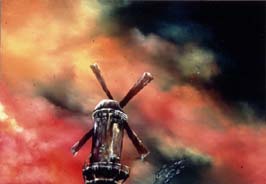 The cold burns. The heat
freezes the world to ice. In "Frozen Windmill," the sky looks
like the mouth of hell, moving from red in the lower right corner, to dark
seen and blue in the upper left. The windmill is stilled, itself a bad omen.
Historically, windmills have positive associations since they conduct the
wind, transforming it into energy and power. In the nineteenth century,
artists such as John Constable created idyllic scenes, and windmills were
often painted into the distance amid an expansive, rural landscape. They
were considered symbols of tranquility, solitude and spiritual transcendence.
Allen's paintings stem from a German Romantic sensibility, full of mist
and deep shadows, yet possessed of their own heat. His windmill broods the
sky open, churning cold fire, only to stop, frozen in the orange sky, to
let the world burn. (left: Tom Allen, Frozen Windmill, 2001,
oil on linen, 28 1/2 x 41 inches, Courtesy of the artist and Richard Telles
Fine Art, Los Angeles, CA)
The cold burns. The heat
freezes the world to ice. In "Frozen Windmill," the sky looks
like the mouth of hell, moving from red in the lower right corner, to dark
seen and blue in the upper left. The windmill is stilled, itself a bad omen.
Historically, windmills have positive associations since they conduct the
wind, transforming it into energy and power. In the nineteenth century,
artists such as John Constable created idyllic scenes, and windmills were
often painted into the distance amid an expansive, rural landscape. They
were considered symbols of tranquility, solitude and spiritual transcendence.
Allen's paintings stem from a German Romantic sensibility, full of mist
and deep shadows, yet possessed of their own heat. His windmill broods the
sky open, churning cold fire, only to stop, frozen in the orange sky, to
let the world burn. (left: Tom Allen, Frozen Windmill, 2001,
oil on linen, 28 1/2 x 41 inches, Courtesy of the artist and Richard Telles
Fine Art, Los Angeles, CA)
Similarly, Faris McReynolds' paintings suggest their own
dark narratives. His figures also stand inside a frozen 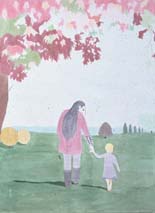 moment, awaiting a reprieve that may never come. In "Let's
Go to the Middle," a heavy metal-like character leads a little girl
by the hand into a clearing. The image simultaneously suggests both a beginning
and an end, and raises many questions. Who is leading whom? The child stares
ahead into the distance while the man gazes down at her, as though seeking
counsel, or relinquishing his adult's position. Is there a forest beyond
the clearing, and is the moment they stand inside simply a respite from
the dark? McReynolds avoids giving us answers, except to indicate that the
unexpected is always expected, and vice versa. (right: Faris McReynolds,
Let's Go to the Middle, 2001, Acrylic and pencil on canvas, 96 x
72 inches, Courtesy of the artist and Roberts & Tilton Gallery, Los
Angeles, CA)
moment, awaiting a reprieve that may never come. In "Let's
Go to the Middle," a heavy metal-like character leads a little girl
by the hand into a clearing. The image simultaneously suggests both a beginning
and an end, and raises many questions. Who is leading whom? The child stares
ahead into the distance while the man gazes down at her, as though seeking
counsel, or relinquishing his adult's position. Is there a forest beyond
the clearing, and is the moment they stand inside simply a respite from
the dark? McReynolds avoids giving us answers, except to indicate that the
unexpected is always expected, and vice versa. (right: Faris McReynolds,
Let's Go to the Middle, 2001, Acrylic and pencil on canvas, 96 x
72 inches, Courtesy of the artist and Roberts & Tilton Gallery, Los
Angeles, CA)
Ruby Osorio's paintings of nubile girls on the brink of
breaking out into fierce and fiery womanhood, profess their own strangeness.
In Osorio's work, "Reconsidering Eve," nature is conflated with
desire. Flowers hang their heads; sensuous and loose, and young women balance
on the edges of leaves, or pick red apples in a lustful frenzy. Osorio's
landscapes are unique in that the figures depicted comprise a kind of human
terrain of 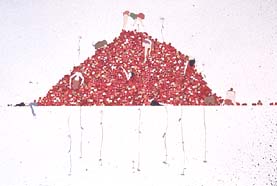 experience and mischievous
curiosity. Osorio's little women want the world, and the world wants them.
Branches bend to meet their faces, and apples gleam with an impossible phosphorescence,
as though lit from within. Who wouldn't want to be them for a day, or even
an hour -- to taste the dew that falls from the leaves into their mouths
only? One gets the sense, however, that the natural world they inhabit would
sadly be too much for any of us to endure. (left: Ruby Osorio, Reconsidering
Eve (detail), 2002, gouache, thread, and ink on paper, 50 x 186 inches,
Courtesy of the artist)
experience and mischievous
curiosity. Osorio's little women want the world, and the world wants them.
Branches bend to meet their faces, and apples gleam with an impossible phosphorescence,
as though lit from within. Who wouldn't want to be them for a day, or even
an hour -- to taste the dew that falls from the leaves into their mouths
only? One gets the sense, however, that the natural world they inhabit would
sadly be too much for any of us to endure. (left: Ruby Osorio, Reconsidering
Eve (detail), 2002, gouache, thread, and ink on paper, 50 x 186 inches,
Courtesy of the artist)
Tony de los Reyes is another artist for whom traditional
landscape painting practice takes form in a uniquely personal aesthetic.
de los Reyes' imagery, as in "Le Jardin d'incident," is directly
influenced by Rococo painting, his own paintings lush and creamy; de los
Reyes' chosen color palette of blue and white emphasizes further the elegant
simplicity of his imagery, whereby he creates a nearly frothy seduction,
like drowning slowly in a bathtub filled with heavy cream. Yet, these paintings
seem somehow dangerous, the multiple curls, the pirouettes of color and
shape, and the rupture of unexpected detail, lead us deeper into a complicated
scene that feels oddly stifling, the cool colors, leading us back out again,
as the tight lines create a feeling of urgency. de los Reyes uses specific
tones to "declare an 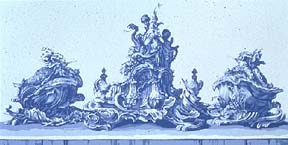 explicit
refinement of taste that is elite and precious." The types of blues
and whites used refer to the "chinoiserie of the Baroque/Rococo period,
which was used in the 18th century to buy and sell exotic (but inauthentic)
objects of art. The process by which de los Reyes creates these paintings
echoes the meticulous precision and elegance of Rococo painting. Looking
at de los Reyes paintings feels akin to losing your mind, softly, irrevocably,
with the least amount of resistance. Flaubert's Madame Bovary would most
certainly approve. (left: Tony de los Reyes, Project de Sculpture
en argent..., 2002, oil alkyd on panel, 28 1/2 x 56 inches, Courtesy
of the artist)
explicit
refinement of taste that is elite and precious." The types of blues
and whites used refer to the "chinoiserie of the Baroque/Rococo period,
which was used in the 18th century to buy and sell exotic (but inauthentic)
objects of art. The process by which de los Reyes creates these paintings
echoes the meticulous precision and elegance of Rococo painting. Looking
at de los Reyes paintings feels akin to losing your mind, softly, irrevocably,
with the least amount of resistance. Flaubert's Madame Bovary would most
certainly approve. (left: Tony de los Reyes, Project de Sculpture
en argent..., 2002, oil alkyd on panel, 28 1/2 x 56 inches, Courtesy
of the artist)
For several of the artists in this exhibition, the "frustrated
landscape" translates into open-ended images that are haunting and
enigmatic. Tyler Stallings' painting "The Black 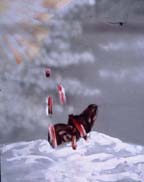 Snowflake,"
poses a set of unsettling questions from which the image derives its power.
In the upper right corner of the picture plane, a tiny black snowflake incises
the sky, cleanly, like a razor to a rabbit's pelt, while below, two brown
hares sit huddled into each other, one gazing up, confused or resigned,
at the punctured horizon. Similarly, Stallings' "The Fiery Pelt"
seems a bizarre homage to the 19th century huntsman, though the "red
pelt" could also been seen as a reference to Saint Peter in Michelangelo's
Last Judgment, who sits holding the artist's rendering of his own
loose skin. In Stallings' paintings, the "next moment still to come"
becomes an anchor where time seems to pivot around to face itself. The hare
knows the black snowflake could be his undoing, to cut him out of the scene
entirely. (right: Tyler Stallings, The Black Snowflake, oil
on canvas, 60 x 48 inches, Courtesy of the artist)
Snowflake,"
poses a set of unsettling questions from which the image derives its power.
In the upper right corner of the picture plane, a tiny black snowflake incises
the sky, cleanly, like a razor to a rabbit's pelt, while below, two brown
hares sit huddled into each other, one gazing up, confused or resigned,
at the punctured horizon. Similarly, Stallings' "The Fiery Pelt"
seems a bizarre homage to the 19th century huntsman, though the "red
pelt" could also been seen as a reference to Saint Peter in Michelangelo's
Last Judgment, who sits holding the artist's rendering of his own
loose skin. In Stallings' paintings, the "next moment still to come"
becomes an anchor where time seems to pivot around to face itself. The hare
knows the black snowflake could be his undoing, to cut him out of the scene
entirely. (right: Tyler Stallings, The Black Snowflake, oil
on canvas, 60 x 48 inches, Courtesy of the artist)
Finally, Wayne White's jaunty landscapes celebrate perversion
with charm and wit. "Sugar Tit" looks almost like "bad"
motel art, those seascape paintings from the 1970s with seagulls and sailboats,
yet pushing across the sea, luminous and watery, are the words "sugar
tit," the last thing one might think of while gazing out to sea, held
in some private reverie, or weighing the "magnitude of life' s worries,"
only to behold this unexpected surprise. White's landscapes fly hard in
the face of convention The text overtakes the landscape, towering over the
shoreline, each letter standing in ubiquitous formation, like soldiers invading
paradise. This odd and disorienting effect is further heightened by the
fact White paints directly onto lithographs, creating another disjunction
between the kitschy artifice of the image itself, and the manufactured gesture
of "building" with letters. White's work also references Ruscha's
"Standard Oil" painting where the letters extend out from a one
point perspective. The images are funny, and scathing, and profess to be
nothing more than they are, the sea seeming to beckon the words in as the
shore pulls hard to keep its "sugar tit."
All of these artists struggle to beat out their tunes,
whether for dancing bears, naughty little girls balanced at the throats
of flowers, or alienated brown hares amid fields of snow. The common thread
that connects the works in this show is each artist's desire to translate
conventional imagery on their own terms, at once electric, synthetic, manufactured,
and calibrated to a highly personalized individual perception of the natural
world in the wake of history and this new-fangled popular culture.
About the author
-
- Eve Wood is an artist and writer living in L.A. Her writing
has appeared in many magazines including "The New Republic,"
"Tema Celeste," "Artweek," "Artext," and
"Artnet.com."
Search for more
articles and essays on American art in Resource Library. See America's Distinguished Artists for biographical information on historic artists.
This page was originally published in 2002 in Resource
Library Magazine. Please see Resource Library's Overview section for
more information.
Copyright 2014 Traditional
Fine Arts Organization, Inc., an Arizona nonprofit
corporation. All rights reserved.