 Wadsworth Atheneum Museum of Art, Hartford, Connecticut.
Editor's note: The Phillips Collection provided source material to Resource Library Magazine for the following article or essay. If you have questions or comments regarding the source material, please contact The Phillips Collection directly through either this phone number or web address:
Marsden Hartley
Marsden Hartley, the first retrospective of the artist's work in 20 years, will
arrive at the home of one of American modernism's greatest supporters this
summer. Comprising 85 paintings and 21 works on paper representing each
important stage of Marsden Hartley's creative life, the exhibition will
be on view at The Phillips Collection From June 7 - September 7, 2003 before
moving on to The Nelson-Atkins Museum of Art in Kansas City, Missouri, October
11, 2003- January 4, 2004. This exhibition was organized by the Wadsworth Atheneum Museum of Art, Hartford, Connecticut.
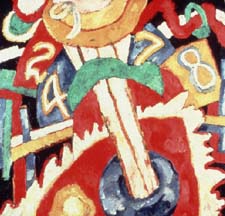
Widely acknowledged as the greatest of the early American modernists, Marsden Hartley (1877-1943) belonged to a circle of artists promoted by photographer and gallery owner Alfred Stieglitz that included Georgia O'Keeffe, John Marin, Arthur Dove, and Charles Demuth. He was also a widely published poet and essayist whose work appeared in Camera Work, The Dial, Vanity Fair, The New Republic, and Yankee. (right: Military, 1913, Oil on canvas ,39 1/4 x 39 1/4 inches, Wadsworth Atheneum Museum of Art, Hartford, The Ella Gallup Sumner and Mary Caitlin Sumner Collection Fund)
"Duncan Phillips admired Marsden Hartley's talents as both a painter and an art critic, and was an early supporter of Hartley, presenting a retrospective in 1943, one year before the Museum of Modern Art's major Hartley exhibition. We welcome the opportunity to explore Hartley's compelling career within the context of our own strong collection of American Modernist paintings," said Jay Gates, director of The Phillips Collection. "Hartley's ability to create a dynamic, expressive and wholly personal image appealed to Duncan Phillips, who was most captivated by the artist's New England scenes, six of which remain in The Phillips Collection today."
Hartley's greatest misfortune was timing. Falling out of
synch with historic events and public sentiment, the politically naïve
Hartley was plagued by professional setbacks. His first breakthrough achievement,
the 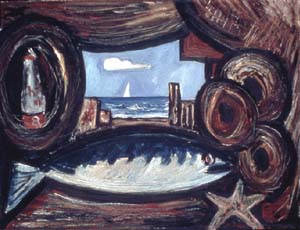 symbolic and abstract "War
Motif" series, painted in Berlin during 1914-1915, featured the Iron
Cross, German imperial flags, and regimental insignia. Upon the outbreak
of World War I, American viewers interpreted these bold, colorful paintings
as pro-German statements. (right: Sea View - New England,
1934, Oil on academy board, 12 x 16 inches, The Phillips Collection, Washington,
D.C.)
symbolic and abstract "War
Motif" series, painted in Berlin during 1914-1915, featured the Iron
Cross, German imperial flags, and regimental insignia. Upon the outbreak
of World War I, American viewers interpreted these bold, colorful paintings
as pro-German statements. (right: Sea View - New England,
1934, Oil on academy board, 12 x 16 inches, The Phillips Collection, Washington,
D.C.)
Later, critics saw his stylistic shifts and wanderlust as troubling signs of "personal incompletion." In 1929 Henry McBride wrote, "Americans should not flee their country but should work in America even though the conditions for the artist be impossible here."
The rebuke rankled. Although Hartley traveled incessantly in Europe and in North America, and lived in France and Germany for lengths of time, he was proud of his New England roots. Steeped in Emerson, Thoreau, and Whitman, place mattered to Hartley. He aimed at "voicing the soul" in his art, and viewed the totality of his landscape, figure, and still life paintings as "portraits" of the spiritual essence he divined in nature and mankind alike.
Marsden Hartley opens with
several early Maine landscapes that were first shown in 1909 at Stieglitz's
291 Gallery, followed by the "Pre-War Pageant," "Amerika,"
and "War Motif" series painted in Berlin during 1913-15. Returning
to North America, Hartley produced the "Provincetown" series,
the most abstract work by any of the Stieglitz circle, in 1916; still lifes
in Bermuda in 1917; and depictions of the New Mexico landscape and Hispanic
church imagery in 1918-19. He made an artistic pilgrimage to France in 1925-27,
capturing the 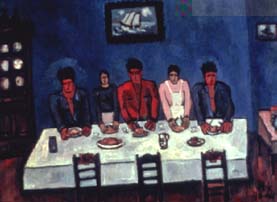 Venice landscape and
Cézanne's Mont Saint-Victoire. Over the next few years, Hartley worked
in many places. He returned to Gloucester, Massachusetts, in 1931, where
he began the cubistic "Dogtown" series; he painted in Mexico during
1932-33; he sought inspiration in the Bavarian Alps in 1933. In the last
nine years of his life, Hartley reinvented himself as "the painter
from Maine." Coinciding with the Great Depression, this period marked
his first sustained venture into figurative painting, for which he consciously
adopted a primitive style to celebrate the "sturdy simple people"
with whom he identified. It was his second breakthrough achievement.
(right: Fisherman's Last Supper, 1940-41, Oil on masonite-type hardboard,
29 7/8 x 41 inches, Roy R. Neuberger Collection)
Venice landscape and
Cézanne's Mont Saint-Victoire. Over the next few years, Hartley worked
in many places. He returned to Gloucester, Massachusetts, in 1931, where
he began the cubistic "Dogtown" series; he painted in Mexico during
1932-33; he sought inspiration in the Bavarian Alps in 1933. In the last
nine years of his life, Hartley reinvented himself as "the painter
from Maine." Coinciding with the Great Depression, this period marked
his first sustained venture into figurative painting, for which he consciously
adopted a primitive style to celebrate the "sturdy simple people"
with whom he identified. It was his second breakthrough achievement.
(right: Fisherman's Last Supper, 1940-41, Oil on masonite-type hardboard,
29 7/8 x 41 inches, Roy R. Neuberger Collection)
Indeed, love, loss, and memory impelled Hartley to create his most compelling images. The "War Motif" series recalls his beloved German officer, Karl von Freyburg. Eight Bells Folly (1933) is a memorial for fellow poet Hart Crane. A variety of late portraits, seascapes, and still lifes are remembrances of the Masons, a Nova Scotia fishing family whose sons Alty and Donny, along with a cousin, were drowned. Some of these and other paintings in the exhibition are undeniably homoerotic, yet one must remember that Hartley concealed his identity as a gay man to all but a few intimates.
"Undergirding Hartley's originality and formal power was his uncompromising sense of realism," explains Phillips Collection senior curator Elizabeth Hutton Turner. "Hand in hand with his extended sojourns both in Europe and America was his uncanny ability to meld vision and emotion. At the end of his life working in the remoteness of Maine though ill and weak, Hartley never lost his authority or conviction. As Alfred Stieglitz said, 'What a lucky man Hartley was to have passed out in his zenith."
Although Duncan Phillips never actually met Marsden Hartley, he had the impression of him as "an ardent...soul" with outstanding abilities as both painter and critic. He considered Hartley's paintings of Maine in particular "a personal and powerful contribution to the outstanding traditions of American art -- romantic mysticism and robust realism." Although he believed that Hartley's talents were diminished by an excessive intellectual aestheticism, Phillips agreed with other critics in greatly valuing his paintings of the scenery and images of his Maine homeland. Phillips believed that Hartley's "self-knowledge and his accolade would have come to him earlier had he shaped his course according to his own innermost promptings and kept close to the native forests and seacoasts of New England...."
Phillips briefly owned two still lifes from Hartley's middle period, both influenced by Cézanne. He exchanged them for later works after he visited a 1938 Hudson Walker Gallery exhibition of Maine paintings. In 1944 he wrote in retrospect: "Suddenly and with dramatic intensity Hartley had come into a command of composition and a sonorous eloquence of shapes, colors, and textures." Throughout the next few years, Phillips acquired six of what he called "powerful and personal and wholly American" paintings: Sea View, New England, 1934; Gardener's Gloves and Shears, ca. 1937; Off to the Banks, 1936-1938; Wood Lot, Maine Woods, 1939; Off the Banks at Night, 1942; and Wild Roses, 1932. In these works, he recognized the influence of Ryder's spiritualism and Homer's rugged realism and felt that Hartley had "reverted to an almost primitive Yankee saltiness."
The Phillips Memorial Gallery held a retrospective of Hartley's work in 1943, shortly after the artist's death, preceding by one year the Museum of Modern Art's major Hartley exhibition. In his catalogue essay, Phillips concluded that Hartley had "righted his course in mid-channel, after fighting through many cross-currents and had headed straight for home. In the end, Hartley stands out as a profoundly, a resonantly American painter." Today, The Phillips Collection owns two early and six late oils by Hartley, all representing Maine and New England locations.
Read more articles and essays concerning this institutional source by visiting the sub-index page for the Phillips Collection in Resource Library Magazine.
Search for more articles and essays on American art in Resource Library. See America's Distinguished Artists for biographical information on historic artists.
This page was originally published in 2003 in Resource Library Magazine. Please see Resource Library's Overview section for more information.
Copyright 2012 Traditional Fine Arts Organization, Inc., an Arizona nonprofit corporation. All rights reserved.