Editor's note: The Corcoran Gallery of Art provided
source material to Resource Library Magazine for the following article.
If you have questions or comments regarding the source material, please
contact the Corcoran Gallery of Art directly through either this phone number
or web address:
The Impressionist Tradition
in America
July 19, 2003 - Late March, 2004
From Auguste Renoir
and Edgar Degas to Mary Cassatt and John Singer Sargent, the Corcoran's
collection of 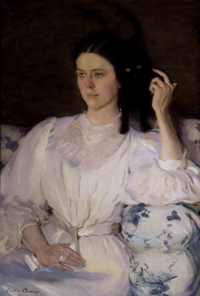 Impressionist works
has ties to Europe but ultimately reflects a distinctly American sensibility.
The Impressionist Tradition in America explores American Impressionism
through paintings, sculptures and works on paper selected from the Corcoran's
permanent collection. The exhibition illustrates the development of American
Impressionism from its European roots and complements the Museum's groundbreaking
exhibition, Beyond the Frame: Impressionism Revisited, the Sculptures
of J. Seward Johnson, Jr. On view at the Corcoran Gallery of Art from
July 19, 2003 through late March 2004, The Impressionist Tradition in
America showcases the Museum's finest Impressionist masterpieces. (right:
Cecilia Beaux, Sita and Sarita, c. 1921, oil on canvas, Corcoran
Gallery of Art, Museum Purchase)
Impressionist works
has ties to Europe but ultimately reflects a distinctly American sensibility.
The Impressionist Tradition in America explores American Impressionism
through paintings, sculptures and works on paper selected from the Corcoran's
permanent collection. The exhibition illustrates the development of American
Impressionism from its European roots and complements the Museum's groundbreaking
exhibition, Beyond the Frame: Impressionism Revisited, the Sculptures
of J. Seward Johnson, Jr. On view at the Corcoran Gallery of Art from
July 19, 2003 through late March 2004, The Impressionist Tradition in
America showcases the Museum's finest Impressionist masterpieces. (right:
Cecilia Beaux, Sita and Sarita, c. 1921, oil on canvas, Corcoran
Gallery of Art, Museum Purchase)
"Though American artists were somewhat slow to embrace
Impressionism, they did eventually adopt the style, adding their own innovations,"
says Sarah Cash, Bechhoefer Curator of American Art at the Corcoran. "American
artists maintained the essential forms of the objects they depicted, unlike
the French Impressionists who dissolved form into the paint. Furthermore,
American Impressionists tended to have diverse approaches rather than a
uniform style."
Organized thematically, The Impressionist Tradition
in America is divided into several sections: the urban scene, the rural
landscape, John Singer Sargent and his influence, Gilded Age representations
of women and the influence of Impressionism on The Eight, a group of progressive
early twentieth-century American artists. In addition, several French Impressionist
works are included for introductory and comparative purposes. Highlights
of the exhibition include landscapes by Theodore Robinson, who lived next
door to Claude Monet in Giverny, as well as bucolic scenes by Willard Metcalf
and John Twachtman. Childe Hassam's street scenes and intimate city interiors
reflect the artist's response to his increasingly urbanized surroundings.
John Singer Sargent is well represented with his majestic portrait of Mrs.
Henry White, Italian landscape Simplon Pass and noted canvas 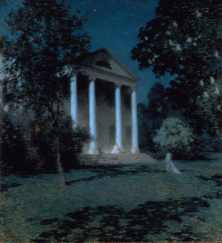 Oyster Gatherers of Cancale.
Often compared with Sargent, Cecilia Beaux is represented by Sita and
Sarita, a painting influenced by Sargent's portrait style.(right:
Willard Leroy Metcalf, May Night, 1906, oil on canvas, Corcoran Gallery
of Art)
Oyster Gatherers of Cancale.
Often compared with Sargent, Cecilia Beaux is represented by Sita and
Sarita, a painting influenced by Sargent's portrait style.(right:
Willard Leroy Metcalf, May Night, 1906, oil on canvas, Corcoran Gallery
of Art)
A significant portion of The Impressionist Tradition
in America is devoted to works addressing the American woman during the
Gilded Age (1873 - 1921). Paintings by Edmund Tarbell and Thomas Wilmer
Dewing, works on paper by Mary Cassatt, sculptures by Bessie Potter Vonnoh
and watercolors by Winslow Homer touch on themes of motherhood, handiwork
and other domestic pursuits.
The influence of American Impressionism was far-reaching,
extending well into the early twentieth century. The work of Maurice Prendergast
and William Glackens references Impressionism but adds a distinctly modern
touch. For instance, Prendergast's Landscape with Figures evidences
a vivid palette and a heavily built-up surface that recall the work of his
French forerunners but the mosaic-like patterning anticipates mid-century
abstraction.
RELATED EXHIBITION
Known primarily for his street sculptures, which appear
in many American and European cities, J. Seward Johnson, Jr. has recently
turned his attention to creating life-sized sculptures of famous Impressionist
paintings. Beyond the Frame: Impressionism Revisited, the Sculptures
of J. Seward Johnson, Jr. invites visitors to explore more than 20 tableaux,
previously known only as paintings. Audiences can walk into the settings
and, surrounded by the painting, view the work in three dimensions - a perspective
Johnson has wholly imagined. On view at the Corcoran from September 13,
2003 through January 5, 2004, Beyond the Frame marks the first museum
presentation of these works. A fully-illustrated book published by Bulfinch
Press accompanies the exhibition.
EXHIBITION ORGANIZATION
The Impressionist Tradition in America is organized by the Corcoran Gallery of Art.
Read more articles and essays concerning this institutional
source by visiting the sub-index page for the Corcoran
Gallery of Art in Resource Library
Magazine
Search for more
articles and essays on American art in Resource Library. See America's Distinguished Artists for biographical information on historic artists.
This page was originally published in 2003 in Resource
Library Magazine. Please see Resource Library's Overview section for
more information.
Copyright 2012 Traditional
Fine Arts Organization, Inc., an Arizona nonprofit
corporation. All rights reserved.