Editor's note: The Natural History Museum of Los
Angeles County provided source material to Resource Library Magazine
for the following article or essay. If you have questions or comments
regarding the source material, please contact the Natural History Museum
of Los Angeles County directly through either this phone number or web address
California's Native Grandeur:
Preserving Vanishing Landscapes
The beauty of California's
striking landscapes and clear, intense natural light have inspired painters
for more than 100 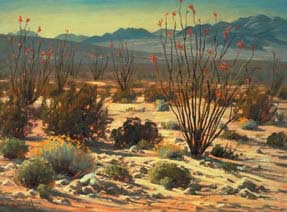 years. "California's
Native Grandeur: Preserving Vanishing Landscapes" is an exhibition
of more than 40 oil paintings from the late 19th and early 20th centuries
by artists whose works inspired early environmentalists. The exhibition
opened June 8, and runs until September 1, 2003 at the Natural History Museum
of Los Angeles County. These light-filled canvases depict many visions of
California, from the South Coast's gleaming beaches to the Sierra Nevada's
rugged peaks. (right: Paul Grimm, Desert Flowers: Private
Collection, Courtesy of The Irvine Museum, Irvine, California)
years. "California's
Native Grandeur: Preserving Vanishing Landscapes" is an exhibition
of more than 40 oil paintings from the late 19th and early 20th centuries
by artists whose works inspired early environmentalists. The exhibition
opened June 8, and runs until September 1, 2003 at the Natural History Museum
of Los Angeles County. These light-filled canvases depict many visions of
California, from the South Coast's gleaming beaches to the Sierra Nevada's
rugged peaks. (right: Paul Grimm, Desert Flowers: Private
Collection, Courtesy of The Irvine Museum, Irvine, California)
"Visitors to Native Grandeur will experience California
as they never have before," said Dan Danzig, manager of special exhibits
at the Natural History Museum. "These brilliant paintings are a testament
to the beauty of our state."
Featuring the Best Work of Renowned California Painters
The exhibition features some of the best work of such renowned
California painters as William Wendt, Granville Redmond, Maynard Dixon,
William Keith, Thomas Hill, Paul Grimm and Guy Rose. These artists worked
in a Romantic-Realist style associated with the French Barbizon school.
Southern California landscape painting was 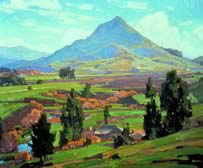 dominated,
beginning the 1890s, by Impressionists whose subject was the natural light
on the landscape, painted outdoors in what became known as the plein-air
style. It is based on the book "Native Grandeur: Preserving California's
Vanishing Landscapes," published by The Nature Conservancy of California.
(right: William Wendt, The Soil (Near San Luis Obispo): Private
Collection, Courtesy of the Irvine Museum, Irvine, California )
dominated,
beginning the 1890s, by Impressionists whose subject was the natural light
on the landscape, painted outdoors in what became known as the plein-air
style. It is based on the book "Native Grandeur: Preserving California's
Vanishing Landscapes," published by The Nature Conservancy of California.
(right: William Wendt, The Soil (Near San Luis Obispo): Private
Collection, Courtesy of the Irvine Museum, Irvine, California )
The exhibition begins in the deserts, with their crystal-clear
light and deep shadows. Next, the Sierra Nevada, famous for its rugged terrain
and the breathtaking national monuments Yosemite, Lake Tahoe and Mount Whitney,
also includes a gentler landscape of pine-covered slopes, wetlands, streams,
lakes and meadows.
The North Coast and Shasta-Cascades are some of California's
wildest and most remote landscapes, which today are threatened by logging
and the encroachment of suburban housing. The Great Central Valley, which
has been changed drastically in the past 150 years by agriculture and development,
is the site of an ancient sea and one of the flattest places on earth.
The populous Central Coast, stretching from San Luis Obispo
County to Marin County, is varied in landscape, from beaches and wetlands
to forests and coastal mountain ranges. The exhibit ends with California's
species-rich South Coast, from Santa Barbara south to Baja California, a
region of rugged hills, steep mountains, gentle valley, deep canyons, and
spectacular cliffs overlooking sandy beaches.
"California's Native Grandeur: Preserving Vanishing
Landscapes" was produced by The Nature Conservancy of California in
partnership with The Irvine Museum, Irvine, California.
rev. 7/2/03
Read more articles and essays concerning this institutional
source by visiting the sub-index page for the Natural
History Museum of Los Angeles County in Resource
Library Magazine
Search for more
articles and essays on American art in Resource Library. See America's Distinguished Artists for biographical information on historic artists.
This page was originally published in 2003 in Resource
Library Magazine. Please see Resource Library's Overview section for
more information.
Copyright 2012 Traditional
Fine Arts Organization, Inc., an Arizona nonprofit
corporation. All rights reserved.