Editor's note: The James A. Michener Art Museum
provided source material to Resource Library Magazine for the following
article and essay. If you have questions or comments regarding the source
material, please contact the James A. Michener Art Museum directly through
either this phone number or web address:
Emmet Gowin: Changing the
Earth
"The astonishing thing to me is that in spite
of all we have done, the earth still offers back so much beauty, so much
sustenance. So much of what we need is embodied in it."
- Emmet Gowin
The James A. Michener
Art Museum in Doylestown, PA is proud to announce a major exhibition of
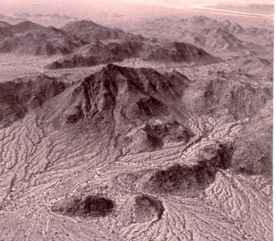 aerial photography by Bucks County
resident Emmet Gowin. Emmet Gowin: Changing the Earth opens on January
17, 2004 in the Fred Beans Gallery and runs through April 4th. Arguably
Bucks County's best-known living artist, Gowin has created hundreds of compelling
aerial images since the early 1980s of military test sites, battlefields,
mining areas, and missile silos in locations including Oregon, Kuwait and
the Czech Republic. (right: Emmet Gowin, Natural Drainage Systems
near the Palo Verde Nuclear Power Station, Arizona, 1988, Toned gelatin
silver print, Collection of the Yale University Art Gallery)
aerial photography by Bucks County
resident Emmet Gowin. Emmet Gowin: Changing the Earth opens on January
17, 2004 in the Fred Beans Gallery and runs through April 4th. Arguably
Bucks County's best-known living artist, Gowin has created hundreds of compelling
aerial images since the early 1980s of military test sites, battlefields,
mining areas, and missile silos in locations including Oregon, Kuwait and
the Czech Republic. (right: Emmet Gowin, Natural Drainage Systems
near the Palo Verde Nuclear Power Station, Arizona, 1988, Toned gelatin
silver print, Collection of the Yale University Art Gallery)
Gowin, a native of Danville, Virginia and longtime resident
of Bucks County, received his BFA from Richmond Professional Institute (now
Virginia Commonwealth University) in spring of 1965, where his undergraduate
thesis dealt with the pioneering writings and photography of Alfred Stieglitz.
He went on to pursue his MFA at Rhode Island School of Design, where he
studied under Harry Callahan, who would become the artist's lifelong teacher,
mentor and friend.
Gowin began taking aerial photographs when he was commissioned
to document the aftermath of the 1980 eruption of Mount St. Helens. Returning
from what he believed would be his last flight over the area in 1986, Gowin
took a side trip over the Hanford Reservation -- the now-deserted city where
uranium had 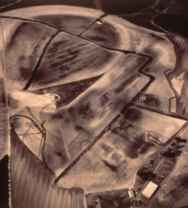 been enriched for use
in atomic bombs and nuclear reactors four decades earlier. It was, in Gowin's
words, "a flight that changed my whole perception of the age in which
I live." (left: Emmet Gowin, Drainage Ditches in a low Agricultural
Field, Savannah River Nuclear Site, SC, 1992, Toned gelatin silver print,
Collection of the Yale University Art Gallery)
been enriched for use
in atomic bombs and nuclear reactors four decades earlier. It was, in Gowin's
words, "a flight that changed my whole perception of the age in which
I live." (left: Emmet Gowin, Drainage Ditches in a low Agricultural
Field, Savannah River Nuclear Site, SC, 1992, Toned gelatin silver print,
Collection of the Yale University Art Gallery)
Old Hanford City Site and the Columbia River, Hanford
Nuclear Reservation near Richland, Washington, 1986,
was the first in a series of aerial photographs that would cover sixteen
years of Gowin's career, recording sites throughout the U.S. and around
the world where human intervention has radically altered the appearance
of the earth. "What I saw, imagined, and now know, was that a landscape
had been created that could never be saved," he says of his first flight
over Hanford Reservation.
These aerial images offer the viewer a glimpse at our world
from a privileged and rarely seen vantage, prompting questions about the
essence of nature, and about our own role as humans on earth. "It is
clear from talking with Gowin that he has come to understand his own place
and time in the universe more fully through observing the earth from great
distances of elevated physical perspective," says curator Reynolds.
Devoid of the traditional horizon lines and other elements of landscape
photos, Gowin's aerial images force the viewer to draw his or her own conclusions,
make personal references and visual associations. Extreme 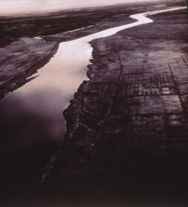 beauty and extreme cruelty exist side by side, within
the same frame, in this work.
beauty and extreme cruelty exist side by side, within
the same frame, in this work.
In addition to the moral and environmental concerns evident
in his images, Reynolds notes Gowin's deep respect for the craft of photography,
calling him "one of the finest producers of hand-toned prints in the
world." Among the artists Gowin pays homage to in his exquisitely detailed
work are Walker Evans, Frederick Sommer, Robert Frank, Aaron Siskind, and
Harry Callahan. (right: Emmet Gowin, Old Hanford City Site &
the Columbia River, Hanford Nuclear Reservation, near Richland, Washington,
1986, Toned gelatin silver print, Collection of the Yale University
Art Gallery)
"I believe that difficult images bring us all closer
to a shared experience," Gowin says... "A picture is like a prayer,
an offering, and hopefully an opening through which to seek what we don't
know, or already know and should take seriously."
In conjunction with the exhibition, Yale University Art
Gallery, in association with the Corcoran Gallery of Art and Yale University
Press, has published a hardbound catalog featuring 92 full-color illustrations
of Gowin's aerial work. Edited by Reynolds, Changing the Earth includes
an essay and interview by Terry Tempest Williams and Philip Brockman.
The first comprehensive exploration of the artist's aerial
work, this exhibition has been organized by the Yale University Art Gallery
in association with the Corcoran Gallery of Art in Washington, D.C., and
is sponsored in Doylestown by Branch Valley Associates, Inc.; Feeney's Nursery;
Keller Williams Real Estate, Doylestown; and Worth & Company, Inc. The
exhibition is curated by Jock Reynolds, Henry J. Heinz II Director of the
Yale University Art Gallery.
rev. 12/29/03
Read more articles and essays concerning this institutional
source by visiting the sub-index page for the Michener
Art Museum in Resource Library
Magazine.
Search for more
articles and essays on American art in Resource Library. See America's Distinguished Artists for biographical information on historic artists.
This page was originally published in 2003 in Resource
Library Magazine. Please see Resource Library's Overview section for
more information.
Copyright 2012 Traditional
Fine Arts Organization, Inc., an Arizona nonprofit
corporation. All rights reserved.