Editor's note: The Scottsdale Museum of Contemporary
Art provided source material to Resource Library Magazine for the
following article or essay. If you have questions or comments regarding
the source material, please contact the Scottsdale Museum of Contemporary
Art directly through either this phone number or web address:
Philip C. Curtis: Watercolors
January 10 - April 11,
2004
Philip C. Curtis is
one of the best-known of Arizona's modern artists. His surrealist images
of circuses and fantasy landscapes, populated by a cast of characters from
days gone by, are beloved by local audiences. Yet Curtis had another, little-known
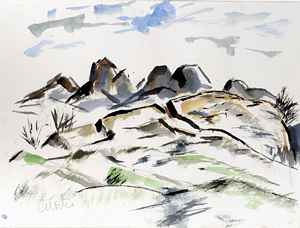 side as an artist. At periods
throughout his career, he made casual watercolors that are the antithesis
of his paintings -- loose, gestural, and full of exuberance. In keeping
with its goal of bringing to light the history of contemporary art in Arizona,
the Scottsdale Museum of Contemporary Art [SMoCA] presents "Philip
C. Curtis: Watercolors," an exhibition of more than 40 of the artist's
rarely seen works. (right: Philip C. Curtis, "Untitled"
(undated), watercolor on paper, Collection of Ellis Family. Photo credit:
Scott Farence)
side as an artist. At periods
throughout his career, he made casual watercolors that are the antithesis
of his paintings -- loose, gestural, and full of exuberance. In keeping
with its goal of bringing to light the history of contemporary art in Arizona,
the Scottsdale Museum of Contemporary Art [SMoCA] presents "Philip
C. Curtis: Watercolors," an exhibition of more than 40 of the artist's
rarely seen works. (right: Philip C. Curtis, "Untitled"
(undated), watercolor on paper, Collection of Ellis Family. Photo credit:
Scott Farence)
"These watercolors, infrequently shown, reflect the
sheer joy of Curtis's vision and his skilled observation of nature,"
remarked Susan Krane, director of SMoCA and curator of the exhibition. "In
them, we see the artist's eye and hand dance in perfect harmony -- with
a pleasure that similarly absorbs the viewer."
Spanning nearly five decades, "Philip C. Curtis: Watercolors"
follows the evolution of Curtis's career and includes examples of his early
Social Realist and Cubist-inspired imagery of the 1930s as well as mature
works from the early 1980s. Curtis painted most of his watercolors outdoors
in the Arizona desert he knew and loved so well. With great technical skill
and bravura, Curtis was able to describe the 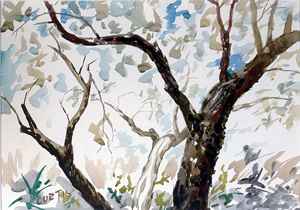 boulders,
mesquite, cottonwoods, palo verde and mountains of the Valley abstractly,
with a few brilliantly placed strokes of his brush. He captured the subtle
patchwork of green that carpets the Sonoran Desert, the saturated blue of
morning sky and the crisp light that casts this landscape into sharp, sculptural
relief. If it took him more than 20 minutes to complete a watercolor, Curtis
claimed it could be "no good." The artistic freedom of his watercolors
reflects Curtis's aesthetic alter ego--and offers an intimate view into
his practice. (left: Philip C. Curtis, "Untitled," 1966,
watercolor on paper, Collection of Ellis Family. Photo credit: Scott Farence}
boulders,
mesquite, cottonwoods, palo verde and mountains of the Valley abstractly,
with a few brilliantly placed strokes of his brush. He captured the subtle
patchwork of green that carpets the Sonoran Desert, the saturated blue of
morning sky and the crisp light that casts this landscape into sharp, sculptural
relief. If it took him more than 20 minutes to complete a watercolor, Curtis
claimed it could be "no good." The artistic freedom of his watercolors
reflects Curtis's aesthetic alter ego--and offers an intimate view into
his practice. (left: Philip C. Curtis, "Untitled," 1966,
watercolor on paper, Collection of Ellis Family. Photo credit: Scott Farence}
ABOUT THE ARTIST
Curtis was born in 1907 in Jackson, Michigan. He attended
Albion College and started law school before studying art at Yale University
from 1932-35, after which he supervised mural projects for the Works Progress
Administration (WPA) in New York. He was sent to Arizona in 1936 to start
the Phoenix Art Center (which became the Phoenix Art Museum in 1959), and
in 1939 similarly went to Iowa to start the Des Moines Art Center, now one
of the nation's premier museums of modern and contemporary art. After undertaking
museum studies at Harvard University, which were interrupted by his service
in World War II, Curtis returned to Arizona to live in 1947. He died in
Scottsdale in 2000.
- Curtis is one of the last of the great hermits: St. Jerome without
the lion. When he telephones long distance, the unmistakable gravely voice
takes up the conversation as if it had never been broken off, absence and
the passage of time are as if they had never been. The work has, equally,
a timeless quality. Historians would be hard put to date a Curtis: 'anywhere
between 1925 and 1970,' they would say. 'His imagination is like the desert
air: pellucid, hiding nothing. The desert hates to let anything go. It
preserves, where the big cities destroy; and, in the same way, a painting
by Curtis preserves something once seen - or imagined. Halfway, I'd say,
between the two'.
-
- John Russell, London, 1970; catalog essay excerpt
- (from the Laynor Foundation Museum Website)
PUBLICATION
The exhibition is accompanied by a free illustrated brochure,
designed by Nargess Salaas, with an essay by Susan Krane.
SPONSORSHIP
"Philip C. Curtis: Watercolors" was organized
by the Scottsdale Museum of Contemporary Art in collaboration with The Philip
C. Curtis Charitable Trust. The exhibition is made possible in part by the
Scottsdale League for the Arts, The Arizona Republic, The Philip C. Curtis
Charitable Trust and the SMoCA Salon, with in-kind support from Armstrong-Prior,
Inc.
PUBLIC PROGRAMS
- FEBRUARY 26, 6:30pm
- GALLERY TALK
- Jim Ballinger, director of the Phoenix Art Museum and
longtime friend of Philip C. Curtis, discusses the work and life of this
much-beloved Arizona artist. Meet in the museum lobby. Free.
-
- FEBRUARY 28, 8:30am
- NATURE HIKE
- In celebration of Curtis's joyous watercolors of the
desert, experience the subtleties of the Arizona landscape on a nature
hike in the McDowell Sonoran Preserve with a guide from the McDowell Sonoran
Land Trust and a bird specialist from the Audubon Society. Wear covered
shoes and bring water, sun protection, a snack and binoculars. The easy
4.5-mile, round-trip hike has mild inclines. Meet at 8:30am at the Anasazi
School parking lot on 124th Street north of Via Linda. Space is limited--reservations
required by calling 480-998-7971. First come, first served. Free.
-
- MARCH 18, 6:30pm
- PAINTING DEMONSTRATION AND EXHIBITION TOUR
- Watercolor artist Lew Lehrman demonstrates the elegant
but difficult magic of watercolor painting. Followed by a docent-led tour
of the exhibition "Philip C. Curtis: Watercolors." Meet in the
museum lobby. Free.
Read more articles and essays concerning this institutional
source by visiting the sub-index page for the Scottsdale
Museum of Contemporary Art in Resource
Library Magazine.
Search for more
articles and essays on American art in Resource Library. See America's Distinguished Artists for biographical information on historic artists.
This page was originally published in 2003 in Resource
Library Magazine. Please see Resource Library's Overview section for
more information.
Copyright 2012 Traditional
Fine Arts Organization, Inc., an Arizona nonprofit
corporation. All rights reserved.