Editor's note: The National Academy Museum and
School of Fine Arts provided source material to Resource Library Magazine
for the following article or essay. If you have questions or comments
regarding the source material, please contact the The National Academy Museum
and School of Fine Arts directly through either this phone number or web
address:
Bold Strokes: California
Watercolors
February 6 - April 18, 2004
Bold Strokes: California
Watercolors showcases fifteen paintings from the
California Watercolor Movement, also known as California Scene Painting.
This exhibition is drawn from the Museum's superb, but little known watercolor
collection, and highlights those artists who embraced and depicted the regional
uniqueness of agriculture, industrialization, and recreation within the
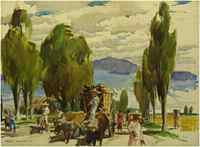 California landscape from the
1930's to the 1970's. Included are works by Millard Sheets, Frederic Whitaker,
Dong Kingman, and Mario Cooper, with many of the watercolors being exhibited
for the first time. (right: Frederic Whitaker
(1891-1988), Market Day, 1948, watercolor, 22 1/16 x 30 inches, 35-W)
California landscape from the
1930's to the 1970's. Included are works by Millard Sheets, Frederic Whitaker,
Dong Kingman, and Mario Cooper, with many of the watercolors being exhibited
for the first time. (right: Frederic Whitaker
(1891-1988), Market Day, 1948, watercolor, 22 1/16 x 30 inches, 35-W)
The California watercolor movement was born in the burgeoning
Los Angeles metropolis of the 1920s. Regional organizations such as the
California Watercolor Society provided a forum for artists to exhibit, and
circulated these artists' work nationwide. During the Great Depression,
the movement gained strength as artists were attracted to the portability,
affordability, and immediacy of the medium. Following the interest in depiction
of regional areas of the country by such notable artists as Grant Wood and
Thomas Hart Benton, California watercolorists turned to depicting scenes
specific to their area. The movement expanded rapidly and came to include
artists from both Northern and Southern California.
The beautiful California landscape was a natural subject
for these artists, and they often used it as a backdrop for scenes of 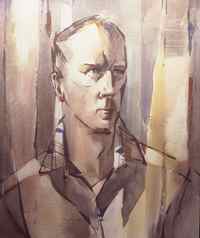 agriculture and labor, as in Millard Sheets' Winter
in Temecula, and Frederic Whitaker's Market Day. The rapidly
increasing industrialization was captured in a positive spirit by many of
the artists as seen in Dong Kingman's Dead End, and Mario Cooper's
Dredges. During the 1930's, Los Angeles experienced dramatic growth
and, under the instruction of Rex Brandt, Phil Dike, Millard Sheets and
others, the watercolorists blossomed into a pervasive movement. While landscape
painters had been working in watercolor since the nineteenth century in
California, the California Scene Painters distinguished themselves from
their predecessors by their large format, vibrant colors, bold design, and
vigorous brushwork. (left: Rex Brandt (1914-2000), Self Portrait)
agriculture and labor, as in Millard Sheets' Winter
in Temecula, and Frederic Whitaker's Market Day. The rapidly
increasing industrialization was captured in a positive spirit by many of
the artists as seen in Dong Kingman's Dead End, and Mario Cooper's
Dredges. During the 1930's, Los Angeles experienced dramatic growth
and, under the instruction of Rex Brandt, Phil Dike, Millard Sheets and
others, the watercolorists blossomed into a pervasive movement. While landscape
painters had been working in watercolor since the nineteenth century in
California, the California Scene Painters distinguished themselves from
their predecessors by their large format, vibrant colors, bold design, and
vigorous brushwork. (left: Rex Brandt (1914-2000), Self Portrait)
The popularity of the movement continued through the 1940s
and into the post-War era, when many watercolorists turned to scenes of
leisure and recreation. While interest in watercolors remained strong in
the 1960s, by the following decade the California Watercolor Society, renamed
the National Watercolor Society, lost its regional character.
Bold Strokes (February 6 - April 18, 2004) offers landscapes, industrial scenes, and portraits by the most
celebrated and influential artists of the movement, who ultimately attained
the honor of election to the National Academy.
Editor's note: RLM readers may also enjoy these essays:
Also see the California
Art Club and Top
California Artists articles from AskArt.com.
Please Note: TFAOI and RLM
do not endorse sites behind external links.
Read more articles and essays concerning this institutional
source by visiting the sub-index page for the National
Academy Museum in Resource Library
Magazine
Search for more
articles and essays on American art in Resource Library. See America's Distinguished Artists for biographical information on historic artists.
This page was originally published in 2004 in Resource
Library Magazine. Please see Resource Library's Overview section for
more information.
Copyright 2012 Traditional
Fine Arts Organization, Inc., an Arizona nonprofit
corporation. All rights reserved.