Editor's note: The Montclair Art Museum provided
source material to Resource Library Magazine for the following article
or essay. If you have questions or comments regarding the source material,
please contact the Montclair Art Museum directly through either this phone
number or web address:
The Unseen Cindy Sherman:
Early Transformations (1975-1976)
March 21 - August 1, 2004
The Unseen Cindy Sherman,
curated by MAM's Chief Curator Gail Stavitsky, 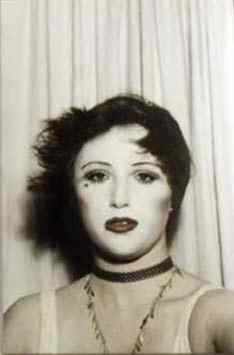 offers
a little-known selection of works by this leading contemporary artist. Primarily
culled from family collections, the exhibition comprises early photographs
and photographic assemblages created by Sherman as a college student, when
she had begun to use herself as the subject of staged photographs. These
early works vividly illustrate Sherman's early explorations of the myriad
constructions of self and female identities as a young woman, and her interest
in challenging conventions of beauty and behavior. (right: Untitled,
1975 (Untitled), 13 black and white photographs, 9? x 45 inches, Lent by
Elizabeth and Frank Leite)
offers
a little-known selection of works by this leading contemporary artist. Primarily
culled from family collections, the exhibition comprises early photographs
and photographic assemblages created by Sherman as a college student, when
she had begun to use herself as the subject of staged photographs. These
early works vividly illustrate Sherman's early explorations of the myriad
constructions of self and female identities as a young woman, and her interest
in challenging conventions of beauty and behavior. (right: Untitled,
1975 (Untitled), 13 black and white photographs, 9? x 45 inches, Lent by
Elizabeth and Frank Leite)
Sherman was born in 1954 in Glen Ridge, New Jersey, and
moved to Huntington Beach in suburban Long Island, New York when she was
three. There, Sherman's interests in art, movies, television, makeup and
clothing began their lifelong evolution into artmaking. Her three siblings
had 'artistic leanings' according to Sherman, and she would play with paint
tubes they left behind. As a child, she also frequently posed for her father
who was a dedicated amateur photographer, and was given her own Brownie
camera at an early age. Beyond this, Sherman had little exposure to art,
nor did she venture into nearby New York City as her parents considered
the city too dangerous. Sherman says when she was young, her "idea
of being an artistwas a courtroom artist or one of those boardwalk artists
who do caricatures." Still, Sherman took high school art courses, and
in 1972, enrolled in Buffalo State College, initially studying painting.
She also drew self-portraits as a way of studying 'how a face is put together,'
and during this period experimented with making mock covers of magazines
like Vogue and Family Circle, her face superimposed on the
covers.
 Sherman began dating fellow art student
Robert Longo, who was instrumental in introducing her to contemporary art,
which resulted in her diminished interest in painting and an increasing
focus on photography. Though she had failed a required photography class
as a freshman, she took the course again with Barbara Jo Revelle, who she
credits with introducing her to conceptual art and other contemporary trends,
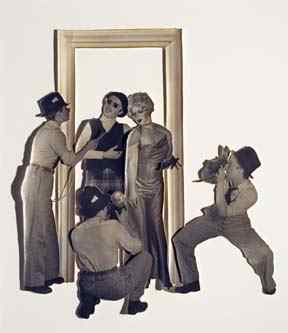
all of which had a liberating effect on Sherman. (left: The Fairies,
1976, black and white cut-out photographs mounted on paper, 10 x 23 inches,
Lent by Elizabeth and Frank Leite)
Sherman began dating fellow art student
Robert Longo, who was instrumental in introducing her to contemporary art,
which resulted in her diminished interest in painting and an increasing
focus on photography. Though she had failed a required photography class
as a freshman, she took the course again with Barbara Jo Revelle, who she
credits with introducing her to conceptual art and other contemporary trends,
all of which had a liberating effect on Sherman. (left: The Fairies,
1976, black and white cut-out photographs mounted on paper, 10 x 23 inches,
Lent by Elizabeth and Frank Leite)
As she began pursuing her own direction in photography,
eschewing becoming literate in the academics of classic photography, Sherman
found a vital support system through the artist-run, alternative space,
Hallwalls, in Buffalo. At Hallwalls, with its communal atmosphere, Sherman
became immersed in the work of a number of visiting artists like Suzy Lake,
Katherina Sieverding, Hannah Wilke, and Lynda Benglis, and consequently
began to identify her own direction of exploring cultural stereotypes of
women through her art, performance and body art and dramatic characterizations.
Among the works in the exhibition is Sherman's early representation
of herself in both male and female stereotypical roles in The Play of
Selves, a drama which Sherman authored -- The sub characters (Vanity,
Desire, Madness, and Agony) begin to close in on the male friend, features
the artist in the roles of various invented personae. Also on view will
be two rare surviving works from Sherman's The Murder Mystery series,
a relatively unknown aspect of her work that contrasts to the entirely female
roles of her first well-known series, the Untitled Film Stills 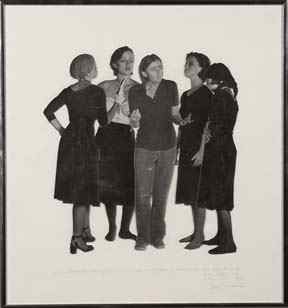 (1977-1980). Sherman also explored male roles in her Bus
Rider works of 1976. An example from this series will be included in
the Montclair Art Museum's exhibition. The Unseen Cindy Sherman will
also include Untitled, 1975, which Sherman considers her first important
work. Consisting of 23 hand-colored photographs of herself progressing from
drab to glamorous, this little-known work was exhibited in a group show
of western New York artists at the Albright-Knox Art Gallery in 1975 with
the title Laminated Transmutation. (right: The sub characters
(Vanity, Desire, Madness, and Agony) begin to close in on The male friend,
Act 3, Scene 7 from The Play of Selves, 1976, black and white cut out
photographs mounted on paper, 15 ? x 11 inches, Lent by Elizabeth and Frank
Leite)
(1977-1980). Sherman also explored male roles in her Bus
Rider works of 1976. An example from this series will be included in
the Montclair Art Museum's exhibition. The Unseen Cindy Sherman will
also include Untitled, 1975, which Sherman considers her first important
work. Consisting of 23 hand-colored photographs of herself progressing from
drab to glamorous, this little-known work was exhibited in a group show
of western New York artists at the Albright-Knox Art Gallery in 1975 with
the title Laminated Transmutation. (right: The sub characters
(Vanity, Desire, Madness, and Agony) begin to close in on The male friend,
Act 3, Scene 7 from The Play of Selves, 1976, black and white cut out
photographs mounted on paper, 15 ? x 11 inches, Lent by Elizabeth and Frank
Leite)
The idea for the current exhibition came to the Montclair
Art Museum through Sherman's niece, Ms. Dorothy Waldt, a resident of Glen
Ridge, New Jersey. "Cindy gave the work I have to my dad, Bob Sherman
and he gave it to meWe are so used to this stuff as our private treasures.
The Montclair Art Museum is a little jewel and a serious museum so I thought
it seemed perfect for MAM to be the vehicle to show these important works
and to share them with everyone," said Ms. Waldt.
The Unseen Cindy Sherman is
accompanied by an illustrated catalogue co-published with Smart Art Press,
Santa Monica, California, and authored by exhibition curator Gail Stavitsky.
Read more articles and essays concerning this institutional
source by visiting the sub-index page for the Montclair
Art Museum in Resource Library
Magazine.
Search for more
articles and essays on American art in Resource Library. See America's Distinguished Artists for biographical information on historic artists.
This page was originally published in 2004 in Resource
Library Magazine. Please see Resource Library's Overview section for
more information.
Copyright 2012 Traditional
Fine Arts Organization, Inc., an Arizona nonprofit
corporation. All rights reserved.