Editor's note: The Washington County Museum of
Fine Arts provided source material to Resource Library Magazine for
the following article. If you have questions or comments regarding the source
material, please contact the Washington County Museum of Fine Arts directly
through either this phone number or web address:
Nineteenth Century Selections
from the Permanent Collection of the Washington County Museum of Fine Arts
March 5 - May 2, 2004
An exhibition of nineteenth
century American paintings will be on view in the Kerstein Gallery of the
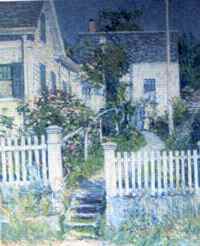 Washington County Museum of Fine
Arts in Hagerstown from March 5 through May 2, 2004. Drawn from the Museum's
Permanent Collection, the show will include portraits, landscapes and marine
scenes. Artists Thomas Moran, Frederic E. Church, Harriet Cany Peale, Thomas
Sully and Alfred Bricher will be represented. (right: F. Childe Hassam,
White House, Gloucester)
Washington County Museum of Fine
Arts in Hagerstown from March 5 through May 2, 2004. Drawn from the Museum's
Permanent Collection, the show will include portraits, landscapes and marine
scenes. Artists Thomas Moran, Frederic E. Church, Harriet Cany Peale, Thomas
Sully and Alfred Bricher will be represented. (right: F. Childe Hassam,
White House, Gloucester)
Stunning landscapes including several works from renowned
Hudson River School artists will be on view including, Encampment in
the Redwoods, by Jules Tavernier, on loan from a private collector,
Scene on Catskill Creek, 1847, by Frederic E. Church and A
Mountain Pool, 1863 by John Kensett. Other beautiful landscape
vistas will include Childe Hassam's impressionistic canvas White
House, Gloucester, given to the Museum by its founders, Mr. and Mrs.
William Henry Singer, Jr. of Olden, Norway and Songo River, Maine, an
1865 oil by James Fairman donated by Dr. Richard D. Robbins of Baltimore,
Maryland in memory of Mrs. Betty Sumner Michael.
Hassam was born in Dorchester, Massachusetts, the son of
a wealthy Boston merchant. His formal art training began in Boston under
Ignaz Marcel Gaugengigl. After working as a wood engraver and illustrator,
he continued his studies at the 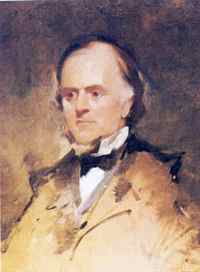 Academie
Julian in Paris under Boulanger and Lefebvre. During his stay in France,
Hassam fell under the unfluence of the Impressionists. Upon returning from
Europe in 1889, Hassam settled in New York and continued to work both as
a painter and an illustrator, doing most of his work in the New England
area. He became a member of the National Academy of Design in 1902 and was
elected to the American Academy of Arts and Letters in 1920. Hassam was
a founding member of "The Ten," a group of Boston and New York
painters who rebelled against the prevailing art and promoted their Impressionistic
works, giving birth to the American Impressionism Movement. (left:
Thomas Sully, Portrait of Daniel Webster)
Academie
Julian in Paris under Boulanger and Lefebvre. During his stay in France,
Hassam fell under the unfluence of the Impressionists. Upon returning from
Europe in 1889, Hassam settled in New York and continued to work both as
a painter and an illustrator, doing most of his work in the New England
area. He became a member of the National Academy of Design in 1902 and was
elected to the American Academy of Arts and Letters in 1920. Hassam was
a founding member of "The Ten," a group of Boston and New York
painters who rebelled against the prevailing art and promoted their Impressionistic
works, giving birth to the American Impressionism Movement. (left:
Thomas Sully, Portrait of Daniel Webster)
Tumultuous waves, rocky coastlines, raging seas and battered
ships will be seen in works such as Puritan & Priscilla by James
Buttersworth, a gift of Mr. Sidney A. Levyne of Pikesville, Maryland, The
U. S. Monitor Weehawken in a Gale off the Coast of Virginia, by James
Hamilton and Early Morning Effects, 1889 by Alfred Bricher.
Born near Belfast, Ireland, Hamilton emigrated to America
when he was 15 years old, settling in Philadelphia. In 1839, he set up his
studio as a landscape and seascape artist and a teacher of drawing. The
young artist began to exhibit his work about 1840, first in Philadelphia
and ultimately in Washington, D.C., Baltimore, Boston and New York. Hamilton
became known for the 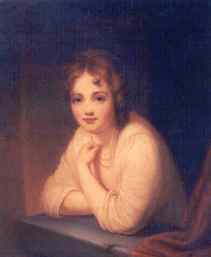 extraordinary
imaginativeness that he brought to American marine painting. He was capable
of painting both identifiable coastal scenes and highly inventive visions.
Hamilton's loose accents of light and his silvery colors became his special
style, one appreciated by two of his pupils, the highly regarded marine
painters, Thomas and Edward Moran.
extraordinary
imaginativeness that he brought to American marine painting. He was capable
of painting both identifiable coastal scenes and highly inventive visions.
Hamilton's loose accents of light and his silvery colors became his special
style, one appreciated by two of his pupils, the highly regarded marine
painters, Thomas and Edward Moran.
Portraits included in the exhibition will feature Woman
at the Window by Harriet Cany Peale, a gift of the William Eliason Pennington
Art Fund, Charles Loring Elliott's Portrait of Henry Van Schaick,
Portrait of Ada by Robert Bogle, donated by Mr. and Mrs. George M.
Durrett of Owings Mills, Maryland, Edmund Pendleton, 1844 by Philadelphia
artist Samuel Waugh, a gift of the Philip A. Rauth Memorial Fund and Portrait
of Daniel Webster by Thomas Sully, donated by Mr. and Mrs. Louis E.
Shecter of Baltimore, Maryland. (right: Harriett Cany Peale, Woman
at the Window)
Sully was born in Horncastle, Lincolnshire, England and
emigrated with his family to Charleston, South Carolina in 1792. His first
art teacher was his brother Lawrence, and later, he studied in London under
Gilbert Stuart and Benjamin West. In 1801, Sully launched himself in an
art career in Virginia, painting 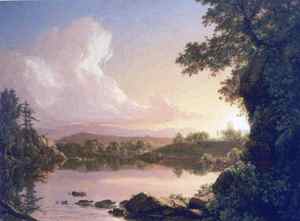 portraits
in both Norfolk and Richmond. Four years later, he married his brother's
widow and the couple moved to New York City, then to New England. By 1808,
Sully returned to Philadelphia where he soon became the leading portrait
painter in that city. In order to fulfill his commissions, he traveled to
the major cities of the East Coast. The artist died in Philadelphia having
painted more than 2,600 portraits. Six of his children also became artists.
(left: Frederic E. Church, Scene on Catskill Creek)
portraits
in both Norfolk and Richmond. Four years later, he married his brother's
widow and the couple moved to New York City, then to New England. By 1808,
Sully returned to Philadelphia where he soon became the leading portrait
painter in that city. In order to fulfill his commissions, he traveled to
the major cities of the East Coast. The artist died in Philadelphia having
painted more than 2,600 portraits. Six of his children also became artists.
(left: Frederic E. Church, Scene on Catskill Creek)
Read more articles and essays concerning this institutional
source by visiting the sub-index page for the Washington
County Museum of Fine Arts in Resource
Library Magazine.
Visit the Table
of Contents for Resource Library Magazine for
thousands of articles and essays on American art, calendars, and much more.
Copyright 2003, 2004 Traditional Fine Arts
Organization, Inc., an Arizona nonprofit corporation. All rights reserved.ed.