Editor's note: The Muscatine Art Center provided
source material to Resource Library Magazine for the following article
or essay. If you have questions or comments regarding the source material,
please contact the Muscatine Art Center directly through either this phone
number or web address:
Allan Houser: Water
March 21 - May 24, 2004
- Rarely is there an artist who defies all categories
of culture, medium and style. Too often we typecast artists into groupings
that provide an easy handle by which we carry their identity, often missing
out on the complexity of their work. To place Allan Houser in a simple
category is an error in judgment. The only good qualifying descriptive
adjective for him is a great artist.
-
- David Turner, Director, Colorado Springs Fine
Arts Center
-
The great-grandson
of the legendary chief Mangas 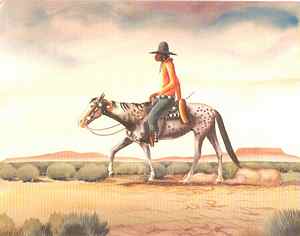 Coloradas
and great-nephew of Geronimo, Houser was raised on his family's Oklahoma
farm and from his earliest years loved to sketch and draw. His first formal
art education took place between 1934 and 1938 with Dorothy Dunn at the
Painting Studio of the Santa Fe Indian School. It was here that Houser began
to depict his cherished Apache tradition in his own way. (right:
Allan Houser, 1914-1994, Untitled)
Coloradas
and great-nephew of Geronimo, Houser was raised on his family's Oklahoma
farm and from his earliest years loved to sketch and draw. His first formal
art education took place between 1934 and 1938 with Dorothy Dunn at the
Painting Studio of the Santa Fe Indian School. It was here that Houser began
to depict his cherished Apache tradition in his own way. (right:
Allan Houser, 1914-1994, Untitled)
During the many years he taught art -- in Utah and at the
Institute of American Indian Arts in Santa Fe, New Mexico -- Houser encouraged
his students to find and express their own identity and voice. Many artists
have emulated his style over the years, but the sculptor's greatest joy
was in seeing young artists work from deep within themselves.
In 1949 Houser received a Guggenheim Fellowship in painting
and sculpture which allowed him to set up a studio on his family's Oklahoma
farm. From 1962 to 1975 he taught at the Institute of American Indian Arts,
where he also 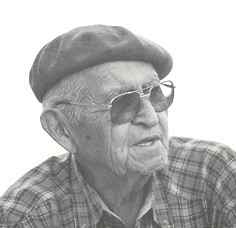 served as chairman
of the sculpture department. When he retired in 1975 it was to devote his
time to his own art. (left: Allan Houser, 1914-1994)
served as chairman
of the sculpture department. When he retired in 1975 it was to devote his
time to his own art. (left: Allan Houser, 1914-1994)
The exhibition Water represents only one facet of
the artistic legacy of Allan Houser. His career is remarkable in the range
of artistic mediums he was able to master. This collection of forty-six
watercolors and seven bronzes represents an archive of more than ten thousand
pieces of art created by the artist during his lifetime. This work is now
housed in the Allan Houser Archives and maintained by the Allan Houser Foundation,
who is circulating this exhibition. These watercolors demonstrate Allan
Houser's proficiency with the medium as well as his profound connection
with his environment. The scenes reflect the landscape of the southwest
and the culture of its people. They were painted between 1960 and 1975 on
trips with students as well as at his studio in Santa Fe. In this collection
one can clearly see how Houser's two-dimensional work served as a catalyst
for his sculptural creations.
Visitors to the Muscatine Art Center may also view the
Allan Houser sculpture "Prayer of Peace" given by Mr. and Mrs.
Stanley M. Howe in 1987 in honor of C. Maxwell Stanley, in the Art Center's
courtyard. (right: Allan Houser, 1914-1994, Untitled)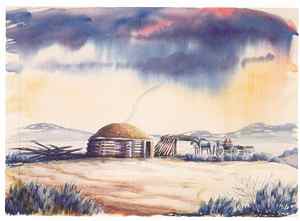
Editor's note: RLM readers may also enjoy these earlier articles:
Read more articles and essays concerning this source by
visiting the sub-index page for the Muscatine
Art Center in Resource Library
Magazine.
Visit the Table
of Contents for Resource Library Magazine for
thousands of articles and essays on American art, calendars, and much more.
Copyright 2003, 2004 Traditional Fine Arts Organization, Inc., an Arizona nonprofit corporation. All rights
reserved.