Editor's note: The Portland
Museum of Art provided source material to Resource
Library Magazine for the following article or essay. If you have questions
or comments regarding the source material, please contact the Portland Museum
of Art directly through either this phone number or web address:
Calico & Chintz: Early
American Quilts from the Smithsonian American Art Museum
Calico & Chintz:
Early American Quilts from the Smithsonian American Art Museum will be on view at the 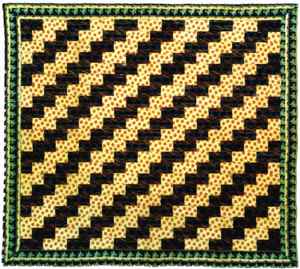 Portland
Museum of Art from April 8, 2004 through June 6, 2004. The exhibition features
22 rare pieced and whole-cloth American quilts made before 1850, selected
from the collection donated to the Smithsonian in 1999 by Patricia Smith
Melton, a Washington playwright and quilt historian. These heirloom
quilts, dating from about 1810 to 1850, preserve a notable era in textile
and quiltmaking artistry. Before the United States developed a textile industry
in the 1840s, colonists and citizens imported quality printed cottons from
Britain or France. These fabrics were used by affluent quiltmakers along
the Eastern Seaboard and on Southern plantations for the sumptuous bedcovers
that were an important decorative element in prosperous homes. (right:
Unknown Maker, "Pieced Quilt (Bricks)," circa 1835, Maryland,
calico and "fondu" printed cotton (quilted in diagonal crosshatch
with border in chevrons), 93 3/4 x 83 1/4 inches. Smithsonian American Art
Museum, Gift of Patricia Smith Melton, 1998.149.21.)
Portland
Museum of Art from April 8, 2004 through June 6, 2004. The exhibition features
22 rare pieced and whole-cloth American quilts made before 1850, selected
from the collection donated to the Smithsonian in 1999 by Patricia Smith
Melton, a Washington playwright and quilt historian. These heirloom
quilts, dating from about 1810 to 1850, preserve a notable era in textile
and quiltmaking artistry. Before the United States developed a textile industry
in the 1840s, colonists and citizens imported quality printed cottons from
Britain or France. These fabrics were used by affluent quiltmakers along
the Eastern Seaboard and on Southern plantations for the sumptuous bedcovers
that were an important decorative element in prosperous homes. (right:
Unknown Maker, "Pieced Quilt (Bricks)," circa 1835, Maryland,
calico and "fondu" printed cotton (quilted in diagonal crosshatch
with border in chevrons), 93 3/4 x 83 1/4 inches. Smithsonian American Art
Museum, Gift of Patricia Smith Melton, 1998.149.21.)
"These rare and beautiful quilts will come as a revelation
to all quilt lovers," said Kenneth Trapp, curator-in-charge of the
Smithsonian American Art Museum's Renwick Gallery. "The pre-1850s textiles
demonstrate this earlier society's embrace of vivid color, rich pattern,
and exuberant beauty."
The cotton fabric used in these early American quilts incorporated
vegetable and mineral colors -- chemical aniline dyes did not arrive until
the 1850s -- and represented high standards of woodblock, copperplate, and
roller printing. The term "calico" comes from Calicut, a port
on the Malabar Coast of India where European traders in the 17th century
bought the colorful cottons that revolutionized Western taste in textiles.
"Chintz" is derived from "chints," a phonetic transliteration
of the Hindi word meaning variegated. While the terms calico and chintz
were used interchangeably to describe colorful cottons, calico properly
describes unglazed fabric printed with repeat patterns of small floral or
abstract shapes. Chintz refers to fine glazed cotton printed with prominent
flowers, birds, and other representational motifs. The exhibition also includes
fragments of the kinds of imported period textiles used to construct the
quilts in the collection.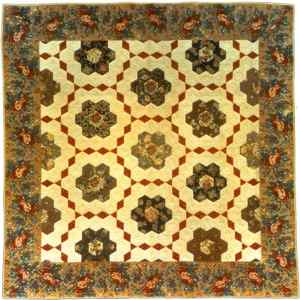
Some of the quilts in this exhibition are the most intricate
and complex of their kind. Pieced Bedcover (Honeycomb), about 1825,
is composed of template-formed hexagons -- each measuring only 5/8 inch
-- for a total of 442 rosettes of colorful cotton. Others are quite bold
and expressionistic, including Pieced Quilt (Nine Patch on Point),
about 1845. This New York quilt would have been appropriate with the interior
decor of a middle-class bedroom of the early 1840s. (right:
Unknown Maker, New England, "Pieced Quilt (Honeycomb)," ca.
1830, Chintzes, calicoes, and white cotton; quilted in concentric hexagons
and diagonal lines, 58 x 57 inches. Collection of the Smithsonian American
Art Museum. Gift of Patricia Smith Melton.)
The textile fragment, English Pillar Print Chintz,
about 1825-1835, demonstrates a design that was extremely popular in the
United States. Pillar prints depicted classical columns garlanded with ribbons,
birds, or wicker fruit baskets. This design was often used on America's
highest quality quilts as borders, as long stripes in bar-patterned designs,
and as tops for whole-cloth bedcovers.
Patricia Smith Melton has collected American pre-1850 hole-cloth,
pieced, and appliquéd bedcovers for more than 20 years. She built
the collection with the intent to have it viewed in its entirety as an educational
experience and has taught classes on the history of quilts and quilt textiles. 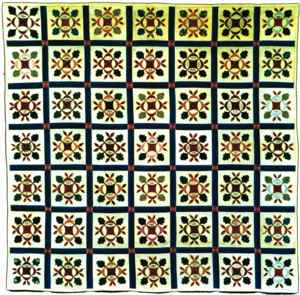
A catalogue accompanies the exhibition, with an essay by
Jeremy Adamson, chief of the Prints and Photographs Division at the Library
of Congress. The catalogue will be available in the Museum Shop.
The Calico & Chintz exhibition itinerary is
as follows: The Speed Art Museum, Louisville, Kentucky (December 16, 2003-March
14, 2004); Portland Museum of Art, Portland, Maine (April 8, 2004-June 7,
2004); The Hermitage: Home of the President Andrew Jackson, Nashville, Tennessee
(June 26, 2004-August 29, 2004); Butler Institute of American Art, Youngstown,
Ohio (September 19, 2004-November 21, 2004). (right: Unknown
Maker, "Pieced and Appliqued Friendship Quilt Top (Hickory Leaf Variation),"
1843-45, New England, calicoes, white cotton, and moire-printed furnishing
fabric (unquilted), 86 3/4 x 87 1/2 inches. Smithsonian American Art Museum,
Gift of Patricia Smith Melton, 1998.149.29.)
Calico & Chintz: Early American Quilts from the Smithsonian
American Art Museum is one of five exhibitions featuring the Museum's collections,
touring the nation through 2005. The tour is supported in part by
the Smithsonian Special Exhibitions Fund.
RELATED QUILT EXHIBITS
- Another Layer: Selected Maine Art Quilts, April 8, 2004 through June 6, 2004
-
- This spring, when the main exhibition galleries are hung
with early 19th-century quilts from the Smithsonian American Art Museum,
the Museum's Great Hall will feature their contemporary counterparts in
works by quilt artists currently living and working in Maine. In recent
years, quiltmaking has transcended its historical role and traditional
methods to become a vocation and a primary artistic medium for many artists
in this state. Another Layer celebrates Maine's vibrant community
of quilt artists with works by eight members of Maine Fiberarts, an arts
service organization formed to promote the enjoyment and quality of Maine
fiber work. The exhibition features the work of Kimberly Becker, Elizabeth
Busch, Mary Allen Chaisson, Jo Diggs, Gayle Fraas and Duncan Slade, Natatsha
Kempers-Cullen, Stephanie Green Levy, and Phyllis Harper Loney.
-
- Another Layer is a collaborative
effort among the Portland Museum of Art, Maine Fiberarts, and June Fitzpatrick
Gallery. It is presented in conjunction with Maine Fiberarts's statewide
initiative, The State of Fiber 2004: Exhibits & Events Celebrating
Maine Fiber. This exciting, year-long celebration of the fiber arts
in Maine will be kicked off with a keynote lecture by nationally known
writer and art critic Polly Ullrich at the Portland Museum of Art on April
23 at 8:30 p.m. For more information about this event or about The State
of Fiber 2004, please contact Maine Fiberarts at (207) 721-0678, or
visit them on the internet at www.mainefiberarts.org.
QUILT LECTURES
- Lecture: Polly Ullrich, Friday, April 23 at 8:30 p.m.,
Museum Auditorium
-
- The Maine Fiberarts' statewide initiative, The
State of Fiber 2004: Exhibits & Events Celebrating Maine Fiber,
an exciting, year-long celebration of the fiber arts in Maine, will kicked
off with a keynote lecture by nationally known writer and art critic Polly
Ullrich. For more information about this event or about The State of
Fiber 2004, please contact Maine Fiberarts at (207) 721-0678, or visit
them at www.mainefiberarts.org.
-
- Lecture: Betsey Telford, Saturday, April 24 at 1 p.m.,
Museum Auditorium
-
- Historic quilt specialist Betsey Telford will speak about
some of the more extraordinary quilts in her extensive collection. Owner
of Rocky Mountain Quilts in York, Maine, Telford will explain how she is
able to date a quilt and what elements to look for in hunting for antique
quilts. As a result of her extensive knowledge, Telford has been featured
on the Discovery Channel, and in Country Living, Early American
Homes, the Boston Globe, Quilt Mania of France, and New
England Antiques Journal. This special event is co-sponsored by the
Friends of the Collection at the Portland Museum of Art. Visitors are encouraged
to bring a quilt for Telford to examine, however, advance reservations
are required. Please call (207) 775-6148 ext. 3227 to purchase tickets.
Editor's note: RLM readers may also enjoy these earlier articles:
Read more articles and essays concerning this institutional
source by visiting the sub-index page for the Portland
Museum of Art in Resource Library
Magazine
Visit the Table
of Contents for Resource Library Magazine for
thousands of articles and essays on American art, calendars, and much more.
Copyright 2003, 2004 Traditional Fine Arts Organization, Inc., an Arizona nonprofit corporation. All rights
reserved.