Editor's note: The following source material was provided by The Holter Museum of Art. The essay is reprinted with permission of the Museum. If you have questions or comments regarding the essay or article, please contact The Holter Museum of Art directly through either this phone number or web address:
Peter Koch: Nature/Morte
March 12 June 13, 2004
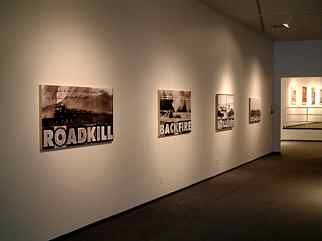
(above: Peter Koch; Installation Photo (Raodkill, Backfire, Still Life, Crowbait) digital iris print; 2004, Collection of the Holter Museum of Art, Museum Purchase)
This exhibition comes
in the midst of the Bicentennial of Lewis and Clark's epic voyage through
Montana. It is 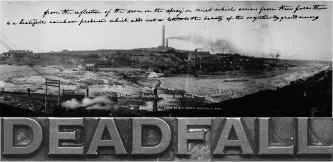 part of a larger multi-organization
arts initiative titled "Echoes of Discovery", whose goal is to
celebrate contemporary voices along the Lewis and Clark Trail. Helena, in
proximity to the Missouri River and the Gates of the Mountain Wilderness
Area, is an important stopping point along the trail. Nature/Morte
consists of eleven large-scale, panoramic digital pigment prints that excerpts
and phrases from the journals of Lewis and Clark to contrast images taken
from trade cards, historical photographs, postcards and tourism promotional
materials. The result is work that has an historic foundation, but is more
concerned with questions about the nature of interpretation, exploration,
national history, and the implications of nationalism. (right: Peter
Koch, Peter Koch; Deadfall; digital iris print; 2004, Collection
of the Holter Museum of Art, Museum Purchase)
part of a larger multi-organization
arts initiative titled "Echoes of Discovery", whose goal is to
celebrate contemporary voices along the Lewis and Clark Trail. Helena, in
proximity to the Missouri River and the Gates of the Mountain Wilderness
Area, is an important stopping point along the trail. Nature/Morte
consists of eleven large-scale, panoramic digital pigment prints that excerpts
and phrases from the journals of Lewis and Clark to contrast images taken
from trade cards, historical photographs, postcards and tourism promotional
materials. The result is work that has an historic foundation, but is more
concerned with questions about the nature of interpretation, exploration,
national history, and the implications of nationalism. (right: Peter
Koch, Peter Koch; Deadfall; digital iris print; 2004, Collection
of the Holter Museum of Art, Museum Purchase)
Peter Koch's family roots are in Bozeman, Montana, but
he now resides in Berkeley, California, where he is 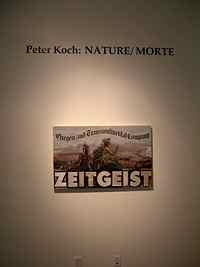 noteworthy
in the distinguished tradition of fine printmaking and typesetting. Stepping
outside the world of books and letterpress printing, Koch once again joins
fellow Montanan Griff Williams of Urban Digital Design, San Francisco, to
focus on newer technology and the process of digital iris printing for this
exhibition. Peter is active in Bay Area literary circles, producing a distinctive
library of limited editions with his small press. (left: Peter Koch;
Zeitgeist; digital iris print; 2004, Collection of the Holter Museum
of Art, Museum Purchase)
noteworthy
in the distinguished tradition of fine printmaking and typesetting. Stepping
outside the world of books and letterpress printing, Koch once again joins
fellow Montanan Griff Williams of Urban Digital Design, San Francisco, to
focus on newer technology and the process of digital iris printing for this
exhibition. Peter is active in Bay Area literary circles, producing a distinctive
library of limited editions with his small press. (left: Peter Koch;
Zeitgeist; digital iris print; 2004, Collection of the Holter Museum
of Art, Museum Purchase)
Dead Nature
by Rick Newby
" . . . the fear of death from civilization": A profound melancholy pervades the images in Nature Morte, master letterpress printer Peter Koch's second foray into the realm of the digital Iris print-and a profoundly bitter irony arises from the juxtaposition of these images with the blocky words with which Koch chooses to caption them (and even more so, with the forward-looking, grandiloquently expansionist entries from the journals of Lewis and Clark that float across the picture plane).
With these somber works, Peter Koch gives us an irreverent antidote to the boosterism-and even sheer silliness-that has surrounded much of the celebratory afflatus that has thus far surfaced on the occasion of the two-hundredth anniversary of the grand expedition to open the American West.
As scion of a prominent Montana pioneering family, Koch
brings an insider's perspective to his critique of Westward Expansion, and
as a literary outlaw, he offers a decidedly postmodern take on issues of
colonialism, environmental degradation, and racism. Quoting Kafka, Koch
asks, "If the [text] we are reading doesn't wake us up with a blow
on the head, what are we reading it for?"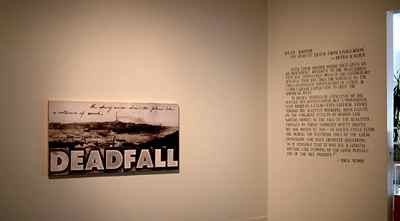
Nature Morte partakes of a tradition in Montana arts that critic Ken Egan, Jr., characterizes as producing "visions of cataclysm," narratives that recount "promising beginnings and disastrous endings." Many of these works, Egan argues in his study, Hope and Dread in Montana Literature, leave us feeling helpless in the face of historical forces beyond our control. This strain of nostalgic catastrophism has long been a powerful theme for Montana's visual artists, from George Catlin's early lament that the region's native peoples were "fast travelling to the shades of their fathers," to Charlie Russell's fury over "trails plowed under," to photographer L. A. Huffman's urgent effort to capture "This Last West" before it vanished irrevocably. (right: Peter Koch; Installation Photo (Deadfall); digital iris print; 2004, Collection of the Holter Museum of Art, Museum Purchase)
In Peter Koch's "visions of cataclysm," we are offered something quite different, not hopelessness, but a provisional hope based on a clear-eyed critical stance toward the accepted wisdoms. Koch insists-and I think rightly-on the purgative effects of works like the somberly witty prints in Nature Morte. Like an "axe for the frozen sea inside us" (again quoting Kafka), these heartrending (and angry) images ask us to ponder the nature of our beautiful but threatened place in this world. Like Koch's uncle, Elers, we are driven to ask the most difficult questions: "Is it possible that it was all a ghastly mistake, like plowing up the good buffalo sod of the dry prairies?"
About the author
Rick Newby is an independent scholar and cultural journalist who has written extensively about the arts and culture of the American West, as well as having edited several works, including most recently The New Montana Story (Riverbend Publishing and Bedrock Editions, 2003). His articles have appeared in American Craft; American Ceramics; Sculpture; Ceramics: Art and Perception; and High Ground, as well as in publications by the Holter Museum of Art and the Archie Bray Foundation. He is the co-author of A Ceramic Continuum: Fifty Years of the Archie Bray Influence (University of Washington Press, 2001) and of The Most Difficult Journey: The Poindexter Collections of American Modernist Paintings (Yellowstone Art Museum, 2002).
He was trained as a poet under Richard Hugo and John Haines, and is the author of three collections of poetry, A Radiant Map of the World, winner of the Montana Arts Council's First Book Award for 1981, and Old Friends Walking in the Mountains (Bedrock Editions, 1994) and, The Suburb of Long Suffering, (Bedrock Editions, 2002).
Currently, Rick manages his own communications firm, Zadig,
LLC (www.zadig-llc.com). He resides in Helena, Montana.
Read more articles and essays concerning this institutional source by visiting the sub-index page for the Holter Museum of Art in Resource Library Magazine
Visit the Table of Contents for Resource Library Magazine for thousands of articles and essays on American art, calendars, and much more.
Copyright 2003, 2004 Traditional Fine Arts Organization, Inc., an Arizona nonprofit corporation. All rights reserved.