Editor's note: The Museum of Art and History, Santa
Cruz provided source material to Resource Library Magazine for the
following article or essay. If you have questions or comments regarding
the source material, please contact the Museum of Art and History, Santa
Cruz directly through either this phone number or web address:
Another Side of Ansel Adams:
Santa Cruz and Beyond
Another Side of
Ansel Adams: Santa Cruz and Beyond commemorates
twenty years since the passing of one of 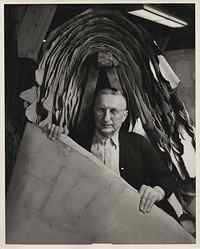 America's
most revered artists. Just as, without seeing it from several different
aspects, an appreciation of the enormity and grandeur of an American icon
such as Half Dome in Yosemite is a daunting task, any familiarity with an
artist as legendary as Ansel Adams requires more than one vantage point.
His audiences have learned much about him through his landscape photography
and his consistent work as an advocate for America's parklands. This exhibition
adds to our understanding of the man and of his art by illuminating,
in six sections that weave in and out of his life, unexpected views for
us to enjoy. (right: Ansel Adams, Joe Bellas, Factory Manager
of Salz, 1955. Black and white photograph. Collection of The Museum
of Art & History, gift of the Lezin Family, 2001.H.28.37.)
America's
most revered artists. Just as, without seeing it from several different
aspects, an appreciation of the enormity and grandeur of an American icon
such as Half Dome in Yosemite is a daunting task, any familiarity with an
artist as legendary as Ansel Adams requires more than one vantage point.
His audiences have learned much about him through his landscape photography
and his consistent work as an advocate for America's parklands. This exhibition
adds to our understanding of the man and of his art by illuminating,
in six sections that weave in and out of his life, unexpected views for
us to enjoy. (right: Ansel Adams, Joe Bellas, Factory Manager
of Salz, 1955. Black and white photograph. Collection of The Museum
of Art & History, gift of the Lezin Family, 2001.H.28.37.)
Beginning with a selected timeline of his life (1902-1984),
the exhibition continues with an expanded discussion of two commercial projects,
one very early-1930 -- and one in the middle of his career -- 1955; a portrait
grouping of six Californian artists who were also his great friends: Dorothea
Lange, Maynard Dixon, Imogen Cunningham, Beniamino (Benny) Bufano,
Robert Boardman Howard, and Edward Weston; an example of his superb craftsmanship
in the darkroom in reprinting photographs that Arnold Genthe (1869-1942)
took in 1906; and a tribute to Adams's enduring influence on other photographers
as a teacher, mentor, and colleague.
Like so many artists, Adams punctuated his long career
with numerous commercial projects, notwithstanding his mixed feelings about
the use of photography for promotion and advertising. In 1933 he wrote to
Alfred Steiglitz, 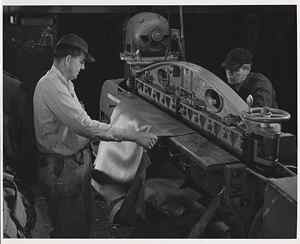 "The high
priest of commercialism bellows from the tower of necessity the call to
prayer, the faithful bend and sprawl and grovel at the ghost of the Almighty
$ -- rents have to be paid, food bills have to be paid, shoe-shines and
clean shirts have to be bought, -- so that the smirk of ideals compensating
with existence is given a proper setting." Caught between his creative,
independent spirit and his pragmatic, responsible personality, Adams used
commissions to perfect his technique and bring the eye of the discerning
artist to the task of commercial promotion. Many of those assignments were
so supremely elegant and original that they transcend any expectations of
merely "grinding out the goods." (right: Ansel
Adams, Bob Laverty and Bernard 'Red' McCafferty, splitting leather down
to the specified thickness, 1955. Black and white photograph. Collection
of The Museum of Art & History, gift of the Lezin Family, 2001.H.28.36.)
"The high
priest of commercialism bellows from the tower of necessity the call to
prayer, the faithful bend and sprawl and grovel at the ghost of the Almighty
$ -- rents have to be paid, food bills have to be paid, shoe-shines and
clean shirts have to be bought, -- so that the smirk of ideals compensating
with existence is given a proper setting." Caught between his creative,
independent spirit and his pragmatic, responsible personality, Adams used
commissions to perfect his technique and bring the eye of the discerning
artist to the task of commercial promotion. Many of those assignments were
so supremely elegant and original that they transcend any expectations of
merely "grinding out the goods." (right: Ansel
Adams, Bob Laverty and Bernard 'Red' McCafferty, splitting leather down
to the specified thickness, 1955. Black and white photograph. Collection
of The Museum of Art & History, gift of the Lezin Family, 2001.H.28.36.)
Over the span of his many years, while working continuously
with Eastman-Kodak, he produced projects for corporations, businesses, and
institutions such as Pacific Gas & Electric, the M. H. deYoung Memorial
Museum, Gump's, the St. Francis Hotel, American Telephone & Telegraph,
Hills Brothers Coffee, Del Monte Forest, Dominican College, Union Carbide,
Southern Pacific Railway, and Yosemite Park and Curry Company. Notable among
those assignments were two architectural subjects he documented here in
northern California: the Allied Arts Guild in Menlo Park and the Salz Tannery
in Santa Cruz.
The number of people that Adams, a gregarious man, called
friends was large and he enjoyed collaborating with them. He befriended
Garfield and Delight Merner through his early association with the Sierra
Club and his deep admiration for their mutual friend, Francis Farqhuar,
an officer of the club. The Merners designed and developed an innovative complex
consisting solely of studios for artisans, choosing for it a Spanish style
that appealed to Adams's new-found enchantment with the terrain and architecture
of the Southwest. In 1930, collaborating with the writer Mary Austin, Adams
had published Taos Pueblo, an artistically significant book of words
and photographs set in 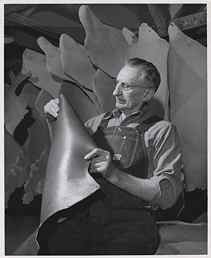 New Mexico.
There, also in 1930, he met the photographer Paul Strand, whose images had
irrevocably changed Adams's photographic style. Moving away from the pictorial
style he had favored in the 1920s, he turned to what he called "straight
photography." Adams wanted the final print to give the impression of
a direct image, with no evidence of having been manipulated in the camera
or in the darkroom.He was soon to become straight photography's most articulate
and insistent champion. It was also at this juncture, in the beginning of
a new decade, that Adams decided to forego a musical career as a pianist
and concentrate on photography. The Merners' Allied Arts project, coming
on the heels of his work in the Southwest, allowed Adams to photograph a
California architectural gem and to work with his ever-widening circle of
friends. It also provided income for the growing Adams family and helped
him finance the construction of a new home and commercial studio next door
to his parents' residence in West Clay Park, San Francisco. (right:
Ansel Adams, Joe Bellas, examining a piece of Calif. Saddle Leather,
1955. Black and white photograph. Collection of The Museum of Art &
History, gift of the Lezin Family, 2001.H.28.40.)
New Mexico.
There, also in 1930, he met the photographer Paul Strand, whose images had
irrevocably changed Adams's photographic style. Moving away from the pictorial
style he had favored in the 1920s, he turned to what he called "straight
photography." Adams wanted the final print to give the impression of
a direct image, with no evidence of having been manipulated in the camera
or in the darkroom.He was soon to become straight photography's most articulate
and insistent champion. It was also at this juncture, in the beginning of
a new decade, that Adams decided to forego a musical career as a pianist
and concentrate on photography. The Merners' Allied Arts project, coming
on the heels of his work in the Southwest, allowed Adams to photograph a
California architectural gem and to work with his ever-widening circle of
friends. It also provided income for the growing Adams family and helped
him finance the construction of a new home and commercial studio next door
to his parents' residence in West Clay Park, San Francisco. (right:
Ansel Adams, Joe Bellas, examining a piece of Calif. Saddle Leather,
1955. Black and white photograph. Collection of The Museum of Art &
History, gift of the Lezin Family, 2001.H.28.40.)
The second project highlighted in this exhibition is the
Salz Tannery commission. Recently, the Museum of Art and History received
a large collection of photographs donated, along with a number of historical
artifacts, by the Lezin family. Adams knew Ansley Salz and Santa Cruz well.
He and his family spent many of their vacations at the summer home of his
father's attorney on the banks of the San Lorenzo River in the Santa Cruz
Mountains. Salz, a long-time friend who lived in San Francisco, had, like
Adams, a deep love of music. Through this mutual interest and their shared
 connections in San Francisco,
the friendship grew. Salz introduced Adams to Norman Lezin, Salz's son-in-law
and then President of the Tannery. It was Lezin's prescient decision to
hire the artist to document the buildings, the process, and the workmen
on River Street in 1955. This section of the exhibition includes a timeline
and history of the tannery to give context to the photographs and a description
of the future plans for the site.
connections in San Francisco,
the friendship grew. Salz introduced Adams to Norman Lezin, Salz's son-in-law
and then President of the Tannery. It was Lezin's prescient decision to
hire the artist to document the buildings, the process, and the workmen
on River Street in 1955. This section of the exhibition includes a timeline
and history of the tannery to give context to the photographs and a description
of the future plans for the site.
Renowned for his camerawork, Adams's mastery in the darkroom
likewise set high standards. Evidence of his expertise lies in the printing
of the amazing photographs that Arnold Genthe made of the San Francisco
earthquake in 1906. Using Genthe's glass negatives, Adams carefully developed
the prints for the fifty-year commemorative exhibition at the M. H. deYoung
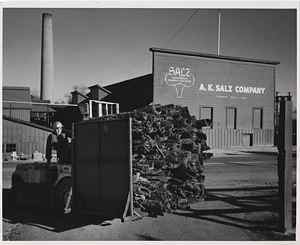
Memorial Museum in San Francisco in 1956. (right: Ansel
Adams, Marion Brown delivering a load of tan bark from the sheds across
from the tannery, 1955. Black and white photograph. Collection of The
Museum of Art & History, gift of the Lezin Family, 2001.H.28.44.)
The mark made by an innovative and interested teacher resonates
throughout a student's life and the last section in 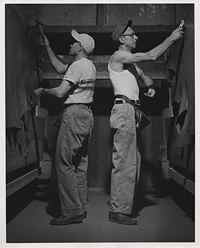 the
exhibition reminds us of the enduring significance of this great artist.
"No man," said Bertrand Russell, "can be a good teacher unless
he has feelings of warm affection toward his pupils and a genuine desire
to impart to them what he himself believes to be of value." Adams dedicated
his life to photography, so it followed that he believed wholeheartedly
in the power of the photographic image. This section includes photographs
by his fellow artists and written sketches of their memories. Not only did
he instruct those of us in the twentieth century to look with fresh eyes
and open hearts upon a relatively new art form, but also he presented, in
the twenty-first century, an example of inspired and steadfast vision that
continues to impress our contemporary lives. (right: Ansel
Adams, John Bei and Dick Stubendorff, removing leather from the drying
loft boards, 1955. Black and white photograph. Collection of The Museum
of Art & History, gift of the Lezin Family, 2001.H.28.48.)
the
exhibition reminds us of the enduring significance of this great artist.
"No man," said Bertrand Russell, "can be a good teacher unless
he has feelings of warm affection toward his pupils and a genuine desire
to impart to them what he himself believes to be of value." Adams dedicated
his life to photography, so it followed that he believed wholeheartedly
in the power of the photographic image. This section includes photographs
by his fellow artists and written sketches of their memories. Not only did
he instruct those of us in the twentieth century to look with fresh eyes
and open hearts upon a relatively new art form, but also he presented, in
the twenty-first century, an example of inspired and steadfast vision that
continues to impress our contemporary lives. (right: Ansel
Adams, John Bei and Dick Stubendorff, removing leather from the drying
loft boards, 1955. Black and white photograph. Collection of The Museum
of Art & History, gift of the Lezin Family, 2001.H.28.48.)
- Kathleen Moodie, Director of Exhibitions
Editor's note: RLM readers may also enjoy these earlier articles
and essays:
Also see more articles on American photography:
Read more articles and essays concerning this institutional
source by visiting the sub-index page for the Museum
of Art and History, Santa Cruz in Resource
Library Magazine.
Visit the Table
of Contents for Resource Library Magazine for
thousands of articles and essays on American art, calendars, and much more.
Copyright 2003, 2004 Traditional Fine Arts Organization, Inc., an Arizona nonprofit corporation. All rights
reserved.