Editor's note: The Portland Museum of Art provided source material to Resource Library Magazine for the following article or essay. If you have questions or comments regarding the source material, please contact the Portland Museum of Art directly through either this phone number or web address:
Monet to Matisse, Homer to Hartley: American Masters and their European Muses
June 24 - October 17, 2004
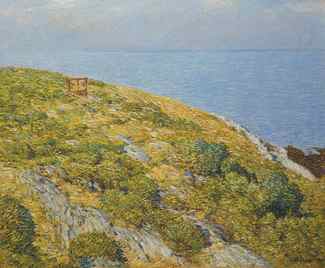
(above: Frederick Childe Hassam (United States, 1859-1935), "Isles of Shoals," 1915, oil on canvas, 25 x 30 inches. Portland Museum of Art, Maine, Bequest of Elizabeth B. Noyce,1996.38.19. Photo by Melville D. McLean.)
Monet to Matisse,
Homer to Hartley: American Masters and their European Muses explores the rich relationship between European and American artists
between the years of 1870 and 1950. The eighty-year period broadly coincides
with the rise of modernist art, starting with French Realism and Impressionism
and continuing through the advent of a truly international art culture.
The exhibition will run at the Portland Museum of Art (Maine) from June
24 through October 17, 2004, and will include approximately 80 painting
and works on paper. The exhibition will be accompanied by an amply illustrated
catalogue, with essays by Richard R. 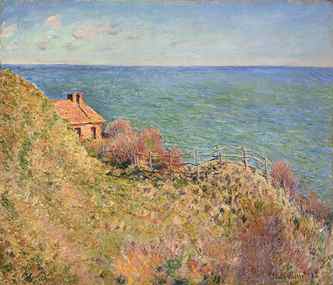 Brettell,
Professor of Aesthetic Studies at the University of Texas at Dallas and
Adjunct Senior Curator at The Meadows Museum; Donna Cassidy, Director of
American and New England Studies at the University of Southern Maine; Anne
Dawson, Associate Professor of Art History at Eastern Connecticut State
University; Martica Sawin, critic, curator, and art historian; and Carrie
Haslett, Joan Whitney Payson Curator at the PMA. Each essayist focuses on
a unique moment in the history of exchange between European and American
artists. (right: Claude Monet (France, 1840-1926), "[Le] Cabane
des douaniers (The Customs House)," 1882, oil on canvas, 23 5/8 x 27
7/8 inches. Private collection, courtesy of Christie's.)
Brettell,
Professor of Aesthetic Studies at the University of Texas at Dallas and
Adjunct Senior Curator at The Meadows Museum; Donna Cassidy, Director of
American and New England Studies at the University of Southern Maine; Anne
Dawson, Associate Professor of Art History at Eastern Connecticut State
University; Martica Sawin, critic, curator, and art historian; and Carrie
Haslett, Joan Whitney Payson Curator at the PMA. Each essayist focuses on
a unique moment in the history of exchange between European and American
artists. (right: Claude Monet (France, 1840-1926), "[Le] Cabane
des douaniers (The Customs House)," 1882, oil on canvas, 23 5/8 x 27
7/8 inches. Private collection, courtesy of Christie's.)
Countless American artists during this era were influenced in innumerable ways by European artists and their work. Rather than attempting to be comprehensive, the exhibition aims to provide a gateway, using carefully chosen pairings and descriptive labels, for better understanding various aspects of the European/American dialogue -- including identifying certain aesthetic ideals and practices that were exchanged, the means of transmission (exhibitions, publications, art classes, etc.), and how American artists adapted what they saw or read to fit their unique goals. It is hoped that collectively these pairings and texts will provide viewers an opportunity to enrich their appreciation of works from both sides of the Atlantic.
The earliest works in the exhibition date to the late 1860s
and 1870s and acknowledge the influence of the 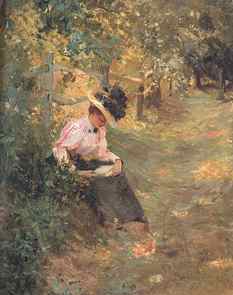 French
Barbizon School, as well as a realist style of painting taught at the Munich
Academy, adopted by Americans traveling to Europe to study and by those
who saw such works exhibited in the United States. The legacy of French
Impressionism on American art was profound, varied, and long lasting, and
works by Monet, Renoir, and Caillebotte for instance, are paired with examples
by Theodore Robinson, William Glackens, and Childe Hassam to allow for expanded
discussion. Post-Impressionist works by Cézanne, Degas, and Toulouse-Lautrec
will provide opportunities to consider these artists' significant legacy
in the work of such American artists as Mary Cassatt, Marsden Hartley, John
Marin, and Walt Kuhn. Still other Americans working in the late 19th century
-- like John Singer Sargent, Thomas Eakins, and Edwin Lord Weeks -- studied
in French Academics or ateliers and were influenced by their approach for
at least part of their careers. One of the key pairings of the exhibition
will be Eakins' Swimming (Amon Carter Museum) and Frédéric
Bazille's Summer Scene (Fogg Art Museum, Harvard University). (right:
Theodore Robinson (United States, 1852-1896), "The Lane," circa
1893, oil on canvas, 27 3/16 x 22 1/16 inches. High Museum of Art, Atlanta,
Georgia. Gift of Miss Mary E. Haverty for the J. J. Haverty Collection,
65.47.)
French
Barbizon School, as well as a realist style of painting taught at the Munich
Academy, adopted by Americans traveling to Europe to study and by those
who saw such works exhibited in the United States. The legacy of French
Impressionism on American art was profound, varied, and long lasting, and
works by Monet, Renoir, and Caillebotte for instance, are paired with examples
by Theodore Robinson, William Glackens, and Childe Hassam to allow for expanded
discussion. Post-Impressionist works by Cézanne, Degas, and Toulouse-Lautrec
will provide opportunities to consider these artists' significant legacy
in the work of such American artists as Mary Cassatt, Marsden Hartley, John
Marin, and Walt Kuhn. Still other Americans working in the late 19th century
-- like John Singer Sargent, Thomas Eakins, and Edwin Lord Weeks -- studied
in French Academics or ateliers and were influenced by their approach for
at least part of their careers. One of the key pairings of the exhibition
will be Eakins' Swimming (Amon Carter Museum) and Frédéric
Bazille's Summer Scene (Fogg Art Museum, Harvard University). (right:
Theodore Robinson (United States, 1852-1896), "The Lane," circa
1893, oil on canvas, 27 3/16 x 22 1/16 inches. High Museum of Art, Atlanta,
Georgia. Gift of Miss Mary E. Haverty for the J. J. Haverty Collection,
65.47.)
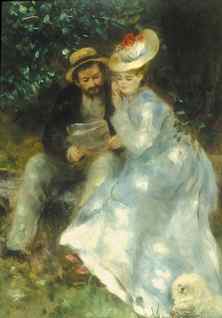
Exhibitions at Alfred Stieglitz's '291' Gallery in New York City and the landmark Armory Show of 1913 introduced many Americans to Europe's most radical artistic developments, though a large number of American artists had already encountered these new styles when visiting Europe. Pairings of works by Francis Picabia and Joseph Stella, Pablo Picasso and William Zorach, Fernand Léger and Stuart Davis, and Henri Matisse and Milton Avery, for instance, speak to the relationship of some of Europe and America's most important 20th-century artists. Later in the century the influx of European emigrées into America, especially beginning in the 1930s, reinforced the emergence of Surrealism in America, and works by Magritte, Dali, Miró, and de Chirico will be paired with examples by Jared French, James Guy, Alexander Calder, and George Ault. (below: Pierre-Auguste Renoir (France, 1841-1919), "Confidences," circa 1873, oil on canvas, 32 x 23 3/4 inches. The Joan Whitney Payson Collection at the Portland Museum of Art, Maine, Gift of John Whitney Payson, 1991.62. Photo by Bernard C. Meyers.)
Read more articles and essays concerning this institutional source by visiting the sub-index page for the Portland Museum of Art in Resource Library Magazine
Visit the Table of Contents for Resource Library Magazine for thousands of articles and essays on American art, calendars, and much more.
Copyright 2003, 2004 Traditional Fine Arts Organization, Inc., an Arizona nonprofit corporation. All rights reserved.