Editor's note: The Tucson Museum of Art provided source material to Resource Library Magazine for the following article or essay. If you have questions or comments regarding the source material, please contact the Tucson Museum of Artdirectly through either this phone number or web address:
Serenading the Light: Painters of the Desert Southwest at the Tucson Museum of Art
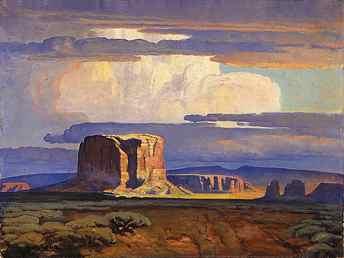
(above: Carl Redin, Enchanted Mesa)
Serenading the
Light: Painters of the Desert Southwest opened
at the Tucson Museum of Art May 8, 2004, 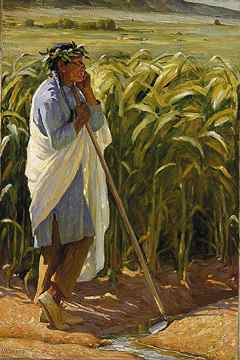 featuring
paintings from the southwest created between 1913-1952. This exemplary collection
is on loan by William Schenck, a renowned contemporary Southwest artist.
(right: Joseph Sharp, Indian Irrigating His Corn)
featuring
paintings from the southwest created between 1913-1952. This exemplary collection
is on loan by William Schenck, a renowned contemporary Southwest artist.
(right: Joseph Sharp, Indian Irrigating His Corn)
The Schenck collection boasts examples of extraordinary etchings and aquatints and there is no absence of thickly painted, full-blown, magnificent western landscapes-landscapes with stately trees, wine-colored mountains, enchanted mesas, and blue skies full of clouds trailing off into the interminable distance of the horizon so very far away.
Enchanted mesas are the exact subject Clyde Forsythe examines and then re-examines in his two oil paintings of that title. In Carl Redin's Enchanted Mesa, Gerard Delano's Navajo Desert Sheep and Maynard Dixon's Last Gleam the sky is so large and the landscape so vast that you can feel the weather changing. Will Shuster caught with paint and canvas just that in Rain on the Mountain.
Charlotte Berney writes in Cowboys & Indians Magazine:
Many of the artists found in the Schenck collection can also be found in the impressive Santa Fe Railway collection. Much like their East Coast counterparts of the Ash Can school, many of the Taos painters used bold brush strokes of sumptuous paint, capturing light and shadow in broad gestures. It goes along to say many of the early Taos painters were from the New York scene and some, like E. I. Couse, traveled back and forth.
Serenading the Light will continue, housed in the Goodman Pavilion of Western Art, through August 23, 2004. "Serenading the Light Painters of the Desert Southwest,",authored by art historian David Clemmer, will be available in the Museum Shop during the exhibition. This beautiful publication is a survey of early twentieth-century artists who painted the Southwest desert.
Serenading the Light is organized by the Hearst Art Gallery at Saint Mary's College, Moraga, CA. with the seven museum tour developed by Smith Kramer fine Arts Services, Kansas City, MO. This exhibition is supported by Friends of Western Art, Harvey and Rica Spivack and the generous bequest of Mary E. Henderson.
Editor's note: For Southwest art history and Western art, enjoy articles and essays inluding American Impressionism Goes West, an essay by Charles C. Eldredge; Remington: The Color of Night; Women Artist Pioneers of New Mexico, an article by Dottie Indyke; A Century of Western Art; Southwestern Colonial Art, an essay by Robert William Brown; The Pictoral Record of the Old West: the Beginning of the Taos School of Art, an essay by Robert Taft; Painters in Taos, New Mexico Prior to 1940; Taos Society of Artists, an article by Sarah Beserra; "New Deal" Art in New Mexico, an article by Kathryn Flynn; How the Santa Fe Art Colony Began, an article by Suzanne Deats; CCA: Cowboy Artists of America; Grand Canyon Painters and Their Earliest Patron, The Santa Fe Railroad; Introduction from "Celebrating America: Masterworks from Texas Collections", an essay by Jane Myers and Barbara McCandless and Art of the American West, an essay by Peter MacMIllan Booth.
RLM readers may also enjoy:
Please Note: TFAOI and RLM do
not endorse sites behind external links.
Read more articles and essays concerning this institutional source by visiting the sub-index page for the Tucson Museum of Art in Resource Library Magazine
Visit the Table of Contents for Resource Library Magazine for thousands of articles and essays on American art, calendars, and much more.
Copyright 2003, 2004 Traditional Fine Arts Organization, Inc., an Arizona nonprofit corporation. All rights reserved.