Editor's note: The National Cowboy & Western Heritage Museum provided source material to Resource Library Magazine for the following article or essay. If you have questions or comments regarding the source material, please contact the National Cowboy & Western Heritage Museum directly through either this phone number or web address:
Beneath A Turquoise Sky: Navajo Painters and Their World
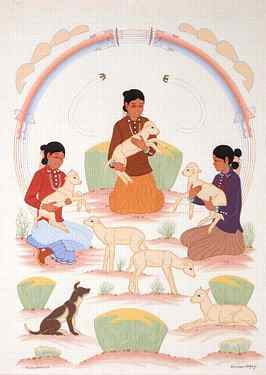
(above: Harrison Begay (born 1917), Navajo Maidens, c. 1970, 14 x 10 inches, Arthur and Shifra Silberman Collection, No. 1996.27.0206, National Cowboy and Western Heritage Museum, Oklahoma City.)
The National Cowboy
& Western Heritage Museum®
in Oklahoma City will feature Navajo painters in a special 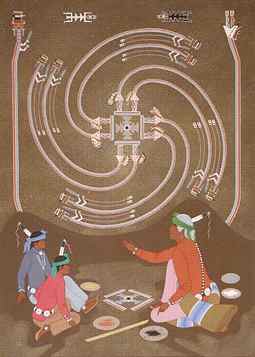 exhibition, Beneath A Turquoise Sky: Navajo Painters
and Their World. The exhibition is scheduled to open June 25, 2004,
and remain open until January 30, 2005. (right: Harrison Begay (born
1917), Painting Sandpainting, c. 1971, 21-3/4 x 15-1/2 inches, Arthur
and Shifra Silberman Collection, No. 1996.27.0209, National Cowboy and Western
Heritage Museum, Oklahoma City.)
exhibition, Beneath A Turquoise Sky: Navajo Painters
and Their World. The exhibition is scheduled to open June 25, 2004,
and remain open until January 30, 2005. (right: Harrison Begay (born
1917), Painting Sandpainting, c. 1971, 21-3/4 x 15-1/2 inches, Arthur
and Shifra Silberman Collection, No. 1996.27.0209, National Cowboy and Western
Heritage Museum, Oklahoma City.)
Drawing from the Museum's expansive Arthur and Shifra Silberman Collection, Steve Grafe, Curator of Native American Collections selected 40 items to showcase how some 20th-century Navajo painters portrayed their world. Included in the exhibit are works by Harrison Begay Gerald Nailor, Quincy Tahoma and Andrew Van Tsihnahjinnie who received their initial training in the Santa Fe Indian School's painting studio of the 1930s and 1940s. These four artists are reported to have painted and sold more pictures than all of the other Studio alumni combined. The works in the exhibit date from the 1930s through the 1970s.
One of the major milestones in 20th-century American Indian art was the 1932 founding of the painting studio at the Santa Fe Indian School. Not only did the appearance of the Santa Fe Studio represent a break with the prior governmental policy of encouraging Indians to abandon their culture, it actually provided art instruction to a number of individuals whose work defined public perceptions of Native American art during much of the last century and influenced two succeeding generations of Native artists. The Studio provided a training ground for approximately 30 significant painters from a dozen tribes. Of this number, seven were Navajo.
The Santa Fe Indian School was initially founded to help
Native young people learn marketable skills and the 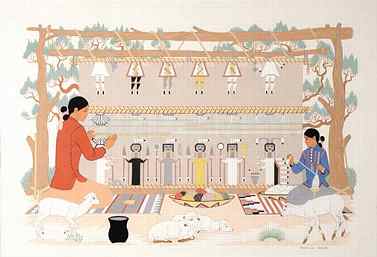 advent
of art classes furthered the school's mission. Santa Fe had become an art
center with the coming of the railroad to the Southwest and Native American
art accounted for a fair portion of arts-related revenue. As one congressman
aptly noted, "Who wants to go West to buy a picture painted by an Indian
of three apples on a plate!" (left: Harrison Begay (born 1917),
The Weavers, c. 1952, 14-3/4 x 21-1/4 inches, Arthur and Shifra Silberman
Collection, No. 1996.27.0219, National Cowboy and Western Heritage Museum,
Oklahoma City.)
advent
of art classes furthered the school's mission. Santa Fe had become an art
center with the coming of the railroad to the Southwest and Native American
art accounted for a fair portion of arts-related revenue. As one congressman
aptly noted, "Who wants to go West to buy a picture painted by an Indian
of three apples on a plate!" (left: Harrison Begay (born 1917),
The Weavers, c. 1952, 14-3/4 x 21-1/4 inches, Arthur and Shifra Silberman
Collection, No. 1996.27.0219, National Cowboy and Western Heritage Museum,
Oklahoma City.)
The Studio fostered new public appreciation of American
Indian painting by encouraging students to produce work that replicated
traditional forms and appearances, while maintaining tribal and individual
distinction. The school's curriculum sought to "evolve new motifs,
styles, and techniques in character with the old" and the existing
Navajo tradition allowed for the appropriation of sandpainting designs.
According to Studio teacher Dorothy Dunn, "The sandpainting holds in
its richly productive systems of design and abstract symbolism potentials
for far greater contributions to modern Navajo art than have usually been
recognized." Artists Gerald Nailor and Harrison Begay were particularly
adept at placing isolated sandpainting motifs in their otherwise representational
compositions and these elements are now 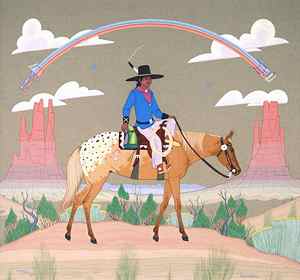 synonymous
with Navajo Studio-style art. (right: Harrison Begay (born 1917),
Navajo Looking for Lost Horses, no date, 16 x 17 inches, Arthur
and Shifra Silberman Collection, No. 1996.27.0197, National Cowboy and Western
Heritage Museum, Oklahoma City.)
synonymous
with Navajo Studio-style art. (right: Harrison Begay (born 1917),
Navajo Looking for Lost Horses, no date, 16 x 17 inches, Arthur
and Shifra Silberman Collection, No. 1996.27.0197, National Cowboy and Western
Heritage Museum, Oklahoma City.)
In their works, Navajo painters drew on visual richness of their own land and people. The vastness of their reservation allowed them a sense of expansive autonomy. Their paints show the remote landscape and private moments of Navajo life and include singers, dancers, shepherds, and horsemen and women.
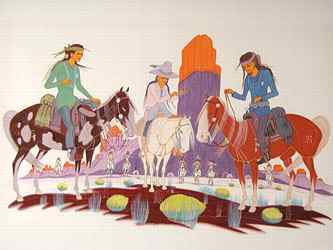
(above Andrew Van Tsihnahjinnie (1918-2000), Untitled, no date, 21 x 28 inches, Arthur and Shifra Silberman Collection, No. 1996.27.1296, National Cowboy and Western Heritage Museum, Oklahoma City.)
Please Note: Traditional Fine Arts Organization, Inc and RLM do not endorse sites behind external links. We offer them for your additional research; external links were chosen on the basis of being the most informative online source at the time of our search.
Read more articles and essays concerning this institutional source by visiting the sub-index page for the National Cowboy & Western Heritage Museum in Resource Library Magazine.
Visit the Table of Contents for Resource Library Magazine for thousands of articles and essays on American art, calendars, and much more.
Copyright 2003, 2004 Traditional Fine Arts Organization, Inc., an Arizona nonprofit corporation. All rights reserved.