Editor's note: The Columbus Museum of Art provided
source material to Resource Library Magazine for the following article
or essay. If you have questions or comments regarding the source material,
please contact the Columbus Museum of Art directly through either this phone
number or web address:
Jacob Lawrence: The Migration
Series from the Phillips Collection
June 14 - August 31, 2004
AN AMERICAN EPIC IN PATTERNS AND COLORS
By Mark Cole, Columbus Museum of Art Curator of American
Art
An American epic told through vivid patterns and colors,
Jacob Lawrence: The Migration Series from the Phillips Collection
is on view at the Columbus Museum of Art June 14 through August 31, 2004.
One of the great 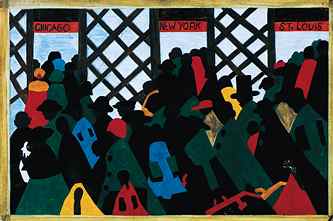 storytellers
of his generation, Jacob Lawrence developed a highly distinctive style to
bring to life important historical events. His powerful narrative of the
Great Migration unfurls over thirty panels chronicling the struggle, strength,
and perseverance of African Americans in search of a better life in the
North. The powerful Migration Series ranks as one of the great visual
and social documents of twentieth-century American art. (right: Jacob
Lawrence, The Migration of the Negro (panel No.1), 1940-41, casein,
tempera on hardboard, 12 x 18 inches, Acquired 1942, The Phillips Collection,
Washington, D.C. © Gwendolyn Knight Lawrence, courtesy of the Jacob
and Gwendolyn Lawrence Foundation.)
storytellers
of his generation, Jacob Lawrence developed a highly distinctive style to
bring to life important historical events. His powerful narrative of the
Great Migration unfurls over thirty panels chronicling the struggle, strength,
and perseverance of African Americans in search of a better life in the
North. The powerful Migration Series ranks as one of the great visual
and social documents of twentieth-century American art. (right: Jacob
Lawrence, The Migration of the Negro (panel No.1), 1940-41, casein,
tempera on hardboard, 12 x 18 inches, Acquired 1942, The Phillips Collection,
Washington, D.C. © Gwendolyn Knight Lawrence, courtesy of the Jacob
and Gwendolyn Lawrence Foundation.)
Lawrence was born in Atlantic City, New Jersey in 1917.
His move to Harlem in 1930 proved central to his artistic maturation. Raised
among the emerging African American writers, artists, and musicians, who
were a manifestation of the Harlem Renaissance, Lawrence was the first major
painter trained in and by the African American community.
Inspired by the expressive power of abstraction while also
sensitive to the struggle and hardships of the people in his community,
Lawrence defined a new mode of modern art, distilling subject matter based
on the experience of life around him into bright colors and elemental shapes.
Lawrence also painted what he learned from Harlem 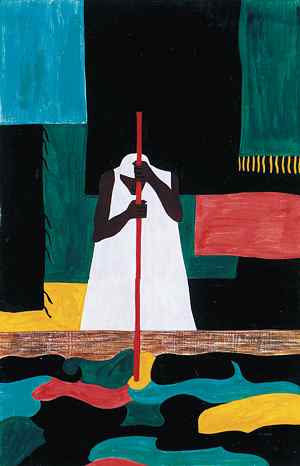 storytellers,
and by the age of 21 had chronicled the lives of Toussaint L'Ouverture,
Frederick Douglas, and Harriet Tubman.
storytellers,
and by the age of 21 had chronicled the lives of Toussaint L'Ouverture,
Frederick Douglas, and Harriet Tubman.
In 1941, Lawrence burst onto the national scene with The
Migration Series which was exhibited at the prestigious Downtown Gallery
in New York City. Soon after, two major museums-The Phillips Collection,
and the Museum of Modern Art, New York-each purchased half of the series.
At twenty-four, Lawrence became one of the first African Americans to receive
acclaim in the ostensibly segregated art world of the 1940s.
Lawrence's The Migration Series Panel no. 1 portrays
a crowd of travelers lugging their belongings through in a train station,
moving together in one direction amidst a backdrop of gates announcing the
cities of "Chicago," "New York" and "St. Louis."
In The Migration Series Panel no. 57, Lawrence renders a woman hard
at work over her wash tub, laboring to raise money to move north. The bold
colors and expressive forms in these panels convey with stark poignancy
the aspirations, determination, and dedication of individuals and families
striving for a better existence. Lawrence's distinctive combination of abstraction
and socially relevant subject matter along with his vivid palette and patterns
make him a quintessential American modern artist. (right: Jacob Lawrence,
The Migration of the Negro (panel No.49), 1940-41, casein tempera
on hardboard, 18 x 12 inches, Acquired 1942, The Phillips Collection, Washington,
D.C. © Gwendolyn Knight Lawrence, courtesy of the Jacob and Gwendolyn
Lawrence Foundation.)
Editor's note: RLM readers may also enjoy:
There are 137 articles in RLM citing Jacob Lawrence:
Read more articles and essays concerning this institutional
source by visiting the sub-index page for the Columbus
Museum of Art in Resource Library
Magazine
Visit the Table
of Contents for Resource Library Magazine for
thousands of articles and essays on American art, calendars, and much more.
Copyright 2003, 2004 Traditional Fine Arts Organization, Inc., an Arizona nonprofit corporation. All rights
reserved.