Editor's note: The National Academy Museum and
School of Fine Arts provided source material to Resource Library Magazine
for the following article or essay. If you have questions or comments
regarding the source material, please contact the The National Academy Museum
and School of Fine Arts directly through either this phone number or web
address:
Into the Storm: Expressions
in the American Landscape, 18001940
July 2 - October 10, 2004
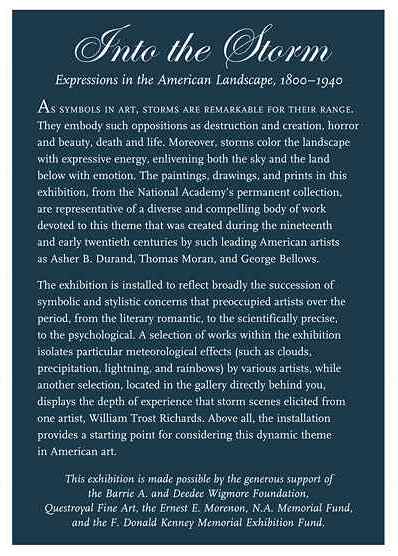
Into the Storm:
Expressions in the American Landscape, 1800-1940
consists of approximately 70 paintings, drawings and prints, including a
special selection of works by William Trost Richards, and examines artists'
fascination with the storm. It was at this time that Thomas Cole, Jasper
Cropsey, Albert Bierstadt, George Bellows and many others began using this
motif as a symbolic and stylistic tool. Cole referred to the sky as "the
soul of all scenery," and these artists' interpretations of clouds,
wind, rain, and lightning, were full of national, spiritual and personal
meaning.
Storms offered almost limitless possibilities for expressiveness,
filling landscapes with romantic and emotive qualities. The ever-changing
nature of storms made them difficult to depict with accuracy, and the paintings'
contrast of tightly rendered landscapes with dramatic, gestural skies, offered
the artists an opportunity to showcase their range.
Symbolically, for the artists working in the early 19th-century,
storms could signify renewal, destructiveness or the divine. Throughout
the 19th century, storms often served as a symbol of nature's destructive
force against man. In Arthur Quartley's After the Tempest, Morning,
1879 and in The Resounding Sea, 1880 by Thomas Moran, for example,
we are shown man's vulnerability in the face of nature, and the little control
that he often has over his own destiny. In these works, and others of this
period, storms act as an avenging, violent force, destroying the land and
crop that were critical to the survival and prosperity of the nation.
In contrast, John Frederick Kensett's Approaching Storm,
1855 portrays weather as giving and restorative. A figure is pictured
with livestock (a symbol of prosperity), in a bountiful landscape. The
rain, seen in the painting's top right corner, promises continuity of the
cycle of nature. Similarly, the storm is shown as a source of renewal, a
life-giving force, in James David Smillie's engraving, The Voyage of
Life- Childhood, 1855, after Thomas Cole. In this religious allegory,
a child begins his journey down river - a symbol of life. Illuminated by
a heavenly light, he emerges from a womb-like cavern which Cole described
as "emblematic of our earthly origin, and the mysterious past."
The skies above him whirl with the same symbolic chaos of the cavern, but
also contain nurturing, bathing rays of light which reflect the child's
innocence at this stage in his journey.
By the early twentieth century, represented in the exhibition
by George Bellows, Ernest Blumenschein and others, storms were primarily
used as a poetic symbol. Painters used the imagery with awareness of the
visual tradition of their predecessors or as tool to "set the mood"
of a painting or print. The storm was used less specifically in the rendering
of a particular landscape and more as an expressive stroke, leading up to
the abstraction of the mid- twentieth century.
Into the Storm: Expressions in the American Landscape,
1800-1940, explores the stylistic approaches and
symbolism of storms as they evolved over the course of the nineteenth and
early twentieth centuries. Curated by Mark D. Mitchell, Assistant Curator
of Nineteenth-Century Art, this exhibition's rich selection of paintings,
drawings and prints, will provide viewers with insight into one of American
art's most captivating themes.
Into the Storm: Expressions in the American Landscape,
1800-1940, opens July 2 and runs through October
10, 2004.
Wall text from the exhibition:
LITERARY SYMBOLISM
During the early and mid-nineteenth century, American artists such as
Thomas Doughty, Thomas Cole, and Asher B. Durand favored two types of landscapes:
allegorical and realistic. The line between idealization and realism, however,
was often blurred. Storms were among the devices that artists often used
to give moral or emotional meaning to the landscape.
The specific roles that the storm plays within these landscapes are often
clear. In the allegorical mode, the storm may represent death, evil, or
damnation, but could as readily symbolize hope, fertility, or regeneration.
The storm's many potential meanings may account for its popularity during
the period. For realist works of a particular location, allegorical meanings
of the storm often carried over and suggested the landscape's role as sublime
wilderness or earthly paradise in the United States.
The association of landscape elements such as the storm with symbolic
meanings reflected the close relationship of art and literature in America
during the period. Artists, writers, and other intellectuals met regularly
in social clubs and associations. Members of these organizations often tried
their hands at each other's art forms, encouraging the introduction of such
literary metaphors into visual art.
THE ART OF SCIENCE
The scientific study of weather was relatively new in the nineteenth
century, largely the domain of amateurs well into the 1830s. Throughout
mid-century, however, debate about the causes and nature of storms, in particular,
attracted intense interest in both Europe and America, culminating in a
longstanding scientific feud between competing theoreticians that became
known as the "storm controversy." The first national weather bureau,
however, was not created until 1870.
Although the science of weather was itself young, the devastating effects
of storms on communities, crops, and shipping attracted considerable attention.
Interest in the subject among artists, in particular, was also widespread
during the mid-nineteenth century. Artists, like their scientist peers,
made extensive and detailed studies of the effects of weather on the landscape,
participating in the search for a clearer understanding of the complex forces
at work in nature.
THE MIND'S EYE
During the later nineteenth and early twentieth centuries, psychology
became a topic of scientific and popular interest that was reflected in
art. Artistic renderings of storms from the period often resonate with contemporary
psychological investigations. Detailed specificity was steadily replaced
by suggestiveness and broad handling, displacing the clear symbolic meanings
of the earlier nineteenth century with evocations of the subconscious.
The dramatic power of the storm made it an excellent vehicle for the
representation of psychological mood. As artists increasingly valued direct
personal expression, they reversed the direction of art, from depicting
the natural world's impression on the artist, to the artist's impression
on the natural world. The storm itself became a virtual metaphor for artistic
creation.
Seeking more intuitive stylistic approaches, artists often distilled
the storm to its most abstract components: force, mass, and brooding conflict.
Some, like Ernest Blumenschein, also turned to symbolic vocabularies of
form and color that derived from Native American and African cultures in
particular to invest their landscapes with mystery and exoticism.
ASPECTS OF THE STORM
Storms have many faces that render each unique. The following works have
been selected for their emphasis upon one or more particular elements that
constitute the storm, including wind, precipitation, clouds, lightning,
and powerful waves. Collectively, they portray the varied manifestations
of the storm in both nature and the art of the period.
WILLIAM TROST RICHARDS, 18331905
Honorary Member 1862; NA 1871
A storm reportedly changed William Trost Richards' life. In December
1867, the artist was returning to the United States from an extended trip
to Europe when his ship was nearly destroyed by a powerful winter gale.
Three days after the steamer was forced out to sea to ride out the storm,
it limped into New York harbor severely damaged and out of coal. Awed by
his experience, Richards thereafter made coastal storms one of his primary
subjects until his death nearly four decades later.
Richards established his artistic reputation during the 1850s as a follower
of the principles expounded by the influential British critic John Ruskin
to record meticulously every detail in nature. Trained as a designer of
ornamental metalwork, Richards was accustomed to such detailed work and
careful draftsmanship. Over the course of his career, his interest in luminosity
and spontaneity as championed by the impressionists during the 1870s and
1880s and the psychological romanticism that prevailed at the turn of the
century influenced his depictions of the storm. Though an imitator of neither
style, Richards incorporated aspects of each, as the works in this installation
will show.
The National Academy Museum has a rich and deep collection of Richards'
works in large part because of a generous bequest from the artist's daughter,
Anna Richards Brewster (Mrs. William T. Brewster), in 1952.
Image labels from the exhibition:
- The Voyage of Life
-
- Thomas Cole's popular series, The Voyage of Life (183940),
was made available and affordable by the publication of a set of engravings
by James David Smillie. Two of the prints are shown here as representatives
of the contrasting symbolism of the storm as creative and destructive within
a single series.
-
-
- James David Smillie (18331909)
- ANA 1865; NA 1876
- After Thomas Cole, 18011848
- Founder NA 1826
-
- The Voyage of Life-Childhood, 1855
- Engraving on wove paper
-
- Childhood, the first scene in Cole's series, shows an infant
with his guardian angel emerging from a cavern, beginning the child's journey
down the allegorical river of time. The storm swirling overhead represents
the creative chaos from which life is born. Visually, the storm is associated
with the cavern below, which the artist described as "emblematic of
our earthly origin, and the mysterious past."
-
-
- James David Smillie (18331909)
- ANA 1865; NA 1876
- After Thomas Cole, 18011848
- Founder NA 1826
-
- The Voyage of Life-Manhood, 1855
- Engraving on wove paper
-
- The storm in Manhood symbolically portrays the dangers and temptations
that life presents. The mature voyager has left his guardian angel behind,
but now rediscovers his faith in the presence of mortal peril. In his accompanying
text for the series, Cole identified the demons circling in the clouds
overhead as "Suicide, Intemperance and Murder."
-
-
-
- Thomas Doughty (17931856)
- Honorary 1827
-
- Landscape
- Oil on canvas
- Gift of James D. Smillie, 1909
-
- Thomas Doughty's reverence for nature was idealized, distilled from
personal experience. His Landscape is a poetic invocation of beauty
and harmony, with the storm as a reminder of man's small scale in the presence
of nature.
-
-
-
- Thomas Cole (18011848)
- Founder NA 1826
-
- Seascape with a Waterspout, 1836
- Oil on wood panel
- Collection of Henry and Sharon Martin
-
- Thomas Cole wrote that the sky is "the soul of all scenery, in
it are the fountains of light, and shade, and color. Whatever expression
the sky takes, the features of the landscape are affected in unison, whether
it be the serenity of the summer's blue, or the dark tumult of the storm."
-
- Cole himself was a critical figure in the emerging tradition of American
landscape painting during the early nineteenth century. This work, one
of a set of four panels commissioned by patron Luman Reed that depict the
elements of nature, is believed to represent the element of water. The
painting also serves as a reminder of the storm's lethal power, both in
the surging water in relation to a tiny ship in the distance and in the
shattered mast in the foreground.
-
-
-
- Asher Brown Durand (17961886)
- Founder NA 1826; President NA 184561
-
- Landscape, 1850
- Oil on canvas
- Bequest of James A. Suydam, 1865
-
- Asher B. Durand was among the most influential American artists of
the mid-nineteenth century, leading to his election as president of the
National Academy for sixteen consecutive years (184661). He wrote
that sunshine is "the joyous expression of Nature," adding "the
best time to observe the ordinary effect of sunshine on the landscape,
is to watch the gradual clearing up of a cloudy day, when its presence
is first announced by occasional patches of light." The artists who
converse in the foreground are not working, perhaps because they are waiting
for the remnants of stormy gray cumulus clouds in the distance to pass.
-
-
-
- Aaron Draper Shattuck (18321928)
- ANA 1858; NA 1861
-
- The Ford, 1856
- Oil on canvas
- Bequest of James A. Suydam, 1865
-
- This peaceful rendering of a coming rain offers one of the most harmonious
scenes in the exhibition. Shattuck's idyllic landscape provides a reassuring
vision of the natural world, balancing sun and clouds, sky and earth.
-
-
-
- John Frederick Kensett (18161872)
- ANA 1848; NA 1849
-
- Approaching Storm
- Oil on canvas
- Gift of Samuel P. Avery, 1875
-
- One of the leaders of the Hudson River School, John Frederick Kensett
painted very few storm scenes, generally preferring bright, light-filled
scenes of atmosphere to the high drama of storm scenes. In Approaching
Storm, he navigated between the two, offering a peaceful scene of a
herdsman tending his cattle, undisturbed by the rain and encroaching shadows.
-
-
-
- Jasper Francis Cropsey (18231900)
- ANA 1844; NA 1851
-
- Coast Scene, 1855
- Oil on canvas
- Bequest of James A. Suydam, 1865
-
- The expressive intensity of Cropsey's Coast Scene, in its composition,
palette, and handling, honors the romantic tradition in American landscape
painting as articulated by Thomas Cole earlier in the century. In the same
year that he painted this work, Cropsey also published his essay "Up
Among the Clouds," in which he wrote that, "in its grandest moods,"
the storm cloud is "more impressive than all the other cloud regions-awakening
the deepest emotions of gloom, dread, and fear; or sending thrilling sensations
of joy and gladness through our being." The looming clouds, sharp
rocks, and prevailing darkness of Coast Scene favor the former meaning,
even as a ray of white light cascading down through the storm front sustains
a lingering note of hope.
-
-
-
- George Boughton (18331905)
- Honorary 1858; NA 1871
-
- Winter Scene, 1860
- Oil on canvas
- Bequest of James A. Suydam, 1865
-
- George Boughton first achieved recognition as a rising young artist
for a winter landscape that he submitted to the National Academy's annual
exhibition in 1858. That distinction led to a series of landscape commissions,
probably including this painting belonging to the painter and collector
James A. Suydam. These works convey the hardships of winter and anticipate
Boughton's later historical compositions in which he romanticized the lives
and struggles of the Puritans in early New England. In Winter Scene,
the overcast conditions contribute substantially to the feeling of
gloom.
-
-
-
- Albert Bierstadt (18301902)
- Honorary 1858; NA 1860
-
- On the Sweetwater near the Devil's Gate, 185960
- Oil on millboard
- NA diploma presentation, 1860
-
- The awesome power and grandeur of the storm is apparent here in the
ominous shadows and a towering cumulonimbus cloud in the distance. Bierstadt
began the painting in the same year that he visited the West for the first
time, traveling in the company of Frederick W. Lander's official geographic
survey expedition. The artist's attention to meteorological, geological,
and topographical detail in the painting reflects the documentary nature
of their journey.
-
-
-
- Charles Temple Dix (18381873)
- ANA Elect 1861
-
- Marblehead Rocks, 1868
- Oil on canvas
- Gift of William Frederick Havemeyer, 1911
-
- Charles Dix's painting offers a marvelously specific combination of
landscape and credible climatic effects, complete with gathering cumulus
clouds and massing storm surge. Balancing the active clouds and waves with
the rigid rocks, Dix's attentive realism does not detract from the power
of his subject.
-
-
-
- Arthur Quartley (18391886)
- ANA 1879; NA 1886
-
- After the Tempest, Morning, 1879
- Oil on canvas
- Gift of Mrs. Stephen H. Brown, 1942
-
- Arthur Quartley's composition addresses the dynamic element of time
in storm depictions. In contrast to the expectancy of the oncoming storm,
as seen in Albert Bierstadt's work on view in this gallery, Quartley's
painting portrays the senses of relief and hope that come in its wake.
-
-
-
- Thomas Moran (18371936)
- ANA 1881; NA 1884
-
- Three Mile Harbor, Long Island, 1884
- Oil on panel
- NA diploma presentation, 1884
-
- Thomas Moran had a particular flair for the dramatic, but he balanced
it with attention to specific detail. Known for his sweeping panoramas
of the American West, during the 1880s he turned to smaller, more intimate
compositions such as this one. Here he accurately represents the billowing
cumulous clouds and beachfront terrain in East Hampton, but nevertheless
conveys an evocative sense of mood.
-
-
-
- Robert Swain Gifford (18401905)
- ANA 1867; NA 1878
-
- Landscape, 1878
- Oil on canvas
- NA diploma presentation, 1878
-
- Swain Gifford, as the artist was known, garnered recognition for his
paintings and prints of stormy coastal regions. The relatively small scale
and broad treatment here reflect the artist's longstanding admiration for
the intimacy and freshness of the French Barbizon artists whose works he
had seen while traveling abroad during the 1870s. As one contemporary wrote,
"Mr. Gifford will paint a barren moor under a leaden sky so that it
shall almost palpitate with emotion."
-
-
-
- Edith Loring Peirce Getchell
- (18551940)
-
- Solitude, ca. 1884
- Etching on wove paper
- Gift of Samuel Colman, 1903
-
- Edith Getchell participated in the American Etching Revival of the
later nineteenth century that drew new and serious attention to the medium.
In the wake of impressionism, etching was particularly valued for its characteristically
soft lines that facilitated atmospheric effects. Getchell's Solitude
is more expressionist than impressionist, however, offering a contrast
of approaches in her depictions of sky and earth. The oppressive, overcast
sky above is rendered almost purely by toning, as opposed to the sharp,
deep lines the constitute the grasses below.
-
-
-
- Albert Pinkham Ryder (18471917)
- ANA 1902; NA 1906
-
- Marine, ca. 1890
- Oil on wood panel
- NA diploma presentation, 1907
-
- This work accentuates expressiveness at the very edge of abstraction.
Albert Pinkham Ryder, one of the late nineteenth century's great romantics,
has here reduced the overcast sky and dark sea to two masses of agitated,
surging color. Without even the customary boat motif as an intermediary,
the painting exposes the viewer directly to the storm's restlessness. Ryder
employed different types of brushstroke, nuanced color within the two larger
areas, and varied texture to suggest depth and turmoil within this seemingly
straightforward composition.
-
-
-
- Frank Knox Morton Rehn
- (18481914)
- ANA 1899; NA 1908
-
- A Passing Shower, 1886
- Charcoal on laid paper
- Gift of Charles Kurtz, 1991
-
- A contemporary of fellow marine painter and romantic Albert Pinkham
Ryder, who worked in a similar style, Frank Rehn shared Ryder's belief
in the expressive potential of the open sea. Like the boat in Thomas Cole's
Voyage of Life (in the entrance of the exhibition), Rehn's
lone vessel struggles through the high seas, evoking the adversity of life.
-
-
- Henry Hobart Nichols (18691962)
- ANA 1912; NA 1920; President NA
- 193949
-
- Snowbound
- Oil on canvas
- NA diploma presentation by exchange, 1942
-
- Hobart Nichols' expressive depiction of a group of buildings closed
in by a winter storm epitomizes a feeling of isolation. The artist wrote
of a similar scene, "Who could have hoped to survive the storms and
rigor of bleak winter in such a location?" In Nichols' scene, the
storm is an aggressor, filling the sky with darkness and offering no reprieve.
-
-
-
- George Wesley Bellows
- (18821925)
- ANA 1909; NA 1913
-
- Three Rollers, 1911
- Oil on canvas
- NA diploma presentation, 1913
-
- George Bellow's Three Rollers explores the limits of realism
in pursuit of expressive power. Best known for his vibrant portrayals of
urban life, particularly boxing and street scenes, the artist here distills
the energy of his urban scenes in natural, tempestuous terms. The painting
depicts the coastline of Maine's Monhegan Island in surging, broad strokes
that convey the mass and motion of his subjects: storm, land, and sea.
The rollers of Bellows' title seem to describe the island's headlands more
than the surf to which the term is normally applied.
-
-
-
- Ernest Blumenschein (18741960)
- ANA 1910; NA 1927
-
- The Lake
- Oil on canvas
- NA diploma presentation, 1927
-
- This vivid depiction of the New Mexican landscape displays the artist's
interests in modernist aesthetics and the symbolism of Pueblo visual culture.
The looming storm front over the mountains is reduced to stylized ovals
of clouds, radiating lightness upward and weighing heavily downward on
the valleys below. The artist's rich palette of the foreground addresses
agricultural bounty in contrast to the powerful force at work in the distance.
Direct in its symbolism, Blumenschein's work adheres perhaps more closely
to an earlier, more literary form of symbolism than to the purely evocative
scenes of his contemporaries.
-
-
-
- Jay Hall Connaway (18931970)
- ANA 1933; NA 1943
-
- A Maine Storm, ca. 1940
- Oil on masonite
- NA diploma presentation, 1946
-
- This powerful depiction of a storm along the coast of Maine demonstrates
the lingering influence into the mid-twentieth century of similar scenes
by Winslow Homer and George Bellows, whose Three Rollers is also
on view in this gallery. Connaway's gestural technique, simplified forms,
and spare palette portray powerful massings of clouds, waves, and rocks.
His art of the period reflects the personal hardships that confronted many
artists during the Depression; when asked in what medium he worked, the
artist replied, "Sweat!" In his marine paintings of storms, Connaway
strove to capture the "everchanging hues of the sky and the sea as
it moves, rolls, thunders, bangs, foams and sprays against craggy rocks."
-
-
-
- Elihu Vedder (18361923)
- ANA 1863; NA 1865
-
- From 30 Drawings of Nile Journey No. 19, 1890
- Crayon, charcoal, and white chalk on wove paper
- Gift of the American Academy of Arts and Letters, 1955
-
- Vedder was an enthusiastic admirer of Egypt's cultural history and
unique landscape. While visiting the country in 1890, he took a boat trip
along the Nile during which he created this drawing, one in a series of
thirty collectively entitled "Up the Nile." The group included
depictions of such sights as the Sphinx, a ruined mosque, a cemetery, and
several tombs. The nuanced, yet colorful overcast sky and deep shadows
of this work, however, suggest the Egyptian landscape's mystery phrased
in meteorological terms alone.
-
-
-