Editor's note: The National Academy Museum and School of Fine Arts provided source material to Resource Library Magazine for the following article or essay. If you have questions or comments regarding the source material, please contact the The National Academy Museum and School of Fine Arts directly through either this phone number or web address:
Contemporary Prints from the collection of the National Academy Museum
July 2 - October 3, 2004
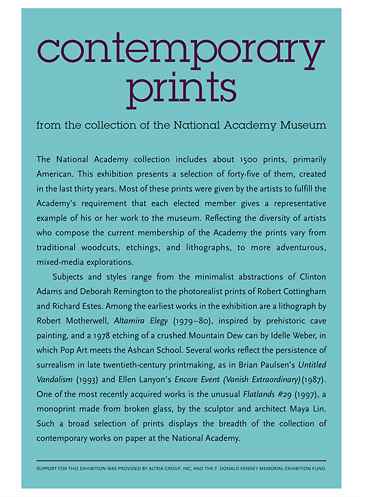
Contemporary Prints from the Collection of the National Academy Museum, which opened July 2, 2004 showcases forty-five of the 1,500 prints in the museum's collection. Focusing on works done in the last thirty years, the exhibition includes Chuck Close, Richard Estes, Robert Cottingham, Jasper Johns, Maya Lin, Robert Motherwell and Idelle Webber, among others. A range of printmaking techniques is represented, from traditional woodcuts, etchings, and lithographs, to more adventurous, mixed-media explorations.
One of the earliest works in the exhibition is Robert Motherwell's Altamira Elegy, 1979-80, a lithograph inspired by the prehistoric cave paintings of Altamira, Spain. The artist explored this subject most famously with his series of large scale paintings, Elegy to the Spanish Republic, which he began in 1948 to commemorate the Spanish Civil War. This lithograph provides a more intimate view of the subject, scaled to 4 3/4 x 10 inches, and printed with two aluminum plates, creating wash effects and intricate passages. The softer, rounded forms evoke the depictions of bison found on the cave walls.
Another abstraction, Clare Romano's depiction of a Vermont waterfall, Big Falls, 1986, utilizes both collagraph and woodcut techniques. The artist, known for her use of mixed media, printed the color patches of this large work (60 x 22 inches) with the collagraph plates, and then the black areas from woodcuts. The varied textures in the resulting piece mimic the currents and flow of the waterfall that inspired it.
Chuck Close and Nathan Oliveira provide examples of figurative works in the show. In Close's Self-portrait, 1988, the spit-bite aquatint technique is masterfully manipulated. This process is particularly effective in producing areas of closely related tones, and lends itself perfectly to this print. The small series of dots combine to produce a realistic, almost photographic image of the artist's face. Close often employs such a device in his paintings as well. Nathan Oliveira adapted the gestural approach of his painting style to the drypoint technique in order to suggest the energy of a Baboon, 1994. Obscured by these gestural lines, a human leg and foot are defined on the right side of the print.
Other highlights of the exhibition include Jasper Johns's color etching Green Angel, Maya Lin's Flatlands #29, a monoprint made from broken glass, and Warrington Colescott's Life and Times of Prof. Dr. S Freud, derived from the aesthetic of the comic book. Surrealism is addressed in the works of Ellen Laynon and Brian Paulsen and Photorealism is represented by works from Richard Estes and Robert Cottingham. Idelle Webber provides a small gem in Mountain Dew, E. 6.78, a 1978 etching in which Pop Art meets the Ashcan School.
The print collection of the National Academy Museum is characterized by the broad variety of both subjects and styles represented. Beginning with 1830's engravings by Asher B. Durand and continuing through to the most recent works by Gregory Amenoff, James Bohary, and others, the Academy has chronicled and preserved the history of American art as represented through printmaking.
Checklist of the exhibition:
Read more articles and essays concerning this institutional source by visiting the sub-index page for the National Academy Museum in Resource Library Magazine
Visit the Table of Contents for Resource Library Magazine for thousands of articles and essays on American art, calendars, and much more.
Copyright 2003, 2004 Traditional Fine Arts Organization, Inc., an Arizona nonprofit corporation. All rights reserved.