Editor's note: The Museum of Northern Arizona provided
source material to Resource Library for the following article or
essay. If you have questions or comments regarding the source material,
please contact the Museum of Northern Arizona directly through either this
phone number or web address:
Arizona: A View from the
Mountains
From the highest mountains
to the most delicate wildflowers, Arizona: A View from the Mountains,
the new 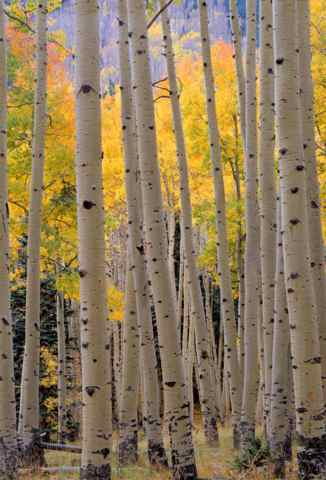 photography exhibit at the
Museum of Northern Arizona, will open visitors' minds and eyes to the rich
diversity of Arizona landscapes. On display from September 4, 2004 - April
17, 2005, it features text and 76 photographs from the recently published
Arizona Highways book by author Rose Houk and photographer Michael
Collier, The Mountains Know Arizona: Images of the Land and Stories of
Its People. (right: Michael Collier, Aspens in Lockett Meadow,
photo copyright Michael Collier)
photography exhibit at the
Museum of Northern Arizona, will open visitors' minds and eyes to the rich
diversity of Arizona landscapes. On display from September 4, 2004 - April
17, 2005, it features text and 76 photographs from the recently published
Arizona Highways book by author Rose Houk and photographer Michael
Collier, The Mountains Know Arizona: Images of the Land and Stories of
Its People. (right: Michael Collier, Aspens in Lockett Meadow,
photo copyright Michael Collier)
Collier's vivid photography tells the stories of ten Arizona
mountain ranges while Houk's writing adds a human element by focusing on
people who live on or study these geologically-rich landscapes. The two
traveled two years and 30,000 miles to compile images and text celebrating
Arizona. They wandered through aspen groves on the San Francisco Peaks,
walked canyons around Navajo Mountain, and explored Mount Trumbull in the
Uinkarets. Now, they want to hear what vsistors have to say.
As a special addition to the show, Collier is including
seven additional images of the San Francisco Peaks. Unlike the book photographs,
these images show human interaction with the Peaks. Exhibit goers are invited
to scribe their thoughts about the mountains in a book at the exhibit. Collier
and Houk will share some of these public thoughts during a slide show and
reading at 4 p.m. Sunday, November 7, 2004.
"We thought it would be nice not only to have people
see lovely images of Arizona, but to elicit responses to the exhibit and
get their thoughts of what the mountains mean to them," says Collier.
"One way to do that is to step out of the "beautiful mountains"
mode. The new pictures show people another reality. It's the reality that
these mountains are not just a beautiful landscape, but it is a landscape
influenced by people."
When they are not hiking, biking, or working on another
book, Collier and Houk often work from their sandstone brick office overlooking
Flagstaff's Heritage Square. They took the time to speak with the Museum
about their show as a soft summer breeze meandered through the historic
open windows:
Q&A with author Rose Houk and photographer Michael
Collier:
- MNA: Why did you produce this book?
-
- Collier: It was nice to organize a way of thinking about
the state. When you're traveling away from Arizona, people always say,
"It must be hot!" To most people, Arizona is a desert state.
I don't deny the deserts, but in large measure, my view of the state is
from mountains. Sitting on top of a mountain or from a plane, I can see
all the surrounding landscapes-be they deserts, or foothills or other mountains.
I count myself incredibly lucky because for the two years we worked on
the book. It was my job to get up in the morning, scratch my belly and
say, "What can I see that's beautiful today?" I would go out
and I see things and make pictures. It was a fabulous opportunity to indulge
in beauty and not have to be always thinking about the political ramifications.
-
- MNA: Rose, how did you create such interesting text while
writing about such academic topics?
-
- Houk: Bringing it home. In writing about science
and nature, the thing I try to be mindful of is making it human. In
the Mountains book, you'll note I used lots of first person and history.
There are stories everywhere, and my hope is simply to make them compelling
enough that people may want to keep reading.
-
- MNA: When did you first know you were a writer?
-
- Houk: I knew in the sixth grade when I wrote my first
(and last) piece of fiction titled "Smugglers on Bali."
-
- MNA: Why did you add seven new photographs to the exhibit
at the Museum of Northern Arizona?
-
- Collier: The new pictures show people another reality.
It's the reality that these mountains are not just a beautiful landscape,
but a landscape that people interact with. For example, a picture of Hart
Prairie is among the seven new images; the picture is pretty but you can
see ski slopes intruding onto the slopes of Agazzi. There is a photo showing
the effects of fire. There are pictures of construction. There are pictures
of the pumice mines. The extra pictures are trying to dislodge people from
that simple "Aren't they beautiful?" mindset to "How do
we interact with these mountains?" I don't like preaching to people,
telling them how they are supposed to think about mountains. I'd rather
say here's one view and there's another.
-
- MNA: So, you're not making a political statement with
the new photographs?
-
- Collier: We all make political statements by just being
alive and making choices. But, I want to be open to other views. Rose and
I spent two years honing one view of the mountains. Everybody brings their
own view to the pictures. To some they might mean beautiful places they
can escape to, or beautiful places that linger above our home here in Flagstaff,
but it also may be there are people who truly see in the Peaks a glorious
place to build a second home.
-
- MNA: Why didn't these photos make it into the book?
-
- Collier: I've worked on books focusing on things that
are degrading: power plants, smog, and diversions out of the Colorado River.
This time we chose to make a book about what is beautiful with the mountains.
The seven additional images evoke emotions about human interaction. Beyond
every political notion and every political argument, the mountains are
beautiful for their own sake. Beauty is what the book is about. The seven
additional pictures were added later; they lay outside the original intent
of the book.
-
- MNA: Why was making this book important to you?
-
- Collier: We got to go to a lot of places I hadn't seen
in a long time or I had before never seen. It expanded on what I knew of
the state and freshened my image of it. In some ways there was poignancy
to it because we spent a lot of time and energy getting out into places
and we won't do that again for a little while. There's also poignancy behind
the pictures because the landscapes are changing.
-
- MNA: Has working on this book changed you?
-
- Collier: I'm not sure it deeply changed me, but it added
to a sense of where I live and what I am all about. It added to my sense
of home. Changes don't have to be huge; each is a stepping stone to help
you move from one place to another. Everything is connected. You are out
there in the stream of life because of steps you've taken to get from here
to there. You try to stay nimble enough to move to the next rock-so you
do a book on the mountains and canyons. It may not turn you into John Muir,
but it adds to where you've been and where you are going. It's another
stepping stone along the way.
- Houk: Work on the Mountains book affected me deeply.
It felt like the culmination of a lot of years of exploring this state-of
beautiful places, memorable experiences, and interesting people.
I always envied Charles Kuralt, and this may be the closest I could ever
come to realizing a life like he lived "on the road."
-
- MNA: Do you have a favorite image in The Mountains
Know Arizona?
-
- Collier: My favorite is one
of frost on aspen and fir that spans pages 248249.
- Houk: My favorite image is the leaves in the water in
the Huachuca chapter. I think my favorite story was getting hooked into
making frybread with the Navajos at the Sheep of Life get together
at Tsaile.
-
- MNA: Rose, there was a lot to write. How did you stay
inspired?
-
- Houk: Inspiration wasn't so hard-I just kept going to
neat places on each of our trips. When I realized that each would
be new and different, it wasn't really so much of a problem.
-
- MNA: Michael, how do you balance being a photographer
with being a pilot, a doctor, and a geologist?
-
- Collier: Stay organized. Life's short. I'd hate to wake
up dead and not have done most of what I wanted to do. I would turn into
a grumpy old man if I were just a photographer, a pilot, or if I were just
a doctor. There's this drive to maintain the infusion of different interests
throughout each month. I work for a week as a doctor, and then I'm off
photographing or writing in my Flagstaff studio.
-
- MNA: How did you get such extraordinary photos?
-
- Collier: We hiked up many mountains to get a high vantage
point. For most of the photography, I used an AcraSwiss camera and five
different lenses.
-
- MNA: Some of these images seem very bird's eye view.
Did you take them from a plane?
-
- Collier: I fly a Cessna 180 built in 1955 that I've flown
a lot in the last 18 years. Rosie says when I walk up to the plane, the
tail wags. But as much as I love aerial photography, only a few in the
book were taken from a plane. Mostly, we hiked to our destinations, which
were often very high vistas.
-
- MNA: How does Rose feel about flying?
-
- Houk: I'm a person who likes to have her feet on the
ground as much as possible
-
- MNA: Do you enhance photographs during processing?
-
- Collier: A lot of people raise that question these days.
The fact is, if you are true to what is beautiful, who cares? You enhance
a picture long before you touch the camera. You enhance a picture by shooting
it at sunset or sunrise or shooting it at noon. You enhance a picture by
choosing the light or by choosing a particular lens. You choose to cram
a mountain into a dramatic profile with a long lens, or use a wide lens
and have it fall away. You make huge choices when you choose which film
you're going to use. If I shoot on Blah-chrome, I've made the choice to
get a blah blue picture. If I shoot on Fuji Velvia, I'm going to get one
hell of a picture.
-
- MNA: How many books have you worked on together?
-
- Houk: Michael and I have worked together on four or five
books and several Arizona Highways magazine pieces together.
-
- MNA: Why are you showing these photos at the Museum of
Northern Arizona rather than in an art gallery?
-
- Collier: I wanted very badly for these 76 pictures to
spend time in the Museum. The Museum of Northern Arizona has always been
a special place to me and the community. It is Flagstaff's window on Arizona.
I am delighted to have the pictures come home to roost here.
Michael Collier
Collier is a former Grand Canyon boatman, now working as
a freelance photographer, writer, and pilot living in Flagstaff. During
the other half of his life, he practices family medicine in Williams. He
received geology degrees from Northern Arizona University and Stanford University.
He has published numerous books about geology around the West.
Rose Houk
Houk lives in Flagstaff and is a freelance writer and editor
specializing in natural history, archaeology, and travel. A published author,
she is also a frequent contributor to Arizona Highways magazine.
Houk has worked as a travel guide, a newspaper reporter, and a ranger at
Grand Canyon National Park.
Arizona: A View from the Mountains (Arizona Highways, ISBN:1-893860-87-6) is available in the
Museum of Northern Arizona Bookstore.
Read more articles and essays concerning this institutional
source by visiting the sub-index page for the Museum
of Northern Arizona in Resource
Library.
Visit the Table
of Contents for Resource Library for thousands
of articles and essays on American art, calendars, and much more.
© Copyright 2004 Traditional Fine Arts Organization, Inc., an Arizona nonprofit corporation. All rights
reserved.