Editor's note: The Mitchell Art Gallery at St.
John's College provided source material to Resource Library for the
following article or essay. If you have questions or comments regarding
the source material, please contact the The Mitchell Art Gallery at St.
John's College directly through either this phone number or web address:
Louise Nevelson: Selections
from the Farnsworth Art Museum
Sepember 17 - October 30, 2004
The Mitchell Gallery
at St. John's College will display "Louise Nevelson: Selections from
the Farnsworth Art Museum" Sepember 17 through October 30, 2004 The
Russian-born American artist is considered a pioneer of 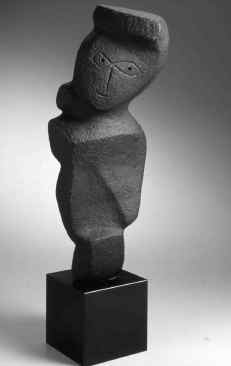 20th-century art in both painting and sculpture. This
exhibition presents 37 of Nevelson's paintings, prints, sketches, sculptures,
collages, and a selection of pendants. (right: Louise Nevelson, Figure
of a Woman, c. 1946-1951)
20th-century art in both painting and sculpture. This
exhibition presents 37 of Nevelson's paintings, prints, sketches, sculptures,
collages, and a selection of pendants. (right: Louise Nevelson, Figure
of a Woman, c. 1946-1951)
Born in Tsarist Russia in the autumn of 1899, Nevelson
immigrated to Rockland, Maine, with her family in 1905. As an artist she
was undeniably American, but with a progressive European sensibility. She
evolved into one of the major proponents of modernism in the United States,
and eventually become known as "the doyenne of American sculpture."
Following her marriage in 1920 to Charles Nevelson, a cargo
ship owner, Louise Nevelson moved to New York City, a step that was instrumental
to her artistic development. The exhibition begins with paintings and drawings
created by Nevelson circa 1929-31, while she studied at the Art Students
League. Her youthful exuberance is expressed in the painting, "Maine
Meadows, Old Country Road," circa 1931, created on the eve of her departure
to Munich to study with the influential teacher Hans Hofmann, an Abstract
Expressionist. Her subsequent studies with Hofmann in Munich and afterward
in New York marked a turning point in her life and art. She later credited
him with introducing her to cubism and the "push and pull" of
negative and positive space, concepts that were critical to the development
of her mature work.
In 1933 Nevelson began studying with Chaim Gross, a young
artist who was gaining recognition as one of the new generation of sculptors
interested in a
return to direct carving. Although she continued to paint
into the early 1950s, from this point forward, sculpture began to dominate
Nevelson's artistic interests. The exhibition illustrates this phase of
Nevelson's career with a number of examples of her early figurative sculpture
including "Martha Graham," circa 1950, and "Bronze Bird,"
1952.
By the late 1950s Nevelson found her mature voice as an
artist and in a series of acclaimed exhibitions rapidly ascended to the
heights of American art. The Farnsworth Collection includes "Dawn Column
I," from Nevelson's sensational, all-white installation, Dawn's Wedding
Feast, created for the exhibition "Sixteen Americans" at the Museum
of Modern Art in 1959. Also included is the large, black wall construction,
"The Endless Column," 1969 and 1985, a piece that has been described
as "stately and dignified a fugue of repeating forms." 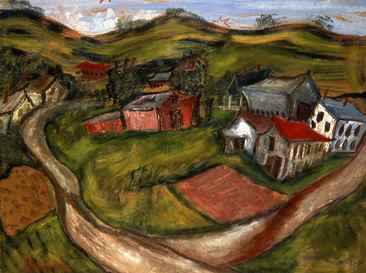
Appropriately the exhibition concludes with two wall reliefs
from the artist's Volcanic Magic series, created in 1985 and among her final
works. Before her death in April 1988, Nevelson donated 56 of her own works
to her hometown museum. This exhibition presents 37 works from the Farnsworth
Art Museum's collection and traces the full span of the artist's career,
from her student days at the Art Students League to her emergence as an
artist of national stature. (right: Louise Nevelson, Maine Meadows,
Old Country Road, c. 1931
The opening reception and family program for "Louise
Nevelson: Selections from the Farnsworth Art Museum" will be held from
3:30 to 5 p.m. on Sunday, September 19, 2004. Art educator Lucinda Edinberg
will offer a Sunday afternoon tour of the exhibit at 3 p.m. on September
26 and a lunchtime tour from 12:15 to 12:45 p.m. on Wednesday, October 20.
A seminar on "Looking at the Elephant" in relation to the exhibition
will be led by Ebby Malmgren, a local artist and writer, and Samantha Buker,
head of St. John's Student Art Society, at 7 p.m. on October 5. Independent
scholar Stephen May will give a lecture on "Louise Nevelson: An American
Original" at 7:30 p.m. on October 13, in the Conversation Room.
This exhibition was organized by The Farnsworth Art Museum,
with tour development by Smith Kramer Fine Art Services, Kansas City, Mo.
Funding has also been provided in part by Anne Arundel County, the City
of Annapolis, Crosby Marketing Communications, the Cultural Arts Foundation
of Anne Arundel County, the Maryland State Arts Council, members of the
Mitchell Art Gallery, the National Endowment for the Arts, the Clare Eddy
and Eugene V. Thaw Fine Arts Fund, William Paca Beatson Jr., Frederick Graul,
and Carleton Mitchell.
Following is text from the wall panels for the exhibition:
- This exhibition of the work of Louise Nevelson has been selected from
the collection of the Farnsworth Art Museum in Rockland, Maine, which holds
the largest public collection of the artist's work after the Whitney Museum
of American Art in New York City. Between 1981 and 1985, Nevelson donated
87 pieces of art to the Farnsworth, including 56 of her own works. Other
significant gifts came from the artist's family. It is perhaps fitting
that the Farnsworth collection is especially strong in early examples of
Nevelson's work, as it was Rockland where she spent her formative years
and discovered her love of art.
-
- Born Leah Berliawsky in the autumn of 1899 in Tsarist, Russia, Nevelson
immigrated to the small coastal town of Rockland, Maine, with her family
in 1905. At an early age, she received recognition from her school teachers
as "the artist." She later stated, "From the first day in
school until the day I graduated, everyone gave me 100 plus in art. Well,
where do you go in life? You go to the place where you get 100 plus."
-
- Following her marriage in 1920 to Charles Nevelson, a cargo-ship owner,
the artist moved to New York City, where she lived and worked until her
death in April 1988. Her attraction to the city was immediate and lasting;
she called New York, "a city of collage . . . the whole thing is magnificent."
Upon her arrival, she began vigorously pursuing her interests in painting,
acting, dance, and singing.
-
- By 1931 Nevelson's studies at the Art Students' League confirmed her
resolve to become an artist, and from that time forward the visual arts
became her primary focus, although she maintained a life-long interest
in modern dance and theater. For the next two decades, she sought to develop
her own artistic voice, studying painting with Hans Hofmann and sculpture
with Chaim Gross, and serving as an assistant to the Mexican muralist Diego
Rivera. Her paintings and early figurative sculpture reveal her assimilation
of the principles of Cubism, her interest in tribal arts, and her unconventional
approach to materials-all aspects critical to the development of her mature
work.
Following is text from the object labels for the exhibition:
-
- York Avenue, New York City
- 1934
- Oil on board
- Bequest of Nathan Berliawsky
-
- In the fall of 1932, after studying in Munich with Hans Hofmann, and
subsequent travels in Europe, Nevelson returned to New York and re-enrolled
in classes at the Art Students League. That winter, separated from her
husband, a situation that remained until her divorce in 1941, she took
an apartment at 1237 York Avenue, where this work was painted. Despite
her deep affection for urban life and the architecture of the city, this
work is one of only two known cityscapes by Nevelson; the other is New
York City off 30th Street, also in the Farnsworth collection.
-
- Figure in a Blue Shirt
- 1952
- Oil on canvas
- Bequest of Nathan Berliawsky
-
- While the identity of this figure is not conclusively known, it may
be either the artist's son Mike or her close friend, the artist Ralph Rosenberg,
as the majority of her paintings from this period are portraits of herself,
family, and friends. Most are heavily impastoed, with thick layers of paint
that project as much as an inch from the picture plane, as in the topknot
of hair in Figure in a Blue Shirt. In this work, as well as in the
painting Woman, Child and Three Cats, the background is composed
of a grid of stacked rectangles, anticipating the form of her later wooden
wall constructions.
-
- Woman, Child and Cats
- circa 1946
- Oil on canvas
- Gift of Nathan Berliawsky
-
- As in her earlier drawing, Four Figures, Nevelson's interest
in totemic form is evident in several paintings in the Farnsworth collection,
including this work in which three cats' heads form a totem in the lower
right. Her attraction to totemic form stems from her long-held interest
in tribal arts, which, it has been suggested may stem back as far as her
childhood in Rockland where American Indian artifacts were sold to summer
tourists. Undoubtedly her interest was strengthened by her exposure to
museum collections in New York and Paris; her acquaintance with Wolfgang
Paalen and his writings on primitive art in the Surrealist magazine Dyn;
and her apprenticeship with the Mexican muralist Diego Rivera in 1933.
-
- Female Figure
- circa 1937
- Carved wood
- Gift of Mrs. Anita Berliawsky Weinstein
-
- This small relief is one of Nevelson's earliest references to tribal
art in sculptural form, and a rare extant example of her direct carving
in wood. In 1933, she began studying with Chaim Gross, a young artist,
who, along with William Zorach, was becoming known as one of the new generation
of sculptors interested in a return to direct carving. Throughout the next
two decades, Nevelson continued to practice both painting and sculpture,
only in the mid-1950s did she stop painting and turn conclusively to three-dimensional
work.
-
- Seated Figure
- circa 1946-51
- Cast stone
- Gift of Louise Nevelson
-
- Nevelson's early experiments in sculpture include numerous semi-abstract
animals and figures in black-painted terracotta, plaster, and cast stone.
Many of these were made at a WPA-supported sculpture workshop on 39th Street
run by Louis Basky and his apprentice Alexander Tatti. Tatti is credited
with developing "tattistone," a self-hardening material used
frequently by Nevelson for these early works. Her strong appreciation for
Mayan statuary and the Cubist sculpture of Lipchitz, Picasso and others
is clearly evident in works such as these.
-
- Maine Meadows, Old County Road
- circa 1931
- Oil on board
- Bequest of Nathan Berliawsky
-
- Filled with exuberance and youthful energy, this is one of Nevelson's
most successful paintings from the early years of her career. Although
undated, it relates closely to another less finished work in the Farnsworth
collection, View of Rockland Meadows, which bears the date 1931.
The road of the title, Old County Road, is still in use today; it runs
along Rockland's inland side, connecting the north and south of town with
coastal Route 1. Very likely painted on the eve of her departure for Munich
to study with the influential teacher Hans Hofmann, Maine Meadows, Old
County Road, gives testament to Nevelson's happiness at the prospect.
As if to suggest her newfound confidence as an artist, she has filled the
narrow band of pale blue sky with colorful stars. She later said, "[the
star] could be a crown, five points, I've always felt like a star."
-
- Woman with a Red Scarf
- circa 1947
- Oil on canvas
- Bequest of Nathan Berliawsky
-
- Although undated, similar works in the Farnsworth collection place
this painting, which is undoubtedly a self-portrait, in late 1947. In this
extremely powerful work, the artist has depicted herself with bound hands
while surrounded by stars, symbolically suggesting forces outside herself
that are restricting her ascent as an artist. A number of traumatic events
in Nevelson's personal life around this time may help explain her anguished
portrayal. In October 1946, her father died suddenly of heart failure;
in June 1947, her son Mike, who had been living with her in New York, returned
to Rockland under strained relations; and in October 1947, her dealer and
close friend Karl Nierendorf died unexpectedly.
-
- Ancient Splendor
- 1953-55
- Etching
- Bequest of Nathan Berliawsky
-
- In the spring of 1950 and the winter of 1951, Louise and her sister
Anita traveled to Mexico and Guatemala to visit the Mayan ruins. The experience
had a profound affect on the artist, she said, "This was a world of
forms that at once I felt I could identify witha world of geometry and
magic." As a result of this trip, she produced a series of thirty
etchings that evoke the forms and atmosphere of the ancient sites. These
prints, from that series, were all created between 1953-55 at Atelier 17,
a highly regarded printmaking workshop led by Stanley William Hayter. A
selection of these prints was included in Nevelson's critically acclaimed
exhibition, "Ancient Games in Ancient Places," held at Grand
Central Moderns Gallery in 1956.
-
- Martha Graham
- circa 1950
- Cast Bronze
- Gift of Louise Nevelson
-
- Nevelson was a devoted follower of modern dance, in particular the
work of Martha Graham. This piece, one of the few examples of her early
sculpture to be cast in bronze, captures the great dancer's strength and
fluidity, and is one of Nevelson's strongest figurative works. A kindred
spirit, Nevelson said, "Martha Graham by the nature of her spirit,
by the nature of her energy, by her presence and intensitywas undoubtedly
movement of the twentieth century. She was a pioneer."
-
- Dawn Column I
- 1959
- Painted wood
- Museum purchase
-
- After years of struggle establishing herself as an artist, by the late
1950s, Nevelson began making great strides towards her mature style. In
1958, for her annual exhibition at Grand Central Moderns Gallery, she created
Moon Garden + One, a totally black environment that included her
first wall construction, Sky Cathedral, now in the collection of
the Museum of Modern Art. The critical success of this show confirmed her
stature as an artist of importance, and in the following year she was included
the exhibition "Sixteen Americans" at MOMA. For this show, she
created Dawn's Wedding Feast, a lavish all-white environment suggesting
a nuptial ceremony. This work, Dawn Column I, represents one of
the witnesses to the marriage; it stood in the exhibition with ten similar
columns on a narrow platform flanking the symbolic altar. Although it was
Nevelson's wish to keep the installation intact, this proved impossible,
and over the years individual pieces, such as this, were sold to museums
and private collectors.
-
- The Endless Column
- 19691985
- Painted wood
- Bequest of Nathan Berliawsky
-
- Rather than an assemblage of irregular found wood which characterized
her first wall constructions, this later piece is composed of machine-made
shapes in a regular, rhythmic pattern. In his catalog essay for the 1985
exhibition of Nevelson's art at the Farnsworth, Willy Eisenhart described
this work as "stately and dignified, musical in its harmonies of lines
and shadows, defined by a fugue of repeating forms." Nevelson added
the top two rows of boxes and the flanking sentinel-like constructions
to the original central column at the time of the 1985 exhibition.
-
- Volcanic Magic XVI
- 1985
- Wood and paper collage
- Gift of Louise Nevelson
-
- Constructed from a variety of found materials, these late works closely
recall Nevelson's native Russian roots. Their dynamic, abstract compositions
bear striking similarity to the non-objective relief sculptures created
by the Russian Constructivists Vladimir Tatlin, Ivan Puni, Vassily Ermilov
and others around 1915-20. In a radical change from her previous constructions,
the works in the Volcanic Magic series retain their original finishes,
strengthening their ties to the work of the Constructivists and their antecedents,
Cubist collage.
-
- Pendants
- 1985
- Wood with brass overlay
- Wood with silver overlay
- Gifts of Louise Nevelson
-
- Nevelson inherited her flair for dressing from her mother, and as her
reputation as a leading American artist grew, her mode of dress became
increasingly extravagant, an assemblage of textures and cultures as unique
as her art. A favorite ensemble was a skirt made from an Amish quilt, worn
under an 18th-century Chinese robe, and topped by a floor-length Persian
coat, a riding helmet, and her signature false eyelashes. She designed
many pieces of her personal jewelry as well, each one as artfully created
as one of her sculptures; these examples were donated to the museum on
the occasion of her 1985 exhibition.
-
- Mother and Child II
- circa 194651
- Terra Cotta
- Gift of Louise Nevelson
-
- Figure of a Woman
- circa 194651
- Terra Cotta
- Gift of Louise Nevelson
-
- Full Moon
- 1980
- Polyester resin cast
- Gift of Kurt Olden
-
- The Ancient One
- 195355
- Etching
- Bequest of Nathan Berliawsky
-
- Bronze Bird
- 1952
- Cast Bronze
- Gift of Anita Berliawsky
-
- Child
- circa 194651
- Terra-cotta
- Bequest of Nathan Berliawsky
-
- Facade: 1 "The Drum"
- 1967
- Photo collage
- Gift of Mr. and Mrs. Robert Rothschild
-
- Moon Passage
- 1976
- Color lithograph with collaged paper
- Gift of Maurine and Robert Rothschild
-
- Night Form
- circa 194651
- Terra-cotta
- Gift of Louise Nevelson
-
- Nude
- circa 1930
- Graphite on paper
- Bequest of Nathan Berliawsky
-
- Portrait of a Woman
- circa 194647
- Oil on board
- Bequest of Nathan Berliawsky
-
- Reclining Female
- circa 194651
- Terra-cotta
- Gift of Louise Nevelson
-
- Series of an Unknown Cosmos I
- 1979
- Wood and paper collage
- Gift of Louise Nevelson
-
- Small Stele
- circa 194651
- Terra-cotta
- Gift of Louise Nevelson
-
- Still Life with Pitcher
- 1927
- Oil on canvas
- Gift of Arnold Glimcher, 1981
-
- Sunken Cathedral
- 195355
- Etching
- Bequest of Nathan Berliawsky
-
- Three Children
- 1946
- Oil on canvas
- Bequest of Nathan Berliawsky
-
- Two Women
- 1946
- Oil on canvas
- Bequest of Nathan Berliawsky
-
- Two Women
- circa 1946
- Cast aluminum
- Gift of Louise Nevelson
-
- The Woman
- circa 1946
- Oil on canvas
- Bequest of Nathan Berliawsky
-
- Untitled
- 1973
- Aquatint and collage
- Gift of Pen Bay Board of Realtors
-
- Untitled
- 1976
- Wood and paper collage
- Gift of Louise Nevelson
-
- Volcanic Magic XXIII
- 1985
- Wood and paper collage
- Gift of Louise Nevelson
-
- Female Nude
- circa 1929
- Oil on canvas
- Gift of Louise Nevelson
-
- Woman, Child and Cats
- 1946
- Oil on canvas
- Gift of Nathan Berliawsky
Editor's note: RL readers may also enjoy these earlier articles:
- Women: A Century of Art featuring Louise Nevelson:
Selections from the Farnsworth Art Museum (6/14/04)
- Four Originals: Cassatt, O'Keeffe, Nevelson,
Frankenthaler (7/31/03)
rev. 9/1/04
Read more articles and essays concerning this institutional
source by visiting the sub-index page for the Mitchell
Art Gallery at St. John's College in Resource
Library
Visit the Table
of Contents for Resource Library for thousands
of articles and essays on American art, calendars, and much more.
© Copyright 2004 Traditional Fine Arts Organization, Inc., an Arizona nonprofit corporation. All rights
reserved.