Editor's note: The Georgia Museum of Art provided
source material to Resource Library for the following article or
essay. If you have questions or comments regarding the source material,
please contact the Georgia Museum of Art directly through either this phone
number or web address:
Shaping a Collection: Recent
Acquisitions in the Decorative Arts
December 18, 2004 - March 20, 2005
Shaping a Collection:
Recent Acquisitions in the Decorative Arts will
be on view at the Georgia Museum of Art from December 18, 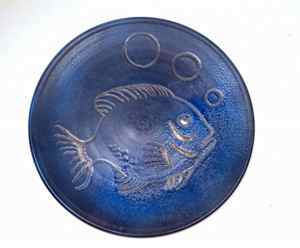 2004, through March 20, 2005. (left: Eulala Amos,
fish plate with silver inlay, 1946. Earthenware with alkaline blue glaze,
25 1/2 inches (diameter). Georgia Museum of Art, University of Georgia,
gift of Dr. Elizabeth T. Sheerer, GMOA 2004.44)
2004, through March 20, 2005. (left: Eulala Amos,
fish plate with silver inlay, 1946. Earthenware with alkaline blue glaze,
25 1/2 inches (diameter). Georgia Museum of Art, University of Georgia,
gift of Dr. Elizabeth T. Sheerer, GMOA 2004.44)
Featuring the recent additions to the museum's young and
rapidly expanding collection of decorative arts, this exhibition will showcase
17 pieces of period silver flatware. The Georgia pieces all are made by
mid-19th-century silversmiths and include a ladle made by H. P. Horton who
worked in Savannah.
Ashley Callahan, curator of decorative arts, says the primary
collecting focus of the department is to assemble works made in, or related
to, Georgia. Callahan, a specialist in textiles, has added two rare examples
of this medium to the collection, which will be on view: an 1834 Masonic
apron and a wool and cotton quilt, c. 1956, found in Hart County and made
by an unidentified African American maker. The apron features embroidery
and watercolor on silk and originally belonged to a physician in Macon.
This ceremonial textile is highly decorated with symbols important to the
Masonic tradition. The African American quilt is made of dark pieces of
cloth used in men's suits, and is decorated with brightly embroidered names.
An unusual work related to Georgia is a certificate of
merit (1847) executed in watercolor on paper and in its original gilt frame.
It is a rare work of art that was presented to a young student from Georgia
who attended a female seminary in Washington, D.C.
A large segment of the exhibition is composed of pottery
by Eulala Amos (American, 1907-2001). Amos began teaching at the University
of Georgia's Lamar Dodd School of Art in 1949 and retired as professor emeritus
in 1970. Born in Ohio, Amos attended Ashland College and began teaching
immediately after graduation. "The art of pottery runs in Amos's family,"
says Irja Thurlow, who authored a brochure on Amos. "A Pennsylvania
Dutch ancestor made pottery until the onset of the Revolutionary War. One
of his works is in the collection of the Philadelphia Museum of Art."
Amos's methods were much more contemporary than those of
her colonial forebear. Throughout her career, she experimented with different
clays and glazes. She was known for her philosophy of "fitting the
glaze to the pot." She is recognized for her use of silver inlay, inspired
by a trip to the dentist for a filling, which eventually led to her master's
thesis at Ohio State. 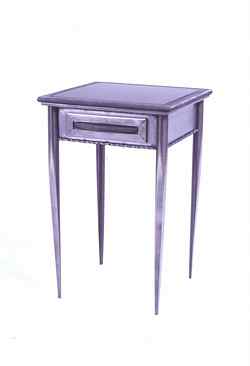
Another contemporary note in the exhibition is the forged
and fabricated steel table (2003) made by Andrew T. Crawford. A native of
New Jersey, Crawford has lived in Atlanta since 1971. He founded Andrew
T. Crawford Ironworks in 1993 after his graduation from the Rhode Island
School of Design, and continues his work there with three full-time craftsmen.
The museum's decorative arts collection dates back to 1999
when the museum started the Henry D. Green Center for the Study of Decorative
Arts that now numbers approximately 200 objects. The late Henry Green was
an early advocate of the decorative arts in Georgia. All of the works in
this exhibition have been either museum purchases or donated to the museum
by patrons.
On view in the Martha and Eugene Odum Gallery of Decorative
Arts, Shaping a Collection is sponsored by the Friends of the Museum
and the W. Newton Morris Charitable Foundation. (right: Andrew T
Crawford (American, b. 1970), All Thread , 2003. Forged and fabricated
steel, 28 x 18 x 18 inches. Georgia Museum of Art, University of Georgia.)
Label text and object information from the exhibition:
In 1998 the Georgia Museum of Art held the first meeting
of its Decorative Arts Advisory Committee. The following year the committee
named the museum's new decorative arts program the Henry D. Green Center
for the Study of the Decorative Arts in honor of the pioneer advocate of
Georgia's decorative arts, Henry D. Green (1909-2003). The Green Center
holds biennial symposia (the first in 2002, the third planned for early
2006); presents decorative arts exhibitions and lectures; and houses the
Green Library, the papers of Henry D. Green, and the Georgia Decorative
Arts Survey, which was sponsored by the National Society of the Colonial
Dames of America in the State of Georgia in the late 1980s.
The Green Center also encourages the acquisition of decorative
arts for the museum's permanent collection. Shaping a Collection
celebrates these new additions to the collection, many of which have never
been presented publicly. This selection of objects reflects the Green Center's
collecting mission: the primary focus is on works made in Georgia, such
as the Masonic apron and All Thread, and works of significance to
Georgia, such as the certificate of merit and the clock, while the secondary
focus is on works made in the Southeast, such as the silver sorbet spoons.
Subsequent collecting focuses are to acquire works that provide an American
and then a European context for the Southern objects. By bringing these
works into the museum's permanent collection, the Green Center is endeavoring
to place them in a context in which they can be studied and to maintain
them for future generations.
The Green Center appreciates the generous donors of
both objects and funds who have made these recent acquisitions possible.
-
- -- Ashley Callahan
- Curator, Henry D. Green Center for the Study of the Decorative Arts
-
-
-
- The study of nineteenth-century Georgia silver is complicated
by the fact that many wares from the North were imported to the South and
marked with the name of their retailer. Determining whether a particular
object was crafted or just retailed in Georgia often is difficult or impossible.
Regardless of the place of origin, though, the items with Georgia marks
indicate that consumers in this state purchased wares that were consistent
stylistically with production in other parts of the country. An important
reference book documenting silversmiths and retailers in Georgia is George
Barton Cutten's The Silversmiths of Georgia (1958), which was reprinted
in 1998 with the addition of an article from The Magazine Antiques
by Katharine Gross Farnham and Callie Huger Efird titled "Early Silversmiths
and the Silver Trade in Georgia" (1971). The Georgia Decorative Arts
Survey documents additional marks of silver makers and retailers working
in Georgia.
-
- F. & H. Clark (American, active Augusta, Georgia
1830-1840)
- Mustard ladle, c. 1830-40
- Silver
- 4 5/8 x 15/16 x 5/8 inches
- Georgia Museum of Art, University of Georgia; museum
purchase with partial funds provided by Betty Myrtle, 2002 Volunteer of
the Year, and M. Smith Griffith
- GMOA 2004.27
-
- This ladle originally belonged to the mother-in-law of
Athens silversmith A. K. Childs.
-
-
- David B. Nichols (American, 1791-1860, active Savannah,
Georgia c. 1815-1855)
- Set of four teaspoons, n.d
- Silver
- approximately 5 5/8 x 1 1/8 x 1 3/16 inches each
- Georgia Museum of Art, University of Georgia; museum
purchase with partial funds provided by Betty Myrtle, 2002 Volunteer of
the Year, and M. Smith Griffith
- GMOA 2004.28-.31
-
- These teaspoons originally belonged to the Taylor family
of Athens.
-
-
- H. P. Horton (American, active in Savannah, Georgia c.
1850)
- Ladle, c. 1850
- Silver
- 7 3/8 x 2 1/2 x 5/8 inches
- Georgia Museum of Art, University of Georgia; museum
purchase with funds provided by the Beverly H. Bremer Charitable Lead Unitrust
- GMOA 2004.33
-
- According to the previous owner this ladle and the set
of forks descended in the same family. The mark "Horton," seen
on the forks, is not included in the book The Silversmiths of Georgia
by George Barton Cutten, but it is documented in the Georgia Decorative
Arts Survey.
-
-
- Horton (American, active in Savannah, Georgia c. 1850)
- Set of eight forks, c. 1850
- Silver
- approximately 7 7/8 x 1 x 1 1/16 inches each
- Georgia Museum of Art, University of Georgia; museum
purchase with funds provided by the Beverly H. Bremer Charitable Lead
Unitrust
- GMOA 2004.34-.41
-
-
- Thomas T. Wilmot (American, c. 1804- c. 1850, active
Charleston, South Carolina c. 1837-1841, Columbus, Georgia 1844-1845, and
Savannah, Georgia 1843-1850)
- Two spoons, c. 1840s
- Silver
- 6 5/8 x 1 9/16 x 1 inches each
- Georgia Museum of Art, University of Georgia; gift of
Mr. and Mrs. Brian S. Brown
- GMOA 2004.18-.19
-
- These spoons originally belonged to Mary Clay Hill, whose
monogram is engraved on the spoons. She died in Clarkesville, Georgia.
-
-
- Newton E. Crittenden (American, 1826-1872, active Cleveland,
Ohio, c. 1826-1872)
- Tongs, 1856
- Coin silver
- 8 1/2 x 3 1/2 inches
- Georgia Museum of Art, University of Georgia; gift of
Edgar and Betty Myrtle
- GMOA 2004.14
-
- Newton E. Crittenden was active in Cleveland, Ohio in
the mid-nineteenth century. These tongs are marked with a patent date of
1856.
-
-
- Eulala Amos inscribed the following words into one of
her pots: "Of clay we are made, and fire. This is true of the pots
and of you and me and everybody else who lives and breathes." She
brought the passion and dedication to pottery expressed in that quotation
to her role as a ceramics professor in the art department of the University
of Georgia from 1949 until her retirement in 1970.
-
- Amos is particularly noted for her use of silver in her
ceramics. Inspired by a visit to the dentist, she devised a method of inlaying
silver in her pottery in a manner similar to adding a filling to a tooth.
She drilled holes in the pottery and filled them with silver amalgam. This
collection of objects, which represents a wide span of her career, features
two works with silver inlay, the plate with the fish design and the vase
with the silver and green ornamentation on its exterior.
-
- Eulala Amos (American, 1907-2001)
- Plate, 1946
- Earthenware with silver inlay
- 15 1/2 inches (diameter)
- Georgia Museum of Art, University of Georgia; Gift of
Dr. Elizabeth T. Sheerer
- GMOA 2004.44
-
- Eulala Amos (American, 1907-2001)
- Vase, 1946
- Stoneware with silver inlay
- 6 3/4 (h) x 6 1/2 (d) inches
- Georgia Museum of Art, University of Georgia; Gift of
Dr. Elizabeth T. Sheerer
- GMOA 2004.45
-
- Eulala Amos (American, 1907-2001)
- Vase, 1956
- Earthenware
- 8 3/4 (h) x 3 1/4 (d) inches
- Georgia Museum of Art, University of Georgia; Gift of
Dr. Elizabeth T. Sheerer
- GMOA 2004.46
-
- Eulala Amos (American, 1907-2001)
- Vase, 1968
- Stoneware
- 6 1/2 (h) x 4 1/4 (d) inches
- Georgia Museum of Art, University of Georgia; Gift of
Dr. Elizabeth T. Sheerer
- GMOA 2004.47
-
- Eulala Amos (American, 1907-2001)
- Vase, 1970
- Stoneware
- 5 1/2 x 3 1/2 x 3 1/2 inches
- Georgia Museum of Art, University of Georgia; Gift of
Dr. Elizabeth T. Sheerer
- GMOA 2004.48
-
- Eulala Amos (American, 1907-2001)
- Vase, 1945
- Earthenware
- 4 (h) x 5 (d) inches
- Georgia Museum of Art, University of Georgia; Gift of
Dr. Elizabeth T. Sheerer
- GMOA 2004.49
-
- Eulala Amos (American, 1907-2001)
- Bowl, 1942
- Earthenware
- 2 (h) x 7 1/4 (d) inches
- Georgia Museum of Art, University of Georgia; Gift of
Dr. Elizabeth T. Sheerer
- GMOA 2004.50
-
- Eulala Amos (American, 1907-2001)
- Pitcher with lid, 1965
- Stoneware
- 6 (h) x 4 1/2 (d) inches
- Georgia Museum of Art, University of Georgia; Gift of
Dr. Elizabeth T. Sheerer
- GMOA 2004.51
-
- Eulala Amos (American, 1907-2001)
- Vase, 1946
- Stoneware
- 5 x 4 1/2 x 4 1/2 inches
- Georgia Museum of Art, University of Georgia; Gift of
Dr. Elizabeth T. Sheerer
- GMOA 2004.52
-
-
- Eulala Amos (American, 1907-2001)
- Ashtray, 1953
- Earthenware
- 1 1/2 (h) x 4 1/2 (d) inches
- Georgia Museum of Art, University of Georgia; Gift of
Dr. Elizabeth T. Sheerer
- GMOA 2004.53
-
-
- Unidentified maker (American) (object found in Hart County,
GA)
- Quilt, ca. 1956
- Wool and cotton
- 85 x 71 inches
- Georgia Museum of Art, University of Georgia; museum
purchase
- GMOA 2004.71
-
- The strip construction of this quilt is typical of African
American quilts. The bright lettering enlivens the surface of the somber
strips, possibly constructed from mens' suit fabrics. The names may be
from an extended family, church group, or social organization. The quilt
was found in Hart County by pickers Mary and Jack Latimer.
-
-
- Mrs. Robert Carver (Georgia)
- Masonic apron, 1834
- Silk with watercolor and metallic beads, linen
- 16 _ x 15 3/8 inches
- Georgia Museum of Art, University of Georgia; gift of
Emmett T. Bragg
- GMOA 2004.20
-
- Unidentified maker (Georgia)
- Masonic apron, c. 1834
- Silk and linen
- Georgia Museum of Art, University of Georgia; gift of
Emmett T. Bragg
- GMOA 2004.21.1-3
-
- Unidentified maker
- Masonic certificate, July 13, c. 1840s
- Engraving on paper
- Georgia Museum of Art, University of Georgia; gift of
Emmett T. Bragg
- GMOA 2004.22
-
- This rare Masonic ceremonial apron is accompanied by
an undecorated apron and a certificate, all originally belonging to Dr.
Robert Carver of Marshallville and Macon, Georgia. His wife embroidered
the apron and the group of objects descended in their family until their
recent owner, a family friend, donated them to the Georgia Museum of Art.
-
- All of the images on the apron are significant to the
fraternal organization and symbolize the Mason's rank, stages of life,
and moral beliefs. The numerous symbols, both individually and collectively,
have various meanings and many levels of interpretation. Following are
possible explanations for some of the images: the All-Seeing Eye at the
top represents the watchfulness of God; the beehive is a symbol of industriousness;
the twenty-four inch gauge in the lower left symbolizes the hours of the
day divided into three equal parts, devotion to God, work, and rest; the
anchor is an emblem of hope; the ladder is known as Jacob's Ladder and
the letters on the rungs stand for Faith, Hope, and Charity; the G represents
both God and geometry; and the architectural structure recalls King Solomon's
Temple, which some believe to be the place of origin of Freemasonry.
-
-
Furniture:
-
- Andrew T. Crawford (American, b. 1970)
- All Thread, 2003
- Forged and fabricated steel
- 28 x 18 x 18 inches
- Georgia Museum of Art, University of Georgia; gift of
the artist
- This gift is in progress.
-
- Andrew T. Crawford offers a new perspective on the traditional
wooden Shaker end table. With this work in steel he mixes references to
the Shaker form -- he took the dimensions from a table he particularly
liked -- with his interest in sculpture, metal, and tools-the title, All
Thread, and the detailing suggest the threads on a screw.
-
- Crawford, who has lived in Atlanta since he was one year
old, is founder and owner of Andrew T. Crawford Ironworks. He is a full-time
professional sculptor, and his work is displayed in numerous public spaces
in Georgia including at the Atlanta Botanical Gardens, Brenau University,
and midtown Atlanta. Crawford often references tools and machinery in his
lighthearted sculpture and functional objects-twisting rulers, super sizing
hammers, and melting wrenches.
-
-
- New Haven Clock Company (New Haven, Connecticut, 1853-1960)
- Mantle clock, c. 1850s
- Mixed woods and metals, with glass tablet
- 25 7/8 x 15 3/8 x 4 1/8 inches
- Georgia Museum of Art, University of Georgia; gift of
Jackie and Tony Montag
- GMOA 2004.17
-
- Unidentified artist
- Franklin College, in Athens, Georgia, c. 1844
- From Gleason's Pictorial Drawing-Room Companion
- Color wood engraving on paper
- 6 x 9 _ inches
- Georgia Museum of Art, University of Georgia; gift of
Mrs. Laura Blackshear
- GMOA 1964.1054
-
- Painted on the reverse of the glass tablet in this clock
is an early image of the University of Georgia. Shown here from Franklin
College is Old College in the center with the Chapel, Demosthenian Hall,
the Ivy Building and the Presbyterian Church to the right, and Phi Kappa
Hall to the left. The wooden fence depicted was replaced in the 1850s
by a cast iron fence produced in Athens. The print was illustrated in
Gleason's Pictorial Magazine in 1844 and appeared on mantle clocks
manufactured by several New England clock companies in the mid-nineteenth
century.
-
-
Works on paper:
-
- Lydia Scudder English (American, 1802-1865)
- Certificate of merit for Sarah Elizabeth Moughon, 1847
- watercolor on paper in original gilt frame
- 6 1/8 x 5 3/8 inches (sight)
- Georgia Museum of Art, University of Georgia; museum
purchase with funds provided by the Collectors Group of the Friends of
the Georgia Museum of Art
- GMOA 2004.10
-
- The delicate handwritten script on this certificate of
merit reads:
-
Female Seminary Georgetown DC
February 11th 1847
Miss Sarah Elizabeth Moughon,
during the Term ending this day,
has strictly complied with the
regulation for Early Rising, thereby
meriting approbation in the high-
est degree, and ranking in the
First Grade for Punctuality
L. S. English
Principal
-
- Lydia Scudder English, founder and principal for over
thirty years of the Female Seminary in Georgetown, presented this certificate
to Sarah Elizabeth Moughon, a student from Columbus, Georgia, in 1847.
This rare object contributes to our understanding of schoolgirl education
in Georgia in the mid-nineteenth century, and documents the connection
between southern girls and northern schools.
-
- Though it is often more difficult to find documentation
relating to women's lives than men's during this period, schoolgirls, unlike
schoolboys, left behind embroidered pictures, needlework samplers, and
artistic ephemera that provide clues about their experiences.
-
- Several items related to this certificate survive, including
a handwritten certificate from 1850 with the same text and a different
image for another girl, a bookmark by Moughon, and a printed certificate
for Moughon "for diligence and attention to her studies".
-
-
- Campbell & Wyman (American, active Montgomery, Alabama
c. 1855- c. 1859)
- John Campbell (American, 1824-1887)
- Justus Wyman (American, dates unknown)
- Sorbet spoons with original case, 1855
- Coin silver
- Georgia Museum of Art, University of Georgia; gift of
Mr. and Mrs. Harry T. Catchpole
- This gift is in progress.
-
- The original paper label on the bottom of the case for
these spoons describes the firm of Campbell & Wyman as importers and
dealers of watches, jewelry and silverware. This firm, like many others
in the South, imported and retailed silver from New York, and though these
spoons only bear the mark of the Alabama firm, they may have been executed
in New York.
-
- John Campbell was born in South Carolina and orphaned
at a young age. He studied at The Citadel in Charleston before joining
the U.S. Army and serving in the Mexican War. After the war he worked in
Columbia, South Carolina as a silversmith and jeweler, then moved to Montgomery,
Alabama in 1849 to work in the same field. After working on his own, he
formed a partnership with Justus Wyman, then added a third partner. He
sold his interest in 1859 and became a farmer and served in the Civil War.
Editor's note: RL wishes to express appreication to Ashley Callahan,
Curator of Decorative Arts, Georgia Museum of Art for providing texts for
this article.
Read more articles and essays concerning this institutional
source by visiting the sub-index page for the Georgia
Museum of Art in Resource Library.
Visit the Table
of Contents for Resource Library for thousands
of articles and essays on American art, calendars, and much more.
Copyright 2003, 2004 Traditional Fine Arts Organization, Inc., an Arizona nonprofit corporation. All rights
reserved.