Editor's note: The Akron Art Museum provided source
material to Resource Library for the following article and essay.
The essay was reprinted in Resource Library on March 1, 2005 with
the permission of the Akron Art Museum If you have questions or comments
regarding the source material, please contact the Akron Art Museum directly
through either this phone number or web address:
New Master Drawings
February 19 - April 23, 2005
Selected didactic texts from the exhibition:
- Drawing is the fundamental pictorial act. It reveals
the most direct impulses of both the artist's mind and body. New Master
Drawings, the tenth installment in the Akron Art Museum's Ohio Perspectives
series, reflects the heightened interest in drawing today. Here in Ohio
and around the world many artists are now seeking to reconnect with craft
and handwork.
- Last spring, the Akron Art Museum closed its galleries
to begin an exciting expansion project. Although we are temporarily without
our own galleries, we are collaborating with three area institutions to
present New Master Drawings, a three-part exhibition. The Butler
Institute of American Art/Salem, the first institution to host the show
features the work of Laurence Channing, Robert Robbins and Zena Zipporah.
This summer, Summit Artspace in Akron will exhibit drawings by three different
artists, and in the fall the Canton Museum of Art will show works by a
final group. A free gallery guide, available in the box to your left, provides
information on all three venues and all artists in the series.
- Like contemporary artists in other fields, artists who
draw also create expansive bodies of work and sometimes straddle the boundaries
between media. Robert Robbins blends thick layers of charcoal over coated
paper to create rich, painterly woodland scenes. Perhaps reflecting his
previous work as a painter, Laurence Channing grinds charcoal into a fine
powder and applies it to paper using pieces of felt in order to create
his figures and landscapes. Zena Zipporah prefers to draw on found objects:
antique dresses, eggshells and stones that she finds in flea markets and
around her home.
- These three artists and the others you will see later
this year in Akron and Canton all relish drawing's power to capture, shape
and transform their ideas. Their work reflects not only a key trend in
contemporary art but also the continuing vitality of art in Ohio.
-
- Large-type copies of the labels and wall texts for this
exhibition are available from the gallery attendant.
-
- Information about the purchase of works in this exhibition
is also available from the gallery attendant.
-
- New Master Drawings is organized
by the Akron Art Museum and made possible by a lead gift from Malone Advertising.
Additional support provided by generous gifts from The Mirapaul Foundation
and the R.C. Musson and Katharine M. Musson Charitable Foundation.
-
-
-
- Robert Robbins
- Columbus
- In his large-scale landscape drawings, Robbins (b. 1968)
combines soft forms and dense shadows to create scenes that are both picturesque
and tinged with melancholy. "All of my work is theatrical," he
observes, "with the emphasis on value and mood."
-
- Robbins, who teaches at the Columbus College of Art and
Design, often sketches outdoors around Columbus, but his drawings do not
represent actual sites. Almost all of his works are made up of multiple
sheets of paper-he tacks on additional pieces until he achieves the composition
he sees in his mind's eye. The seams where sheets are joined (Robbins calls
these "sutures") hint at the artificiality of the landscapes.
- The heavy, moist atmosphere in Robbins' images relate
to the tradition of American romantic landscape painting. Although he is
interested in painting, Robbins relies on drawing to achieve the otherworldly
quality he seeks for his images. He first coats paper with gesso (a mixture
of liquid plaster and glue), then rubs on layers of charcoal and uses rags
and erasers to "lift out" shapes and light areas. "There's
a slow, more leisurely read when you're looking at a black and white landscape
because it's so stark," he says.
-
-
- Zena Zipporah
- Shaker Heights
-
- Zipporah (b. 1942) engages in a frankly compulsive drawing
technique, covering eggs, stones, bones, children's clothing and christening
gowns with words and drawings. She follows in the tradition of ancient
art by drawing upon found objects, but she chooses her materials for personal
reasons. "I like to draw on things that make me feel comfortable,
and I don't usually feel that with paper," she says.
-
- The subjects of Zipporah's works reflect her intensive
study of world religions, especially the creation myths formed by ancient
cultures. Because she works so minutely, it is often difficult to discern
all that she has drawn. "I make my writing small enough that it's
really hard to read," she acknowledges. "That's how ancient texts
work too. They are full of symbols and codes that you have to decipher."
- Zipporah has also worked as a freelance writer, and she
sees a clear connection between drawing and writing: both offer her a way
to sort through feelings and ideas. In her more autobiographical works,
including a drawing on eggshells and two journals on view here, Zipporah
relies on the complexity of her drawing style to hide some of her works'
content. "This is a way to do writing about myself that's not dangerous,"
she notes.
-
- Laurence Channing
- Cleveland Heights
- Working with powdered charcoal, Channing (b. 1942) draws
shorelines, city streets and crowds of people that are precisely modeled
but also slightly blurred, as though seen through a haze. His drawings
are based on photographs he makes, but the photographic image is only a
guide. Through his past experiences as a painter and designer and his current
position as head of publications at the Cleveland Museum of Art, Channing
has developed a refined sense of space and patterning. He begins his drawings
by taping several photographs together to build a composition and then
changes perspective, moves or deletes objects and plays with value contrast
to form patterns of light and dark.
-
- Channing's images are filled with activity-people walking,
trees swaying and cars zooming along-but they are also remarkably tranquil.
He heightens this serene, meditative quality by centering his compositions
on large forms or dividing complex scenes into separate panels. By slowing
the rhythm of his images, he allows us to inscribe onto the scenes our
own meaning. "The subjects of my drawings are alluded to rather than
explicitly stated," Channing says.
-
- ROBERT ROBBINS
-
- Beryl Green, 2003
- Charcoal, acrylic and pastel on gessoed paper
-
- Robbins recently began to incorporate color into some
drawings, but he limits himself to monochromatic palettes. The jewel-like
tones, circular composition and high viewpoint in this work are purposefully
seductive, meant to draw the viewer up and into the scene. "I am very
intentionally trying to push the ground out from under your feet,"
says Robbins.
-
-
- ROBERT ROBBINS
-
- Midnight, 2003
- Charcoal, acrylic and pastel on gessoed paper
-
- ROBERT ROBBINS
-
- Dusk, Late Spring, 2003
- Charcoal on gessoed paper
-
-
- ROBERT ROBBINS
-
- Hillcrest #1, 2001
- Charcoal on gessoed paper
-
- ROBERT ROBBINS
-
- Hillcrest #2, 2001
- Charcoal on gessoed paper
-
- In 2001, Robbins introduced what he calls "beads
of light" into his more expansive horizontal compositions. These pools
of light, seen scattered across the middle ground and background of this
image, emphasize the depth of the space and lend the images a lighter,
more lyrical quality.
-
-
- ROBERT ROBBINS
-
- Nocturne #2 (Study), 2001
- Charcoal on gessoed paper
-
-
- ROBERT ROBBINS
-
- Sharon Woods Meadow, 2004
- Charcoal on gessoed paper
-
- The close-up view of the trees in this drawing hints
at the fact that it is more directly inspired by an actual landscape than
most of Robbins's works. Sharon Woods Metro Park is located just north
of Columbus. Robbins says, "The trees I'm most attracted to are the
ones that get a lot of salt in the winter, too much rain in the spring-they're
just bleached sticks at a certain point."
-
- ROBERT ROBBINS
-
- Sugar Maple Torrent, 2003
- Charcoal on gessoed paper
-
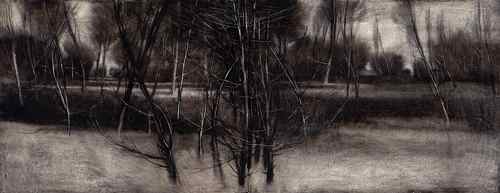
- Robbins drew arching trees in the foreground of this
work and kept the background relatively simple in order to heighten the
stage-like quality of the composition. In comparing this work to his more
static images, Robbins jokes, "I think this is as nuts as I can make
a drawing." (right: Robert Robbins, Sugar Maple Torrent,
2003, Charcoal on gessoed paper)
-
-
- ROBERT ROBBINS
-
- Thicket, 2000
- Charcoal on gessoed paper
-
- ZENA ZIPPORAH
-
- Book of Creation: Sefer Yetzirah,
2004
- Linen, silk and ink
-
- The Sefer Yetzirah, an ancient document related
to Jewish mysticism, uses abstract language to describe God's creative
power. Zipporah plays on the age and complexity of that text by lightly
scratching its words onto this sheer piece of material so that individual
letters are barely discernable.
-
-
- ZENA ZIPPORAH
-
- Destruction Myths, 1994
- Cast stone and ink
-
- ZENA ZIPPORAH
-
- Book of the Hopi, 2000
- Linen, cotton and ink
-
- Zipporah transcribed onto this dress a religious text
related to the Hopi, a Native American culture in northeast Arizona. The
bodice features the Song of Creation, sung by the Spider Woman, a central
Hopi deity, as she created living beings. Zipporah notes, "I wanted
to write out the entire first Book of the Hopi, which is such a great story,
so I chose a big dress."
-
-
- ZENA ZIPPORAH
-
- Creation Myths from Egyptian Book of the Dead, 2002
- Linen, silk and ink
-
-
- ZENA ZIPPORAH
-
- Sanskrit Myth, 2001
- Cotton, ink and metal
-
-
- ZENA ZIPPORAH
-
- Creation Myths - Japan, 1994
- Linen, cotton, silk and ink
-
- The snake-headed beasties and calligraphic curlicues
that Zipporah drew on the collar of this dress reflect the romantic but
sometimes violent nature of ancient Japan's creation mythology. Central
deities are burned and cut into pieces but always regenerate in their quest
toward building a new world.
-
- ZENA ZIPPORAH
- My Autobiography on Eggs,
2001
- Eggshells, ink, wire and found frame
-
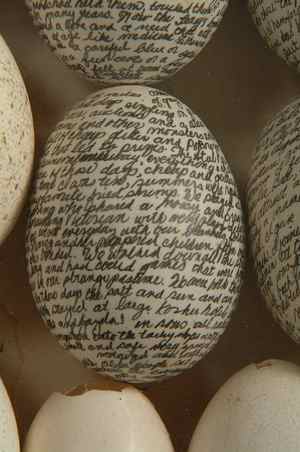
- Onto each eggshell in the center of this work, Zipporah
wrote about an event from her childhood. She notes that the fragility of
the shells echoes the tenuousness of her memories. By writing around the
entire shell and mounting the eggs in a sealed box, she has preserved what
she can remember but also hidden parts of the stories from the viewer.
- ZENA ZIPPORAH (right: Zena Zipporah, My Autobiography
on Eggs, 2001, Eggshells, ink, wire and found frame)
-
- God and Satan, 1994
- Polyester and ink
-
- Zena Zipporah
-
- Tuatha Dé Danaan, Whence They Came, 1994
- Linen, cotton and ink
- The Tuatha Dé Danaan are gods and goddesses from
medieval Irish mythology. Zipporah drew these imaginary characters along
the hem of this dress, varying each figure's shape, posture, expression
and hairstyle in order to suggest different personalities.
-
-
- ZENA ZIPPORAH
-
- Zohar and Merkabah, 2000
- Linen, silk and ink
- Zipporah adapted both the text and drawing in this work
from a book about Jewish mysticism. The Zohar, a medieval document
reflecting upon the Torah, and texts related to Merkabah mysticism (which
flourished after the year 100) include descriptions of how God formed the
Hebrew alphabet. Each "ray" in Zipporah's sunset-shaped drawing
contains a Hebrew letter along with the part of the mouth with which the
sound is associated.
-
- LAURENCE CHANNING
-
- Elders Study, 2002
- Charcoal on paper
-
-
- LAURENCE CHANNING
-
- Irving Place, 2004
- Charcoal on paper
-
-
- LAURENCE CHANNING
-
- Stories: Cain Park, 2003
- Charcoal on paper
-
- Courtesy of the artist and Bonfoey Gallery, Cleveland
-
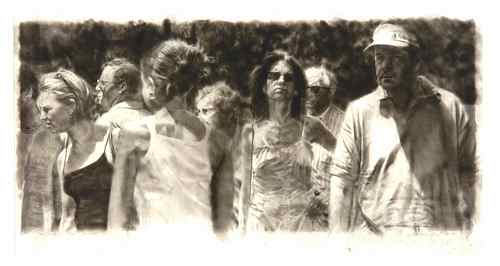
- Channing combined parts of four photographs to create
this composition depicting visitors to a park near his home. Although he
devised the positioning of the figures in relation to one another, Channing
rendered their faces and bodies as accurately as possible. "I'm actually
quite superstitious about getting the likenesses," he says. (right:
Laurence Channing, Stories: Cain Park, 2003, Charcoal on paper.
Courtesy of the artist and Bonfoey Gallery, Cleveland)
-
-
- LAURENCE CHANNING
-
- Stories: Threesome, 2003
- Charcoal on paper
-
- Courtesy of the artist and Reeves Contemporary, New York
-
-
- LAURENCE CHANNING
-
- Stories: The Courier, 2003
- Charcoal on paper
-
- Courtesy of the artist and Bonfoey Gallery, Cleveland
-
- This drawing is based on photographs made by Channing
in New York City. Although a dark-haired man with glasses and another man
in a white tank shirt appear in both panels of the drawing, Channing did
not intend the image to be sequential or to have narrative content. Instead,
his separation of the image into sections emphasizes the rhythm of the
crowd's movement along the street.
-
-
- LAURENCE CHANNING
-
- Unicum: Headlands, 2004
- Charcoal on paper
-
- The aerial perspective in this drawing of a break wall
along Lake Erie compresses the structure and draws the image toward abstraction.
Channing notes that he arrived at this stark composition after he scanned
his photograph of the wall into his computer and began to manipulate the
image using photo-editing software.
-
-
- LAURENCE CHANNING
-
- Unicum: Interstate, 2004
- Charcoal on paper
-
- This drawing of a stretch of woods along an interstate
is a familiar scene for Channing, who often travels by car from Ohio to
the east coast. He enlivens the scene by rendering it on a colossal scale
and creating a rich pattern of criss-crossing lines among the tree branches
and dense, powdery shadows along the edge of the road.
-
-
- LAURENCE CHANNING
-
- Unicum Study: Earth, 2003
- Charcoal on paper
-
- Courtesy of the artist and Bonfoey Gallery, Cleveland
-
- "This is just a rock on a beach," says Channing.
In choosing a close-up view, however, he creates intense focus upon the
coarse texture of the stone. By minimizing the background, Channing also
purposefully subverts our sense of scale: the rock could be a small pebble
or a large boulder.
-
-
- ZENA ZIPPORAH
-
- Notes from Other Worlds,
2002
- Mixed media
-
- This scrapbook, begun by a nurse living in Nebraska in
the 1930s, was purchased at an antique store by Zipporah's daughter. She
gave the book to her mother, who pasted onto each page old letters and
vintage postcards she had collected. On some pages, Zipporah also made
drawings that play off of images or words in the letters and cards.
-
-
- ZENA ZIPPORAH
-
- Obsession, 1991-1994
- Ink on paper and paper board
-
- Each two-page spread in this book relates to a day in
Zipporah's life. She surrounded and sometimes covered her words with drawings,
circles, lines and scribbles in order to make the text difficult to read.
Zipporah says, "The writing is small and the drawings are everywhere.
That blur between illustration and text is what I'm interested in."
-
-
- On the Pedestal:
-
- ZENA ZIPPORAH
-
- Notes from Other Worlds,
2002
- Mixed media
-
- This scrapbook, begun by a nurse living in Nebraska in
the 1930s, was purchased at an antique store by Zipporah's daughter. She
gave the book to her mother, who pasted onto each page old letters and
vintage postcards she had collected. On some pages, Zipporah also made
drawings that play off of images or words in the letters and cards.
-
-
- On the Pedestal:
-