Editor's note: The Williams College Museum of Art provided source material to Resource Library for the following article or essay. If you have questions or comments regarding the source material, please contact the Williams College Museum of Art directly through either this phone number or web address:
Moving Pictures: American Art and Early Film, 1880-1910
July 16 - December 11, 2005
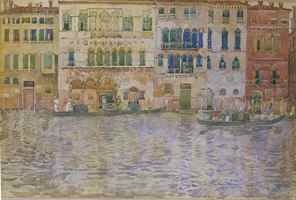
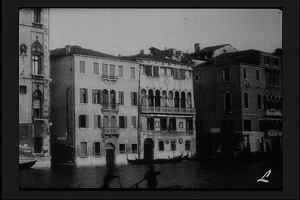
(above left: Maurice Brazil Prendergast (1858-1924), Venetian Palaces on the Grand Canal, 1899, watercolor and pencil on paper, 14 x 20 3/4 inches, Collection of Karen A. and Kevin W. Kennedy; above right: Cinématographe Lumière, Panorama of Grand Canal as Seen from a Boat, 1896, 50 feet, Producer: Alexandre Promio; camera: Alexandre Promio, Archives du Film du Centre National de la Cinématographe, neg. no. 295/1251)
Williams College Museum
of Art (WCMA) presents "Moving Pictures" a traveling exhibition
that explores the relationship between 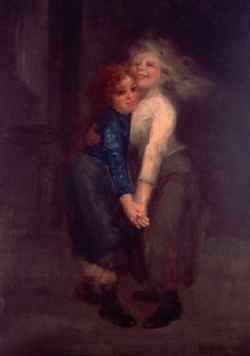 American
art and the new medium of film at the beginning of the 20th century. Showcasing
approximately 100 paintings and 50 films, "Moving Pictures" installs
art and film side by side, examining the complex relationship between these
two media at the turn of the last century. The dynamic relationship between
American art and early film not only resulted in new subjects but also new
poses, facial expressions, and constructions of space, challenging old assumptions
about what was real. This change brought about a new wave of creativity
to start the 20th century. (right: George Luks (1866-1933), The
Spielers, 1905, oil on canvas. Addison Gallery of American Art, Phillips
Academy, Andover, MA Gift of anonymous donor, 1931.9)
American
art and the new medium of film at the beginning of the 20th century. Showcasing
approximately 100 paintings and 50 films, "Moving Pictures" installs
art and film side by side, examining the complex relationship between these
two media at the turn of the last century. The dynamic relationship between
American art and early film not only resulted in new subjects but also new
poses, facial expressions, and constructions of space, challenging old assumptions
about what was real. This change brought about a new wave of creativity
to start the 20th century. (right: George Luks (1866-1933), The
Spielers, 1905, oil on canvas. Addison Gallery of American Art, Phillips
Academy, Andover, MA Gift of anonymous donor, 1931.9)
The exhibition will open at the Williams College Museum of Art on July 16 and continue through December 11, 2005. It will then travel to the Reynolda House Museum of American Art, Winston-Salem, NC (March 24 - July 16, 2006), the Grey Art Gallery of New York University (September 13 - December 9, 2006), and the Phillips Collection, Washington, DC (February 17 - May 20, 2007).
"Both paintings and films emphasize movement," says Curator Nancy Mowll Mathews, "which was crucial to the illusion of lifelikeness in both media. In recreating the modern experience of fragmentation and spectacle both art and film explore issues of human perception and understanding of reality that were part of the intellectual climate of their day."
The films are drawn primarily from the Edison, Lumière, and American Mutoscope and Biograph companies; the paintings are by American masters such as George Bellows, Thomas Eakins, Childe Hassam, Maurice Prendergast, William Merritt Chase, George Luks, and John Sloan.
The experiments of motion photographers of the 1880s, such as Eadward Muybridge and Etienne Jules Marey, were eagerly studied by American artists and were inspired in turn by them. When technology was perfected to show the photographs in motion in the 1890s, these early films quite naturally echoed established currents in American art. By 1900, the influence was going both ways, with American painting echoing the new view of the world offered by moving pictures.
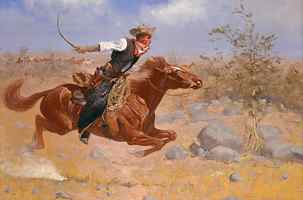
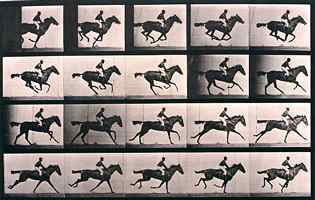
(above left: Frederic Remington (1861-1909), Cowboy,
ca. 1890, oil on canvas, 18 x 24 incches, Private Collection; above
right: Eadweard Muybridge (1830-1904), "Annie G." galloping, Animal
Locomotion, pl. 627, 1884-86, collotype mounted and toned, image: 8
1/4 x 13 inches; sheet: 19 1/8 x 24 1/4 inches, Williams College Museum
of Art, Williamstown, MA Gift of the Commercial Museum, Department of Commerce,
Philadelphia 62.41.42)
Exhibition Overview:
The exhibition will be designed in four sections: The introductory ection will present parallels between the first American films and the popular American artistic traditions of rural genre, landscape, and marine painting. The second section examines the rise of motion photography by Muybridge, Marey, and Eakins and its influence on the concept of the body in art and film in the 1890s. The third section addresses urban motion as it grows out of a cosmopolitan, Impressionist vision and evolves into realist imagery after 1900. The exhibition concludes with the mutual fascination between film and the visual arts in the early days of the new medium.
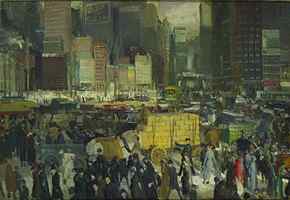
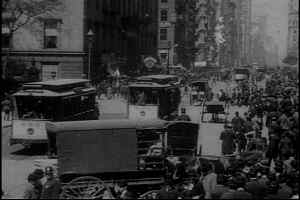
(above left: George Bellows (1882-1925), New York, 1911, oil on canvas, 42 x 60 inches, National Gallery of Art, Washington, D.C., Collection of Mr. and Mrs. Paul Mellon, 1986.72.1; above right: American Mutoscope & Biograph Company, Scene of Lower Broadway, May 1902, 89 feet, Producer: Wallace McCutcheon; camera: Robert K. Bonine, The Library of Congress, Paper Print Collection, neg. no. 2848)
A catalogue, published by Hudson Hills Press, with accompanying compact disk featuring the films, will include contributions by thirteen art and film historians and include essays focusing on the interrelationship of still and moving pictures.
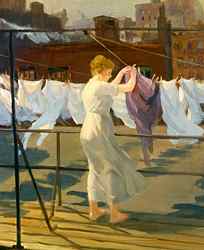
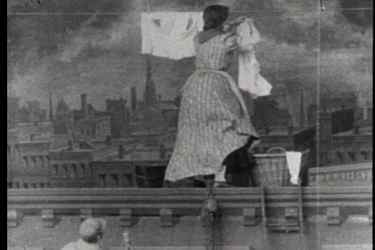
(above left: John Sloan (1871-1951), Sun and Wind on the Roof, 1915, oil on canvas, 24 x 20 inches, (Collection of the) Maier Museum of Art, Randolph-Macon Woman's College, Lynchburg, VA, Fine Arts Fund, 1947; above right: American Mutoscope & Biograph Company, A Windy Day on the Roof, 1904, 25 feet, Producer: n/a; camera: A.E. Weed, The Library of Congress, Paper Print Collection, neg. no. 1299)
"Moving Pictures" is curated by Nancy Mowll Mathews, Eugénie Prendergast Senior Curator of 19th and 20th Century Art, and is part of "American Traditions," an array of programming countywide at cultural, arts, and historical venues based on America's rich and varied heritage. Coordinated with the help of the Berkshire Visitors Bureau, the spring and summer 2005 festival features performances, dance, artwork and exhibitions highlighting a vast range of historical and contemporary aspects of America. For information on "American Traditions" in the Berkshires, visit www.berkshiresarts.org.
This exhibition was funded in part by The Henry Luce Foundation, the Eugénie Prendergast Trust, and the Williams College Center for Technology in the Arts & Humanities (CTAH).
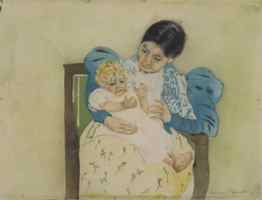
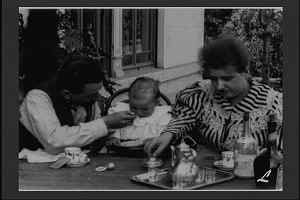
(above left: Mary Cassatt (1844-1926), The Barefooted
Child, ca. 1896-97, Drypoint and aquatint in colors, 9 5/8 x 12 5/8
inches, platemark Brooklyn Museum of Art, New York, NY, Bequest of Mary
T. Cockcroft, 46.103; above right: Cinématographe Lumière,
Feeding the Baby, 1895, 50 feet, Producer: n/a; camera: Louis Lumière,
Archives du Film du Centre National de la Cinématographie, neg. no.
88/ 655)
Related Events
"Moving Pictures" Opening Festival -- July 16, 2005, 4:00-8:00 pm
"Moving Pictures" Symposium -- October 21 - 22
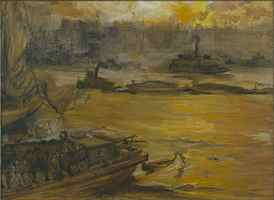
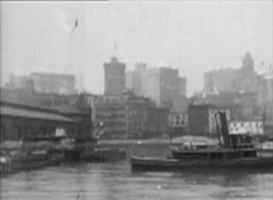
(above left: Everett Shinn (1876-1953), Barges on the
East River, 1898, charcoal and wash on paper, 20 x 27 inches, Private
collection; above right: Edison Manufacturing Company, Panorama Waterfront
and Brooklyn Bridge from East River, 1903, 140 feet, Producer: Edwin
S. Porter; camera: Edwin S. Porter, The Library of Congress, Paper Print
Collection, neg. no. 1799)
rev. 4/29/05
Links to sources of information outside of our web site are
provided only as referrals for your further consideration. Please use due
diligence in judging the quality of information contained in these and all
other web sites. Information from linked sources may be inaccurate or out
of date. TFAO neither recommends or endorses these referenced organizations.
Although TFAO includes links to other web sites, it takes no responsibility
for the content or information contained on those other sites, nor exerts
any editorial or other control over them. For more information on evaluating
web pages see TFAO's General Resources
section in Online Resources for Collectors and Students of Art History.
Read more articles and essays concerning this institutional source by visiting the sub-index page for the Williams College Museum of Art in Resource Library.
Visit the Table of Contents for Resource Library Magazine for thousands of articles and essays on American art.
Copyright 2005 Traditional Fine Arts Organization, Inc., an Arizona nonprofit corporation. All rights reserved.