Editor's note: The Rockwell Museum of Western Art
provided source material to Resource Library for the following article.
If you have questions or comments regarding the source material, please
contact the Rockwell Museum of Western Art directly through either this
phone number or website:
Fusing Traditions: Transformations
in Glass by Native American Artists
May 7 - July 24, 2005
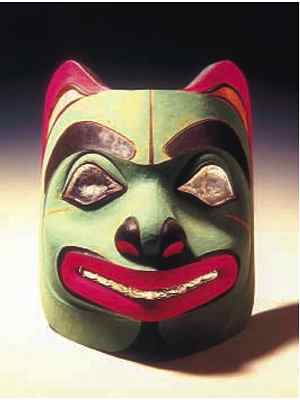
(above: Wayne G. Price, Tingit
Bear Visions, 2002, carved red cedar, glass acrylic, 7 x 7 inches. Photograph
by M. Lee Fatheree, Oakland, CA. Courtesy of Museum of Craft and Folk Art,
San Francisco, CA. Used with permission.)
The Rockwell Museum
of Western Art will present, as one of four special exhibitions this year,
Fusing Traditions: Transformations in Glass by Native American Artists
May 7 - July 24, 2005. Complementing the Rockwell Museum's broad permanent
collection of Native 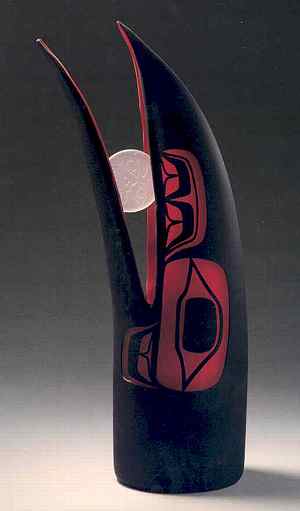 American art,
this exhibition introduces the first generation of Native American studio
glass artists. These eighteen artists fuse cultural heritage and individual
creativity into dazzling new glass forms. This traveling exhibition features
thirty-seven artworks and was organized by the Museum of Craft & Folk
Art (MOCFA) in San Francisco, California. The exhibit will open with a reception
at 5:30 p.m. on Friday, May 6th at the Rockwell Museum.
American art,
this exhibition introduces the first generation of Native American studio
glass artists. These eighteen artists fuse cultural heritage and individual
creativity into dazzling new glass forms. This traveling exhibition features
thirty-seven artworks and was organized by the Museum of Craft & Folk
Art (MOCFA) in San Francisco, California. The exhibit will open with a reception
at 5:30 p.m. on Friday, May 6th at the Rockwell Museum.
Meet the Artists:
Fusing Traditions recognizes
an important artistic movement that began in the 1970s when Tony Jojola
(Isleta Pueblo) first experimented in glass at the Institute of American
Indian Arts in Santa Fe. Most recently, Preston Singletary (Tlingit) realized
his dream when a cedar totem pole with glass and neon components was raised
at the Pilchuck Glass School in celebration of the school's thirtieth anniversary.
Influenced by their experience at the glass school, master carvers Joe David
(Nuu-cha-nulth), John Hagen (Alaskan Native), and Wayne Price (Tlingit),
began to experiment with glass in their subsequent art. This artistic exchange
demonstrates the strength of the ties between the Pilchuck Glass School
and the vigor of the Native American artists who have studied there. The
movement continues, as both Jojola and Singletary teach Native students
in Seattle and Taos. Two of Singletary's students are represented in the
exhibition. The artwork of Robert Tannahill (Mohawk/Metis) and Brian Barber
(Pawnee) have broken with the functional and decorative origins of glass
to create enigmatic and authoritative forms based in their cultural traditions.
Both artists are working in a cultural realm where the visible is not always
legible to the uninitiated, yet even the culturally initiated will find
these figures in glass startlingly new. (right: Preston Singletary,
Raven Steals the Moon, 2002, blown and sand carved glass, 16 1/2
x 9 inches. Photograph by M. Lee Fatheree, Oakland, CA. Courtesy of Museum
of Craft and Folk Art, San Francisco, CA. Used with permission.)
In Fusing Traditions, cultural art forms -- beadwork,
pottery, masks, spindle whorls, dance wands, and hats -- are reinvigorated
and re-imagined. Preston Singletary and Susan Point (Coast Salish) use the
strong Northwest Coast imagery of their cultures to create revolutionary
new glass forms in sand blasted and carved glass. Tony Jojola transforms
pottery shapes into light-filled blown glass vessels. Drawing from American
popular culture, Marcus Amerman's (Choctaw) glass-bead art relocates Native
American art in the twenty-first century. The exhibition also includes the
artwork of Larry Ahvakana (Inupiaq), Michael Carius (Siberian Y'upic), Conrad
House (Navajo), Clarissa Hudson (Tlingit), Ramson Lomatewama (Hopi), Ed
Archie NoiseCat (Salish), Marvin Oliver (Quinalt), Shaun Peterson (Salish),
and C. S. Tarpley (Choctaw). The neon artwork of David Svenson , a non-Native
American, is featured in this exhibition at the request of his students
who honor him. He has been an influential teacher at the Pilchuck Glass
School for many of the Native artists.
Museum of Craft and Folk Art and Exhibit Background:
The exhibition, organized by the Museum of Craft and Folk
Art in San Francisco, California with co-curators Carolyn Kastner and Roslyn
Tunis, will travel for two years. The Los Angeles Museum of Craft and Folk
Art , the Heard Museum in Phoenix, Arizona, the Santa Cruz Museum of Art
and History , the Anchorage Museum of Art and History in Alaska, the Alaska
State Museum in Juneau, Alaska and the Mashantucket Pequot Museum and Research
Center in Connecticut will host the exhibition from 2003 to 2005.
The companion catalogue, Fusing Traditions: Transformations
in Glass by Native American Artists, interprets the cross-cultural development
of these studio artists, who draw from their individual cultural roots to
create a new language of American art in glass. The 92-page catalogue features
a foreword by the distinguished glass artist William Morris, color plates
of the artwork, artist biographies, and four essays. Leading scholars, artists,
and curators trace the history of studio glass art in the United States
and the context of the emergence of this movement in American art. This
catalogue will be available through the Rockwell Museum of Western Art or
the MOCFA website at www.mocfa.org
The Museum of Craft & Folk Art (MOCFA) promotes the
understanding and ppreciation of human expression, ranging from utilitarian
objects to contemporary art. This is accomplished through innovative exhibitions
of craft and folk art from cultures past and present, educational programs,
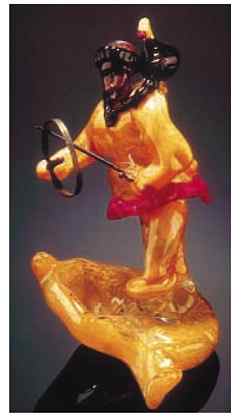
and publications. (left: Michael Carius, Emperor Goose Clan Drummer,
1999, hot sculpted glass, forged steel, 12 x 7 x 6 inches. Photograph by
M. Lee Fatheree, Oakland, CA. Courtesy of Museum of Craft and Folk Art,
San Francisco, CA. Used with permission.)
The Museum of Craft & Folk Art (formerly the San Francisco
Craft & Folk Art Museum) was founded in 1983 and is the only museum
of its kind in northern California. Its unique exhibition program is dedicated
to contemporary craft, American folk art, and traditional cultural art.
For 20 years, the Museum has offered acclaimed exhibitions, educational
programs, and publications dedicated to the understanding of human expression,
ranging from utilitarian objects to contemporary art. The Museum presents
innovative and enlightening exhibitions that challenge conventional definitions
of art. Changing exhibitions are complemented by a gift shop featuring handmade
objects respecting the Museum's focus. The Museum of Craft & Folk Art
School Program offers hands-on presentations that introduce Bay Area children
to the central role of folk art in traditional cultures around the world.
Fusing Traditions has been
generously supported by Dorothy & George Saxe, the National Endowment
for the Arts, and the Art Alliance for Contemporary Glass.
Exhibition wall texts:
- FUSING TRADITIONS
- Transformations in Glass by Native American Artists
-
- You don't have anything if you don't have the stories. - Leslie Marmon
Silko
-
- Fusing Traditions: Transformations in Glass by Native American Artists
features the work of eighteen artists who fuse cultural heritage and individual
creativity in dazzling new glass forms that expand the language of American
art. This first generation of Indian artists working in glass came to the
medium one by one. Together they comprise a powerful artistic movement
rooted in the tradition and place of their Native cultures. As they experimented
with the properties of glass -- its ability to assume any form, its translucence,
its permanence -- each one brought something new to the medium's formal
language. Together they have transformed the genre of glass art. This exhibition,
organized by the Museum of Craft & Folk Art in San Francisco, brings
the work of these artists together for the first time.
-
- The most mature of these artists have been working in glass for more
than twenty years, yet this exhibition marks the first time that their
art has been exhibited together. As a group they are reinvigorating and
re-imagining cultural art forms - beadwork, pottery, masks, spindle whorls,
and dance wands. Inspired by the pottery and basket shapes of the Southwest,
Tony Jojola (Isleta Pueblo) and Ramson Lomatewama (Hopi) create light-filled
blown glass vessels. Jojola also invokes his personal past when he uses
his grandfather's jewelry-making tools to embellish his vessels. Conrad
House's (Navajo) singular vision inspires art for new traditions and rituals,
like that of C. S. Tarpley (Choctaw/Chickasaw), who consciously fuses many
cultures to create his vessels, and Marcus Amerman (Choctaw), who relocates
American Indian beadwork in the twenty-first century by layering images
of American popular culture. Preston Singletary (Tlingit), Susan Point
(Coast Salish), Ed Archie NoiseCat (Salish), Shaun Peterson (Salish), Marvin
Oliver (Quinalt/Isleta Pueblo), and Clarissa Hudson (Tlingit) have adapted
the iconic Northwest Coast imagery to create revolutionary glass forms
that visualize old stories from their cultures. Michael Carius (Siberian
Y'upic) imagines a figure from his Emperor Goose Clan and Larry Ahvakana
(Inupiaq) recreates an icy Arctic landscape in glass. Each artist opens
a window on his or her personal experience and cultural past.
-
- Glass is a fluid medium that by its nature can fuse and meld disparate
ideas, colors, and forms. Furthermore, the collaborative nature of the
hot glass process invigorates the art form as artists assist each other
to bring personal visions to life. In the summer of 2001, David Svenson
(the sole non-Native American included in this exhibition) and Preston
Singletary realized their dreams when a cedar totem pole with glass and
neon components was raised at the Pilchuck Glass School in celebration
of the school's thirtieth anniversary. Influenced by their experience at
Pilchuck, Master carvers Joe David (Nuu-Chah-Nulth), John Hagen (Alaskan
Native), and Wayne Price (Tlingit) began to experiment with glass in their
subsequent art. This artistic exchange demonstrates the strength of the
ties between the Pilchuck Glass School and the Native American artists
who have studied there. The movement continues, as both Jojola and Singletary
teach Native students in Taos and Seattle. Two of Singletary's students,
Robert Tannahill (Mohawk/Metís) and Brian Barber (Pawnee), have
broken with the functional and decorative origins of glass to create enigmatic
and authoritative forms based in their cultural traditions. Both artists
are working in a cultural realm in which the visible is not always legible
to the uninitiated; yet even the culturally initiated will find these figures
in glass startlingly new. The spiritual and artistic power of this first
generation of Native American glass artists is manifest in the vigor of
the second generation.
-
- The artwork presented in this exhibition is alive with relationships
among generations, individuals, and cultures. Each work of art enunciates
the power of cultural heritage. Equally powerful is the community built
in the process of creating this art. Articulating a fusion of culture and
community, these artists are shaping a new language of American art.
-
- - Carolyn Kastner and Roslyn Tunis, co-curators
-
- Fusing Traditions: Transformations in Glass was organized by
the Museum of Craft & Folk Art, San Francisco, California - www.MOCFA.org.
This exhibition has been generously supported by the National Endowment
for the Arts, the Art Alliance for Contemporary Glass, and Dorothy and
George Saxe.
-
-
-
- OBJECT LIST/WALL LABELS
- revised 1/9/03
-
- Larry Ahvakana
- Landscape at Icy Cape
- Fused glass, Kugler glass
- 18 3/8" x 18 3/8" x 1/2"
- 1988
- Collection of Sue Ericsen
-
-
- Marcus Amerman
- Butterfly Maiden
- Cut and seed beads, nylon thread, leather
- 16 1/4" x 14 1/4" x 1 1/2"
- 1984
-
-
- Marcus Amerman
- Killer Necklace
- Peyote-stitched beads, bear claws, cut beads, leather-covered wood
beads
- Necklace: 14" in length, x 2" in diameter
- Earrings: 2" in length
- 2002
-
-
- Brian Barber
- Writings
- Solid worked glass; hand-made book
- Glass: 5" x 3" in diameter.
- Book: 10" x 13" (open position) x 1"
- 2000
-
-
- Brian Barber
- The Breath of Heaven, The Vault of Heaven
- Sandcast glass, oil paint
- 8 1/2" x 6 " x 8" in diameter
- 2000
-
-
- Brian Barber
- The Great Cleansing Ceremony
- Sandcast glass; wood, painted with wax and pigment
- 21 1/4" x 6 1/4" x 1 1/2"
- 2000
-
- Michael Carius
- Emperor Goose Clan Drummer
- Hot-sculpted glass, forged steel
- 9 1/2" x 6" x 8"
- 1999
-
-
- Joe David
- Spirit Wolf
- Cast glass, cedar bark, horsehair,
- painted feathers, cotton, tobacco, string
- 5" x 11" x 7"
- 2001
- Collection of John and Joyce Price
-
-
- John Hagen
- Moonlit
- Cast glass, carved red cedar, neon
- 21 1/4" x 19 1/8" 7 3/4"
- 2002
-
-
- John Hagen
- Soulcatcher
- 11 3/8" x 31" x 5"
- Polychromed wood, cast glass, neon
- 2001
-
-
- Conrad House
- (1956 - 2001)
- Pair of Dancing Sticks
- Sandcast glass (clear series)
- 14" x 3 3/4" x 1 1/4"
- 1988
- Collection of John and Carolyn House
-
- Conrad House
- (1956 - 2001)
- Lightning Prayersticks Protected by Turquoise Mountain Lions
- Pyrex glass rods, sandblasted; ceramic attachments, acrylic,
- turquoise, white shell and heishi beads, abalone, non-endangered
- species parrot feathers
- 11" x 2" x 1"
- 1989
- Collection of John and Carolyn House
-
-
- Conrad House
- (1956 - 2001)
- Mountain Lions
- Sandcast glass: 1 clear series; 1 copper and frit series;
- parrot and flicker feathers, turquoise, white shell
- 12" x 4" x 1"
- 1988
- Collection of Carrie House
-
-
- Clarissa Hudson
- Egyptian Tlingit - Headdress
- Austrian and Czech crystal beads, fire-polished glass beads,
- glass discs, smoked moose hide, base metal discs, seed beads
- 17" x 7" x 7"
- 2002
-
-
- Tony Jojola
- Evening Colors
- Free-blown glass with drawing and stamps
- 13 1/2" x 9"
- 2001
-
-
- Tony Jojola
- Guarding Our Sacred Water
- Free-blown glass with solid bears and stamps
- 6 1/2" x 8 3/4"
- 2001
-
- Tony Jojola
- As Water Serpents Meet
- Free-blown glass with drawing
- 11" x 8 1/2"
- 2001
-
-
- Tony Jojola
- Untitled Olla
- Free-blown glass with basket drawing
- 14" x 13 1/2"
- 2001
-
-
- Ramson Lomatewama
- Matrix of Life Becoming
- Blown glass, 24-karat gold leaf
- 5" x 12" in diameter
- 1997
-
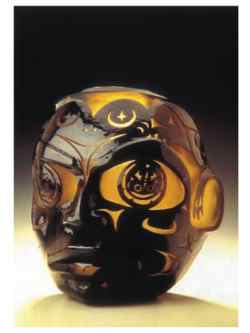
- Ed Archie NoiseCat
- Baby Frog
- Blown and sandcarved glass.
- 11" x 12" x 8"
- 2001 (above left: Ed Archie NoiseCat, Baby Frog, Blown and sandcarved
glass,11" x 12" x 8". Photograph by M. Lee Fatheree,
Oakland, CA. Courtesy of Museum of Craft and Folk Art, San Francisco, CA.
Used with permission.)
-
- Marvin Oliver
- Facing You
- Cast glass, polished dichroic glass, steel
- 28" x 13" x 6 1/2"
- 2002
-
- Shaun Peterson
- Defining Wolf
- Sandblasted glass, carved western red cedar,
- stainless steel, acrylic pigment
- 36" in diameter x 4"
- 2002
-
-
- Susan A. Point
- Mythical Bird
- Slumped and carved glass, painted and carved yellow cedar base,
- painted maple spindle
- 24" x 24" in diameter
- 2002
-
-
- Wayne G. Price
- Tlingit Bear Visions
- Carved red cedar, glass, paint
- 9 1/2" x 6 1/2" x 6 1/2"
- 2002
-
- Preston Singletary
- Raven Steals the Moon
- Blown and sandcarved glass
- 19 3/4" x 8" x 6"
- 2002
-
-
- Preston Singletary
- Blue Fin
- Blown and sandcarved glass
- 17" x 9" x 6"
- 2002
-
-
- Preston Singletary
- Crystal Canoe Grease Dish
- Blown and sandcarved glass
- 16" x 7" x 5"
- 2002
-
-
- Preston Singletary
- Wall Screen Panel
- Fused and sandblasted glass, metal
- 25 3/4" x 33 1/2" x 6"
- 2002
-
-
- David Svenson
- Touched by the Better Angels of Our Nature
- Carved polychromed wood, glass, neon
- Wood figure: 25" x 11" x 11"
- Glass figures: 21" x 8" x 7"; 21" x 7" x 6"
- 1992
-
-
- David Svenson
- Light As a Feather
- Carved polychromed red cedar, neon
- 47" x 10" x 4"
- 2000
-
-
- David Svenson
- Hauberg Totem
- (Prototype for the Pilchuck Founders Totem Pole)
- Wood, cast and blown glass, polychromed argon tube
- Pole: 18 3/4" x 8"
- Glass hat: 5 3/4" in diameter
- 2000
- Collection of Pacific Denkmann Company