Editor's note: The Corcoran Gallery of Art provided source material to Resource Library for the following article. If you have questions or comments regarding the source material, please contact the Corcoran Gallery of Art directly through either this phone number or web address:
Current Evince: Selected Prints by William T. Wiley from the Smithsonian American Art Museum
July 2 - September 12, 2005
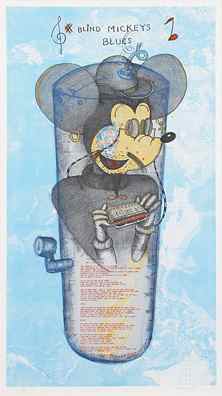
(above: William T. Wiley, born 1937, Blind Mickey's Blues, 1997, color lithograph, 36 x 20 inches (91.4 x 50.8 cm). Smithsonian American Art Museum, Gift of the artist. 2003.68.12)
The Corcoran Gallery
of Art is collaborating with the Smithsonian American Art Museum (SAAM)
to host Current Evince: Selected Prints by William T. Wiley from the
Smithsonian American Art Museum. This unique selection of prints, chosen
from a major gift of 75 prints and 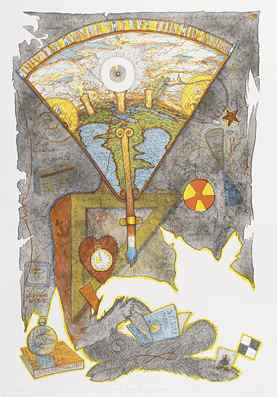 drawings
given to SAAM by Wiley and augmented by selected works on loan from the
artist and from the Corcoran's own permanent collection, offers an intimate
opportunity to engage the highly imaginative imagery and philosophical complexity
of Wiley's art and to admire his unique artistry. The exhibition Current
Evince: Selected Prints by William T. Wiley from the Smithsonian American
Art Museum includes forty-one prints, each laced with Wiley's trademark
layers of design and wry text, will be on view at the Corcoran Gallery of
Art from July 2 - September 12, 2005.
drawings
given to SAAM by Wiley and augmented by selected works on loan from the
artist and from the Corcoran's own permanent collection, offers an intimate
opportunity to engage the highly imaginative imagery and philosophical complexity
of Wiley's art and to admire his unique artistry. The exhibition Current
Evince: Selected Prints by William T. Wiley from the Smithsonian American
Art Museum includes forty-one prints, each laced with Wiley's trademark
layers of design and wry text, will be on view at the Corcoran Gallery of
Art from July 2 - September 12, 2005.
More than 35 years ago, William T. Wiley began printmaking at Jack Lemon's now legendary Landfall Press in Chicago, IL. Since then, he has executed prints regularly, both alone in his studio and in conjunction with various presses and workshops, using his characteristic style to uncover the expressive possibilities of lithography, etching and monotype. In Wiley's earliest work in both painting and printmaking the draftsmanship was controlled and confident, a supple line actively leading the viewer around each of his seemingly improvised and spontaneous designs. Although his artistic style did not evolve radically over time, it does reveal a broadening appreciation of various constituent elements. (left: William T. Wiley, born 1937, Three Mile Island, Three Years Later, 1983, color lithograph, 38 x 27 inches (96.5 x 68.6 cm). Smithsonian American Art Museum, Gift of the artist. 2003.68.15)
As opposed to his style, which appears to have sprung forth almost fully formed, Wiley's imagery has changed significantly as his interests have evolved. He employs an array of symbols drawn from his personal history most notably: the triangle, the figure eight, the tic-tac-toe grid, the dunce's cap, the skull and the black-and-white staff. Sometimes they are arcane references to specific people, such as the connection of the tic-tac-toe design to one of Wiley's artistic inspirations, H.C. Westermann. In other instances, they may simply refer to the artist's attraction to a pleasing shape or motif, as the triangle appears to be sometimes. In either case, these elements take on a referential life of their own as a viewer follows them from work to work and they become a primer of personal history.
These symbols are combined with Wiley's affection for word play in both his titles and his imagery. Wiley's employment of puns, re-combinant words and deliberate distortions are at once his work's most recognizable trait and its greatest disguise. His prints have been called whimsical, wry, mischievous and droll. While they are all of these to some degree, most importantly the prints are contemplative and insightful. The initial smiles of recognition and bemusement at his puns often mask the serious content of Wiley's images. His titles and words fuel the engine of an imagery that transports the viewer toward a serious meditation on the issues of the day.
Many of Wiley's early prints, as with his paintings, are
autobiographical. They are replete with modest personal references. He is
the first 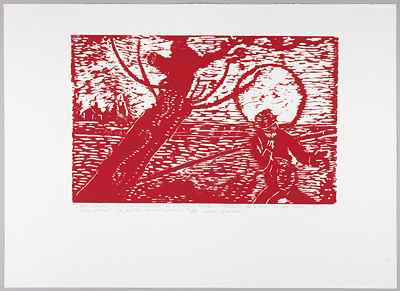 person narrator of
a rich inner landscape, and the grist for his images are his experiences
and his abundant imagination-what he has seen and what he was thinking about
at the time, the reflections and reactions within Wiley's world. On first
glance they seem simple and direct, yet they are often ambiguous, open to
broad interpretation. Whatever layers a viewer penetrates, Wiley's cartoon-
like imagery seduces his audience into a closer examination that compels
us to ruminate on the nature of art and the messages of the artist. (right:
William T. Wiley, born 1937, The Sower after Van Gogh, 1997, color
woodcut, 19 x 26 inches (48.3 x 66.0 cm). Smithsonian American Art Museum,
Gift of the artist. 2003.68.20)
person narrator of
a rich inner landscape, and the grist for his images are his experiences
and his abundant imagination-what he has seen and what he was thinking about
at the time, the reflections and reactions within Wiley's world. On first
glance they seem simple and direct, yet they are often ambiguous, open to
broad interpretation. Whatever layers a viewer penetrates, Wiley's cartoon-
like imagery seduces his audience into a closer examination that compels
us to ruminate on the nature of art and the messages of the artist. (right:
William T. Wiley, born 1937, The Sower after Van Gogh, 1997, color
woodcut, 19 x 26 inches (48.3 x 66.0 cm). Smithsonian American Art Museum,
Gift of the artist. 2003.68.20)
Throughout his career, Wiley has employed humorous word play in both titles and images to explore profound human concerns. For example, in Three Mile Island, Three Years Later, a 1983 color lithograph, the mysterious landscape seen through the gauge suggests the aftermath of America's continued, and perhaps dangerous, attraction to nuclear power. Wiley deploys short phrases and clauses throughout the image, such as "GLOWING ACCOUNTS" that subtly and not-so-subtly allude to the inherent perils of this attraction.
"We are so pleased to be collaborating with the Smithsonian
American Art Museum to host an exhibition honoring such a legendary printmaking
artist whose work is known to challenge, provoke, intrigue and amuse all
at the same time," said Chief Curator Jacquelyn Serwer. "Wiley
has captivated audiences for more than 40 years with his use of news and
political events as the undertone of his work, but also successfully draws
inspiration from art history, literature, comic books and other sources
to create his famous contemporary sociopolitical statements."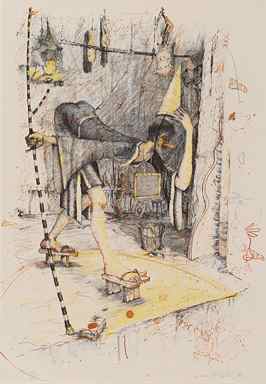
"There is an innate directness to Wiley's work -- he applies his inherent wit and creativity to basic materials to explore very humanistic themes," said Eric Denker, Corcoran Curator of Prints and Drawings. "Wiley's assured draftsmanship and quiet humor draw us into his world, where we pause to marvel at the metamorphosis of symbols and words and images." (left: William T. Wiley, born 1937, Mr. Unatural, 1976, color lithograph on paper sheet: 36 1/8 x 25 inches (91.7 x 63.6 cm). Smithsonian American Art Museum purchase. 1977.8)
Current Evince: Selected Prints by William T. Wiley from the Smithsonian American Art Museum is organized by the Corcoran Gallery of Art, Washington, D.C., and the Smithsonian Art Museum, Washington, D.C. and curated by Eric Denker, Corcoran Curator of Prints and Drawings.
BIOGRAPHY OF WILLIAM T. WILEY
William T Wiley was born in Bedford, Indiana in 1937. He studied at the Institute of Art in San Francisco where he completed a Bachelors of Fine Arts in 1960 and a Masters of Fine Arts in 1962. Since completing his studies in San Francisco, he has taught at the University of California at Davis and appeared regularly in individual and group shows throughout the United States, including major exhibitions in both San Francisco and in New York.
Early on Wiley regularly collaborated with the sculptor
Robert Hudson, both artists being interested in folk art and an intuitive
attitude to the making of art. Wiley's early work was much influenced by
Abstract Expressionism, and especially by Clyfford Still. By the early 1970s,
however, he had begun to make very vibrant, obsessional paintings, prints,
and drawings that combined motifs of pattern-making and text with his own
unique eccentric energy. Wiley developed a painterly language that while
sometimes abstract, frequently contained references to diverse sources of
inspiration, running the gamut from Jungian imagery to Zen Buddhism, from
environmental concerns to art history. His designs are rich with texts that
suggest narrative complexity interspersed with humorous asides. His works
frequently use a figurative style that refers directly to famous artists
of the past.
Resource Library editor's note
RL readers may also enjoy:
and from the Web:
 The Richard
L. Nelson Gallery & The Fine Arts Collection web site features
a panel discussion video that is available for download from its
Archive section. The "You See: Manuel Neri, Wayne Thiebaud
and William T. Wiley" panel discussion was held November 13, 2007
at the Studio Theatre at the Mondavi Center, UC Davis, Moderated by Michael
Schwager, curator of the di Rosa Preserve.
The Richard
L. Nelson Gallery & The Fine Arts Collection web site features
a panel discussion video that is available for download from its
Archive section. The "You See: Manuel Neri, Wayne Thiebaud
and William T. Wiley" panel discussion was held November 13, 2007
at the Studio Theatre at the Mondavi Center, UC Davis, Moderated by Michael
Schwager, curator of the di Rosa Preserve.
Links to sources of information outside of our web site are provided only as referrals for your further consideration. Please use due diligence in judging the quality of information contained in these and all other web sites. Information from linked sources may be inaccurate or out of date. TFAO neither recommends or endorses these referenced organizations. Although TFAO includes links to other web sites, it takes no responsibility for the content or information contained on those other sites, nor exerts any editorial or other control over them. For more information on evaluating web pages see TFAO's General Resources section in Online Resources for Collectors and Students of Art History. Individual pages in this catalogue will be amended as TFAO adds content, corrects errors and reorganizes sections for improved readability. Refreshing or reloading pages enables readers to view the latest updates.
Read more articles and essays concerning this institutional source by visiting the sub-index page for the Corcoran Gallery of Art in Resource Library
Visit the Table of Contents for Resource Library for thousands of articles and essays on American art.
Copyright 2005 Traditional Fine Arts Organization, Inc., an Arizona nonprofit corporation. All rights reserved.