Editor's note: The Baltimore Museum of Art provided source material to Resource Library for the following article or essay. If you have questions or comments regarding the source material, please contact the Baltimore Museum of Art directly through either this phone number or web address:
Henry Ossawa Tanner and the Lure of Paris
December 7, 2005 - May 28, 2006
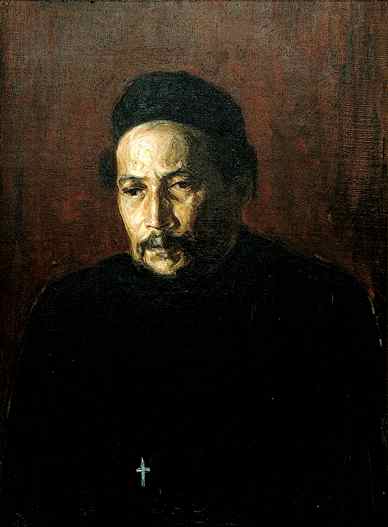
(above: Henry Ossawa Tanner, Bishop Benjamin Tucker Tanner, 1897. The Baltimore Museum of Art: Partial and Promised Gift of Eddie C. Brown, C. Sylvia Brown, and their Children, Tonya Y. Brown Ingersol and Jennifer L. Brown, Baltimore. BMA 2002.561)
The Baltimore Museum
of Art presents the first of two exhibitions on the work and influence of
Henry Ossawa Tanner, one of the most important African-American painters
of the 20th century. Henry Ossawa Tanner and the Lure of Paris, on
view December 7, 2005, through May 28, 2006, brings 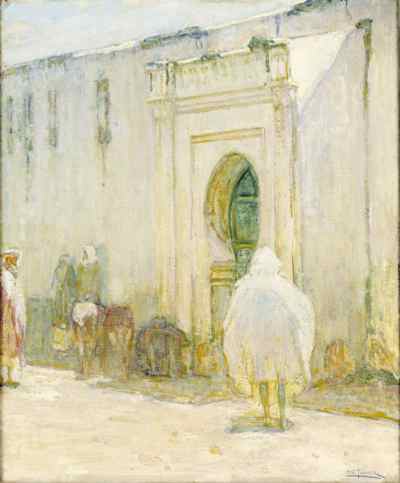 together
works by Tanner -- including major paintings on loan and works recently
acquired by the Museum -- with more than 40 paintings, prints, and drawings
from the BMA's renowned collection of 19th-century French art, including
works by Camille Pissarro, Eugène Delacroix, and Camille Baptiste
Corot. (right: Henry Ossawa Tanner, Near East Scene, c. 1910.
Des Moines Art Center Permanent Collections: Bequest of Edith Kir Perason,
1964.76)
together
works by Tanner -- including major paintings on loan and works recently
acquired by the Museum -- with more than 40 paintings, prints, and drawings
from the BMA's renowned collection of 19th-century French art, including
works by Camille Pissarro, Eugène Delacroix, and Camille Baptiste
Corot. (right: Henry Ossawa Tanner, Near East Scene, c. 1910.
Des Moines Art Center Permanent Collections: Bequest of Edith Kir Perason,
1964.76)
"This is an exciting opportunity to showcase these well-known paintings by Henry Ossawa Tanner alongside works from the BMA's outstanding collection," said BMA Director Doreen Bolger.
Tanner spent most of his career as an expatriate in Paris, where he focused on Biblical and religious subjects, Orientalism, and the French landscape tradition. He visited Egypt and Palestine, where he was inspired to paint religious and Orientalist subjects that fused the exotic, the everyday, and the spiritual. He also spent time with artists in France's Barbizon region, the center of the famous school of plein-air landscape painting, and later painted landscapes near the fishing village of Pont-Aven in Brittany. The exhibition features examples of these paintings and prints alongside works by French artists who likely influenced Tanner during his long and successful career.
In addition to the BMA's Tanner masterpiece Portrait of Bishop Benjamin Tucker Tanner (1897) -- a partial and promised gift presented to the Museum by Baltimore philanthropists Eddie and Sylvia Brown and their daughters in 2002 -- the BMA has added two other works by Tanner to the collection. The Museum has secured a loan of four paintings from the Des Moines Art Center for this exhibition series: The Disciples See Christ Walking on the Water (c. 1907), Christ Learning to Read (c. 1911), Near East Scene (c. 1910), and Le Tonquet (c. 1910), and a loan of The Good Shepherd from Morgan State University's James E. Lewis Museum of Art.
The second exhibition in this series, Henry Ossawa Tanner and his Influence in America, on view June 7 - December 3, 2006, features the Des Moines Art Center paintings along with works by 20th-century African-American artists in the BMA's collection, among them Hale Woodruff, Horace Pippin, and Jacob Lawrence.
This exhibition is guest curated by Dr. James Smalls, Associate Professor of Art History and Theory at the University of Maryland, Baltimore County. He teaches art and visual culture of the 19th and 20th centuries in Europe and America and has written extensively on modern and contemporary black visual culture.
This exhibition is generously sponsored by the Museum Loan Network and M&T Bank. Additional support is provided by the Henry Luce Foundation and Jackie and Freeman Hrabowski.
HENRY OSSAWA TANNER
Henry Ossawa Tanner (1859-1937) was the country's most
celebrated African-American artist at the turn of the 20th century. He was
born in Pittsburgh to 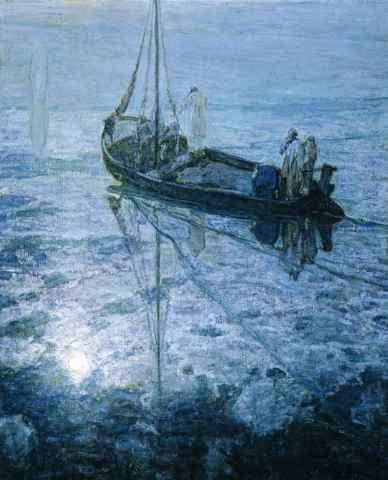 Sarah Tanner, a former slave who had escaped on the Underground
Railroad, and Reverend Benjamin Tucker Tanner, one of the most renowned
intellectual figures in the African-American community in the 19th century.
The family had important ties to Maryland where Bishop Tanner was principal
of the A.M.E. Conference School for Freedman in Frederick and pastor of
the Bethel A.M.E. Church in Baltimore. The family later moved to Philadelphia,
where Tanner enrolled in the Pennsylvania Academy of the Fine Arts and became
the pupil of progressive American artist Thomas Eakins. (right: Henry
Ossawa Tanner, The Disciples See Christ Walking on the Water, c.
1907. Des Moines Art Center)
Sarah Tanner, a former slave who had escaped on the Underground
Railroad, and Reverend Benjamin Tucker Tanner, one of the most renowned
intellectual figures in the African-American community in the 19th century.
The family had important ties to Maryland where Bishop Tanner was principal
of the A.M.E. Conference School for Freedman in Frederick and pastor of
the Bethel A.M.E. Church in Baltimore. The family later moved to Philadelphia,
where Tanner enrolled in the Pennsylvania Academy of the Fine Arts and became
the pupil of progressive American artist Thomas Eakins. (right: Henry
Ossawa Tanner, The Disciples See Christ Walking on the Water, c.
1907. Des Moines Art Center)
Tanner traveled to Paris in 1892 and studied under the French academic painters Jean-Joseph Benjamin Constant and Jean-Paul Laurens at the Académie Julian. He exhibited at the annual Salons and won prizes and recognition for his work. Tanner traveled extensively in Egypt, Palestine, and Italy in 1896 and soon began producing the religious genre and Orientalist subjects for which he is best known. In the last two decades of his life, he achieved international recognition and the admiration of his peers. He achieved one of his greatest distinctions in 1923 when the French government named him chevalier of the Legion of Honor. He died in Paris in 1937.
PROGRAMS
TOURS
With Museum docent; free with Museum admission.
AFRICAN-AMERICAN ART AT THE BMA
The BMA has a long and distinguished record of collecting African-American art that began more than
60 years ago when the Museum presented one of the first exhibitions of works by African-American artists in the country. In recent years the BMA has added more than 30 works by both historical and contemporary artists. The collection includes contemporary works by David Hammons, Kerry James Marshall, Martin Puryear, Allison Saar, Lorna Simpson, Kara Walker, Carrie Mae Weems, and Fred Wilson; important examples of painting and sculpture by Romare Bearden, Elizabeth Catlett, Beauford Delaney, Sam Gilliam, Joshua Johnson, Jacob Lawrence, Horace Pippin, Alma Thomas, and Hale Woodruff; and works on paper by John Thomas Biggers, Gordon Parks, and James Van Der Zee. Among the Baltimore-based artists represented are Carl Clark, Linda Day Clark, Cary Beth Cryor, Robert Houston, Tom Miller, Kenneth Royster, and Joyce J. Scott. Many of these works can be seen on display in the West Wing for Contemporary Art.
Editor's note: Readers may also find of interest:
Read more articles and essays concerning this institutional source by visiting the sub-index page for the Baltimore Museum of Art in Resource Library.
Visit the Table of Contents for Resource Library for thousands of articles and essays on American art,.
Copyright 2003, 2004 Traditional Fine Arts Organization, Inc., an Arizona nonprofit corporation. All rights reserved.