Editor's note: The Norton Museum of Art provided
source material to Resource Library for the following article or
essay. If you have questions or comments regarding the source material,
please contact the Norton Museum of Art directly through either this phone
number or web address:
Betye Saar: Extending the
Frozen Moment
March 18 - June 4, 2006
Betye Saar: Extending
the Frozen Moment is a major exhibition that surveys
the artistic accomplishments of one of the most distinguished figures in
 American art today. On view at
the Norton Museum of Art from March 18 through June 4, 2006, this monographic
exhibition, organized by the University of Michigan Museum of Art, is the
first to focus on the sustained presence of photography-"the frozen
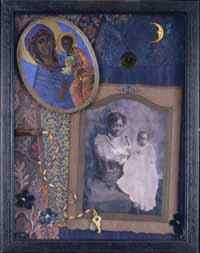
moment" -- as a defining element that unifies Saar's career. (right:
Betye Saar (American, born 1926), Midnight Madonnas, 1996. Mixed
media assemblage, 14 x 11 by 1 1/2 inches. Courtesy the artist and Michael
Rosenfeld Gallery, LLC, New York )
American art today. On view at
the Norton Museum of Art from March 18 through June 4, 2006, this monographic
exhibition, organized by the University of Michigan Museum of Art, is the
first to focus on the sustained presence of photography-"the frozen
moment" -- as a defining element that unifies Saar's career. (right:
Betye Saar (American, born 1926), Midnight Madonnas, 1996. Mixed
media assemblage, 14 x 11 by 1 1/2 inches. Courtesy the artist and Michael
Rosenfeld Gallery, LLC, New York )
Saar is best known for her richly evocative assemblages,
which incorporate found objects and photographic fragments that reflect
her interest in nostalgia, memory, and history and serve as a vital metaphor
for the African American experience. Including 57 works dating from 1967
to 2004 drawn from public and private collections nationwide, the exhibition
offers fresh perspectives on contemporary art, feminism, and American culture
and politics.
"As one of the leading artists of our time, Betye
Saar is central to understanding American art of the last 40 years. Her
use of photography -- one of the most profoundly immediate and powerful
media of the last century -- has allowed Saar to merge the historical, the
personal, and the universal to make art that is transcendent and somehow
remarkably generous," said Christina Orr-Cahall, Director, Norton Museum
of Art.
Born in 1926 in Los Angeles, Betye Saar emerged in the
1960s as a powerful figure in the redefinition of African American identity
in art and in the making of a socially engaged art. Throughout her career,
Saar has injected African American visual histories into mainstream visual
culture by blending cultural, political, and spiritual iconography to create
complex works with universal impact. Saar's innovative and politically trenchant
artwork moves beyond protest to encapsulate what links human beings across
cultures and time. She expresses her interest in the past and in memory
by including vintage portraits and 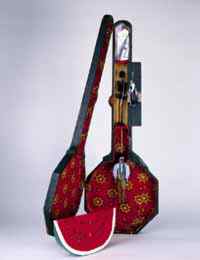 personal
effects in order to challenge stereotypes and reconstruct and reclaim the
identities of those lost to history. (right: Betye Saar (American,
born 1926), Sambo's Banjo, 197172. Mixed-media assemblage, 41
by 14 1/2 x 18 inches. (banjo case); 6 1/2 by 12 3/4 by 2 3/4 inches. (watermelon
slice). Collection California African American Foundation, Courtesy California
African American Museum )
personal
effects in order to challenge stereotypes and reconstruct and reclaim the
identities of those lost to history. (right: Betye Saar (American,
born 1926), Sambo's Banjo, 197172. Mixed-media assemblage, 41
by 14 1/2 x 18 inches. (banjo case); 6 1/2 by 12 3/4 by 2 3/4 inches. (watermelon
slice). Collection California African American Foundation, Courtesy California
African American Museum )
Highlights from the exhibition include Sambo's Banjo
(1971-72), in which the artist transforms a traditional minstrel instrument's
case into a repository of derogatory stereotypes and a commentary on lynching;
Bittersweet (Bessie's Song) (1973), a touching homage to jazz legend
Bessie Smith that incorporates photographs, promotional handbills, and decorative
elements; The Loss (1977), a profoundly personal work that includes
a torn image of her father and herself sewn onto one of her great aunt's
handkerchiefs; Midnight Madonnas (1996), an evocative piece that
merges symbols of the mystical with Christianity and African American legacy;
and Colored (2002), in which the artist creates a visual metaphor
for skin color distinctions by juxtaposing a color spectrum and photographs
of African Americans.
Exhibition Catalog:
The exhibition is accompanied by a 176-page hardcover publication
with 80 color and 10 black-and-white illustrations. Co-published by UMMA
and the University of California Press, essayists include UMMA Director
James Steward; Kellie Jones, Assistant Professor of the History of Art and
African American Studies at Yale University; Lowery Stokes Sims, President
of the Studio Museum in Harlem; Richard Cándida Smith, Professor
of History at the University of California, Berkeley; and Deborah Willis,
Professor of Photography and Imaging at New York University.
Selected Exhibition Programs:
- Marden Gallery Opening
- Saturday, March 18, 2:00 p.m.
- Echoes: Student Responses to the Works of Betye Saar
- Celebrate high school artists from around Palm Beach
County whose works are included in this companion exhibition to Betye
Saar: Extending the Frozen Moment.
-
- Exhibition Lecture Series
- Sunday, March 19, 3:00-4:00 p.m.
- A Conversation with Betye Saar
- Join us for an illustrated conversation with artist Betye
Saar as she discusses her career as well as the subjects and inspiration
for her art. Jonathan Stuhlman, The Harold and Anne Berkley Smith
Curator of American Art, will lead the discussion.
-
- First Saturday Family Studio
- Saturday, April 1, 10:30 a.m.-12:30p.m.
- Mementos of My Family
- Betye Saar's beautiful collages often include images
of families. Take a closer look at her work, then assemble keepsakes
that capture your own life. Bring photos and other memorabilia to
personalize your collage. This studio program is recommended for
children ages 4 12 and their parents. Fee. Call to register:
(561) 832-5196, ext. 1133.
-
- Film: Betye and Alison
Saar: Conjure Women of the Arts
- Saturday, April 1, 1:00 p.m.
- Including footage of the artists working in their studios,
this video examines the personal and artistic relationship between mother
and daughter, two of America's leading artists.
-
- The Exhibition Lecture Series has been generously underwritten
by Harriett M. Eckstein. Family Programs are generously underwritten by
The Sarah Vierck Mettler Family Fund, The Andrea and Charles Brandon Fund
for Families and the Samuel Rosenthal Endowment for Outreach Programs.
Exhibition support:
Betye Saar: Extending the Frozen Moment is organized and circulated by the University of Michigan Museum
of Art. This exhibition has been made possible in part by the National Endowment
for the Arts, The Henry Luce Foundation, The Andy Warhol Foundation for
the Visual Arts and the Peter Norton Family Foundation. Support for the
local presentation of this exhibition is being provided by The Georgene
and Hamish Maxwell Exhibition Endowment and the State of Florida, Department
of State, Division of Cultural Affairs, the Florida Arts Council, and the
National Endowment for the Arts.
Editor's note: RL readers may
also enjoy:
and these VHS tapes:
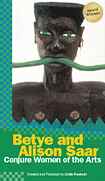
Betye & Alison Saar: Conjure Women of the Arts is a 28 minute L&S video, ISBN 1-882660-06-4, created and produced
by Linda Freeman and written and directed by David Irving, which examines
the personal and artistic relationship between artist Betye Saar and daughter
Alison Saar. The artists' enthusiasm and originality make for an engaging
and wonderful video. It shows both artists working in their studios, discussing
their influences, and collaborating on the installation piece, House
of Gris Gris.
Originals: Women in Art, The:
1977: "This series celebrates some of America's most brilliant women
artists, both past and present. Producer Perry Miller Adato is widely acknowledged
as a leading maker of films on art. In this series she examines the personalities,
lifestyles, and work of those American women whose creative talents have
made valuable contributions to the visual arts... The series includes Spirit-Catcher:
The Art of Betye Saar (28 min) This intriguing film probes the
art, the spirit, the symbols, and the revelations of assemblage artist Betye
Saar. In developing her art, she has had to face the double prejudices of
sexism and racism. What has emerged is the simultaneous penetration of old
and new levels of black awareness. Her constructions use astrology, the
occult, fetishes, and historical photographs." Quotes are from the
Virginia Museum
of Fine Arts.
Links to sources of information outside of our web site
are provided only as referrals for your further consideration. Please use
due diligence in judging the quality of information contained in these and
all other web sites. Information from linked sources may be inaccurate or
out of date. TFAO neither recommends or endorses these referenced organizations.
Although TFAO includes links to other web sites, it takes no responsibility
for the content or information contained on those other sites, nor exerts
any editorial or other control over them. For more information on evaluating
web pages see TFAO's General Resources
section in Online Resources for Collectors and Students of Art History.
Individual pages in this catalogue will be amended as TFAO adds content,
corrects errors and reorganizes sections for improved readability. Refreshing
or reloading pages enables readers to view the latest updates.
Read more articles and essays concerning this institutional
source by visiting the sub-index page for the Norton
Museum of Art in Resource Library.
Visit the Table
of Contents for Resource Library for thousands
of articles and essays on American art.
Copyright 2006 Traditional Fine Arts Organization, Inc., an Arizona nonprofit corporation. All rights
reserved.