Editor's note: The Montclair Art Museum provided source material to Resource Library for the following article or essay. If you have questions or comments regarding the source material, please contact the Montclair Art Museum directly through either this phone number or web address:
Jaune Quick-to-See Smith: Made in America
September 17, 2006 - January 14, 2007
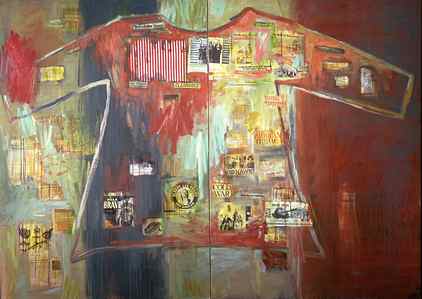
(above: Jaune Quick-to-See Smith, War Shirt, 1992, oil and mixed media collage on canvas diptych. Collection of the Montclair Art Museum. Museum purchase; funds provided by Tamar and Emil Weiss and prior gifts of Roland B. Swart 1937.27 a - b)
Jaune Quick-to-See
Smith: Made in America opens at the Montclair
Art Museum (MAM) on Sunday, September 17th and will remain on view through
January 14, 2007. Jaune Quick-to-See Smith uses humor
and satire to examine myths, stereotypes, and the paradox of American Indian
life in contrast to the consumerism of American society. Her work
is philosophically centered by her political activism and strong American
Indian spirituality. The exhibition 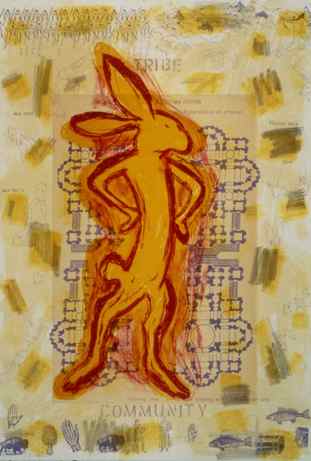 includes
34 pieces of her work over the last decade in drawing, printmaking, painting,
and mixed-media installation. (right: Jaune Quick-to-See Smith, Tribe
Community from Survival suite, 1996, Lithograph, Master printer
Michael Sims, Lawrence Lithography Workshop; published by Zanatta Editions
Courtesy of TREX (Traveling Exhibition Program of the Museum Services, Division
of the New Mexico Department of Cultural Affairs)
includes
34 pieces of her work over the last decade in drawing, printmaking, painting,
and mixed-media installation. (right: Jaune Quick-to-See Smith, Tribe
Community from Survival suite, 1996, Lithograph, Master printer
Michael Sims, Lawrence Lithography Workshop; published by Zanatta Editions
Courtesy of TREX (Traveling Exhibition Program of the Museum Services, Division
of the New Mexico Department of Cultural Affairs)
Born in 1940 on the Flathead Reservation in Montana to Flathead Salish, French-Cree, and Shoshone parents, Quick-to-See Smith became an artist while in her 30s and was earning a living as a painter before she completed her master of fine arts degree at the University of New Mexico in Albuquerque. By the mid-1970s, she had founded artists groups, curated exhibitions, and organized grassroots protests to express concern for the land and its Native people. She has developed a distinctive modernist style over the past 35 years, in a variety of techniques, Quick-to-See Smith has received international critical acclaim through more than 75 solo exhibitions and numerous international shows.
Smith's politically-loaded subject matter ranges from cowboys and Indians to McDonald's and consumerism, reservation life, and war.According to Quick-to-See Smith, "Everything in America is for sale including land, water, air and elections" That's why she includes money signs in her paintings as did Andy Warhol, but she adds other iconic forms such as ancient petroglyphs in her works to reflect both Western and Native cultures.
Twig Johnson, Curator of Native American Art, will coordinate the MAM presentation of the show. Johnson is also inserting selected works by Smith in some of the Museum's Permanent Collection Galleries which will provide visitors with opportunities to consider contemporary Native American creativity, with early Native American easel painting of the 1930s, and 18th and 19th century American portraits, and Native American art and ethnographic objects. Ms. Johnson proudly talks about Smith's work, "we are thrilled to be hosting such an important exhibition. Jaune Quick-to-See Smith's work reflects MAM's mission... her work always stimulates, teaches, and inspires." The Museum will display Smith's Tribal Map, 2001 #2 in its gallery of 18th and 19th century art, alongside portraits by Gilbert Stuart and John Singleton Copley. Smith's map of the United States includes names of Native American tribes in their "home" states, many which are not federally recognized, or are extinct as a result of European contact. This large work (80 x 120 inches) will provide a unique opportunity for visitors to consider the role of U.S. policies on Native American history.
A fully-illustrated catalogue will accompany this show with an essay by exhibition organizer and Director of the Harwood Museum of the University of New Mexico Charles Muir Lovell.
The exhibition was organized in 2003 by Charles Lovell, Director of the Harwood Museum of the University of New Mexico, in Taos, for the Belger Arts Center for Creative Studies at the University of Missouri in Kansas City, and is circulated to MAM by TREX: the Traveling Exhibitions Program of the Museum of New Mexico.
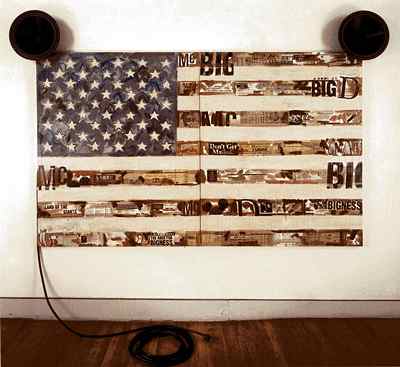
(above: Jaune Quick-to-See Smith, McFlag, 1996, oil and mixed media on 2 panel canvas with speakers and electrical cord, 60 x 100 inches. Courtesy of TREX (Traveling Exhibition Program of the Museum Services, Division of the New Mexico Department of Cultural Affairs)
MAM'S NATIVE AMERICAN COLLECTION
The Native American collection comprises more than 4,000 ethnographic and fine art objects, representing cultural developments of peoples in the major areas in the United States: the Northwest Coast, California, the Southwest, the Plains, the Woodlands, the Southeast and the Arctic. The collection spans the period of 1200 A.D. to the present day, with the core focus being on works of the 19th and 20th centuries. The collection includes a wide range of clothing, household items, jewelry, tools, weapons, and ritual and decorative objects. It is particularly distinguished for its California basketry and Plains material.
Arranged by geographic area, the ceremonial and utilitarian objects in the collection reveal the enormous range of traditions and artistic styles that emerged from each cultural group - from Navajo silver to Plains-Sioux beadwork, Haida carvings to Pomo basketry. The collection also sheds light on the influence that the Europeans had on Native American artwork, both in the materials they brought, such as metals, glass beads, silk and cotton, as well as their design motifs. Recent works by artists who reinterpret traditional Native American arts as well as by those working in contemporary mediums and subject matter reveal how this art form has evolved. Following are highlights of the collection:
RL readers may enjoy:
July 12, 2006 update from the Museum: Jaune Quick-to-See-Smith will open
on September 16th instead of the 17th.
Read more articles and essays concerning this institutional source by visiting the sub-index page for the Montclair Art Museum in Resource Library.
Visit the Table of Contents for Resource Library Magazine for thousands of articles and essays on American art.
Copyright 2006 Traditional Fine Arts Organization, Inc., an Arizona nonprofit corporation. All rights reserved.