Editor's note: The Tampa
Museum of Art provided source material to Resource
Library for the following article or essay. If you have questions or
comments regarding the source material, please contact the Tampa Museum
of Art directly through either this phone number or web address:
What Does This Mean? The
Narrative Tradition
July 22 - October 1, 2006
This summer and early
fall the Tampa Museum of Art will showcase What Does This Mean? The Narrative
Tradition, the last in a series of three special exhibitions organized
to provide visitors with an opportunity to engage in issues and ideas raised
by the museum's permanent collection. What Does This Mean? The Narrative
Tradition, on view July 22 - October 1, 2006, will encourage visitors
to actively look at how we construct meaning from such elements as images,
words, associations, and metaphors.
This exhibition series was made possible by a 2004 Museums
for America grant from the Institute of Museum and Library Services (IMLS).
According to Tampa Museum of Art Interim Executive Director Ken Rollins,
"The Tampa Museum of Art is honored to have been selected for this
prestigious award and we look forward to applying the information we learn
to our mission of promoting lifelong learning."
The 56 works of art featured in this exhibition will encourage
visitors to identify the processes of construction and deconstruction that
often take place in understanding artwork. Because artists choose a
variety of methods to construct narratives and visual literacy in their
work, sub-themes such as "What are the Ways to Construct a Story?,"
"What Happened?," and "Fact or Fiction: Is It Real, Imaginary,
or Fake?" are also explored. Core objects from the museum's permanent
collection and outside loans from regional collections such as The John
and Mable Ringling Museum and the Margulies Collection in Miami, as well
as prominent national museums and galleries, will fill the exhibition.
Some artists juxtapose words with pictures to invoke a
reaction or question a viewer's interpretation of images, such as the photographs
of Duane Michals and Barbara Kruger, or the prints of Carrie Mae Weems.
Other artists, like Jenny Holzer, use words alone as the subject of their
artwork. Still other artists rely simply on images to imply a story,
such as Eric Fischl and Ruth Orkin. Video by Tony Oursler and photographs
by James Casebere and Jerry Uelsmann will explore artifice through photographic
sets and models while surrealist images by Kenny Scharf and Joel-Peter Witkin
will offer alternative realities.
The Narrative Tradition also
will be explored through scenes depicted on Greek vases from the museum's
permanent collection of Greek and Roman antiquities. These narrative scenes
and mythological creatures represent aspects of Greek mythology first recorded
in Greek literature.
"Organizing three exhibitions within a one-year period
has provided fascinating opportunities for the museum to explore and refine
topical themes, to assess the future directional growth of the museum's
collections, and to develop and critique winning installation designs,"
says Elaine D. Gustafson, director of exhibitions &collections and curator
of contemporary art. The IMLS grant also provides the Tampa Museum of Art
with the opportunity to develop different interpretative media from
label copy and interpretative tours to participatory activity stations
all of which allow the museum to explore how people experience art exhibitions.
The IMLS exhibition series began with Why Was This Made?
Understanding Form and Function (April 17 July 10, 2005), followed
by Who Am I? Exploring Identity (October 9 January 8, 2006).
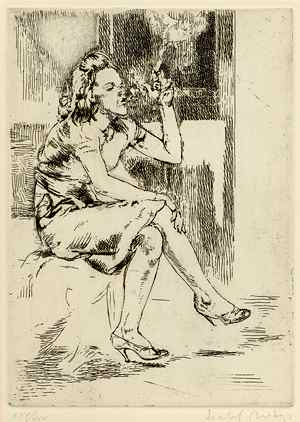
(above: Isabel Bishop (American, 1902-1988), Blowing
Smoke Rings, after 1950. Etching. Tampa Museum of Art. Gift of the Sybiel
B. Berkman Foundation 2000.51)
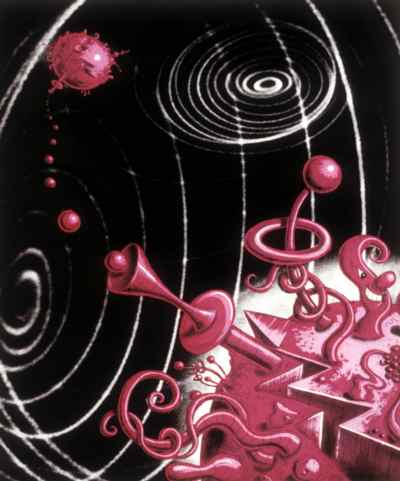
(above: Kenny Scharf (American, born 1958), Galaxiverse,
1998. Two-color line etching and aquatint print on paper. Tampa Museum
of Art. Gift of Jeanne Rozier Winter 2000.17)
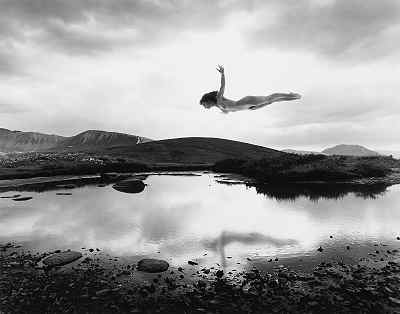
(above: Jerry Uelsmann (American, born 1934), Untitled
(Flying Figure). Silver gelatin print. Tampa Museum of Art. Museum purchase
in honor of Benjamin E. Norbom, President of the Board,1988-1989 1989.37)
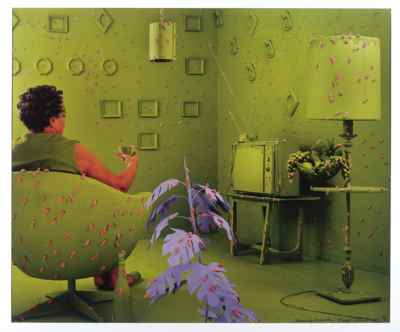
(above: Sandy Skoglund (American, born 1946), Germs are
Everywhere, 1986. Dye destruction/ cibachrome. Tampa Museum of Art.
Bequest of Edward W. Lowman by exchange 1989.21)
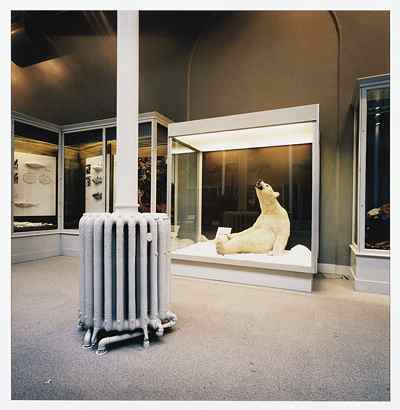
(above: Richard Ross (American, born 1947), Polar Bear, Royal Scottish
Museum, Edinburgh, Scotland, 1995. Color coupler print. Tampa Museum
of Art. Museum Purchase with funds provided by the Frank E. Duckwall Endowment
Fund within the Community Foundation 2001.27)
NARRATIVE LABELS FROM THE EXHIBITION
Theme One: What are the Ways to Construct a Story?
- Shusaku Arakawa (Japanese/American,
born 1936)
- The Sharing of Nameless,
1984-86
- Color lithograph and screen print with embossing
- Edition 47 of 60
- Tampa Museum of Art. Gift of Mr. and Mrs. Franzblau 1987.1
-
- Arakawa and his wife Madeline Gins work in many printmaking
media as well as in filmmaking, video, sculpture, painting, and architecture.
They typically meld the disciplines of physics, metaphysics, phenomenology,
semiotics, and philosophy in their work to examine human thought. This
print explores human awareness through its use of color, line, text, and
graphics.
-
-
- Abel Barroso (Cuban, born
1971)
- Tabaco con ideologia (Cigars
with Ideology), 2001
- Handmade Spanish cedar bas-relief "cigar box"
with
- woodblock print (inside lid) and lithograph scroll-print
- (inside box) viewed by turning two hand-carved crank
- handles
- Edition XXXV/XLX
- Courtesy of Sara and Mort Richter
-
- A meticulous craftsman, Barroso creates playful works
that often invite the viewer to interact. In this work he combined printmaking
with sculpture to produce a biting and humorous commentary on contemporary
Cuban life. Tabaco con ideologia (Cigars with Ideology) is an authentic
cedar cigar box carved by the artist that contains a scroll that can be
hand-cranked to reveal in sequence a story of Cuba, the United States and
cigars. It also serves as a poignant reminder of the deep historical ties
between Tampa and Cuba, particularly the once-thriving cigar industry that
existed in Ybor.
-
-
- Jean-Michel Basquiat (American,
1960-1988)
- 1960 Yellow Door, 1983
- Oil, oil stick, color Xerox on paperboard collage with
metal collage and collaged wood on painted door with nails
- Courtesy of Maureen and Doug Cohn
-
- Basquiat extracted subject matter from personal experiences,
art history, African-American history, politics and pop culture. He painted
loosely, often depicting skeletal figures and mask-like faces that expressed
his obsession with mortality. Other frequently depicted imagery such as
cars, buildings, police, children's sidewalk games, and graffiti came from
his experience living on the streets of New York City. With its complex
iconography and integration of text and images, his artwork is not only
unique but enigmatic as well. The artist once said "I would cross
out words so you'll see them more. The fact that they are obscured makes
you want to read them."
-
- The surface of 1960 Yellow Door is dense with
writing and seemingly unrelated imagery, some of it collaged onto the painting's
surface. The overall composition reveals Basquiat's strong interest in
his black and Haitian identity as well as his identification with historical
and contemporary black figures and events.
-
-
- Alexander Calder (American,
1898-1976)
- Untitled (Circus Performers),
about 1930s
- Watercolor and ink
- Tampa Museum of Art. Gift of Regina O'Brien 2000.44
-
- In 1923 Alexander Calder took a job illustrating for
the National Police Gazette, which sent him to the Ringling Brothers and
Barnum & Bailey Circus to sketch circus scenes for two weeks in 1925.
The circus thereafter became a lifelong interest of Calder's.
-
- This watercolor is a significant example of Calder's
favorite motif and illustrates his talent for conveying narrative through
the simple means of line and color washes. Unbroken lines not only delineate
the circus performers but also convey their movements and energy. The drawing
has a light, humorous feeling to it, which is likewise characteristic of
Calder.
-
-
- Jim Campbell (American, born
1956)
- Suite of four prints, 2003
- Dynamism of an Automobile (after Luigi Russolo)
- Dynamism of a Cyclist 2001 (after Umberto Boccioni)
- Dynamism of a Cow
- Dynamism of an Observer in the Weeds
- Digital inkjet prints
- Edition 29 of 50
- Tampa Museum of Art. Gift of Ina Schnell 2006.23.1-.4
-
- To create these four images, Jim Campbell fed 2-3 minutes
of video or film imagery through a computer, collected every "bit"
of information, and then printed it all at once into a still photograph.
The result is a blurring effect that gives the appearance of motion. The
images are updated variations on Italian Futurism (an art movement in Italy
in the 1920s that sought to capture the dynamism of life in a still image)
and also related to quantum physics' Heisenberg Uncertainty Principle.
As the viewer attempts to move closer to the images to bring them into
focus, they become less legible as the distance decreases. As a result
tension exists between the content of the print s and their surfaces.
-
-
- Lesley Dill (American, born
1950)
- Poem Dress of Circulation,
1994
- Multimedia assemblage lithographed
- USF Proof
- Courtesy of the University of South Florida Contemporary
Art Museum
-
- Lesley Dill pairs fragments of poetry by Emily Dickinson
with her own images of the human body to generate thought-provoking works
of art. By combining words with images, the fragile with the indestructible,
the handmade with the mass-produced, Dill creates evocative works of art
that suggest elusive, layered meanings. In addition to the text, part of
Poem Dress of Circulation's emotional effect is derived from the
image of the heart and the vein-like offshoots. The wrinkled dress that
the text is printed on suggests the seemingly fragile yet resounding effects
that the spoken word can have.
-
-
- Howard Finster (American,
1916-2001)
- Elvis at Three and a Half,
1991
- Serigraph
- Edition 84 of 90
- Tampa Museum of Art. Gift of Ray Kass 1992.31.1
-
- One of the most noted folk artists of the 20th century,
Reverend Howard Finster was both an artist and an unabashed Baptist evangelist.
It is through his artwork that he preached. In his images -- essentially
painted sermons -- Finster included exuberant religious text along with
apocryphal signs and colorful popular culture icons as a way to spread
the word of God.
-
-
- Simone Gad (Belgian/American,
born 1947)
- Esther Williams Water Ballet,
1980
- Mixed media
- Tampa Museum of Art. Gift of the artist in memory of
Jimmy Spheeres, John Gilston, and Monique Girard 1984.68
-
- Since the early 1970s Simone Gad has explored the subject
of Hollywood stars in both visual and performing art. (Gad grew up the
daughter of an over-demanding stage mother who initiated her daughter's
show-biz career at the age of 4.) Her early tableau-installations show
her interest in combining found objects, mannequins, and Pop themes to
create unique visual statements that relate to the life or image of the
star depicted.
-
- Composed of a child's wading pool, water toys, and a
sunburned mannequin relaxing with her toy poodle on an ironing board (as
opposed to a diving board) and wearing dark sunglasses and a camera around
her neck, this kitschy expressionist/pop assemblage is a tribute to 1950s
Hollywood icon Esther Williams, as well as to the human spirit that continues
to keep going even when it appears pointless. The installation ultimately
serves as both a celebration and parody of stardom and America's obsessive
fascination with it.
-
-
- David Hockney (British, born
1937)
- Christopher Isherwood Talking to Bob Holman, Santa
Monica,
- March 14, 1983, 1983
- Collage of 98 color photographs
- Courtesy of The John and Mable Ringling Museum of Art,
Museum purchase, 1986 SN8970
-
- In the early 1980s, Hockney began experimenting with
the camera, making large composite images of Polaroid photographs arranged
in a rectangular grid format. Later, as here, he used regular 35-millimeter,
commercially processed color prints to create photocollages, compiling
a 'complete' picture from a series of individually photographed details.
The subject would actually move while being photographed so that the piece
would show his/her movements seen from the photographer's perspective.
(In later works Hockney changed his technique and moved the camera around
the subject instead.) Because these photos were taken at slightly different
times and show movement, the resulting image has an affinity with cubism
and the way human vision works. The impression is that the viewer is in
the room, witnessing the narrative.
-
-
- David Hockney (British, born
1937)
- Panama Hat, 1972
- Etching and aquatint
- Edition IX/L
- Courtesy of Dr. Bernard and Sharon Stein
-
- David Hockney is an English painter, draftsman, printmaker,
filmmaker, and set and costume designer known for his penetrating portraits
of contemporary personalities and depictions of the lifestyle and landscape
of Los Angeles. His large body of graphic work, concentrating on etching
and lithography, in itself justifies his important place in modern British
art.
-
-
- Barbara Kruger (American,
born 1945)
- Untitled (Who will write
the history of tears?), 1991
- Photographic silkscreen on vinyl
- Courtesy of The John and Mable Ringling Museum of Art,
Museum purchase, 1991 MF 91.1
-
- Barbara Kruger assimilates information taken from popular
culture and the mass media and combines it into bold artworks that critique
gender roles and power structures. Relying on the graphic punch of strong
reds and blacks, terse language, and aggressive design, Kruger confronts
the viewer with provocative ideas and witty reversals.
-
-
- Rebecca Sexton Larson (American,
born 1959)
- Lost Letters, 1996
- Oil on gelatin silver print on paper
- Tampa Museum of Art. Gift of Gregg Thomas, Chairman's
Annual Gift 1999.15
-
- Rebecca Sexton Larson utilizes the written word in combination
with photographic images to create powerful narratives that examine family
structures and personal relationships. Unlike most photographers, Larson
paints over her images and occasionally stitches poignant text onto their
surfaces with thread. Because Larson uses a pinhole camera, her images
have a soft, ethereal quality rather than sharp details, a by-product of
the long exposure time needed. This quality is further embellished by the
application of oil paint (applied with Q-tips and cotton balls) and pencil.
Here, two photographs have been juxtaposed to evoke a narrative. The items
depicted-old love letters, a vintage photograph, the exterior of a house,
a dress, and elements of nature ---all relate to her personal history and
memories, but are also universal. As Larson creates layers of images, paint
and text, she investigates the impact of time and context in understanding
the past.
-
-
- Roy Lichtenstein (American,
1923-1997)
- As I Open Fire (Triptych),
1966
- Offset lithographs
- Unnumbered edition
- Courtesy of Vincent and Sylvia Sorrentino
-
- Famous for his Pop art style that he developed in the
early 1960s, Roy Lichtenstein typically depicted banal objects of modern
commerce and mass media, such as enlarged comic strips showing printing
with Ben-day dots, talk balloons, and exclamations. His works usually are
large scale, employ a limited color scheme (the primaries), and are depicted
in thick outlines and in a neutral deadpan manner. Most of his best-known
works are close, but not exact, copies of comic book panels, a subject
he largely abandoned in the mid-1960s. This three-part print features a
fighter aircraft firing its guns in a dazzling red and yellow fury. Rather
than actually depicting the subject matter, Lichtenstein shows it the way
mass media would portray it. The cartoon style is heightened by the use
of the onomatopoetic lettering BRAT! and the boxed captions.
-
-
- Brian Magee (American, born
1942)
- A Song for the Hearing Impaired,
1983
- Gelatin silver print montage
- Tampa Museum of Art. Gift of Anita Suchocki in memory
of Anthony J. Suchocki 1990.38.a-d
-
- This black-and-white photo-collage consists of four panels
that are meant to be read visually in sequence. Known as a rebus, it is
a puzzle composed of words or syllables that appear in the form of pictures.
Each sentence is made up of a series of photographs attached by photo-mount
corners to the backboard. Each panel is read visually from left to right,
with blank spaces indicating the end of each sentence. Unfortunately, the
text still remains a mystery.
-
-
- Henri Matisse (French, 1869-1954)
- Marie-Jose in Yellow Dress,
1950
- Aquatint
- Courtesy of Dr. Bernard and Sharon Stein
-
- After becoming ill with cancer, Matisse frequently worked
from his bed. One of his later projects involved making brush drawings
created with broad sweeps of black with no color and no surface detailing.
In seeking to find an even more dense black for his "monochrome paintings,"
Matisse learned the technique of sugar-lift aquatint. Working on prepared
copper plates he could draw with his brush and the dilute sugar solution
directly on to the plates while seated or in bed. When the plates were
bitten in the acid bath and inked, the stroke created a line of deep intense
black with all the vitality and variation of the touch of the brush.
-
- This aquatint, with its broad but expressive strokes
and unmatched simplicity, is recognized as one of Matisse's greatest prints.
The artist made several impressions of it, apart from the editions he printed
in color.
-
-
- John "Crash" Matos
- K'AM, 1990
- Screenprint
- Edition 2 of 99
- Tampa Museum of Art. Gift of Martin and Estelle Karlin
2003.5
-
- A pioneer of the Graffiti art movement, Matos spray painted
murals on subway cars, basketball courts, and on the walls of buildings
in dilapidated New York neighborhoods. Through these actions, he created
a visual link between street life and established society. K'AM combines
the stylistic approach of graffiti-for example, overlapping compositional
elements at different angles and using text--with Pop art imagery. Like
Roy Lichtenstein, he uses onomatopoetic lettering to heighten the work's
visual impact.
-
-
- Duane Michals (American,
born 1932)
- Christ in New York, 1981
- Gelatin silver print
- Edition 9 of 25
- Tampa Museum of Art. Bequest of Edward W. Lowman by exchange
- 1989.28.a-.f
-
- Duane Michals creates highly personal stories by arranging
photographs into sequences and painting over the images and/or adding text.
The sequenced imagery signify moments in time temporarily interrupted and
encapsilated. These tableaux evoke the passage of time and make real the
invisible reality of relationships, emotions, and fantasies.
-
-
- Kathie Olivas (American,
born 1976)
- Violent Violet, 2000
- Encaustic on wood
- Tampa Museum of Art. Gift of Jim and Barbra Beeler in
memory of James N. Beeler, Sr. 2000.34
-
- Using literary text and imagery that tends to be deeply
feminine, Olivas explores issues of identity in her work. The literary
fragments and obscured text, in combination with the masked "character,"
are meant to evoke a reaction in the viewer, one that is both comfortably
familiar and questionably introspective.
-
-
- Tony Oursler (American, born
1957)
- Colors, 1995
- Video installation
- Courtesy of the Collection of Martin Z. Margulies
-
- Unlike other media artists, Tony Oursler projects video
of talking heads onto sculptural elements. The visitor can listen to part
or all of the dialogue (scripts written by Oursler but performed by others),
and can start at the beginning or come in in the middle. The visitor can't
help but focus on the face, which reflects and spouts a plethora of emotions,
ranging from bliss to awe. At times the talking head seems to be laughing,
at other times, crying. Ultimately it is up to the viewer to determine
what the head is describing and the installation's overall meaning.
-
-
- Hollis Sigler
- If She Could Free Her Heart to Her Wildest Desires, 1982
- 6-color lithographic, folded multiple printed on white
arches cover
- Edition IV/XXXXV
- Tampa Museum of Art. Gift of Jeanne Rozier Winter 2000.24
-
- Paper engineering contributes to this print's interesting
aesthetic and technical effects. If She Could Free Her Heart to Her
Wildest Desires is presented in the form of a pop-up book. When the
book is opened, the treasure chest and wolves "pop up." Sigler's
naive drawing style adds considerable charm to the work, while the print's
overall message addresses feminist issues of desire and fear of fulfillment.
-
-
- Lorna Simpson (American,
born 1960)
- Two Pairs, 1997
- Photogravure
- Edition 11 of 50
- Courtesy of the Polk Museum of Art, Permanent Collection
Graphicstudio Subscription Purchase 1997.18
-
- Lorna Simpson was one of the first artists to explore
text/image art. In her work she tackles issues of identity, gender, and
social dynamics that are generated by the visual clues she provides and
by the viewers's assumptions about them. This particular work is about
looking and piecing together information for comprehension, but at the
same time not being sure of exactly what is being seen. To convey this
idea, Simpson depicted two different pairs of binoculars divided by text.
The binoculars represent both the presence and absence of the figure while
the text dividing the composition delineates various scenarios and the
different ways of interpreting them.
-
-
- Kiki Smith (American, born
1954)
- The Vitreous Body, 2000
- With adapted translation of "The Way of Seeming"
by Parmenides
- Heliorelief (woodcut) on handmade paper with hand cuts
- Edition 9 of 120
- Courtesy of the Polk Museum of Art, Permanent Collection
Graphicstudio Subscription Purchase through the Kent Harrison Memorial
Acquisition Fund 2001.10.1
-
- Known primarily as a sculptor, Kiki Smith has also devoted
herself to printmaking and book art. The recurrent subject matter in all
of Smith's work has been the human body as a repository and metaphor for
knowledge, belief, and storytelling.
-
- Starting in the 1980s, Smith began creating artworks
based on internal organs, cellular forms, and the human nervous system.
The Vitreous Body pairs images of the inner eye with text about
vision and the cosmos by the pre-Socratic philosopher Parmenides. As the
pages turn, the images progress closer and closer to the eye's center.
Throughout, the translucent paper and the cutout pages underscore the theme
of vision. As in all of Smith's art, The Vitreous Body renders the
human body in frank, non-heroic terms, expressing its dual aspects of vulnerability
and strength.
-
-
- Mitchell Syrop (American,
born 1953)
- Lift and Separate, 1984
- Gelatin silver print triptych
- Tampa Museum of Art. Museum purchase, 1990.19.a-.c
-
- Mitchell Syrop embraces the form of advertising, but
only to question it. His photographs look like slick, seductive advertisements,
but it is under this guise that he investigates the way advertisers construct
meaning. Conditioned to the notion that a caption sheds light on the accompanying
image, viewers automatically compare Syrop's short familiar slogan to the
seemingly unrelated pictures. The shifting connections that result expose
the many meanings language and imagery can carry, depending upon their
context. Ultimately the viewer is challenged to find the meaning behind
the piece.
-
-
- Carrie Mae Weems (American,
born 1953)
- Not Manet's Type, 2000
- Photolithograph
- Courtesy of Segura Publishing Company, Inc.
-
- Known for her sometimes biting use of humor, Weems employs
narrative structures and a choreographed cast of props and characters to
explore and disclose stereotypes of race and gender. Weems creates works
of art that relate to or derive from African American culture in order
to comment on racism and difficult topics seldom addressed in mainstream
media.
-
-
- Red-Figure Krater
- A: Battle of Greeks and Amazons, Death of Semele, Dionysos
with Hermes and Nymphs
- B: Dionysos and Ariadne Flanked by Erotes; Naiskos
Scene of Mounted Oscan Warrior Flanked by Two Pairs of Men and Women
- Attributed to the Arpi Painter
- Greek, Apulian, 310-300 BC
- Ceramic
- Tampa Museum of Art. Gift of Mr. and Mrs. C.W. Sahlman
1987.36
-
- This large krater is an excellent example of the Greeks'
gift for using attributes to create a visual narrative. For example, the
bolt of lightning on the top center of the second register symbolizes Zeus,
and the character to the left of center on the bottom register who wears
winged shoes and carries a caduceus wand is Hermes, the messenger
of the gods. The child at the center of the bottom register is surrounded
with bunches of grapes and floral motifs, attributes associated with the
god Dionysos. The costumed character to the far right of the scene is dressed
as a wooly satyr, offering another clue about the story portrayed on the
vase. Combined, these symbols describe a stage production of the myth about
the birth of Dionysos, the god of wine and celebration.
-
- On the other side of the krater mourners are shown at
the shrine of an Oscan warrior. A reclining Dionysos and his consort Ariadne
are depicted on the neck. If the narrative scenes on both sides of the
krater are considered together then this vase was perhaps a funeral offering
to someone who loved to attend the theater and had a particular liking
for the play depicted on the front side of the vase.
-
-
- Statuette of a Bird Actor
- Character from Aristophanes' Birds
- Greek, about 300 BC
- Terracotta
- Tampa Museum of Art. Gift of Mr. and Mrs. William Knight
Zewadski, to be shared jointly with the Michael C. Carlos Museum, Emory
University, Atlanta 1988.34.10
-
- Sometimes a single image can recall an entire story.
This terracotta statuette, for instance, probably represents a chorus member
from the comedy Birds, written by the famous playwright Aristophanes
and produced in 414 BC. The twenty-four-member chorus in Birds was
made up of performers in costumes designed to look like a variety of birds.
Which bird this statuette portrays is hard to say, but as a souvenir, it
would surely have triggered its owner's memory of the entire performance.
-
Theme Two: What Happened?
-
- Milton Avery (American, 1893-1965)
- Fishing Scene, not dated
- Ink on paper
- Courtesy of Dr. Bernard and Sharon Stein
-
- Largely self-taught as an artist and a steadfast admirer
of Henri Matisse and Pablo Picasso, Milton Avery favored simplified forms
and flat, luminous colors over meticulous details. Avery sketched constantly,
and his drawings of family and friends served as the subjects for nearly
all his paintings. This peaceful fishing scene is indicative of Avery's
joyous response to the world around him.
-
-
- Isabel Bishop (American,
1902-1988)
- Girl Blowing Smoke Rings, 1945
- Etching
- Edition XXV/XXV
- Tampa Museum of Art. Gift of the Sybiel B. Berkman Foundation
2000.51
-
- Isabel Bishop was a leading printmaker during the first
half of the 20th century. Her principal subject matter was anonymous, urban,
working-class women, depicted singularly or in groups, as they went about
their everyday activities in New York City. Along with fellow artists Kenneth
Hays Miller and Reginald Marsh, she captured the character and fleetingness
of such everyday events as taking the subway or eating at a lunch counter.
However her insight and ability to capture the unspoken language of the
human face and body rendered her work unique. Looking at Girl Blowing
Smoke Rings, one easily perceives the woman's pensive mood.
-
-
- Isabel Bishop (American,
1902-1988)
- Girls at Counter, about 1940s
- Etching with gray wash
- Tampa Museum of Art. Gift of the Sybiel B. Berkman Foundation
2000.54
-
-
- Eileen Cowin (American, born
1947)
- Untitled (The Bathers), 1987
- Dye destruction print (Cibachrome)
- Tampa Museum of Art. Bequest of Edward W. Lowman by exchange,
1989.22
-
- The narrative behind this image is left to the viewer's
imagination. The female figure, inspired by the 19th-century painting of
a Turkish bather by the French painter Jean-Auguste-Dominique Ingres (Nude
from the Back), appears as a voluptuous yet vulnerable object of desire.
The man is a stock character from a film noir. The high-gloss black background
both isolates and connects the two figures, whose self-conscious poses
and parallel relationship suggest the tribulations of contemporary life.
The mystery and disquiet of the drama forces the viewer to bring personal
experience to the issues the drama suggests -- for example, male/female
relationships, alienation, aging, joy, and pain.
-
-
- Louise Dahl-Wolfe (American,
1895-1989)
- Night Bather I, 1939 (printed
in 1983)
- Gelatin silver print
- Tampa Museum of Art. Gift of Mr. and Mrs. William Knight
Zewadski 1991.45.2
-
- One of America's foremost fashion photographers, Louise
Dahl-Wolfe worked for Harper's Bazaar, Vogue, Vanity Fair,
and Sports Illustrated, among others. She spent most of her career
documenting haute couture and photographing celebrities, and thus
helped to define the post war look of American women: spirited, sophisticated,
and above all, independent.
-
- Dahl-Wolfe is known for taking her models out of the
studio and into the real world, where they struck natural, comfortable
poses and interacted with their environment. Here the model ironically
mimics the pose of the sculpture in the foreground. Like the classical
figure (Aphrodite, the goddess of beauty?), she appears to have been caught
unaware.
-
-
- Eric Fischl (American, 1948)
- Untitled (Woman with Dog),
1989
- Aquatint etching
- Edition 52 of 100
- Courtesy of Vincent and Sylvia Sorrentino
-
- Much of Eric Fischl's work deals with the anxiety and
discontent found in suburbia. Fischl's provocative images suggest narrative
stories, but obliquely and dispassionately. His figures are engaged in
dramatic scenarios that oftentimes bear overt sexual overtones. Equally
important, their relationships are unclear. As a result, the viewer feels
like a voyeur, a reluctant and embarrassed witness who must construct meaning
behind these powerful, psychological vignettes.
-
-
- Gladys Shafran Kashdin (American,
born 1921)
- Card Players (Rainy Sunday),
1945
- Oil on canvas
- Tampa Museum of Art. Gift of Gladys Shafran Kashdin,
Ph.D.
- in honor of Ruth and R. Andrew Maass 2000.011
-
- Gladys Kashdin's themes and styles have evolved throughout
her career, ranging from social realist and abstract expressionist works
to those based on philosophy, mythology, and ecology. This early painting
shows the influence of cubism and the social realist movement popular in
America in the mid-20th century. The two men are engaged in a common social
activity for adults in post-WW II America.
-
-
- Fletcher Martin (American,
1904-1979)
- The Rural Family, 1934
- Oil on wood
- Courtesy of Dr. Bernard and Sharon Stein
-
- Fletcher Martin was one of many artists who worked for
the government's Works Progress Administration (WPA) during the Great Depression.
United by a desire to use art to promote social change, these artists sympathized
with the labor movement and with the plight of the rural poor. Many were
inspired by artists of the Mexican mural movement; Martin, himself, was
influenced by David Alfaro Siqueiros, whom he assisted on a mural project.
-
- The Rural Family sensitively
draws upon the lives and struggles of the farming community. Although Martin's
artistic skills were largely self-taught, he taught art at the University
of Florida as well as the State University of Iowa, the University of Minnesota,
San Antonio Art Institute, and Washington State University.
-
-
- Ruth Orkin (Americna , 1921-1985)
- American Girl in Italy, 1952
(printed 1980)
- Gelatin silver print
- Courtesy of The John and Mable Ringling Museum of Art,
Gift of Paulette and Kurt Olden, 1986 MF86.53
-
- American Girl in Italy is
Ruth Orkin's best-known image. A photojournalist for many major magazines
including Life, Look, Horizon, and Ladies Home
Journal, Orkin traveled to Israel in 1951 on assignment with the Israeli
Philharmonic. After living in Israel for a few months, she continued her
travels in Italy. In Florence, she met an art student in her hotel who
became the subject for a picture story titled "Don't Be Afraid to
Travel Alone." Orkin shot this timeless image at the Piazza del Repubblica.
The photograph originally appeared in Cosmopolitan in September
1952, but is known throughout the world today.
-
-
- Luis Gonzales Palma (Guatemalen,
born 1957)
- El Reves de las Entrega (The Opposite of the Surrender), 2005
- Kodalith film, silver leaf, red paper and resin
- Edition 3 of 10
- Tampa Museum of Art. Museum purchase with funds provided
by the Frank E. Duckwall Endowment within the Community Foundation 2005.20
-
- This image mixes the realism of a photographic likeness
with obscure narrative to create the impression of witnessing a dramatic
moment in time. By posing his subjects in theatrical ways and transforming
them with the addition of angel wings, thorns, roses, etc., Palma crafts
mythic worlds that transcend time and place. In the past, he has torn,
colored, and otherwise defaced his photographic prints to convey meaning
as well. Here he uses silver leaf and encases the entire photograph in
resin. The overall impression is of a young girl molded by sorrow and pain.
-
- Richard Ross (American, born
1947)
- Polar Bear, Royal Scottish Museum, Edinburgh, Scotland, 1995
- Color coupler print
- Edition 3 of 25
- Tampa Museum of Art. Museum purchase with funds provided
by the Frank E. Duckwall Endowment Fund within the Community Foundation
2001.27
-
- Museums can be viewed as modern temples of learning or
old-fashioned repositories. This paradox intrigues Richard Ross, who uses
photography to focus on and ultimately question the museum's role as a
cultural agent of representation: an institution whose exhibitions freeze
ideas (what we're supposed to know), values (what we think is worth preserving),
and objects in timeless-and often humorous-environments. Ross does not
alter the objects or their settings, yet they seem to come to life. Here
a taxidermal (stuffed!) polar bear relaxes in its display case behind an
old fashioned heating unit. The irony of the juxtaposition as well as the
anthropomorphized bear infuses the image with humor, melancholy, and nostalgia.
-
-
- William Wegman (American,
born 1942)
- Waiting for Dinner, 1988
- Dye diffusion print (Polaroid Polacolor II)
- Tampa Museum of Art. Bequest of Edward W. Lowman by exchange,
1989.40
-
- William Wegman's Weimaraners Man Ray, Fay Ray,
and her puppies have become part of the standard iconography of contemporary
photography. Since 1970, Wegman has painted, photographed, and created
videos of his dogs in a wide variety of witty, anthropomorphic tableaus.
This large image of Fay Ray wryly comments on portraiture and the human
condition. Fay's pose satirizes the conventions of portrait photography
while Fay herself represents childhood qualities of innocence and purposeful
play. In Waiting for Dinner, the absurdity of the situation prompts
us, in a spirit of good humor, to question man's behavior and "real-life"
conditions.
-
-
- Black-Figure Kalpis
- Theseus and the Minotaur
- Attributed to the Painter of Vatican G-49
- Greek, Attic, 490-480 BC
- Ceramic
- Tampa Museum of Art. Joseph Veach Noble Collection 1986.36
-
- Shown on the white ground panel of this vessel is the
moment when the legendary Athenian hero Theseus delivers the coup de
grâce that destroys the evil Minotaur. The story glorifies the
hero, and by association emphasizes the greatness of the Greek city of
Athens. To the Greeks the story also served as an allegory for the abstract
concept of the superiority of civilized society over barbarism.
-
-
- Black-Figure Amphora
- A: Herakles Fighting Amazons
- B: Two Standing Warriors, One Fallen Warrior
- Attributed to the Leagros Group
- Greek, Attic, 520-500 BC
- Ceramic
- Tampa Museum of Art. Museum Purchase 1982.11.1
-
- The adventures of the hero Herakles were chosen frequently
as the subject for black-figure vase painting. He is easily recognizable
by his attributes: a lion-skin cloak and a club. The scene on this amphora
shows Herakles engaged in the ninth of his twelve labors, taking the girdle
of the Amazon queen. Battles between Greeks and Amazons symbolized the
struggle of civilization for ascendancy over barbarism, exemplified by
female warriors, a concept that was alien to male-dominated ancient Greek
society.
-
-
- Black-Figure Lekythos
- Wedding of Peleus and Thetis with Gods Dionysos, Apollo
and Hermes
- Attributed to the Edinburgh Painter
- Greek, Attic, about 510 BC
- Ceramic
- Tampa Museum of Art. Joseph Veach Noble Collection 1986.44
-
- This sedate wedding-processional scene is a metaphor
for the calm before the storm. The three male gods in attendance are easily
recognized by their attributes: Dionysos to the left with his rhyton,
or drinking horn; Apollo with his lyre; and Hermes wearing his broad-brimmed
hat. More ambiguous are the two figures in front of the chariot. The woman
facing the chariot may be the goddess Eris (strife), whose anger over not
having been invited to the wedding had dire consequences. She arrived unexpectedly
and demanded the young Trojan prince Paris (probably the youth leading
the procession) to decide who was the most beautiful of the three goddesses:
Athena, Hera or Aphrodite. The result of his choice (Aphrodite) led to
the Trojan War.
Theme Three: Fact or Fiction: Is It Real, Imaginary,
or Constructed?
-
- James Casebere (American,
born 1953)
- Waterfall, about 1985
- Gelatin silver print
- Tampa Museum of Art. Bequest of Edward W. Lowman by exchange,
1989.43
-
- James Casebere photographs tabletop constructions rather
than actual physical environments. With the goal of extending the traditional
uses of the camera, he thinks of photography in terms of its relationship
to sculpture, as well as its kinship to performance, animation, and set
design. His convincing fabrications (semblances of depth, volume, and texture)
play with pictorial illusion. In Waterfall, despite its careful
articulation of light and dark, the space is oppressive, with no discernible
exit or path out of what appears to be rubble. According to Casebere, the
rigid architectural form serves as a metaphor for social structures. The
image conveys a sense of the constricting limits placed on the individual:
the external pressures to conform and assimilate oneself to the social
mass.
-
-
- William Kentridge (South
African, born 1955)
- Walking Man, 2000
- Linocut on canvas
- Edition 2 of 9
- Courtesy of Ina Schnell
-
- Best known for his series of handcrafted, animated films
about a fictional Johannesburg industrialist, South African artist William
Kentridge grapples with such issues as freedom, history, and justice in
his art. Measuring more than nine-feet tall, Walking Man depicts
a striding figure--half man and half tree -- against a brooding sky, low
hills, and electrical towers. The work relates closely to Kentridge's film,
"Shadow Procession," in which shadow puppets reminiscent of characters
from the French Revolution and South Africa's own political rallies march
across the screen in a disturbing procession, hauling their belongings
as if in an exodus. Influenced by the brutality of his native land's apartheid,
Walking Man conveys the drudgery of living amidst prolonged violence.
-
-
- Justine Kurland (American,
born 1969)
- Slumber Party (Denver, Colorado),
2000
- Chromogenic development print
- Courtesy of the Museum of Contemporary Photography, Columbia
College, Chicago 2001:31
-
- Justine Kurland practices a style of photography that
involves staging reality so that she can explore the social dynamics of
girlhood. The adolescents in Kurland's pictures are depicted in groups,
yet each one seeks haven in a hostile environment. The landscapes they
pose in are typically majestic, and the postures and activities of the
girls often create a mysterious, even foreboding tone.
-
- In Slumber Party (Denver, Colorado), girls in
sleeping bags lie scattered across an unprotected expanse. The result is
epic imagery, where isolated figures braving elemental situations are wrought
in a narrative style of photography that is inventive, dramatic, and fragmentary.
The stagecraft of Kurland's art is achieved through a collaboration between
the artist and her models. Upon the selection of a location, usually a
place important to locals and sometimes suggested by the girls themselves,
Kurland talks about certain themes and scenarios the runaway, the
road, a shared paradise which her models respond to and interpret
for the camera.
-
-
- Vik Muniz (Brazilian, born
1961)
- Jorge, 2003
- Photogravure on silk collé
- Edition 5 of 18
- Tampa Museum of Art. Gift of the Board, Staff and FOTA
(Friends of the Arts) of the Tampa Museum of Art in honor of Emily S. Kass,
Director, 1996-2005 2005.5
-
- Muniz combines aspects of sculpture, painting, and photography
to create his artworks. The artist uses common everyday items---dirt, magazines,
toys, chocolate syrup, etc.-to create work that he then photographs. For
this print, Muniz cut _-inch paper circles from magazines and arranged
them in a collage, which was then photographed and used as the basis to
create the photogravure.
-
- The strength of Muniz's work lies in his ability to capitalize
on both the viewer's preconceptions and misconceptions: the image of Jorge
appears to be a portrait evoking the paintings of contemporary artist Chuck
Close, but upon closer inspection, the magazine circles that make up the
image are readily apparent. Muniz's technique forces the viewer to choose
whether to focus on the image as a whole or on its individual components,
and to question the veracity of the depiction. The final image is several
times removed from its source, a painting of a snapshot of Jorge.
-
-
- Nic Nicosia (American, born
1951)
- Real Pictures #11, from the
series Real Pictures,1988 (printed in 1992)
- Gelatin silver print
- Courtesy of the Museum of Contemporary Photography, Columbia
College, Chicago 2001:23
-
- Nic Nicosia examines the underbelly of modern American
life the lust, violence, and humor that pervade many aspects of society.
The artist belongs to the generation of photographers that emerged in the
1970s who questioned the authority of film and exposed the artificiality
inherent in photography. With startling humor, he disrupts the viewer's
expectations by taking intimate, mundane backgrounds of the universally
familiar, in this case a backyard, and altering them with a layer of artifice
that seems all too real. In this photograph, the three children seem caught
in the act of setting the backyard tree on fire. One boy holds a can of
gasoline while the girl warily acknowledges our presence by looking over
her shoulder.
-
-
- Kenny Scharf (American, born
1958)
- Galaxiverse, 1998
- Two-color line etching and aquatint print on paper
- Edition II/ XXXV
- Tampa Museum of Art. Gift of Jeanne Rozier Winter 2000.17
-
- The guiding principle behind Kenny Scharf's work is to
reach out
- beyond the elitist boundaries of fine art and connect
to popular culture. Directly related to graffiti art, Scharf's bright images
are amalgamations of fantastic fictions drawn from television and pop culture,
with cartoon-like characters and playful sinuous lines and shapes, all
set in a make-believe universe.
-
- Scharf was part of a group of East Village artists who
came into prominence in the 1980s and included Keith Haring, John Matos,
and Jean-Michel Basquiat. These artists generally shared an experimental
spirit and favored subject matter related to the gritty cityscape of New
York.
-
-
- Cindy Sherman (American,
born 1954)
- Untitled (#141), 1986
- Dye destruction print (Cibachrome), ed.6/6
- Tampa Museum of Art. Bequest of Edward W. Lowman by exchange,
1989.42
-
- Although Cindy Sherman's photographs are pictures of
herself, they are most definitely not self portraits. Rather, Sherman uses
herself as a vehicle for commentary on a variety of issues, such as the
construction of self-image and the role of women in the modern world. Sherman
dresses up as various characters and stereotypes---here, as an unsettling,
androgynous swashbuckler-in order to question the comfortable norm of beauty
and glamour, thereby asking us to find and accept our own identities.
-
-
- Sandy Skoglund (American,
born 1946)
- Germs are Everywhere, 1986
- Dye destruction print (Cibachrome), ed.20/20
- Tampa Museum of Art. Bequest of Edward W. Lowman by exchange,
1989.21
-
- Sandy Skoglund brings creativity, imagination, and whimsy
to her art. She creates life-size, garishly colored tableau environments
that combine familiar and disturbing elements in domestic or dreamlike
settings, often forcing the viewer to rethink ordinary things in new ways.
(Skoglund's preoccupation with the patterns created by food, animals, and
color is her hallmark.) These environments then serve as the stage sets
for her photographs.
-
- In Germs are Everywhere, Skoglund fabricated a
banal, bilious green domestic setting overrun by a plague of pink germs,
made out of chewed bubble gum. Mesmerized by the blank TV screen, the seated
woman seems unaffected by the pervasive germs. The viewer wonders if this
contented self-absorption is because the woman is oblivious to her surroundings
or blandly accepting the familiar. Skoglund's scene is playfully surreal,
but also vaguely ominous.
-
-
- Jerry Uelsmann (American,
born 1934)
- Untitled (Flying Figure),
1987
- Gelatin silver print
- Tampa Museum of Art. Museum purchase in honor of Benjamin
E. Norbom, President of the Board, 1988-1989, 1989.37
-
- With tools such as Adobe Photo Shop, it is becoming increasingly
difficult to know if a photographic image is factual, enhanced, or totally
contrived. Despite the prevalence of these computer programs, Jerry Uelsmann
creates his surreal photographs entirely in the darkroom, masking and exposing
different areas of photosensitive paper as he changes negatives. The seams
and edges of each successive negative are concealed, and the resulting
composite suggests the unity of a singular view or scene. The metaphoric
and symbolic force of Uelsmann's photographs derive from the juxtapositions
and forms depicted in the images.
-
-
- Joel-Peter Witkin (American,
born 1939)
- The Guernica Variations: Pathological Reproduction, 1986
- Gelatin silver print
- Edition 7 of 15
- Tampa Museum of Art. Bequest of Edward W. Lowman by exchange
1989.12
-
- Joel-Peter Witkin considers issues of morality as central
to his work. Drawing from a rich body of sources - literature, myth, art
history, and the history of photography - Witkin creates elaborate photographic
tableaux that address the morbid, the perverse, the erotic, and the religious.
The photographs are undeniably powerful, with dense contextual narratives
full of myth, allusion, and allegory. Most visitors cannot remain ambivalent
upon seeing one. In nearly all of his darkly fantastic images, the moral
issues are acted out by social outcasts and human oddities. In some cases
the artist also has used dead bodies or body parts in the creation of his
work. Witkin references the 3-hour aerial attack by the German Condor Legion
that struck Guernica, Spain on April 26, 1937 as well as Pablo Picasso's
painting of the catastrophe in the photograph's title. Witkin deliberately
manipulates the photographic surface to make it appear aged, an act that
contributes to the spiritual and ephemeral quality of his imagery.
-
-
- Red-Figure Fragment:
- Pegasus being Tamed by Bellerophon
- Attributed to the Darius Painter
- Greek, Apulian, 360-350 BC
- Ceramic
- Tampa Museum of Art. Joseph Veach Noble Collection 1986.104
-
- Bellerophon was said to have been thrown by the winged
horse Pegasus, carrier of Zeus' lightning bolts, when he tried to ride
up to Olympus, a story that served as a metaphor for the consequences of
lacking humility before the gods. Greek folk tradition tells of numerous
fresh water springs created by the stamping of Pegasus' magical hooves.
-
-
- Black-Figure Lekythos
- Sphinx and Youths Running
- Greek, Attic, 540-530 BC
- Ceramic
- Tampa Museum of Art. Joseph Veach Noble Collection 1986.47
-
- Hybrid creatures abound in Greek mythology. In ancient
Greek art, sphinxes and sirens are half-bird monsters that often symbolize
death. In the scene on this lekythos the youths seem not merely
to be running a foot race; they appear to be fleeing from the sphinx close
on their heels. This could be a symbolic expression of the idea that everyone
is in a race against death.
THE PARTICIPATORY GALLERY
What Does This Mean? The Narrative Tradition will include a participatory gallery space in the exhibition's
adjoining Focus Gallery.
The Participatory Gallery will provide an opportunity for
visitors, especially children, to interpret works of art and make connections
to the world around them. Visitors will be invited to manipulate images
similar to the art viewed in the exhibition, spend time in a reading resource
area, view themselves as part of a piece of artwork, and experiment with
their own interpretations of the works and the stories they provide. As
the Tampa Museum of Art focuses on the visitor experience by creating a
welcoming environment, the aim of the Participatory Gallery is to create
a family-friendly space for the community to play, explore and learn together.
Gallery Activities
A large-scale magnet board on one wall will become a workspace
for recreating an image, based on a photograph by David Hockney, which has
been segmented into smaller pieces. This work is on loan from The John and
Mable Ringling Museum.Visitors will explore the process of the artist and
make a personal connection to his ideas and inspiration.
A set will be constructed that is similar to Sandy Skoglund's
photograph Germs Are Everywhere, showcased in the exhibition.
Visitors will have the ability to change an element in the setting through
a computer program, and will experience how the manipulation of elements
can alter the experience or interpretation of an artwork.
Visitors also will have the opportunity to make a journal
entry to communicate their experience or interpretation of an artwork in
the exhibition. The goal of this activity is to create an environment where
the visitor can reflect upon their individual experience in the exhibition.
INSTITUTE OF MUSEUM AND LIBRARY SERVICES FEDERAL GRANT
The Tampa Museum of Art was awarded a 2004 Museums for
America grant of $115,663 from the federal government through the Institute
of Museum and Library Services. The Tampa Museum of Art is one of three
museums in Florida and the only art museum in the state selected for this
prestigious award. The IMLS grant allowed the Tampa Museum of Art to mount
a series of exhibitions designed to provide a variety of opportunities for
visitors as they engage in issues and ideas raised by the museum's permanent
collection. Findings from the exhibitions will directly affect the installation,
interpretation, and educational programming in the current museum, as well
as in the future home of the Tampa Museum of Art. The purpose of the IMLS
grant is to support lifelong learning.
Read more articles and essays concerning this institutional
source by visiting the sub-index page for the Tampa
Museum of Art in Resource Library.
Visit the Table
of Contents for Resource Library for thousands
of articles and essays on American art, calendars, and much more.
Copyright 2006 Traditional Fine Arts Organization,
Inc., an Arizona nonprofit corporation. All rights reserved.