Editor's note: The Museum of Fine Arts, Boston provided source material to Resource Library for the following article or essay. If you have questions or comments regarding the source material, please contact the Museum of Fine Arts, Boston directly through either this phone number or web address:
Americans in Paris, 1860-1900
June 25 - September 24, 2006
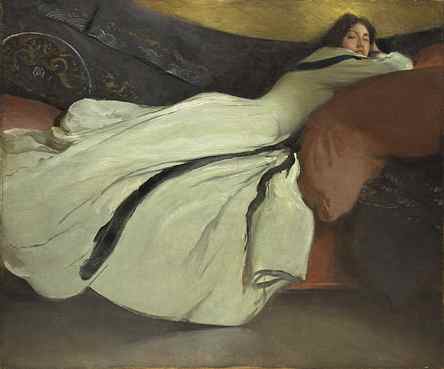
(above: John White Alexander (American,
1856-1915), Repose, 1895, oil on canvas, overall: 52 1/4 x 63 5/8
inches. The Metropolitan Museum of Art, New York, New York. Anonymous gift.
© The Metropolitan Museum of Art, New York. Courtesy, Museum of Fine
Arts, Boston)
Some of America's finest late 19th-century masterpieces went view at the Museum of Fine Arts, Boston (MFA) on June 25, 2006 when Americans in Paris, 1860-1900 made its U.S. debut. With exceptional loans from Europe and the United States, prominent artists featured in the exhibition include James McNeill Whistler, John Singer Sargent, Mary Cassatt, and Winslow Homer.
The exhibition is organized by the National Gallery, London and the MFA, in association with The Metropolitan Museum of Art. This international collaboration comprises approximately 100 paintings, many seen together for the first time, including iconic works such as Whistler's Arrangement in Grey and Black, No 1: Portrait of the Artist's Mother (1871, Musée d'Orsay, Paris)-otherwise known as "Whistler's Mother"-which, rarely shown in the United States, has not been seen in Boston since 1983; Sargent's infamous Madame X (Madame Pierre Gautreau) (1884, The Metropolitan Museum of Art, New York); the impressionist experiments of Mary Cassatt, such as Little Girl in a Blue Armchair (1878, National Gallery of Art, Washington, DC); and Homer's haunting A Summer Night (1891, Musée d'Orsay, Paris). Americans in Paris, which premiered to critical acclaim at the National Gallery, London, will remain on view in Boston through September 24, 2006 before traveling to The Metropolitan Museum of Art.
"Americans in Paris presents a captivating picture of a city that is as alluring today as it was to American artists over 100 years ago," said Malcolm Rogers, Ann and Graham Gund Director of the MFA. "We're thrilled that the exhibition will be at the MFA for its U.S. debut and that it will include some of America's most beloved masterpieces including key works by Whistler, Sargent, and Cassatt."
The curatorial team for Americans in Paris includes Erica E. Hirshler, the Croll Senior Curator of American Paintings at the MFA; Kathleen Adler, Director of Education at the National Gallery, London and a scholar of nineteenth-century French art; and H. Barbara Weinberg, the Alice Pratt Brown Curator of American Paintings and Sculpture at The Metropolitan Museum of Art. Together, they have gathered paintings from superlative American public and private collections to shape this distinctive, international exhibition.
After the Civil War, Paris was the quintessentially cosmopolitan city, and the capital of the western art world. Art students went to Paris to enroll in one of the many art schools there, seeking to polish their academic education; while more established artists used Paris as a proving ground, leveraging its important international exhibitions to establish their artistic reputations. A few made Paris their home, becoming part of a significant American expatriate community in the French capital. As the novelist Henry James reported of the "irresistible city" in an 1887 article, "it sounds like a paradox, but it is a very simple truth, that when today we look for American art we find it mainly in Paris. When we find it out of Paris, we at least find a good deal of Paris in it."
"This exhibition provides a glimpse into the lives of American artists who, in the latter half of the 19th century, turned their attention toward Paris, a place that nurtured their artistic ambitions and where art seemed to be a part of everyday life," said Erica Hirshler, Croll Senior Curator of American Paintings at the MFA. "The show also offers a unique opportunity to explore how these artists responded to and adapted a variety of French styles to suit their unique artistic visions."
Americans in Paris is organized both chronologically and thematically, exploring the paintings Americans made and displayed while living in Paris. The show opens with Picturing Paris, a vivid illustration of the attractions of late 19th century Paris. Of all the artists, Mary Cassatt devoted the most time to the subject, creating works that capture the excitement of Parisian cultural pursuits. Her luminous Woman with a Pearl Necklace in a Loge (1879, Philadelphia Museum of Art, Pennsylvania) shows a young red-headed woman, probably American, bedazzled by the sumptuous display and spectacle of the theater. Along with exploring cultural fare, many American artists were captivated by the beauty of Parisian streets and parks, as can be seen in Sargent's romantic In the Luxembourg Gardens (1879, Philadelphia Museum of Art, Pennsylvania) and Childe Hassam's April Showers, Champs Elysées, Paris (1888, Joslyn Art Museum, Omaha, Nebraska).
Artists in Paris offers a glimpse into the studios and day-to-day lives of the expatriates. The idea of Bohemia -- an aspect of life in Paris that was very appealing to many Americans -- ,is depicted in several paintings that show artists in their studios, their humble surroundings and homemade entertainments made bearable by their devotion to art. In Self Portrait of the Artist in His Studio (1875, Yale University Art Gallery, New Haven, Connecticut), Thomas Hovenden portrays himself as the quintessential Bohemian. Glancing intently at his canvas, cigarette in his mouth, he reclines in his chair with a violin in hand. The artist's clothes are wrinkled, his hair disheveled, and his boot has a gaping hole -- a typical Bohemian's disregard for appearance. Also seen in Artists in Paris are depictions of the dandy, another Parisian type popular at the time. Charles Sprague Pearce's Paul Wayland Bartlett (about 1890, National Portrait Gallery, Smithsonian Institution) depicts a well-dressed esthete who, completely assimilated to Parisian dress and attitude, is presented as a flâneur -- a detached pedestrian or a "gentleman stroller of city streets" -- a popular type first identified by poet Charles Baudelaire. Interestingly, Ellen Day Hale, in her Self Portrait (1885, Museum of Fine Arts, Boston), also depicts herself in this manner-a forthright pose that rarely was used for women.
Whether one became a Bohemian or flâneur, inclusion and success at the highly competitive annual Paris Salon was a pivotal step for most artists. Painters strategically planned their submissions to the Salon throughout the year. The section titled Paris as Training Ground and Proving Ground contains examples of paintings that were both accepted and rejected by the Salon. The portrait of Whistler's model and mistress titled Symphony in White, No. I: The White Girl (1862, National Gallery of Art, Washington, DC) launched Whistler's reputation as a controversial figure on the international art scene. It was rejected by the Paris Salon of 1863, one of hundreds of paintings that were not accepted by the conservative jury. A public outcry led the Emperor himself, Napoleon III, to display the rejected works, including The White Girl, in the infamous alternative salon, the Salon des Refusés. However, Whistler did not abandon the Salon exhibitions. "Whistler's Mother," perhaps the most celebrated of his paintings, was shown at the 1883 Salon, one of the many famous American paintings to be displayed there.
Two of John Singer Sargent's best-known paintings are also featured in Paris as Training Ground and Proving Ground, in dramatic juxtaposition to each other: Mrs. Henry White (Margaret Stuyvesant Rutherfurd) (1883, Corcoran Gallery of Art, Washington, DC) and Madame X (Madame Pierre Gautreau) (1884, The Metropolitan Museum of Art, New York). "I've been brushing away at both of you for the last three weeks," Sargent wrote to Daisy White in March 1883. The artist had been working on this pair of full-length, complementary portraits, both of American women in Paris, which he intended to show at the Salon of 1883. (Delays in completing the two pictures thwarted his plan.) Sargent depicted the graceful Mrs. White, the wife of a diplomat, elegantly dressed in a white satin gown, holding a fan and opera glasses. In contrast, the notorious Virginie Gautreau from New Orleans, "Madame X," strikes a bold pose, wears a revealing black dress, and exudes an overall lack of restraint. The painting provoked the public when it was shown at the 1884 Salon, and Sargent was left without portrait commissions. By 1886 he had moved to England, where he lived for the rest of his life. Yet he maintained his ties to Parisian friends and French artists throughout his career.
Paris as Training Ground and Proving Ground also includes paintings honored by their acquisition for the French state, among them Winslow Homer's beautiful and beloved A Summer Night (1890, Musée d'Orsay, Paris), as well as "Whistler's Mother" which likewise entered the Musée du Luxembourg. While it was not the first American painting to hang there, its acquisition received an unprecedented front-page notice in Le Figaro on November 27, 1891.
Paintings by Sargent and Cassatt-the two artists who were among the most at home of American painters in Paris-are the focal point of At Home in Paris. Having spent his childhood in Europe and speaking fluent French, Sargent easily integrated himself into French society. He settled in Paris, along with his family, in 1874. Sargent painted portraits of both French and American sitters, among them the four young children of fellow artist and expatriate Edward D. Boit (1882, Museum of Fine Arts, Boston). Sargent's haunting portrait of the girls, posed in their Paris apartment, earned notice at the 1883 Salon and remains today the artist's masterpiece.
Similarly, Cassatt settled in Paris along with her parents and her sister Lydia. She too spoke fluent French, flourished in Paris, and became perhaps the most French of all the American painters there. Initially, Cassatt exhibited her work through the Salon system, submitting regularly until 1876. When her paintings were rejected the following year, she accepted an invitation from Edgar Degas to participate in the exhibitions of the Impressionists, becoming the only American to be an "official" member of the French movement. At Home in Paris features tender portraits of her family including Portrait of a Lady (Reading Le Figaro) (1878, Private collection), which shows her mother, and an image of her brother, Portrait of Alexander J. Cassatt and His Son Robert Kelso Cassatt (1884-5, Philadelphia Museum of Art).
When the exhibition season had passed and the city became uncomfortably warm, Americans living in Paris escaped to the countryside to participate in a popular 19th-century phenomenon: painting outdoors. Summer Places offers pastoral views of several popular summer art colonies, including Brittany, whose rocky coast and picturesque inhabitants offered appealing subjects, and Giverny, the home of Claude Monet and the capital of the Impressionist style. Whether they created finished compositions in these distant locales, or sketches which would become larger compositions in the studio, American artists in the French countryside felt free to experiment. Whistler's Coast of Brittany (Alone with the Tide) (1861, Wadsworth Atheneum Museum of Art, Hartford, Connecticut), an exploration of the French Realist style, and Sargent's Claude Monet Painting by the Edge of a Wood (1885, Tate London), one of the earliest American Impressionist works, both provide a feel for the exquisite rural venues that attracted Americans during the summer months.
The final section of Americans in Paris, entitled Back in the USA, explores the manner in which Americans adapted French styles to explore distinctly American subjects. Combining the academic draftsmanship they had learned in the schools of Paris with the brilliant color they borrowed from French Impressionism, American painters created a characteristic national style. They recorded the harbors and fields of New England with the eye for art they had developed in France. No longer rebels, many of them went on to become important teachers in the U.S., among them Edmund C. Tarbell and Frank Weston Benson, who both taught at the School of the Museum of Fine Arts, Boston. The exhibition culminates with Childe Hassam's Allies Day, May 1917 (1917, National Gallery of Art, Washington, DC), which unites the stars and stripes with the French tricouleur, a symbol of the artistic alliance of the two countries.
Several notable works of sculpture from the MFA's collection by William Rimmer, Frederick MacMonnies, Anne Whitney, and Augustus Saint Gaudens are also included in Americans in Paris as a complement to the exhibition. Rimmer's The Falling Gladiator (modeled in 1861) is the powerful image of a man collapsing in battle. Astonished by the realism of the figure, critics accused Rimmer of casting from an actual human form. The Salon jury rejected The Falling Gladiator in 1863. Along with Whistler's The White Girl, it was displayed at the Salon des Refusés. Anne Whitney's Le Modèle (1875), the representation of an old woman, was modeled in clay during the summer in Ecouen and later cast in bronze at a Paris foundry. The bust is realistic in every detail, from the woman's kerchief to the deep lines in her face. By representing this peasant woman in bronze, a material used to portray important historic figures, Whitney made her humble subject heroic.
WALL TEXT FROM THE EXHIBITION
EXHIBITION ORGANIZATION / TOUR
The exhibition is organized by the National Gallery, London and the Museum of Fine Arts, Boston, in association with The Metropolitan Museum of Art, New York; and is supported by an indemnity from the Federal Council on the Arts and the Humanities. It debuted at the National Gallery, London (February 22-May 21, 2006). It makes its U.S. première at the MFA (June 25, 2006-September 24, 2006) before traveling to the Met (October 17, 2006-January 28, 2007).
PUBLICATION
Americans in Paris, 1860-1900, a full-color catalogue published by the National Gallery, features scholarly essays by Kathleen Adler, Erica E. Hirshler, and H. Barbara Weinberg, with contributions from David Park Curry, Rodolphe Rapetti and Christopher Riopelle, all experts in late-19th century French and American art. The 320-page catalogue has 230 illustrations (180 color).
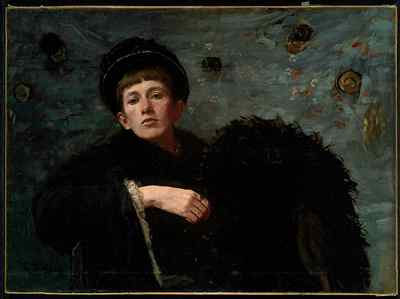
(above: Ellen Day Hale (American, 1855-1940), Self Portrait, 1855, oil on canvas, 28 1/2 x 39 inches. Museum of Fine Arts, Boston, Gift of Nancy Hale Bowers. Courtesy, Museum of Fine Arts, Boston)
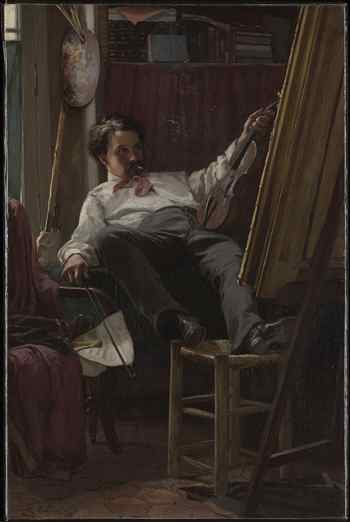
(above: Thomas Hovenden (American, 1840-1895), Self Portrait of the Artist in His Studio, 1875, oil on canvas. Yale University Art Gallery, Mabel Grady Garvan and John H. Niemeyer Funds. Courtesy, Museum of Fine Arts, Boston)
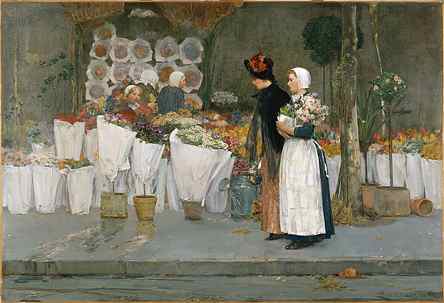
(above: Frederick Childe Hassam (American, 1859-1935), At the Florist, 1889, oil on canvas, overall: 36 1/4 x 54 11/4 inches. Chrysler Museum of Art, Norfolk, Virginia. Gift of Walter P. Chrysler, Jr.. Courtesy, Museum of Fine Arts, Boston)
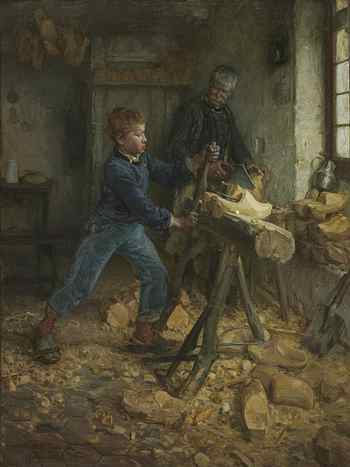
(above: Henry Ossaawa Tanner (American), The Young Sabot Maker, 1895, oil on canvas, overall: 41 x 35 inches. The Nelson-Atkins Museum of Art, Kansas City, Missouri, The George O. and Elizabeth O. Davis Fund and partial gift of an anonymous donor. Photograph by Jamison Miller © 2006 The Nelson Gallery Foundation. Courtesy, Museum of Fine Arts, Boston)
RL editor's note: readers may also enjoy:
rev. 9/1/06
Read more articles and essays concerning this institutional source by visiting the sub-index page for the Museum of Fine Arts, Boston in Resource Library.
Visit the Table of Contents for Resource Library for thousands of articles and essays on American art.
Copyright 2005 Traditional Fine Arts Organization, Inc., an Arizona nonprofit corporation. All rights reserved.