Editor's note: The Blaffer Gallery, the Art Museum of the University of Houston, provided source material to Resource Library for the following article or essay. If you have questions or comments regarding the source material, please contact the Blaffer Gallery directly through either this phone number or web address:
James Surls: The Splendora Years, 1977-1997
September 17 - November 12, 2005
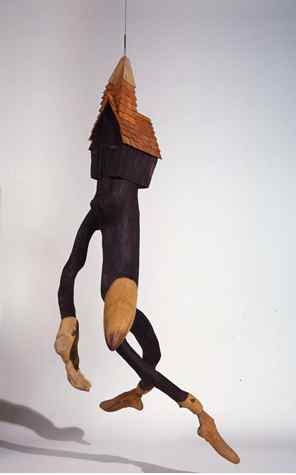
(above: James Surls, How Far Back, 1989, red oak, white oak, 100 x 62 x 55 in (254 x 157.5 x 139.7 cm). Collection of the artist)
 Blaffer
Gallery, the Art Museum of the University of Houston, is presenting James
Surls: The Splendora Years, 1977-1997, a survey of sculpture, wall works,
drawings, and prints, focusing on a singular twenty-year period in the career
of James Surls. During this period, Surls' artwork and career come together
in a compelling story that interweaves the unique aspects of a specific
landscape, his personal story, and the tumultuous nature of art practice
in the latter half of the twentieth century, into a mélange capable
of reconciling counterculture utopianism and the rigor of post-minimalist
sculptural approach.
Blaffer
Gallery, the Art Museum of the University of Houston, is presenting James
Surls: The Splendora Years, 1977-1997, a survey of sculpture, wall works,
drawings, and prints, focusing on a singular twenty-year period in the career
of James Surls. During this period, Surls' artwork and career come together
in a compelling story that interweaves the unique aspects of a specific
landscape, his personal story, and the tumultuous nature of art practice
in the latter half of the twentieth century, into a mélange capable
of reconciling counterculture utopianism and the rigor of post-minimalist
sculptural approach.
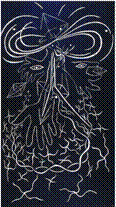
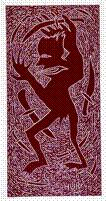
James Surls: The Splendora Years, 1977-1997 will be the artist's first major scholarly exhibition in over twenty years and offers American audiences a rare opportunity to fully assess the depth and breadth of Surls' important contribution to the field of contemporary sculpture. (left: James Surls, To Have -- To Hold, 1989, woodcut, 65 x 37 1/2 inches (165.1 x 95.3 cm), Collection of the Artist)
James Surls makes art to embody the inherent dualities
of natural forces-positive and negative, fluid and static, male and female.
His 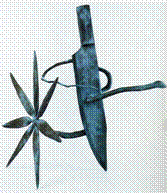 work is simultaneously joyously
optimistic and darkly expressionistic and his signature forms and images,
such as diamond shapes, whirling vortexes, needles, knives, and houses,
infuse highly personalized folk idioms with the aesthetics of high modernism.
His forms are imbued with a visual poetry that arises from the dexterity
with which he manipulates wood, steel, and bronze to craft simple, even
homespun narratives into objects that are freighted with universal meaning.
(right: James Surls, Knife, Flower and Snake, 1997, bronze,
38 x 35 x 31 inches (96.5 x 88.9 x 78.7 cm), Collection of the Artist)
work is simultaneously joyously
optimistic and darkly expressionistic and his signature forms and images,
such as diamond shapes, whirling vortexes, needles, knives, and houses,
infuse highly personalized folk idioms with the aesthetics of high modernism.
His forms are imbued with a visual poetry that arises from the dexterity
with which he manipulates wood, steel, and bronze to craft simple, even
homespun narratives into objects that are freighted with universal meaning.
(right: James Surls, Knife, Flower and Snake, 1997, bronze,
38 x 35 x 31 inches (96.5 x 88.9 x 78.7 cm), Collection of the Artist)
Surls balances his creative process between structure and intuition. On the one hand, his compositional approach was forged from his education and professional instruction in studio art in undergraduate and graduate art school. On the other hand he believes in the invisible, underlying forms inherent in natural materials like wood or stone, his preferred materials.
As a student his work was largely abstract, drawn in part from the ordered chaos of Abstract Expressionism and the Surrealist notion of automatism, or as he says, "the 'just do it' mode of making." By the early 1970s, he began to take more control of the process, seeking to find the balance between his conscious artistic intentions and his more spontaneous, emotional approaches. Its was at this time that recognizable imagery-figures, houses, flowers-emerged as the dominant vocabulary of his work.
Wood is his signature material, and carving and cutting
his preferred gesture. This is a natural outcome of his childhood. With
his father a carpenter, Surls 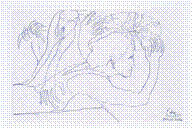 grew
up sawing cedar logs for lumber, making wood beams for housing construction.
He is as confident of his mastery of tools as he is with his artistic vision
and his ability to see the possibilities trapped within natural materials.
He speaks of "powerful forces waiting in the wood just to be released.
But the other side of that is the powerful ability to read the possibility
inherent to materials." The rest, he feels, is a direct process of
sawing, carving, and whittling that brings the work to life. It is for that
reason that his bronzes are cast from wood constructions as well. The duality
of Surls' balancing act between logic and intuition is clearly illustrated
when the intense physicality of his sculpture, executed over time in the
social setting of his studio and the help of assistants is juxtaposed against
the delicate, almost ephemeral nature of his drawings. Executed in solitude
and in the spirit of automatic writing, they are intimate psychological
grew
up sawing cedar logs for lumber, making wood beams for housing construction.
He is as confident of his mastery of tools as he is with his artistic vision
and his ability to see the possibilities trapped within natural materials.
He speaks of "powerful forces waiting in the wood just to be released.
But the other side of that is the powerful ability to read the possibility
inherent to materials." The rest, he feels, is a direct process of
sawing, carving, and whittling that brings the work to life. It is for that
reason that his bronzes are cast from wood constructions as well. The duality
of Surls' balancing act between logic and intuition is clearly illustrated
when the intense physicality of his sculpture, executed over time in the
social setting of his studio and the help of assistants is juxtaposed against
the delicate, almost ephemeral nature of his drawings. Executed in solitude
and in the spirit of automatic writing, they are intimate psychological
 blueprints to a particular state
of mind. (right: James Surls, Fake, 1997, pencil on paper,
10 x 15 inches, Collection of the Artist)
blueprints to a particular state
of mind. (right: James Surls, Fake, 1997, pencil on paper,
10 x 15 inches, Collection of the Artist)
In 1977 Surls acquired a large tract of land in Splendora,
Texas where he built a spacious studio. The ensuing twenty years in which
he worked there was a period of remarkable growth and development. These
Splendora years were an especially productive period for him, a time when
his art "exploded" in a rapid succession of artistic breakthroughs.
Surls also views this period as his "romantic" period, because
of the synergy between his artistic development and the east Texas landscape
from which he took both raw materials and his intellectual inspiration.
(left: James Surls, Cut Hand Hurt Eyes, 1984-1988, woodcut,
painted in red and black ink, 73 1/2 x 37 inches (186.7 x 94 cm), Collection
Whitney Museum of American Art, New York. Gift of Marilou and John Long)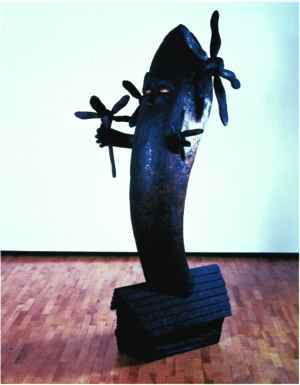
No artist of his generation has had a greater impact upon the development of Texas as a locus of vibrant creativity than James Surls. Surls is a self-described "eternal optimist," and his infectious enthusiasm for all matters artistic made him a catalyst for a generation of young artists during these years. As an instructor and cultural impresario he encouraged artists, including Sharon Kopriva, Joseph Havel, Michael Galbreth and Jack Massing (The Art Guys), among others, to expand the boundaries of their social and aesthetic expressions. But Surls is not simply a regional artist. His unique blend of natural force and intellectual concepts places him securely within the international artistic circuit.
A native of East Texas (he was born in Terrell in 1943) Surls graduated from Sam Houston State College in Huntsville before achieving his Masters of Fine Arts at Cranbook Academy in Bloomfield Hills, Michigan. In 1969 he returned to Texas to teach sculpture at Southern Methodist University in Dallas, before coming to Houston in 1976 to teach sculpture at the University of Houston. In 1979 he was the driving force for the establishment of the Lawndale Annex, a thriving and vibrant alternative space that grew organically from a warehouse for student studios on the University campus into the Lawndale Art and Performance Center, largely through his entrepreneurial spirit. After leaving Lawndale and his teaching position at UH in 1982, Surls devoted himself full time to his studio practice and artistic vision for the growing compound in Splendora. Since 1998 he and his family have lived in Colorado. (right: Night Vision, 1980, pine, oak, sweet gum root, 91 x 48 x 42 inchess (231.1 x 121.9 x 106.7 cm). Collection L.A. Louver Gallery, Venice, California)
The exhibition is organized by Blaffer Gallery's director Terrie Sultan and will be accompanied by a fully-illustrated catalogue with an introduction by Sultan and an interpretive essay be Eleanor Heartney, contributing editor to Art in America and the author of Postmodernism and Critical Condition: American Culture at the Crossroads. Published and distributed by University of Texas Press, the catalogue also features a series of insightful interviews with key figures in the Houston art community, an exhibition history and bibliography.
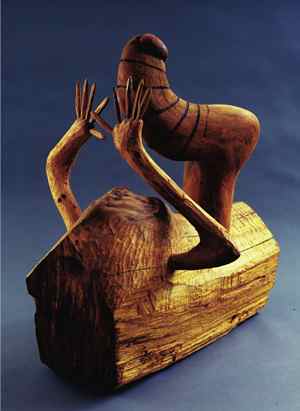
(above: James Surls, Heaven and Earth, 1979, oak, 25 x 23.5 x 19 inches (63.5 x 59.7 x 48.3 cm). Collection Susan and Alvin Chereskin, New York)
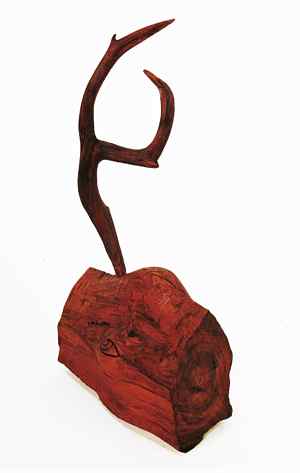
(above: James Surls, On Being Ready to be Born, 1977 heart pine, 22 x 13.5 x 7 inches (55.9 x 34.3 x 17.8 cm). Collection W. Grim and Sharon Locke, Houston)
Read more articles and essays concerning this institutional source by visiting the sub-index page for the Blaffer Gallery, the Art Museum of the University of Houston in Resource Library.
Visit the Table of Contents for Resource Library for thousands of articles and essays on American art.
© Copyright 2005 Traditional Fine Arts Organization, Inc., an Arizona nonprofit corporation. All rights reserved.