Editor's note: The Booth Western Art Museum provided source material to Resource Library for the following article. If you have questions or comments regarding the source material, please contact the Booth Western Art Museum directly through either this phone number or web address:
Western American Art South of the Sweet Line
June 16 - September 30, 2005
Western American
Art South of the Sweet Tea Line, featuring a wide
range of Western art contained in prominent Georgia public and private collections,
opened at the Booth Western Art Museum in Cartersville, Georgia, on June
16, 2005 and will be on view through September 2005.
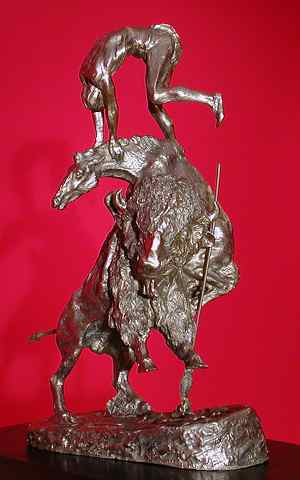
The appeal of the American West knows no bounds; indeed, throngs of visitors from around the world flock to the region each year to see firsthand the icons of the West they have only encountered previously through popular mass media. Uniquely American, the West defines our nation and captures the imagination of people everywhere. Whether through memories, books, memorabilia, photographs, or other fine art, visitors to the region like to take home a remembrance of the West; armchair travelers unable to visit the West experience it vicariously through purchases of these items. Western American art serves as a gateway through which to discover the West. Even in the American South, an area of our nation with a strong regional identity, Western American art has established a foothold. (right: descriptive information for sculpture pending)
The genesis for this exhibition came out of a discussion about the Museum's purpose of offering people in the region an opportunity to visit the West without leaving the South. A list of works of art from public collections in the Southeast was compiled, and private collections were subsequently added. It soon became apparent that the volume of Western American art in the South was so significant that the focus would have to be narrowed. While there are fine pieces from outside Georgia, most of the works in the exhibition come from Georgia collections.
The artwork featured in the exhibition was found in corporate collections, world-class art museums, fine arts centers, refined urban dining rooms, and suburban living rooms, all south of the 'sweet tea line,' also known as the Mason-Dixon line, or the line that divides the North from the South. This is the boundary below which one must ask for un-sweet tea lest one get a glass of sugar, and the line above which if one asks for un-sweet tea one gets a perplexed look and a reply that iced tea is available and what you do with it, sweet or un-sweet, is up to you. Above all, the title is a reference to the South, and the wonderful, but little-known collections of art of the American West in the region. The eighty-four works of art by eighty artists featured in the exhibition span one hundred seventy five years from the 1830s to the present.
Artists represented in the exhibition include Albert Bierstadt, William R. Leigh, Joseph Henry Sharp, Ernest Blumenschein, E. Martin Hennings, Bert Geer Phillips, and many more. The exhibition also contains art by talented living artists, including Deborah Butterfield, Oreland Joe, Herb Mignery, Glenna Goodacre, Grant Speed, and David McGary, among others. Additionally, Native American artists include Pop Chalee, Charlie Begay, Julian Martinez and Fred Kabotie. And, do not miss photographs by famed 19th and 20th century photographers including Ansel Adams, Timothy O'Sullivan, William Henry Jackson, Edward Curtis and Edward Weston.
"Reflecting upon the works of art in this exhibition, and the collectors who cherish them, I am struck by dichotomies," states Booth curator James Burns, who has spent the past two years gathering the art for this exhibition. He adds, "some of the collectors possess a passion for the West, but have never been there, while others split their time, torn between their love of the West and the South. The Native American art borrowed from the Lamar Dodd Art Center came from the Case collection, left to the Center because the donor felt it would be more appreciated there than at a museum in the West with hundreds of similar works already in its collection."
Through the course of the exhibition viewers journey from
the 'Old West' to the 'New West,' with the bulk of the work focusing on
the former, even that of contemporary artists. Why is that; what keeps alive
our insatiable desire for the legendary West of the 19th century? What is
the 'New West' anyway, and why are artists not exploring it more fully?
The photographs in the exhibition capture the differences between the Old
and the New West eloquently. Viewing the images of the 19th and even some
20th century photographers, one sees romanticized views of the environment.
In the post-World War II images of Misrach, Gowin and Stupich, viewers see
human-altered contemporary landscapes. These landscapes have been transformed,
disturbed; we see unexpected scenes, nuclear and mining sites, reminders
of the realities of the 21st century West impinging upon our mythic vision
of it. Such works give the viewer pause to contemplate the relationship
inhabitants of, and visitors to, the West have to the land, and to think
about the landscape in the context of culture.
Editor's note: RL readers may also enjoy:
Western Genre Art of the 20-21st Century
For Southwest art history and Western art, see articles and essays inluding American Impressionism Goes West, an essay by Charles C. Eldredge; Remington: The Color of Night; Women Artist Pioneers of New Mexico, an article by Dottie Indyke; A Century of Western Art; Southwestern Colonial Art, an essay by Robert William Brown; The Pictoral Record of the Old West: the Beginning of the Taos School of Art, an essay by Robert Taft; Painters in Taos, New Mexico Prior to 1940; Taos Society of Artists, an article by Sarah Beserra; "New Deal" Art in New Mexico, an article by Kathryn Flynn; How the Santa Fe Art Colony Began, an article by Suzanne Deats; CCA: Cowboy Artists of America; Grand Canyon Painters and Their Earliest Patron, The Santa Fe Railroad; Introduction from "Celebrating America: Masterworks from Texas Collections", an essay by Jane Myers and Barbara McCandless and Art of the American West, an essay by Peter MacMIllan Booth.
articles and essays on American photography of the
Multimedia on the Web from:
San Francisco Museum of Modern Art
Audio on the Web from:
National Gallery of Art
 Carleton
Watkins: The Art of Perception. Sarah Greenough,
curator of photographs, talks about works by celebrated nineteenth-century
photographer Carleton Watkins, on view in the first major exhibition of
Watkin's work in 20 years. Aired March 11, 2000. (description courtesy
NGA)
Carleton
Watkins: The Art of Perception. Sarah Greenough,
curator of photographs, talks about works by celebrated nineteenth-century
photographer Carleton Watkins, on view in the first major exhibition of
Watkin's work in 20 years. Aired March 11, 2000. (description courtesy
NGA)
WGBH/Boston Forum Network
The WGBH
Archives contains a series of 22 original WGBH/FM radio essays by leading
thinkers in the 20th Century on the nature of creativeness in American
arts, sciences, and professions. One of the essays is titled Creative Method:
Edward Steichen on Photography, with Lyman Bryson interviewing
Edward Steichen, photographer and painter. [December 31, 1969]
Video on the Web from:
J. Paul Getty Museum
 The J. Paul Getty Museum's web site,
as of April 2005, provides over twenty videos, including collection tours,
behind the scenes conservation methods for various types of art, installations,
artist conversations, and the making of several types of art in a "Video Gallery"
that uses RealPlayer. A 3-minute video named "Photographs Overview"
discusses photography as art.
The J. Paul Getty Museum's web site,
as of April 2005, provides over twenty videos, including collection tours,
behind the scenes conservation methods for various types of art, installations,
artist conversations, and the making of several types of art in a "Video Gallery"
that uses RealPlayer. A 3-minute video named "Photographs Overview"
discusses photography as art.
Read more articles and essays concerning this institutional source by visiting the sub-index page for the Booth Western Art Museum in Resource Library
Visit the Table of Contents for Resource Library for thousands of articles and essays on American art, calendars, and much more.
Copyright 2005 Traditional Fine Arts Organization, Inc., an Arizona nonprofit corporation. All rights reserved.