Editor's note: The Pasadena Museum of California
Art provided source material to Resource Library for the following
article or essay. If you have questions or comments regarding the source
material, please contact the Pasadena Museum of California Art directly
through either this phone number or web address:
Dark Metropolis: Irving
Norman's Social Surrealism
January 21 - April 15, 2007
Artist Irving Norman's
vast, highly detailed paintings communicate his perceptions of modern life
and the society in which he lived. His unsettling visions 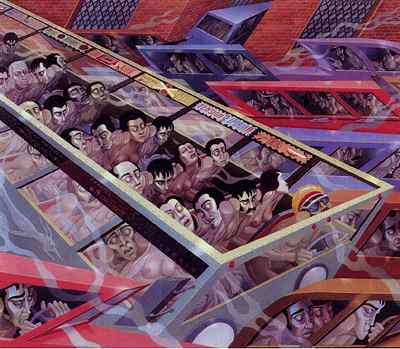 are at once shocking and unforgettable. As a result of
his political beliefs, Norman was under surveillance by the FBI for the
last twenty years of his life. (right: Irving Norman, From Work,
1978. Oil on canvas, 80 x 92 inches. Fine Arts Museums of San Francisco,
gift of Hela Norman)
are at once shocking and unforgettable. As a result of
his political beliefs, Norman was under surveillance by the FBI for the
last twenty years of his life. (right: Irving Norman, From Work,
1978. Oil on canvas, 80 x 92 inches. Fine Arts Museums of San Francisco,
gift of Hela Norman)
Today, Irving Norman's work is being rediscovered, as the
dark themes he explored in his art remain as relevant as when they were
first composed. Now, in the year that Norman would have turned 100, his
powerful works will be explored at the Pasadena Museum of California Art
in Dark Metropolis: Irving Norman's Social Surrealism being held
January 21 through April 15, 2007
An émigré from Poland who survived World
War I as a child, Norman witnessed atrocities as a machine gunner in the
Abraham Lincoln Brigade of the Spanish Civil War. These experiences prompted
him to paint with a dark vision both personal and prophetic. Writing in
Art in America (July 2003), critic Michael Duncan described his work
as "jaw-droppingly effective social indictments that would have been
endorsed by Orwell and Huxley. The unrestrained passion and monumental energy
of [his] work blows most contemporary political art out of the water."
Norman's massive canvases abound with teeming figures,
drone-like and mechanical in their repetition, yet stubbornly and hauntingly
human. The combination of jewel-tone colors, transcendent messages and technical
virtuosity make his work unique in the history of American art.
This exhibition, curated by Scott A. Shields, Ph.D., Chief
Curator at the Crocker Art Museum, consists of approximately 25 large-scale
paintings along with 14 examples of the artist's works on paper, and it
is accompanied by a 228-page color catalogue published by Heyday Press.
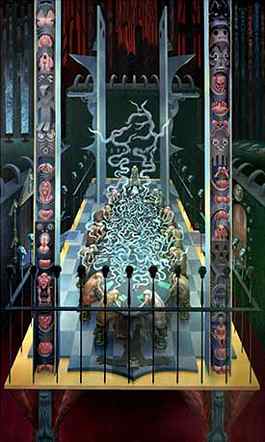
(above: Irving Norman, The Elders, 1957. Oil on canvas,
74 x 44 inches. Collections of Tom von Tersch and Meg Beeler.)
Wall panels from the exhibition
-
- Dark Metropolis: Irving Norman's Social Surrealism
- September 23, 2006 - January 7, 2007
-
- This exhibition, produced on the occasion of what would
have been Irving Norman's one-hundredth birthday, features paintings that
remain as poignant and relevant today as when they were first created.
Norman's dark visions not only reflect a troubled and turbulent world,
but they convey a sense that Norman understood and wished for change. He
believed that by pointing out the inequities, horrors, and foibles of human
behavior that he might somehow cause people to consider the consequences
of their actions. He intended his canvases as public art, which he hoped
would end up in museums where "all people could come and study them
and contemplate."
-
- Norman's monumental paintings teem with detail and are
populated by swarming, clone-like humans. These people are constricted
by small urban spaces and modern technology, caught in the crunch of rush
hour, and decimated by poverty and war. These themes manifest Norman's
perceptions of modern life.
-
- Born Isaac Noachowitz (1906-1989) in Vilnius (the capital
of Lithuania), which was then under Russian control, Norman came to New
York in 1923. In 1938 he volunteered to go to Spain and defend the Republic
against the fascism of General Francisco Franco. Upon his return, he settled
in Los Angeles and began to express the atrocities he witnessed through
drawing and painting. He moved to San Francisco in 1940 to study at the
California School of Fine Arts and later continued his art training in
New York. When he returned to the San Francisco Bay Area he settled permanently
near Half Moon Bay.
-
- Norman's work has only recently begun to attract a broad
audience. His youthful political affiliations made him stand out in the
McCarthy era -- a period of widespread fear and persecution of communists
-- and his earlier obscurity may have stemmed in part from twenty years
of FBI surveillance. However chilling the effect of such government scrutiny,
Norman's paintings stand as testimony to his talent, his determination,
and his dogmatic conscience.
-
- Norman's paintings probe the darkness of human nature
and the contemporary society in which we live. Shocking, revealing, and
profound, the paintings aim, as Norman himself described, to tell the truth
of our time. "I try to go beyond illusions," he explained, "to
tell the truth." "That doesn't always make me popular."
- This exhibition has been underwritten by:
-
- The Judith Rothschild Foundation
- Rolfe Wyer
- Martin Sosin/Stratton-Petit Foundation
- LEF Foundation
- Estate of Moses and Ruth Helen Lasky through Morelle
Lasky Levine
- Janice and Maurice Holloway
-
-
-
- Irving Norman's life (1906-1989) was forever transformed
in 1938 when he volunteered for service in the Abraham Lincoln Brigade
to fight in the Spanish Civil War (1936-1939). The Brigade was one of many
organized by the Communist International to defend the Spanish Republic
against the fascist forces of General Francisco Franco. The American volunteer
force consisted of some 2,600 men, but volunteers came from fifty-two countries
to form a combined force of forty thousand. Like Norman, most members of
the Abraham Lincoln Brigade belonged to the Communist Party. Also like
Norman, many (approximately 33%) were Jewish. These civilian-soldiers represented
Marx's ideal: workers of the world united against injustice.
-
- Norman's combat experience in a machine-gun company left
an indelible impression of death and destruction on his psyche. One-third
of all American volunteers died, and those that survived continued to relive
the horrors that they had experienced. Norman himself did not expect to
return from battle and gave away his belongings before he left. Speaking
about the impetus to volunteer for military service and the reasons that
he later decided to express this experience through art he said:
-
- I was active in the left-wing movement . . . [and] had
to be an example, and when the Communist International called up for volunteers,
I volunteered. . . .
- And after that experience I realized that my direction
was not in the direction of politics. . . .
-
- It's just that I feel that the experience was so powerful
and my realization that this society, the foundation of this society, is
based on war. So I had to find a way to . . . express that thing, especially
the violence of war, and I was looking into the history of artists who
did it. And I found very few.
-
- Norman returned from Spain in late 1938. Deeply depressed,
he began to exorcize his turmoil through drawing but found his technical
skills inadequate to realize the magnitude of his visions. In 1940 he moved
from Los Angeles to San Francisco to study at the California School of
Fine Arts (now the San Francisco Art Institute). He spent much of 1946
in New York, studying at the Art Students League, and also traveled to
Mexico to study the work of the Mexican muralists. When he returned to
the San Francisco Bay Area he settled permanently near Half Moon Bay, where
he lived and painted for the rest of his life, probing the darkness of
human nature and the contemporary society in which we live.
Editor's note - RL readers may also enjoy:
Read more articles and essays concerning this institutional
source by visiting the sub-index page for the Pasadena
Museum of California Art in Resource
Library.
Visit the Table
of Contents for Resource Library.for thousands
of articles and essays on American art.
Copyright 2007 Traditional Fine Arts Organization, Inc., an Arizona nonprofit corporation. All rights
reserved.