
Editor's note: The American Museum of Ceramic Art provided source material to Resource Library for the following article or essay. If you have questions or comments regarding the source material, please contact the American Museum of Ceramic Art directly through either this phone number or web address:
Laying the Foundation: American Art Tile
July 9 - November 5, 2005
(above: Majolica, hand-painted tile, 6 x 6 inches. Broadmoor Pottery, Colorado Springs, Colorado, 1933-1939)
The American Museum
of Ceramic Art is proud to present Laying the Foundation: American
Art Tile. Major U.S. tile manufacturers  will
be represented by more than 450 tiles from the collection of Norman Karlson,
Los Angeles resident and author of American Art Tile: 1876 - 1941
and a soon-to-be-released, four-volume, encyclopedia on the history of American
ceramic tile. AMOCA establishes background information through tile samples
from Holland, France, Spain, Portugal, Italy and England, all exemplifying
designs and techniques that influenced the early development of American's
own tile industry. The core of the exhibition tracks America's love affair
with tile from the time that European artisans started fledgling East Coast
companies; to the burgeoning, turn-of-the-century tile production in the
clay-rich states of the North East; to the Spanish influence found in Texas
and within California's hot tile market. Laying the Foundation:
American Art Tile also includes a separate component of contemporary
tiles, both "revival" and "cutting-edge." (right:
Ten tile mural mantel set, 30 x 12 inches. American Encaustic Tiling
Co., Ohio, c. 1910. American Encaustic Tiling Company (AET) was founded
in Zanesville Ohio in 1875. The company rapidly increased in productivity
making it necessary to move several times to larger facilities. In 1892,
AET was dubbed the largest tile factory in the world. At one point AET had
two satellite manufacturing plants in Southern California, Vernon and Hermosa
Beach. The ten relief tiles in the photo are from the left and right sides
of a fireplace surround set. The unrepresented connecting, top piece
depicted an Aladdin style pot with flames. Referred to as Victorian
art tiles, they were made by AET during the late 1800s or early 1900s)
will
be represented by more than 450 tiles from the collection of Norman Karlson,
Los Angeles resident and author of American Art Tile: 1876 - 1941
and a soon-to-be-released, four-volume, encyclopedia on the history of American
ceramic tile. AMOCA establishes background information through tile samples
from Holland, France, Spain, Portugal, Italy and England, all exemplifying
designs and techniques that influenced the early development of American's
own tile industry. The core of the exhibition tracks America's love affair
with tile from the time that European artisans started fledgling East Coast
companies; to the burgeoning, turn-of-the-century tile production in the
clay-rich states of the North East; to the Spanish influence found in Texas
and within California's hot tile market. Laying the Foundation:
American Art Tile also includes a separate component of contemporary
tiles, both "revival" and "cutting-edge." (right:
Ten tile mural mantel set, 30 x 12 inches. American Encaustic Tiling
Co., Ohio, c. 1910. American Encaustic Tiling Company (AET) was founded
in Zanesville Ohio in 1875. The company rapidly increased in productivity
making it necessary to move several times to larger facilities. In 1892,
AET was dubbed the largest tile factory in the world. At one point AET had
two satellite manufacturing plants in Southern California, Vernon and Hermosa
Beach. The ten relief tiles in the photo are from the left and right sides
of a fireplace surround set. The unrepresented connecting, top piece
depicted an Aladdin style pot with flames. Referred to as Victorian
art tiles, they were made by AET during the late 1800s or early 1900s)
Early examples of ceramic tile can be traced back to the ancient cultures of Egypt, China and Babylon; however, the tradition of tile making as we know it today began with 13th century Moroccan zellige (mosaic) tile work. Techniques and designs found in ancient Persian luster mosaics, Syrian underglaze-painting, and Spanish tin-glazed luster ware had a profound influence on the historic development of tile production. During the Renaissance period, Italian craftsmen contributed tin-glazed majolica tiles and Della Robbia plaques in high relief. Further diversification occurred in Spain and Portugal where alazulejos were painted for architectural decoration, in Tunesia where the cuerda secca (dry line) technique was perfected, and in Northern Europe where the Germans produced small tiles, mounted in copper frames to serve as stove adornments. During the 16th century cuerda secca and polychrome techniques were refined by Ottoman Empire artisans while in Holland majolica tile decoration was introduced. By the 17th century, the Dutch were creating Makkum and Delft tiles. Further diversification of tile-making techniques continued to spread, culminating in England, where Art Nouveau and Victorian designs proliferated in the 1800s. It was the English production which had the largest influence on American tile production.
The first-known production of American tile began with the Pittsburgh Encaustic Tile Company, established by Samuel Keyes in 1876. Born and trained in England, Keyes' immigrated to America where he began to produce ceramic ware very similar to that which he produced in his homeland. His became the model for a number of European ceramicists who followed, bringing skills and trade secrets to a new land. It is small wonder that the first American tiles looked exactly like those being produced in England, Holland, France or Germany -- encaustic tiles, pressmold relief tiles or transfer (decal) tiles.
The initial success of the American tile industry was dependent
on the ceramic craftsmanship of immigrants who first began production in
New England, using the styles and techniques of their homelands. As the
nation grew, tile companies flourished and artisans began adopting a more
American style of decoration, influenced by fresh history and a new environment.
As with all American 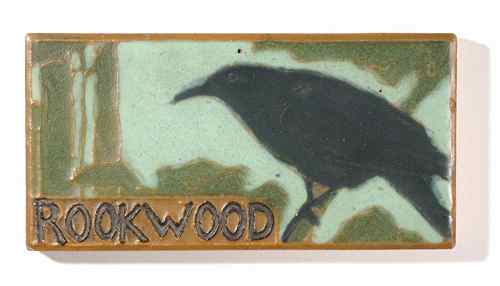 industrialization,
the movement was from the east to the west coast. Along the way, tile became
an essential element of the Arts and Crafts movement, which lasted in America
through the mid 1920s. Eventually reaching the West Coast, Californian tile
production favored Moorish or Aztec designs compatible with the Spanish
architecture, popular at that time. Companies such as Catalina Pottery,
Tudor Pottery, or D. & M. Tiles chose glaze colors suggestive of California
colors -- warm, saturated, and complimented by the bright southern coastline
sunlight. (left: Nameplate tile from Rookwood Pottery, 4.5 x 9 inches,
Cincinnati, Ohio, 1907-1913. The Rookwood Pottery was founded by Maria Longworth
Nichol, the granddaughter of a Cincinnati real-estate millionaire. With
the assistance of her father, Nichol established her own pottery in an old
schoolhouse in 1880. In those days, pottery was considered an acceptable
profession for socially prominent women. Nichol organized clubs of women
who hand painted pottery and attended the Rookwood School for Pottery. In
a few short years the business grew, and its success made Rookwood a household
word. To diversify Rookwood began producing commercial architectural
pieces about 1902 which soon began to appear in buildings across the country.
Rookwood tiles became quite well known through their use in major hotels,
subway station stops in New York City and train terminals such as Grand
Central Station. By the 1920s Rookwood had grown dramatically into a thriving
concern employing over 225 workers. The nameplate tile in the photo, produced
by Rookwood in the early 20th century, was used as a commemorative or promotional
piece and never intended to be used in an installation. Over the years
Rookwood became quite a progressive company. As such it is quite possible
that this might have been a "give away" or used in a storefront
display)
industrialization,
the movement was from the east to the west coast. Along the way, tile became
an essential element of the Arts and Crafts movement, which lasted in America
through the mid 1920s. Eventually reaching the West Coast, Californian tile
production favored Moorish or Aztec designs compatible with the Spanish
architecture, popular at that time. Companies such as Catalina Pottery,
Tudor Pottery, or D. & M. Tiles chose glaze colors suggestive of California
colors -- warm, saturated, and complimented by the bright southern coastline
sunlight. (left: Nameplate tile from Rookwood Pottery, 4.5 x 9 inches,
Cincinnati, Ohio, 1907-1913. The Rookwood Pottery was founded by Maria Longworth
Nichol, the granddaughter of a Cincinnati real-estate millionaire. With
the assistance of her father, Nichol established her own pottery in an old
schoolhouse in 1880. In those days, pottery was considered an acceptable
profession for socially prominent women. Nichol organized clubs of women
who hand painted pottery and attended the Rookwood School for Pottery. In
a few short years the business grew, and its success made Rookwood a household
word. To diversify Rookwood began producing commercial architectural
pieces about 1902 which soon began to appear in buildings across the country.
Rookwood tiles became quite well known through their use in major hotels,
subway station stops in New York City and train terminals such as Grand
Central Station. By the 1920s Rookwood had grown dramatically into a thriving
concern employing over 225 workers. The nameplate tile in the photo, produced
by Rookwood in the early 20th century, was used as a commemorative or promotional
piece and never intended to be used in an installation. Over the years
Rookwood became quite a progressive company. As such it is quite possible
that this might have been a "give away" or used in a storefront
display)
 Today, strong interest in Arts and Crafts
furnishings has prompted a revival of tile making, with an emphasis on replicating
those styles popular in the 20s. With the recent building and remodeling
boom, home owners are abandoning bland and neutral tiles, popular since
the 50s, for more elaborate and unique tile designs. Their choices often
include textured border or trim tiles, hand-painted tile vignettes or stand-alone
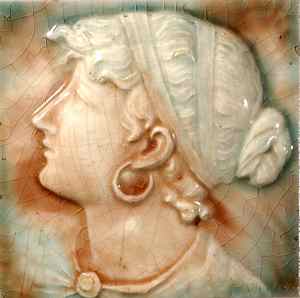
scenes. (right: Relief portrait tile, 6 x 6 inches, influenced by
English tile-making traditions, Trent Tile Co., Trenton New Jersey, mid
1880s)
Today, strong interest in Arts and Crafts
furnishings has prompted a revival of tile making, with an emphasis on replicating
those styles popular in the 20s. With the recent building and remodeling
boom, home owners are abandoning bland and neutral tiles, popular since
the 50s, for more elaborate and unique tile designs. Their choices often
include textured border or trim tiles, hand-painted tile vignettes or stand-alone
scenes. (right: Relief portrait tile, 6 x 6 inches, influenced by
English tile-making traditions, Trent Tile Co., Trenton New Jersey, mid
1880s)
In addition to the Karlson Collection, the works of several well-known Los Angeles contemporary artists are showcased, including Dennis Caffrey, Ralph Bacerra, Lance Henriksen, Dora De Larios, and Marlo Bartels. Caffrey is founder of the digital print and hand painted mural provider, Urban Clay. Examples of his recent tile murals may be found at both the Crenshaw and North Hollywood Metro Stations. Bacerra is known primarily for his intricately decorated ceramic vessels, yet recently created a wall for the Western Asset Building in Pasadena, a portion of which will be shown at AMOCA. Henriksen is best known for his many film and television roles, though his ceramic work is also attracting serious attention. Inspired by his most recent movie, Alien vs. Predator, Henriksen created hand-carved relief tiles to commemorate the experience. De Larios' most recent work is an impressive 7.5' x 39' clay mural for the Montage Resort & Spa in Laguna Beach, depicting a blue porcelain seascape. AMOCA will show the sample for that wall. Bartels has created indoor and outdoor tile murals, fountains, floors and furniture, as well as free-standing sculptures since 1977. His work can be seen at Victoria Gardens in Rancho Cucamonga, the Irvine Medical Center, the Hilton Hotel in Huntington Beach, and many public and private residences.
Other important local artists will include Ricky Maldonado,
Renee Lotenero, Laird Plumleigh, Porntip Sangvanich, Stephani Stevenson,
 and Diana Watson. Laying the
Foundation: American Art Tile affords a complete view of the evolution
of tile manufacturing during the last century as the trade made its way
from East coast to West, but also provides a sample of what contemporary
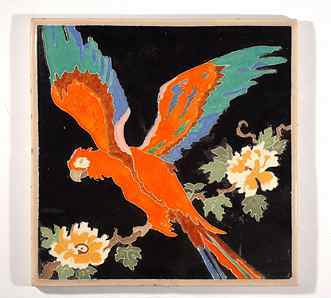
artists are producing amid the current resurgence of tile use. (left:
Claycraft Potteries, Los Angeles California, 1921-1939)
and Diana Watson. Laying the
Foundation: American Art Tile affords a complete view of the evolution
of tile manufacturing during the last century as the trade made its way
from East coast to West, but also provides a sample of what contemporary
artists are producing amid the current resurgence of tile use. (left:
Claycraft Potteries, Los Angeles California, 1921-1939)
About the museum
Founded in 2001 and opened in September, 2004, the American Museum of Ceramic Art is one of the few museums in the United States devoted exclusively to ceramic art and historic innovations in ceramic technology. It is located in an area abounding with ceramic history and internationally recognized clay artists from the Arts and Crafts Movement, the 60's Clay Revolution and the current Studio Pottery Era. The museum is located at 340 S. Garey Avenue, Pomona, CA 91766. Please see the museum's website for hours and other general information.
Editor's note: RL readers may also enjoy
Read more articles and essays concerning this institutional source by visiting the sub-index page for the American Museum of Ceramic Art in Resource Library.
Visit the Table of Contents for Resource Library for thousands of articles and essays on American art.
Copyright 2005 Traditional Fine Arts Organization, Inc., an Arizona nonprofit corporation. All rights reserved.