Editor's note: The Williams College Museum of Art
provided source material to Resource Library for the following article
or essay. If you have questions or comments regarding the source material,
please contact the Williams College Museum of Art directly through either
this phone number or web address:
Warhola Becomes Warhol
- Andy Warhol: Early Work
February 10 - June 10, 2007
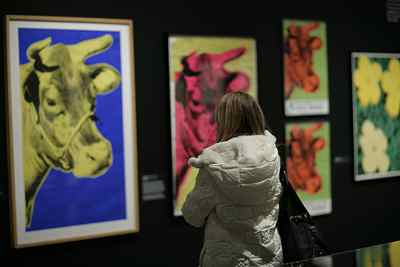
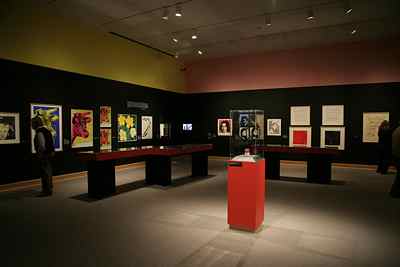
(above: Installation views are courtesy
of the Williams College Museum of Art)
The Williams College
Museum of Art (WCMA) presents Warhola Becomes Warhol - Andy Warhol: Early
Work. Drawn from the museum's collection, this exhibition features Andy
Warhol's early work-from 1952 through the late 1960s-demonstrating his evolution
from commercial artist to Pop icon. Warhola Becomes Warhol contains over
50 works on paper and sculpture, including hand-colored off-set lithographs,
blotted-line drawings, and rare artist books. The exhibition includes several
rare pieces, including a unique, unbound, original manuscript of "Snow
in the Street and Rain in the Sky," 1952. Also on view are several
of Warhol's rarely displayed Polaroid portraits of celebrities, including
Mick Jagger; working "dummies," or mock-ups, created for Warhol's
Interview magazine; and an original collage (1966) that became his iconic
cow wallpaper. Several later works, such as Jackie (1964) and Self Portrait
(1986) will also be on display, allowing visitors to understand how the
techniques that Warhol learned as a commercial artist became the vehicles
he later employed to mass produce his artwork and create the Warhol brand.
The exhibition will be on view through June 10, 2007. A series of related
gallery talks and lectures are listed below.
"We see from Warhol's early commercial work how astute
he was and how he constructed an identity for himself that made him a household
name," says WCMA Director, Lisa Corrin. "We are grateful to have
a major Warhol scholar, Professor Ondine Chavoya, on our faculty. His perspective
on the artist will be complemented by those of a graduate student in our
art history program, and that of a young artist, Alex Donis, who is coming
from Los Angeles for the opening and for a discussion with Professor Chavoya."
The discussion will be held on Tuesday, February 27 at 7:00 pm at the museum,
following the reception that celebrates the museum's spring exhibitions.
All are invited to attend both events.
Corrin also states, "We are so grateful to Williams
alumni for their ongoing and generous gifts to our collection, and in this
case specifically to Richard Holmes, Class of 1946, who recently gave the
balance of his Warhol collection to the museum."
This gift forms the centerpiece of this exhibition. Holmes,
who worked for many years as an assistant headmaster and teacher of history
and of African Studies at the Brooks School in North Andover, Mass., began
collecting early Warhol art and ephemera before it was in vogue to do so.
His first gift to WCMA came in 1995, consisting of 262 issues of Interview
magazine from 1969 through 1991 and 10 books illustrated by the artist.
His second gift of 62 works of art and 117 books were acquired in December
of 2005. This collection will also be shown at the Brooks School.
Warhol has been cited as one of the most famous and famously
controversial American artists of the second half of the 20th century. His
astute eye explored the inventory of American contemporary consumerism in
the '50s and '60s, and he wrestled with issues of artistic appropriation
and mass production. A child of poor Czech immigrants, Andy Warhola was
born and raised in an industrial section of Pittsburgh. In 1949, after formative
experiences at Carnegie Tech (Carnegie Mellon), Andy Warhola came to New
York to start a career as a commercial artist. In the 11 years that followed,
Warhola became Warhol-generating a peculiarly "personalized" portfolio-each
piece marking what is now regarded as one of New York's most successful
careers in commercial illustration.
Andy Warhol became one of the most recognized American
Pop artists of his day. His art, which was characterized by techniques and
themes drawn from mass culture, employed the use of pseudo-industrial silkscreen
process to create "commercial objects" such as Campbell soup can
paintings. Warhol also used this same technique to portray celebrities such
as Jackie Kennedy, Elizabeth Taylor, Mick Jagger, and Marilyn Monroe, as
well as images of Chairman Mao and, yes, cows.
Programming
-
- Gallery Talk: Andy Warhol: Early Work
- Curators Lane Koster, Williams/Clark graduate student,
Class of 2007, and Vivian Patterson, Curator of the Collection, preview
the exhibition.
- Wednesday, February 21
- 4:00 pm
-
- Pop Art Dialogue: "Crumpled Butterflies and Borrowed
Words: A Long Overdue Love Letter to Andy"
- Join Professor Ondine Chavoya & California-based
artist Alex Donis as they discuss the influence of Andy Warhol on Pop art
and specifically on Donis's artistic practice.
- Tuesday, February 27
- 7:00 pm
-
- Gallery Talk: Warhol: Early Work
- Ondine Chavoya, Assistant Professor of Art
- Wednesday, April 11
- 12:10 pm
Introductory text panel from the exhibition
The man who invented Pop Art, who gave everyone 15 minutes
of fame, who startled us with images of Campbell's soup cans and serial
portraits of Marilyn, Elvis, and Liz -- Andy Warhol has always been delightfully
controversial.
This exhibition brings together a body of work that at
once charts Warhol's evolution from commercial illustrator to fine art impresario
and also reflects the tremendous variety of his artistic production: painting,
film, sculpture, rock music, television, and publishing. While the emphasis
of this exhibition is on his early work, examples from the entirety of his
career provide a context for understanding the transformative role of one
of 20th-century America's most important icons.
Warhol grew up dreaming of stars and eventually became
a superstar himself. Born in Pittsburgh, Andrew Warhola came to New York
City to work as a commercial artist, ultimately redefining his identity
as a fine artist and becoming Warhol. His drawings, books, screen prints,
and commercial art seen here -- drawings of cherubs, whole series of portraits
devoted to feet, books decorated with an alphabet rendered in his mother
Julia Warhola's distinctive calligraphic style -- typify his early art.
This is the joyous side of Andy, and, one is tempted to say, the real
Warhol, before he adopted the Pop stance of distance and evasiveness. Here
we get a taste of his giddy success as a 1950s illustrator; we see him as
a person who worked hard and dreamed big. These early works provide a glimpse
into the artist we rarely see.
The museum is very grateful to Richard Holmes, Class of
1946, for his generous gift of early Warhol material that forms the centerpiece
of this exhibition. Holmes, who worked for many years as an administrator
and teacher of history, political science, and African studies at the Brooks
School in North Andover, Massachusetts, began collecting Warhol's art and
ephemera before it was in vogue to do so. The museum would also like to
thank the following individuals and institutions that helped realize this
exhibition: Andreas Brown and the Gotham Book Mart in New York City; Michael
Keating, Class of 1962; David Loughlin; Lucy Keating, Class of 2008; and
Michael McCahill at the Brooks School. This show has been organized by Lane
Koster, Graduate Student in the History of Art, Class of 2007, with Vivian
Patterson, Curator of Collections.
- It is impossible to overestimate the importance of
[his] first [ten] years (1949-1959) in New York for Warhol's personal and
artistic development: it would be naïve to think that his crucial
apprenticeship as a commercial artist - his experiences in the blasé,
hypocritical world of advertising, including work for the exclusive Tiffany,
I. Miller, and Bonwit Teller - played only a minor role in an unbelievably
rapid acceptance by the world of the fine arts establishment of New York,
or that all he wanted was to be a star. His paintings and films of the
1960s would be unimaginable without the experiences and insights of the
1950s.
- Rainer Crone, 1970
-
-
- Andy took any job he was offered, and everything he
did was done professionally and stylishly and on timethe big women's magazines,
first McCall's and The Ladies Home Journal, and later Vogue and Harper's
Bazaar. A lot of people in the industry began to notice Andy's magazine
work. Whatever he illustrated shampoo or bras or jewelry or lipstick
or perfume, there was decorative originality about his work that made it
eye-catchingAndycould hit the right note unerringly. The childish hearts
and flowers and the androgynous pink cherubs that he used were not quite
what they seemed to be, there was a slight suggestiveness about them that
people in the business recognized and approved. He could kid the product
so subtly that he made the client feel witty.
- Calvin Tomkins, 1970
Wall labels from the exhibition
-
- 25 Cats Name Sam and One Blue Pussy, ca. 1954
- [written by Charles Lisanby; printed by Semour Berlin]
- bound artist's book with 36 pages and 18 plates
- offset prints on paper with hand coloring
- Gift of Richard F. Holmes, Class of 1946
- 95.18.4
-
- 25 Cats Name Sam and One Blue Pussy is one of Warhol's first promotional books from his years as
a commercial artist. The drawings reveal the telltale blotted line technique
characteristic of his early graphic work. Warhol used such a line to give
his drawings a "printed" feel, and many works were later serially
reproduced via offset lithography. In this book, each sketch is accompanied
by the name "Sam," written, not in the artist's hand, but in
the distinctive, whimsical script of Warhol's mother, Julia. Originally
from Slovinia, Warhol's mother knew little English and when she would painstakingly
copy the text Andy asked her to write, she occasionally dropped letters
or made misspellings. "Name" in the book's title is an instance
of this kind of accidental elision. Warhol had this book printed and bound
and then enlisted friends to help hand color them.
-
- Following 25 Cats Name Sam, Warhol created The
Gold Book (ca. 1956), a collection of blotted line drawings of friends,
flowers, and shoes, on gold paper (inspired by the gold lacquer work he
had seen during a trip to Bangkok). Then Warhol composed In the Bottom
of My Garden (ca. 1956) replete with slightly suspect cherubs, followed
by Wild Raspberries (ca. 1959), a joke cookbook with Suzie Frankfurt's
recipes.
- (Courtesy, Andreas Brown, Gotham Book Mart, 1971)
-
-
- Andy Warhol and Suzie Frankfurt
- Wild Raspberries, ca.1959
- bound artist's book with 40 pages and 18 plates
- offset prints on paper with hand coloring and tissue
overlays
- Gift of Richard F. Holmes, Class of 1946
- 95.18.8
-
- Like all good social art, Wild Raspberries is
more than just a series of vivid images, and like all good cookbooks, it
offers more than just recipes. This oversized book is impossible to understand
apart from the culture that gave rise to it: the world of New York high
society in the 1950s. A collaboration among Warhol, interior designer Suzie
Frankfurt, and Warhol's mother Julia, Wild Raspberries parodies
the lifestyles of the rich and famous by means of outlandish recipes. "Continental
dining" was all the rage in the 1950s, and any sophisticate worth
her mink was expected to be conversant with European, especially French,
food. Cookbooks of the era were often pretentious, and Wild Raspberries
spoofs the genre in its call for such rarified ingredients as plover's
egg and cock's kidneys. At the same time, the book mocks the author's own
pretensions, especially Warhol's penchant for celebrity. Sprinkled throughout
the text are references to Cecil Beaton, Princess Grace, and Greta Garbo.
The recipes themselves provide an A list of purveyors of food to the social
elite: For "piglet," Warhol and Frankfurt recommended sending
the chauffeur in his Cadillac to pick up a forty-pound suckling pig at
Trader Vic's.
- (Courtesy, Professor Darra Goldstein, 2006)
-
-
- Jackie, 1964
- synthetic polymer paint and silkscreen ink on canvas
- Partial gift of The Andy Warhol Foundation for the Visual
Arts, Inc. and museum purchase from the John B. Turner '24 Memorial Fund
and Karl E. Weston
- Memorial Fund
- 95.11.1 & 2; 94.15.2 & 1
-
- Warhol's artistic exploration of images of Jacqueline
Kennedy began in 1964, one year after the death of her husband, President
John F. Kennedy. Jackie was a celebrity in her own right, ubiquitous in
the media and beloved by the public. In his series of portraits of Jackie,
the artist examines the relationship between public and private life, manipulating
famous source images for the First Lady before and after the historic tragedy.
The photographic juxtaposition of Jackie smiling and weeping highlights
the public nature of this iconic figure's private struggle.
-
- In Jackie, as in many of Warhol's pieces, he appropriates
and alters easily recognizable photographs. The source photos are so famous
that they are comprehensible even when only vestiges of the originals remain.
Images of Jackie at the assassination, funeral, and Vice-President Johnson's
swearing-in were shown with such repetition in print and on television
that the line between Jackie's mourning and the public's mourning became
blurred. The multiplication of Jackie's portraits mimics the media's repetitive,
omnipresent use of her images in magazines and comments on the public display
of private grief.
- (Courtesy, Meredith Sanger-Katz, 2006)
-
-
- Jackie One (silver), 1966
- silkscreen on paper
- Gift of Richard F. Holmes, Class of 1946
- M.2005.17.5
-
-
- Flash - November 22, 1963,
1968
- screenprint and teletype on paper
- Museum purchase, Karl E. Weston Memorial Fund
- M.2002.10
-
- Five years after the assassination of President John
F, Kennedy, Warhol created Flash November 22, 1963, a series
of silkscreens matched with teletype text that narrate the four days between
President Kennedy's assassination and his funeral. Through distortion,
bold colors, and image layering, Warhol created a suite that not only expresses
the collective trauma of the events of those four days, but also comments
on the media's manipulation of public opinion.
-
-
- from A la recherche du shoe perdu, with poems
by Ralph Pomeroy, 1955
- offset lithographs on paper with hand coloring
- Gift of Richard F. Holmes, Class of 1946
- M.2005.17. A-G and J - O
-
-
- top row, right to left
-
- In Her Sweet Little Alice Blue Shoes
- Shoe Fly Baby
- Any One for Shoes?
- I Dream of Jeannie with the Light Brown Shoes
- Shoe of the Evening, Beautiful Shoe
- My Shoe Is Your Shoe
- Dial M for Shoe
-
-
- bottom row, right to left
-
- Uncle Sam Wants Shoe!
- When I'm Calling Shoe
- See a Shoe and Pick It Up and All Day Long You'll
Have Good Luck
- Sunset and Evening Shoe
- The Autobiography of Alice B. Shoe
- Beauty Is Shoe, Shoe Beauty
- You Can Lead a Shoe to Water But You Can't Make It
Drink
-
- In the 1950s, Warhol's artistic interests included his
environment; his jobs: his friends; flowers; butterflies; cats; people,
young and old; and shoes, shoes, and more shoes. He produced a series of
outrageous and bedazzling images of high-heeled glamour from spikes
to boots to mules that have since become some of his most iconic
imagery. Although the drawings were designed for advertisements, they were
playfully personalized to capture the essence of celebrities' personalities.
Evident again is the artist's ability to transform the ordinary into the
extraordinary.
- (Courtesy, Andreas Brown, Gotham Book Mart, 1971)
-
-
- Liz, 1965
- color silkscreen on paper
- Museum purchase, Ruth Sabin Weston Fund
- 73.52
- Throughout his printmaking career, Warhol exploited the
popular images of superstars such as Marilyn, Jackie, and Liz. For Warhol,
Elizabeth Taylor was much more than just a celebrated actress. She was
a goddess of the silver screen, and the embodiment of a life of luxury.
It was the trinity of mortality, celebrity, and fame which so fascinated
him.
-
- As Warhol once said, It would be very glamorous to
be reincarnated as a great big ring on Liz Taylor's finger.
-
- There are many versions of Liz, all based on the
same photograph but printed in different color combinations on different
papers and canvas. The first print version was printed commercially in
three colors under the direction of Leo Castelli and signed by Warhol in
1964. This four-color version was screened in the summer of 1965.
-
-
- Screenprinting
-
- Warhol was one of the first artists to use screenprinting.
He remarked, In August 1962 I started doing silkscreens. I wanted something
stronger that gave more of an assembly line effect. With silkscreening
you pick up a photograph, blow it up, transfer it in glue onto silk, and
then roll the ink across it so the ink goes through the silk but not through
the glue. That way you get the same image, slightly different each time.
It was so simple quick and chancy. I was thrilled with it. My first
experiments with screens were heads of Troy Donahue and Warren Beatty,
and then when Marilyn Monroe happened to die that month, I got the idea
to make screens of her beautiful face -- the first Marilyns.
-
-
- Pop Art
-
- The Pop Art movement was largely a British and American
cultural phenomenon of the late 1950s and early 1960s. Pop Art works were
characterized by the portrayal of any and all aspects of popular culture
that had a powerful impact on contemporary life; its iconography
taken from television, comic books, movie magazines, and all forms of advertising
was presented emphatically and objectively and by means of the precise
commercial techniques used by the media from which the images were initially
borrowed.
-
- Pop represented an attempt to return to a more objective
universally acceptable form of art after the dominance in both the U.S.
and Europe of the highly personal Abstract Expressionist movement. Its
effects including its destruction of the boundary between "high"
and "low" art have continued to be powerfully felt throughout
the visual arts to the present day. [Encyclopedia
Britannica]
-
-
- Andy Warhol's Index Book,
1967
- books [pre-publication "dummys"]
- Gift of Richard F. Holmes, Class of 1946
- 95.18.9. A & B
-
- In the spring of 1967, Alan Rinzler arrived at the Random
House offices with the concept of a book by and/or about Andy Warhol and
his friends. With a nervous deep breath, Christopher Cerf agreed to the
project, and Rinzler, Cerf, and Random House designer David Paul headed
for Warhol's studio, called The Factory, to collect materials and ideas.
-
- Soon after, Warhol arrived at the Random House offices,
where his eye happened to fall on several of the Random House Pop-up Experiments.
"Those are nice," said Andy. Then and there it was decided to
add pop-ups to the book.
-
- When the dummy was finished, David Paul pronounced that
"there is conception and organization here." Warhol and friends
agreed after a fashion. "Um, but," said Warhol, and several boxes
of new materials were produced from the innards of The Factory. "What's
to be done now?" asked Cerf. "Have you seen Mozart's opera Cosi
Fan Tutti?" answered Billy Name, Warhol's photographer. With this
helpful remark ringing in his ears, David Paul accepted the new photographs
and began work on a second dummy.
-
- By the time the galleys of the printed matter in the
book were reaching the Random House offices, with David Paul now hard at
work on dummy number three, the problem of legibility came up. "The
book is too easy to read," said Andy in a rare talkative moment. Warhol
and friends returned to The Factory, with dummies in hand, and soon solved
that problem.
-
- At last the book was ready to go to the offices of Graphics
International, who would eventually produce the book in Japan. Meanwhile,
Warhol struggled with the finishing touches, including the famous "Nose
Job" (for which Christopher Cerf Xeroxed over 1,000 noses before the
artist was satisfied). And even as the book was on press, Warhol was adding
details. The last addition to the book (and an important one it was!) was
the swirl design on the "Notes on Myepic" page. One final time
over the proofs ("leave the typos; Andy loves mistakes"), a final
revision of the title page, and the book was ready for production.
-
- After a frightening few days while the ship carrying
Andy Warhol's Index Book was battered by a Pacific typhoon, copies
of the book arrived at the Random House warehouse in November of 1967.
It is safe to say that in addition to being a catalogue of the world of
Andy Warhol, the Index Book is a work of art, and as far as we know,
no two are exactly the same.
- (Courtesy, Random House, ca. 1967-68)
-
-
- Kiss, 1966
- silkscreen ink on plexiglas with metal stand
- Gift of Richard F. Holmes, Class of 1946
- M.2005.17.29
-
- Warhol was one of the most important and provocative
filmmakers in New York during the early 1960s and early 1970s. His influence
can still be found in Hollywood mainstream film, which took from his work
realism and sexual explicitness, and in experimental film, which reworked
his long-take, fixed camera aesthetic. The movie Kiss, 1963, belonged
to Warhol's early series of silent, black-and-white films that emphasize
stillness and duration.
-
- The screenprint series on plexi was made after the film,
with the model being a still from Tod Browning's Dracula, (1931),
starring Bela Lugosi and Helen Chandler, and originally rendered as a silkscreen
on paper in 1963.
-
- Warhol himself avowed, The best atmosphere I can think
of is film, because it's three- dimensional physically and two-dimensional
emotionally.
-
-
- Velvet Underground and Nico,
ca.1965-67
- poster on paper
- Gift of Richard F. Holmes, Class of 1946
- M.2005.17.25
-
- The Velvet Underground was a New York-based rock band
that released four albums at the end of the 1960s and in the early 1970s.
The original members were Lou Reed, John Cale, Sterling Morrison, and Maureen
Tucker. Their music was based on black rhythm and blues mixed together
with experimental modern classic music.
-
- The Velvet Underground (also known as the Velvets) was
one of the first rock n' roll bands that went on stage to provoke instead
of entertain. Warhol's collaboration with the Velvets from 1965 to 1967
was legendary in music circles and resulted in the album "The Velvet
Underground and Nico"-an album which many music critics now consider
one of the most important records in popular music history.
-
-
- Andy Warhol and David Dalton
- Aspen, The Magazine in a Box: The FAB Issue, 1966
- book
- Gift of Richard F. Holmes, Class of 1946
- M.2005.17.40
-
- The multimedia magazine ASPEN was conceived by
journalist Phyllis Johnson and produced 10 issues between 1961 and 1971,
each by a different designer. The Pop Art issue was designed by Warhol
and David Dalton. It was comprised of a hinged box designed to imitate
a brand-name detergent carton filled with several loose items: The Ten
Trip Ticket Book (excerpts from papers presented by the Berkeley Conference
on LSD, with texts by Timothy Leary and others); The Underground Movie
Flip Book (a small oblong booklet with stills from Andy's movie Kiss
and Jack Smith's Buzzards Over Bagdad); a copy of The Plastic
Exploding Inevitable (Warhol's illustrated underground newspaper),
12 Paintings from the Powers' Collection (twelve cards in a die
cut envelope reproducing works by Warhol, Lichtenstein, Johns, Oldenburg,
Rosenquist, and others); the portfolio Music Man, That's Where It's
At (a FlexiDisk with texts on rock 'n roll by members of the Velvet
Underground); and other sundry ephemeral advertisements.
-
-
- Andy Warhol's Factory
-
- Portrait of Andy Warhol,
ca. 1974
- polaroid
- Gift of Richard F. Holmes, Class of 1946
- M.2005.17.41.A-E
-
- Self-portraiture was a central theme in Warhol's extensive
body of work; and the most recognizable image he produced may have been
his own. Warhol became a cultural symbol, and his face is now as familiar
as the celebrity and commercial icons he depicted and serialized: Marilyn
Monroe, Elvis Presley, and Campbell's Soup.
- (Courtesy, Professor C. Ondine Chavoya, 2006)
-
- I look really awful, and I never bother to primp or
try to be appealing because I don't want anyone to get involved with me.
And that's the truth. I play down my good features and play up the bad
ones. So I look awful, and I wear the wrong pants and the wrong shoes,
and I come at the wrong time with the wrong friends, and I say the wrong
things, and I talk to the wrong person, and then still sometimes somebody
gets interested, and I freak out and wonder: What did I do wrong? -- Warhol
-
-
- Constantin/Vogelmann, (German, 20th century)
- Andy Warhol, ca. 1960-1975
- black and white photograph
- Gift of Richard F. Holmes, Class of 1946
- M.2005.17.38
-
-
- In the Bottom of My Garden,
1956
- bound artist's book with 40 pages and 21 plates
- offset lithograph on paper with hand coloring
- Gift of Richard F. Holmes, Class of 1946
- 95.18.6
-
-
- A Gold Book by Andy Warhol,
ca. 1956
- [designed by Miss Georgie Duffie]
- bound artist's book, with gold boards (first issue);
40 pages and 19 plates
- offset lithograph on paper with hand coloring
- Gift of Richard F. Holmes, Class of 1946
- 95.18.7
-
-
- Interview Magazine, 1969
- [mock-ups for the first and second issues of the magazine]
- newsprint
- Gift of Richard F. Holmes, Class of 1946
- 95.18.11 & 12
-
-
- A Picture Show by the Artist Andy Warhol, 1957
- [announcement card for an exhibition based on A Gold
Book by Andy Warhol]
- print on paper
- Gift of Richard F. Holmes, Class of 1946
- 95.18.14
-
-
- Campbell's Soup Can (Beef Consommé), ca. 1962-1964
- ink on paper mounted to tin
- Gift of Richard F. Holmes, Class of 1946
- 98.4
-
-
- Preparatory Sketch for Self Portrait/ Williams College
Museum of Art Poster, 1986
- magic marker on paper
- Estate of the artist
- EL.86.3
-
-
- Self Portrait/Williams College Museum of Art Poster, 1986
- silkscreen on paper
- Anonymous gift
- 86.29
-
-
- from right to left
-
- Shoe in Bird Cage, ca. 1956
- ink and tempera on paper
- Gift of Richard F. Holmes, Class of 1946
- M.2005.17.1
-
- Shoe in Ice Tea Glass with Butterfly, 1954-1956
- hand colored lithograph on paper
- Gift of Richard F. Holmes, Class of 1946
- M.2005.17.19
-
- Andy Warhol is a very young artist who may be said
to be addicted rather than dedicated. Currently he is addicted to shoes
or, rather, hand-drawn images of them; single, never in pairs, and
usually large enough to fit circus giants of both sexes. Naively outlined
in strict profile and then, as it were, smothered in gold-leaf and decorative
commercial-cutouts in gold (tassels, cupids, conventional borders), they
have an odd elegance of pure craziness. If one doubted they were fetishes,
his doubt would be dispelled by noticing that an evening slipper is inscribed
to Julie Andrews and a boot to James Dean.
- (Art News, December 1956)
-
-
- Campbell's Soup Can, BEEF (with Vegetables and Barley),
ca. 1962
- color silkscreen with silver and gold on paper
- Gift of Richard F. Holmes, Class of 1946
- M.2005.17.2.A
-
-
- Campbell's Soup Can, CONSOMME (Beef), ca. 1962
- color silkscreen with silver and gold on paper
- Gift of Richard F. Holmes, Class of 1946
- M.2005.17.2.B
-
-