Editor's note: The Speed Art Museum provided source
material to Resource Library for the following article or essay.
If you have questions or comments regarding the source material, please
contact the Speed Art Museum directly through either this phone number or
web address:
Building Books: The Art
of David Macaulay
February 6 - May 13, 2007
The Speed Art Museum
is hosting Building Books: The Art of David Macaulay, on display
February 6 through May 13, 2007. Recent "genius awards" 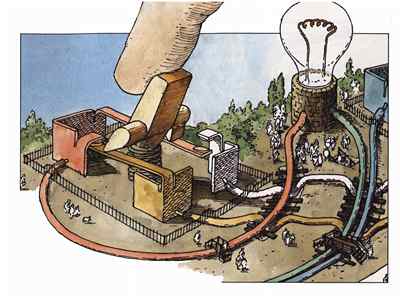 winner, David Macaulay is the author and illustrator of
such best-selling titles as The Way Things Work and The New Way
Things Work, Cathedral and Castle. His novel Black and White
received a Caldecott Medal in 1991. (left: David Macaulay, from The
Way Things Work)
winner, David Macaulay is the author and illustrator of
such best-selling titles as The Way Things Work and The New Way
Things Work, Cathedral and Castle. His novel Black and White
received a Caldecott Medal in 1991. (left: David Macaulay, from The
Way Things Work)
This exhibition includes over 100 original works of art,
studies, sketchbooks, book dummies, manuscripts, correspondence and artifacts
(including hand-built ship models). There will also be interactive family
activities within the exhibition.
The exhibition has been divided into three significant
aspects of Macaulay's work: Big Ideas, Building Ship: Exploring
the Artist's Process, and Journey Books: The Evolution of Ideas.
A biographical section displaying personal artifacts, memorabilia and photographs
will also be on view.
An author and artist who has helped us to understand the
workings and origins of everything from simple gadgets to monumental architectural
structures, David Macaulay employs pictures and words to reveal the secret
lives of objects and emphasize the common sense behind the design of things.
As a young boy living in Lancashire, England, Macaulay
was fascinated by simple technology. Out of cigar boxes, string, and tape,
he constructed elevators; using yarn, he made intricate systems of moving
cable cars. At a very early age, he became interested in how objects are
constructed. Many of his books reflect his love of travel and explore
the places that the imagination takes us when we least expect it.
In 2006, Macaulay was named a recipient of The John D.
and Catherine T. MacArthur Foundation fellowships, also known as "the
genius awards." The awards recognize people in a broad range of disciplines
who show exceptional creativity and the potential for continued innovative
work.
Building Books: The Art of David Macaulay has been organized by the Norman Rockwell Museum in Stockbridge,
Massachusetts. In Louisville, exhibition support has been provided by BellSouth
The Real Yellow Pages ®.
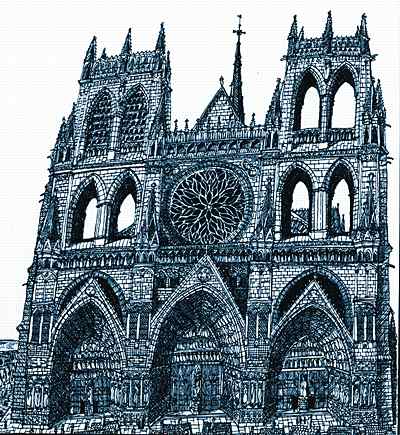
(above: David Macaulay, from Cathedral)
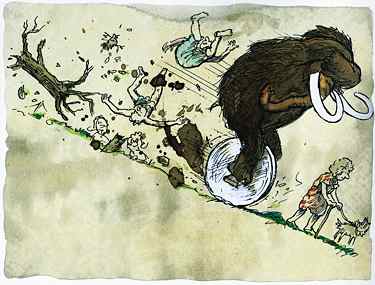
(above: David Macaulay, from The Way Things Work)
Selected wall text for the exhibition
-
- Introduction
-
- "For some time now, I have been encouraging people
to ask themselves why things look the way they do."
- -- David Macaulay
-
- An author and artist who has helped us to understand
the workings and origins of everything from simple gadgets to monumental
architectural structures, David Macaulay employs pictures and words to
reveal the secret lives of objects and emphasize the common sense behind
the design of things. A gifted visual storyteller, he inspires discovery
by demystifying an increasingly complex world while celebrating the places
the imagination takes us when we least expect it.
-
- Startling in their complexity and beauty, David Macaulay's
award-winning books are beloved by readers throughout the world. Rich in
content, they reveal the artist's lifelong love of history, keen sense
of humor, and innate interest in all things - from the marvelous to the
mundane. Vibrant visual experiments, his images place us in the middle
of the action as well as above and below it, inviting us to experience
new realities while compelling us to turn each page.
-
- Translated into twelve languages, David Macaulay's books
encourage readers to draw connections between seemingly unrelated things,
transcending the boundaries of time, culture and geography. His art conjures
up new worlds, defines and comments upon society, enhances our appreciation
of ideas, and challenges our perspectives. We are honored to celebrate
and explore David Macaulay's outstanding artistic legacy, which has profoundly
enhanced and influenced our rapidly changing visual culture.
-
-
- Quotes
-
- "My days were mostly spent watching things being
made and being outin my own world, fueled by my own imagination. That was
a priceless combination, as it has turned out."
- -- David Macaulay
-
- "History was a very important part of my educationI
have always loved history, which is filled with wonderful stories."
- -- David Macaulay
-
- "My work has been shaped by the fact that I am still
growing up."
- -- David Macaulay
-
-
- David Macaulay: The Building of an Illustrator
-
- "As a child, I was very aware of process and how
things get made, and that they do get made. I knew that things didn't
just appear."
- -- David Macaulay
-
- When David Macaulay was a young boy living in Lancashire,
England, he was fascinated by simple technology. Born on December 12, 1946,
it was not long before he began constructing elevators with cigar boxes,
tape and string, and devising intricate systems of moving cable cars with
wood and yarn.
-
- Residing with his family in small house at the end of
a row of identical brick homes typical of those found in industrial Northern
England, David Macaulay spent much time playing and exploring in the nearby
woods, fueled by his own imagination. There, he uncovered a wealth of small
treasures like animal skeletons and unusual rocks, which he collected and
catalogued. If inclement weather kept him indoors, he joined his family
in the kitchen, where projects were always underway. "My parents were
both makers of things," the artist has said, "and we were all
witness to what they were making - whether my mother was preparing food
or my father was involved in some project - it was all done at the kitchen
table." A television was not present in the Macaulay household until
he was ten years old.
-
- Employed in the knitting industry, David Macaulay's father
was adept at repairing and improving the function of complex, clamorous
textile machinery, and his skills were in high demand. After accepting
a manufacturing position in fast-paced Bloomfield, New Jersey, he brought
his family to America when David was eleven years old. The five-day transatlantic
journey on the U.S.S. United States was an exciting one for the
artist, and it was during this period of transition that he began to draw
seriously.
-
- In 1963, as his high school years were drawing to a close,
David Macaulay considered his next steps. The artist's grandfather had
been an architect and a surveyor, and David, too, was interested in a design
education. Pursuing a career in architecture, he attended the Rhode Island
School of Design from 1964 to 1968, and spent his fifth and final year
of study in Rome, Italy -- a city that he has returned over and over again,
both in life and in art. Though he ultimately decided against a professional
career in architecture, his training had served him well, enabling him
to navigate complex ideas with confidence.
-
- After graduation, David Macaulay taught briefly on the
junior and senior high school level, worked in an interior design office,
and experimented with freelance illustration, when he began to explore
the creative connections between words and pictures. His first book, Cathedral,
was published in 1973 and was an immediate success. Since then, David Macaulay's
books have been met with international acclaim and he has received many
prestigious professional citations, including the Caldecott Medal and Honor
Awards. The inspiration for and host of Building Big, a PBS miniseries
about the world's greatest feats of engineering and ingenuity, the artist
is currently at work on a book exploring the complexities of the human
body.
-
-
- Building Ship: Exploring the Artist's Process
-
- "The words 'utter chaos' describe perfectly a seductive
and often frustrating form of self-abuse called the creative process. The
creative process, in turnsets out to bring order and extract meaning from
a conglomeration of parts and elements that are without order or connection."
- -- David Macaulay
-
- David Macaulay's book Ship links the present with
its past by weaving a rich tapestry of words and images that tell the tale
of the Magdalena of Seville, a sixteenth century sailing vessel
long-lost in the reefs of the Caribbean Sea. A vestige of the age of discovery,
this small wooden ship known as a caravel was a technological triumph in
its day, ideally suited to the uncertainties of coastal exploration and
transatlantic travel. Though caravels changed the map of the world forever,
no drawings or models exist that describe exactly what they looked like
or how they were built.
- An engaging work of fiction, Ship's story is
based almost entirely upon fact, and is recounted by the artist in two
distinct parts. We are first invited to enter the world of modern day maritime
archaeologists in their underwater search for the remnants of a sunken
caravel. As artifacts are recovered and interpreted, five-hundred-year-old
clues from the past bring the Magdalena to life again. In the book's
second half, a merchant's diary from the year 1504 offers a detailed account
of the building of the Magdalena, from the choice of timbers to
his reflections as the boat sets sail.
-
- Beautifully conceived and illustrated, Ship also
serves as a roadmap of David Macaulay's creative and technical process.
Recreating history requires imagination, academic care, and passion. This
section of the exhibition offers an in-depth look at the artist's working
methods, from first idea to finished manuscript and artwork. Pieces of
a whole, each fragmentary stage -- from ethnographic research, thumbnail
studies, mechanical drawings, consultation with scientists, and travel
to distant lands -- helps him to find his story and communicate it in a
compelling way.
-
-
- Journey Books: The Evolution of Ideas
-
- "It isn't necessary to think in a straight line
to make sense. While uncertainty brings with it the chance for screaming
failure, it also offers the possibility of exhilarating surprise."
- - David Macaulay
-
- The always unpredictable and often frustrating nature
of the evolution of ideas has been at the center of David Macaulay's thinking
for more than thirty years. In contrast to the historically accurate architectural
books that he is best known for, his "journey books" are flights
of fantasy that explore the ways that people's lives intersect without
their even knowing.
-
- For the artist, the notion of taking a break from his
established approach to bookmaking seemed like a breath of fresh air after
more than a decade spent dissecting the world's most prodigious structures
in Cathedral, City, Pyramid, Underground, Castle,
Unbuilding and Mill. Engaging visual jaunts, his journey
books reveal his love of travel and offer gentle commentary on life's ironies
and complexities as time passes and stories unfold.
- Sometimes built around a fragment of an idea or a single
drawing that needs a home, David Macaulay's journey books have no clear-cut
beginning or end at the outset, and can be challenging to write and design.
Piece by piece and sequence by sequence, each book is "grown"
by letting ideas have a little breathing room.
-
-
- The New Way Things Work From Levers to Lasers,
Windmills to Websites A Visual Guide to the World of Machines
-
- Did you know that your dentist's drill is a direct descendant
of the first windmill? Or that the principle behind the zipper and the
plow also governed the building of the pyramids? David Macaulay's imaginative,
accessible guide to the workings of machines shows how the concept behind
one machine links to the concept of another - from the simplest lever to
the far-reaching capabilities of the Internet.
-
- His most successful book to date, The Way Things Work
was first published in 1988, when it remained on the New York Times
bestseller list for fifty weeks. A sometimes grueling four-year project,
this innovative volume was the result of a close collaboration between
the artist, science writer Neil Ardley, and project editor David Burnie.
Though he usually devotes his energies to one book at a time, David Macaulay
took a break in the process after two years to write and illustrate a lighthearted
work of fiction titled Why the Chicken Crossed the Road - which
he completed in just three weeks.
- In The New Way Things Work, an updated and expanded
second volume, additional illustrations, drawn from life, detail current
technology and underscore the dramatic advancements that had been made
in just ten years. With a touch of whimsy, the artist's bemused woolly
mammoth ambles along the pages of the book, demonstrating his prehistorically
simple approach to a diverse array of concepts. Rooted in the past, he
tends to resist change, as we learn in the book's epilogue.
-
- While mammoth had been impressed by much of the digital
domain, there was
- also plenty about it that left him feeling uncomfortable.
In the end, it was just
- too muchtoo fast, and too unfamiliar. Mammoths, after
all, had never really
- embraced the concept of progress and this one wasn't
going to start now.
-
- Each of the story sequences in Black and White
is painted in a particular way to help readers make visual connections
as they turn the pages of the book. The artist's style and technique is
varied exquisitely from one frame to the next, creating a sense of mood
and atmosphere. On each left-facing page, impressionistic watercolors trace
the boy's solitary journey home and sepia-toned domestic scenes recall
old family photos. On the right, a color-washed rail station teems with
life and an army of lost Holsteins move in and out of abstraction.
-
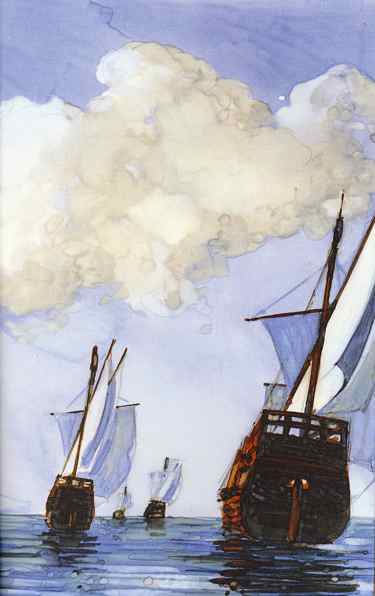
(above: David Macaulay, from Ship)
RL readers may also enjoy:
Read more articles and essays concerning this institutional
source by visiting the sub-index page for the Speed
Art Museum in Resource Library.
Visit the Table
of Contents for Resource Library for thousands
of articles and essays on American art.
Copyright 2007 Traditional Fine Arts Organization, Inc., an Arizona nonprofit corporation. All rights
reserved.