Editor's note: The Flint Institute of Arts provided source material to Resource Library for the following article. If you have questions or comments regarding the source material please contact the Flint Institute of Arts directly through either this phone number or web address:
After Lewis and Clark: The Forces of Change, 1806-1871
February 10 - April 29, 2007
In celebration of the 200th anniversary of the expedition of Lewis and Clark, the Flint Institute of Arts is presenting an exhibition of 115 works of art from the Gilcrease Museum in Tulsa, Oklahoma. The exhibition features paintings, drawings and prints, by artists who accompanied explorers, including Meriweater Lewis and William Clark as they encountered the unexpected and unique subjects of what is now the western United States. The works, created between 1806 and 1871, by artists including George Catlin, Thomas Moran, Albert Bierstadt and Karl Bodmer, help deepen our understanding of the West and its history.
"After Lewis and Clark: The Forces of Change, 18061871" is organized by the Gilcrease Museum, Tulsa, Oklahoma. This exhibition is made possible by the following major sponsors: The Ralph and Frances McGill Foundation, The Trust Company of Oklahoma, and The Harold C. Stuart Foundation.
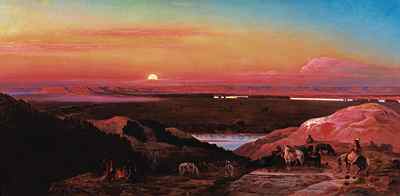
(above: Carl Wilmar, American, b. Germany, 1828-1862, "Indian Encampment on the Big Bend of the Missouri River," oil on canvas, 1860, 25 x 49 inches)
Programs scheduled during the exhibition include:
Wall text from the exhibition
The artistic heritage of the nineteenth century reflects the explorations that came after Lewis and Clark's great adventure and marks the people, events, and places -- the forces of change -- that characterized the passage of an era. As the American West changed in the nineteenth century, the way artists represented it also changed. Western art began predominantly with portrait painting. It then evolved into scenes that spoke of western life and the characteristics of the West, and then finally gravitated toward grandiose landscapes.
The artists who depicted the early American West created visual records of the passing of an era. Their images reached a great number of people, and their endurance as artists is attributed not only to their artistic abilities but also to their role as recorders and, to a degree, shapers of history.Their paintings are not mere reportage. These artists were interpreters of what they encountered, and through their works other artists and illustrators took greater interest in depicting Native Americans and western landscapes.
MAPS OF EXPLORATION
Before the exploration of the American West, there were three centuries of discovery, expansion, and settlement in North America and the United States. After Lewis and Clark's Corps of Discovery mapped their course, it took less than sixty years for mapmakers to fill in other interior features of the American West. The evolution of America can be seen in its maps. As the country was explored and mapped, the subsequent renderings became more complex, showing streams, rivers, deserts, and mountains. Early mapmakers used not only reports and sketches from explorations, but also pure conjecture to fill in some of the spaces-for example some maps as late as 1720 represented California as an island. However, where mapmakers could not obtain evidence as to a country's coastline or interior, the map was left blank.
From 1804 to 1806, Meriwether Lewis and William Clark led the first scientific and ethnographic exploration of the interior of the West. But it was not the first exploration of the interior of America that took place west of the Mississippi. During the 1700s, the British explored part of the Northwest and the French explored south from Canada into the northern Great Plains; the Spanish made explorations from the south into the Southwest, the Great Basin, and the western and central Great Plains.
FIRST ARTISTS OF THE AMERICAN WEST
The American West is identified as being west of a line that extends from the western borders of the upper Mississippi to southern Louisiana. There were no artists that accompanied Meriwether Lewis and William Clark's expedition of 1804-1806, which was the first official party to travel to the Pacific. The first artists of the Great Plains were the Native Americans who decorated their buffalo robes, tepee hides, and garments with paint, porcupine quills, beads, shells, feathers, and trade cloth.
MANIFEST DESTINY
The second quarter of the 1800s was a wide-eyed age of expansionism. Manifest Destiny defined the belief of many Americans in the nineteenth century that the destiny of the United States was to expand across the continent from sea-to-sea. It was also an era of industrial expansion and growth in artistic thought. The kind of painting that developed between 1825 and 1850 dominated the art of the West through the 1860s. However, the decade of the 1840s was the period that gave rise to the expression "manifest destiny" as a prescription for acquisition of land by the U.S. government.
The era of Manifest Destiny was a frontier for pioneers in the creative arts as well as for explorers and settlers. Artist-explorers often developed their paintings of the West from field sketches after returning to their eastern studios. Other painters of the West-those who rarely if ever traveled beyond the East-depended on newspaper or eyewitness accounts and illustrations in the journals and popular magazines of their day for inspiration. From these they created the images to accompany the history of the era.
PORTRAITS FROM LIFE
In the early 1800s American interest in the arts was in a youthful state.The first artworks to gain prominence in America were portraits.Possessing a likeness of a hero of the Revolution or of one's own family members was highly valued. Itinerant portrait painters traveled the land, making portraits for all who could afford their price, from large paintings to be hung on walls to miniature paintings that could be carried as keepsakes in purse or pocket. European-trained painters were among the early leaders in American portrait making.
Although the first true portraits of Native Americans were painted in the 1700s, portraits of tribal leaders were not painted in abundance until the 1800s. One of the first painters to gain recognition for his Indian portraits was from France. Charles Balthazar Julien Févret de Saint-Mémin (17701852) used a mechanical device called a "physiognotrace" to outline the profile of his subject's features and then filled in the outlines with color. Other artists of note include James Otto Lewis, George Catlin, Karl Bodmer, and Alfred Jacob Miller.
SCENES OF THE WEST
All of the artists who traveled in the West during the first seven decades of the nineteenth century were keenly aware that the era of Native American dominance of the land was coming to a close. They were also aware that incoming settlers would eventually change the look of the unspoiled landscape.
Fortunately, the West beyond the Mississippi was recorded for posterity by a number of artists. In their work, one can sense the awe and wonder of the scenes they witnessed. These images of western life serve as tributes to their historic foresight and as a unique visual record of the pristine country they traversed.
WESTERN COMMERCE AND INDUSTRY
The expansion of fur trading has been suggested as a reason for the rapid deployment of America's first official exploration along the Missouri River to the Northwest and Pacific Ocean. The Oregon Territory was first claimed by the British; however, by 1819, the increasing presence of American companies interested in the fur trade resulted in a treaty between the United States and Great Britain to share a mutual claim on the land. Between 1825 and 1840, fur traders gathered on the west side of the Rocky Mountains for what was to become an annual trade fair.
Gold mining was another important industry in the West, particularly after gold was discovered in California in 1848. Citizens from around the world journeyed to the Sierra Nevada Mountains to seek their fortunes. By 1849, thousands of gold prospectors ventured west, a "gold rush" that was known as the "rush of forty-niners." Farming and ranching also became major industries in the West during the nineteenth century; however, depictions of those activities were not popular with artists of that time.
NATIVE AMERICAN LIFE
Easterners did not understand the cultures of the original inhabitants of the lands they bought or made treatywith. For the Americans of the Eastern United States, artists were the first to give a face to these ancient cultures. Some said these native cultures never changed, but in reality their civilizations were constantly adapting to the use of new materials through reasoned choices. The artists depicted their adaptations and advancements. For example, Native Americans were quick to adapt to the availability of the horse, to the use of glass beads for decoration in place of porcupine quills, metal implements and weapons in place of bone or rock, cloth blankets and clothing instead of robes of animal skin and fur, and drawing on paper in place of painting on hides.
DEVELOPMENT AND CONFLICT
The mid-nineteenth century was a period of great technological and industrial development in America. The coming of technology to the West was on the heels of wagon trains and, later, accompanied the railroad industry. But there was more to development than industry. The encroaching culture wanted to introduce a new way of life to the native people, and that also created conflict.
In 1877, Chief Joseph of the Nez Perce spoke of the exasperation of the Indian people to trespassing culture when he said, "The white men were many and we could not hold our own with them. Their country was large. We were contented to let things remain as the Great Spirit made them. They were not, and would change the rivers if they did not suit them."
ARTISTS OF THE MOUNTAINS AND CANYONS
The magnificent landscapes of mountains, canyons, and valleys
painted by Albert Bierstadt and Thomas Moran were preceded by the Rocky
Mountain 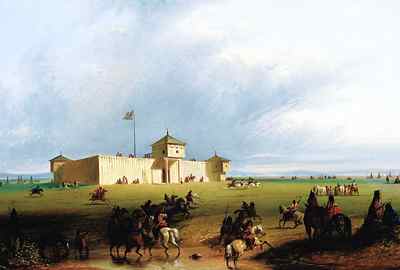 renderings of Alfred Jacob
Miller and the work of Carl Wimar. The vitality of Miller and Wimar's work
is evident in their skillful rendering of light and shadow, yet both artists
are distinct in style and technique. Their paintings are testaments to the
effects of sunshine and shadow, atmosphere and contrast. (right:
Alfred Jacob Miller, American, 1810-1874, "Fort Laramie," oil
on canvas, 1851, 18 x 27 inches)
renderings of Alfred Jacob
Miller and the work of Carl Wimar. The vitality of Miller and Wimar's work
is evident in their skillful rendering of light and shadow, yet both artists
are distinct in style and technique. Their paintings are testaments to the
effects of sunshine and shadow, atmosphere and contrast. (right:
Alfred Jacob Miller, American, 1810-1874, "Fort Laramie," oil
on canvas, 1851, 18 x 27 inches)
Bierstadt and Moran's mature style of the 1860s and 1870s respectively, expanded upon Miller's sophisticated lighting effects. Their work, contrasting "great broad shadows' with "warm, mellow and subdued light," initiated a new era in the art of the American West. Moran's mastery was so effective at capturing the beauty and spirit of Yellowstone that it resulted in the setting aside of lands by the government for the purpose of preservation. On March 1, 1872, President Ulysses S. Grant signed a bill to make Yellowstone the first national park.
AFTER LEWIS & CLARK
The Forces of Change, 1806 -1871
A little more than a year after Lewis and Clark departed on their journey of discovery, President Thomas Jeffersonpenned a prophetic statement particularly applicable to artists, although he was speaking of the mapping the West for future settlement: "The work we are now doing is done for posterity.... We shall delineate with correctness the great arteries of this great country; those who come after us will extend the ramifications as they become acquainted with them, and fill up the canvas we begin."
The artists that accompanied the exploration of the American
West depicted in their canvases landscapes, events and people that had never
before been painted. As witnesses to the nation's great westward expansion,
their artistic legacy was crucial in the development of an aesthetic vision
of the American West.
Read more articles and essays concerning this institutional source by visiting the sub-index page for the Flint Institute of Arts in Resource Library.
Visit the Table of Contents for Resource Library for thousands of articles and essays on American art.
Copyright 2007 Traditional Fine Arts Organization, Inc., an Arizona nonprofit corporation. All rights reserved.